PSW Interview Questions — 20 Questions With Sample Answers

Your PSW Interview, Demystified
You have your PSW certificate. You have passed (or are preparing for) the NACC exam. Now comes the part that makes most new graduates nervous: the job interview.
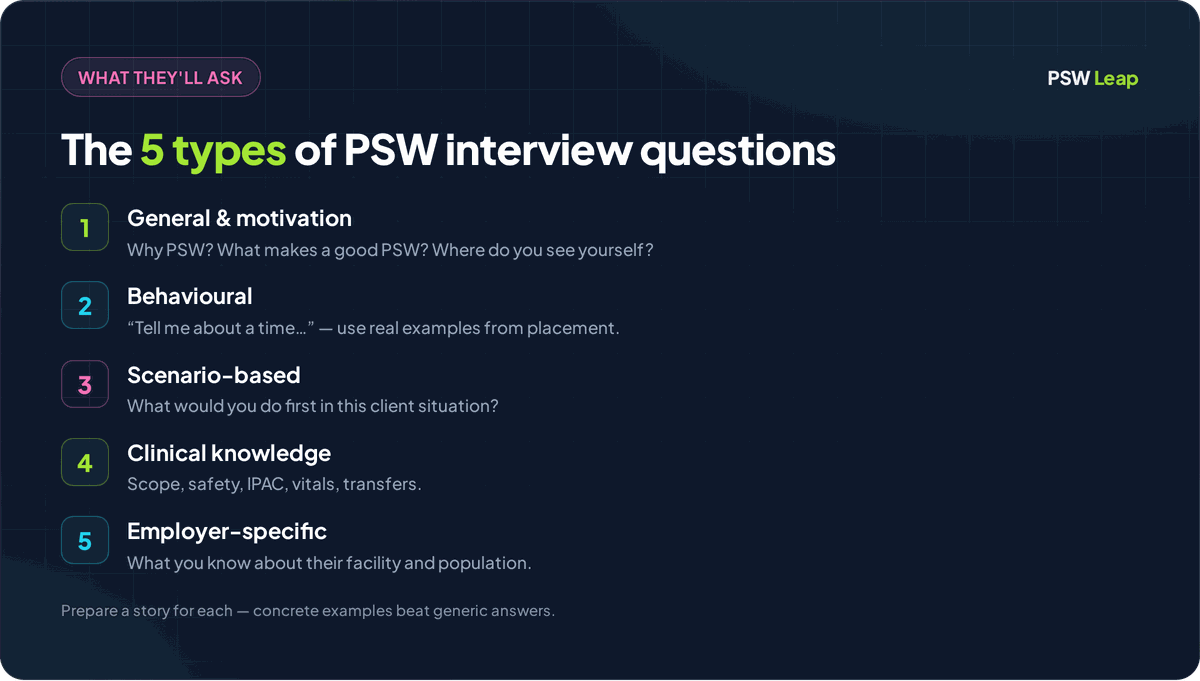
The good news is that PSW interviews are predictable. Employers in long-term care, home care, and hospital settings tend to ask the same categories of questions — and once you know what they are looking for, you can prepare answers that are honest, specific, and confident.
This guide covers 20 real PSW interview questions organized by category, with a sample answer and a tip for each one. Read through all of them, but spend extra time on the scenario-based and clinical questions. Those are where most candidates either stand out or stumble.
Before the Interview: Quick Preparation Checklist
Before we get into the questions, a few fundamentals:
- What to wear: Business casual. Clean slacks or a skirt with a collared shirt or blouse. Closed-toe shoes. No jeans, no sneakers, no heavy perfume or cologne (many healthcare facilities are scent-free).
- What to bring: Two printed copies of your resume, a list of references (with phone numbers and email addresses), your PSW certificate, current CPR/First Aid certification, a recent TB test result or Vulnerable Sector Check if you have one, and a pen and notepad.
- Research the employer: Know the facility name, what type of care they provide (LTC, home care, hospital), how many beds or clients they serve, and any recent news. This information is usually on their website.
General and Motivation Questions
1. Why do you want to be a PSW?
Why they ask it: They want to know your motivation is genuine and sustainable. Caregiving is demanding work, and employers want people who will stay.
Sample answer: "I was drawn to this career after helping care for my grandmother when she was living with dementia. Watching how her PSWs treated her with patience and dignity — even on difficult days — made me realize this was work I wanted to do. I enrolled in my PSW program because I want to provide that same quality of care to others. The direct, hands-on nature of the role is what appeals to me most."
Tip: Always anchor your answer in a real experience. "I want to help people" is too vague on its own — connect it to something specific that happened to you.
2. What qualities make a good PSW?
Why they ask it: They are checking whether you understand what the role actually demands — not just the clinical skills, but the human ones.
Sample answer: "Patience, empathy, and reliability. Patience because clients may need you to repeat things or move at a slower pace. Empathy because you are supporting people during some of the most vulnerable moments of their lives. And reliability because the care team depends on you showing up, on time, every shift. I would also add good communication — being able to report changes clearly to the nursing staff is critical."
Tip: Pick three to four qualities and briefly explain why each one matters. Avoid listing ten qualities with no explanation.
3. What do you know about our facility?
Why they ask it: They want to see that you have done your homework and are genuinely interested in working there — not just applying everywhere.
Sample answer: "I know that [Facility Name] is a 120-bed long-term care home that has been serving the [City/Region] community for over 20 years. I read on your website that you recently expanded your dementia care unit, which is an area I developed a strong interest in during my clinical placement. I also noticed your focus on person-centred care, which aligns with how I was trained."
Tip: Spend 15 minutes on the employer's website before the interview. Note the type of care, the size, any specialties, and their mission statement.
4. Where do you see yourself in five years?
Why they ask it: They want to know you are committed to the field and will not leave after three months.
Sample answer: "In five years, I see myself as an experienced PSW who is a reliable part of your care team. I am also interested in eventually exploring the PSW-to-RPN bridging pathway, but right now my focus is on building a strong foundation in direct care and learning as much as I can from experienced colleagues."
Tip: It is fine to mention long-term goals like bridging to RPN — employers appreciate ambition — but make it clear you are committed to the PSW role first.
Behavioural Questions
5. Tell me about a time you handled a difficult client or situation.
Why they ask it: They want to see how you manage real-world challenges, not just textbook scenarios.
Sample answer: "During my placement in long-term care, I was assigned to a resident who would become agitated during morning care. She did not want to be touched and would push my hands away. Instead of forcing the routine, I stepped back, spoke calmly, and asked if we could try again in 10 minutes. I also let the RPN know what was happening. When I returned, I offered the resident a choice — 'Would you like to wash your face first, or would you prefer we start with getting dressed?' Giving her some control made a real difference. Over the next few days, she became much more cooperative with me."
Tip: Use the STAR method (Situation, Task, Action, Result). Keep it concise and focus on what you did and what happened because of it.
6. How do you handle stress?
Why they ask it: PSW work is physically and emotionally demanding. They need to know you have coping strategies.
Sample answer: "I handle stress by staying organized during my shift — I prioritize tasks and focus on one client at a time rather than worrying about everything at once. After work, I decompress by going for walks and spending time with my family. During my placement, I also found it helpful to talk things through with my peers and supervisor. I believe in asking for support when I need it rather than bottling things up."
Tip: Be honest. Do not pretend you never feel stressed — that is not believable. Show that you have healthy strategies for managing it.
7. Describe a time you worked as part of a team.
Why they ask it: PSWs never work in isolation. You are part of a care team that includes RPNs, RNs, dietary staff, and others.
Sample answer: "On my placement unit, I noticed that a resident's intake at meals had dropped significantly over a few days. I documented what I observed and reported it to the RPN, who then flagged it for the dietitian. Together, the team adjusted the resident's meal plan and I was asked to monitor and record her intake more closely. Within a week, her eating improved. It was a small thing on my part — just noticing and speaking up — but it showed me how the whole team contributes to a resident's wellbeing."
Tip: Emphasize communication and your role within the team, even if it was a small contribution. Employers value PSWs who communicate proactively.
8. Tell me about a mistake you made and what you learned from it.
Why they ask it: They want honesty and self-awareness, not perfection.
Sample answer: "During my first week of placement, I forgot to lock the wheels on a wheelchair before helping a resident transfer. My preceptor caught it immediately and corrected me. I was embarrassed, but I appreciated the feedback. After that, I created a mental checklist for every transfer — lock wheels, position footrests, check the resident's footwear, confirm their balance. I never made that mistake again. It taught me that safety checks need to become automatic, not something I think about only when I remember."
Tip: Choose a real but minor mistake. Show what you learned and how you changed your behaviour going forward.
Ready to practice?
Strengthen your clinical knowledge before your interview. Try 50 free NACC-style practice questions.
Start practising freeScenario-Based Questions
9. A client refuses care. What do you do?
Why they ask it: Client refusal is one of the most common situations PSWs face. They want to know you respect autonomy while following proper protocol.
Sample answer: "First, I would stay calm and not take it personally. I would ask the client if there is a reason they do not want care right now — maybe they are in pain, feeling anxious, or simply want a few more minutes. I would respect their right to refuse while gently explaining why the care is important. If they still refuse, I would document the refusal, report it to the nurse, and try again later. I would never force care on a client."
Tip: The key words interviewers want to hear are respect autonomy, document, and report to the nurse.
10. You notice signs of abuse on a client. What do you do?
Why they ask it: This tests your understanding of your legal and ethical obligations. It is a serious question and they want a serious answer.
Sample answer: "I would document exactly what I observed — the location, size, and colour of any marks, along with anything the client said. I would not confront the suspected abuser or investigate on my own. I would report my observations immediately to my supervisor or the charge nurse. In Ontario, I understand that PSWs have a duty to report suspected abuse, especially in long-term care under the Fixing Long-Term Care Act, 2021. I would follow the facility's reporting policy."
Tip: Be specific about the steps. Do not say "I would tell someone" — say who you would tell and what you would document.
11. A client is choking. What do you do?
Why they ask it: They want to confirm you know basic emergency response. This is not a trick question — they want the correct clinical procedure.
Sample answer: "If the client is conscious and coughing forcefully, I would encourage them to keep coughing and stay with them. If they cannot cough, speak, or breathe, I would call for help immediately and begin abdominal thrusts — standing behind the client, placing my fist above the navel, and thrusting inward and upward. If the client becomes unconscious, I would lower them to the floor, call a code or 911, and begin CPR starting with chest compressions. I would check the mouth for the object before giving breaths."
Tip: Review your CPR/First Aid training before the interview. Being able to describe the steps clearly and calmly makes a strong impression.
12. You walk into a client's room and find them on the floor. What do you do?
Why they ask it: Falls are common in care settings. They want to know you will not panic and will follow the correct protocol.
Sample answer: "I would not try to lift the client immediately. First, I would check if they are conscious and responsive. I would ask if they are in pain and where. I would call for the nurse right away. I would stay with the client and keep them calm and still until the nurse arrives to assess for injuries. I would not move them unless there was an immediate safety concern. After the nurse assesses, I would assist as directed and complete the incident report."
Tip: The most important thing is: do not move the client before they are assessed. Interviewers want to hear that.
13. A family member is upset about the care their loved one is receiving. How do you handle it?
Why they ask it: Family interactions are a regular part of the job, and they can be emotionally charged.
Sample answer: "I would listen to the family member without getting defensive. I would acknowledge their concern — something like, 'I understand this is important to you, and I want to make sure your mother is getting the best care possible.' If the concern is something I can address within my scope — like adjusting how I approach a routine — I would do so. If it is beyond my scope, I would let them know I will pass their concern along to the charge nurse and follow up. I would document the conversation."
Tip: Empathy first, then action. Never argue with a family member, and never make promises you cannot keep.
14. You are running behind schedule and still have three clients to see. What do you do?
Why they ask it: Time management is a daily reality for PSWs, especially in home care.
Sample answer: "I would prioritize based on client needs. If one of the remaining clients needs time-sensitive care — like insulin monitoring or a scheduled medication reminder — that client comes first. I would also let my supervisor know that I am behind so they can adjust if needed. I would not rush through care or cut corners to catch up, because client safety always comes first."
Tip: Show that you can prioritize without compromising care quality.
Clinical Knowledge Questions
15. What are the 4 Moments of Hand Hygiene?
Why they ask it: Infection prevention and control (IPAC) is foundational to PSW work. This is one of the most commonly tested concepts.
Sample answer: "The 4 Moments are: before contact with the client, before a clean or aseptic procedure, after body fluid exposure risk, and after contact with the client or the client's environment. I practise hand hygiene using alcohol-based hand rub or soap and water, depending on whether my hands are visibly soiled."
Tip: If you need a refresher on IPAC fundamentals, our infection control guide for PSWs covers the essentials.
16. What is your understanding of DIPPS?
Why they ask it: DIPPS is the person-centred care framework taught in many Ontario PSW programs, and employers want to hear that you apply it in daily care rather than just recite it. Our DIPPS framework guide explains each principle with care examples.
Sample answer: "DIPPS stands for Dignity, Independence, Preferences, Privacy, and Safety. It is a guiding framework for how PSWs should deliver care. Every interaction with a client should respect their dignity, promote their independence as much as possible, honour their personal preferences, protect their privacy, and ensure their safety. I used DIPPS as a mental checklist throughout my placement."
Tip: If your program used a different framework (like SPICES or PIECES), mention that too — it shows breadth of knowledge.
17. What vital signs do PSWs monitor, and what are normal ranges for an adult?
Why they ask it: They want to confirm you know your clinical basics.
Sample answer: "PSWs typically monitor temperature, pulse, respiration, and blood pressure — and in some settings, oxygen saturation and pain levels. I know the typical adult ranges, but they are a starting point: I compare every reading with the client's own baseline and the care plan's parameters, report changes to the nurse as the care plan and my employer's policy direct, and if a client is in distress I follow the employer's emergency protocol."
Tip: For a more detailed breakdown, see our vital signs reference guide.
18. What is the PSW scope of practice in Ontario?
Why they ask it: Working outside your scope is a serious issue. They want to know you understand the boundaries.
Sample answer: "PSWs provide personal care — bathing, dressing, grooming, toileting, feeding, mobility assistance, and vital signs monitoring. We do not diagnose or prescribe, and we do a sterile or other clinical procedure only when our training, the care plan and our employer's policy allow it — a controlled act also needs an exception or a delegation. With medication, we help with it or give it only as the client's care plan, the rules for the setting, our training and our employer's policy allow, and we never decide on or change a dose ourselves. I understand that my scope can vary slightly depending on the employer and the setting, but I would always confirm with my supervisor before performing any task I am unsure about."
Tip: Our PSW scope of practice guide covers this topic in detail.
Employer-Specific Questions
19. Why do you want to work at this facility specifically?
Why they ask it: This separates candidates who are genuinely interested from those who are mass-applying.
Sample answer: "I want to work here because of your reputation for person-centred care. When I visited your website, I was impressed by the programs you offer for residents, including the music therapy and gardening activities. I also spoke with a PSW who works here and she mentioned the strong mentorship for new staff. That kind of supportive environment is where I know I will grow and contribute my best."
Tip: Reference something specific — a program, a value, a conversation. Generic answers ("You seem like a great place to work") fall flat.
20. What shifts are you available for?
Why they ask it: Scheduling is a practical reality. Most new PSWs start with evening or night shifts, or rotating schedules.
Sample answer: "I am available for all shifts, including evenings, nights, and weekends. I understand that flexibility is important, especially as a new hire. I am happy to work the shifts that are most needed as I get started."
Tip: The more flexible you are, the more likely you are to be hired. If you have genuine constraints (childcare, school), be upfront about them — but offer as much availability as you honestly can.
After the Interview: Follow-Up Etiquette
The interview does not end when you walk out the door. A few small steps can set you apart:
- Send a thank-you email within 24 hours. Keep it brief: thank the interviewer by name, mention one specific thing you discussed, and reaffirm your interest in the position.
- Do not call repeatedly to check on the status. One follow-up email after a week is appropriate if you have not heard back. After that, wait for them to contact you.
- Reflect on the interview. Write down the questions you were asked while they are fresh. Note which ones you answered well and which ones you want to improve for next time.
- Keep applying. Do not stop your job search while waiting to hear back from one employer. Continue submitting applications and preparing for other interviews.
Common Mistakes to Avoid
- Being too vague. "I am a hard worker" means nothing without an example. Every answer should include a specific situation or concrete detail.
- Badmouthing a previous employer or placement. Even if you had a negative experience, keep it professional. Focus on what you learned rather than what went wrong.
- Not asking any questions. When the interviewer asks "Do you have any questions for us?" — always have at least two. Ask about orientation, mentorship for new PSWs, or what a typical shift looks like.
- Not knowing your scope. If you cannot explain what a PSW can and cannot do, that is a red flag for any employer.
- Arriving late. Plan to arrive 10 to 15 minutes early. If you are unfamiliar with the location, do a practice drive or transit run the day before.
Final Thought
PSW interviews are not about performing or memorizing scripts. They are about showing the interviewer that you are safe, reliable, compassionate, and prepared. The best answers are honest ones that draw from your real experiences — in your placement, your education, or your personal life.
Prepare thoroughly, be yourself, and walk in knowing that the fact you were invited to interview means they are already interested. Now you just need to confirm what your resume promised.
If you want to sharpen your clinical knowledge before interview day, try our free NACC-style practice questions — they cover the same content areas that interviewers love to test.
Written by Shashank Jha
Founder, PSW Leap
Shashank Jha is the founder of PSW Leap. He built this platform after going through the NACC exam prep process himself, to help fellow students study smarter with practice questions organized around the NACC PSW curriculum.
He's also the author of PSW Exam Success: The Ultimate Prep Book — the 455-page paperback PSW Leap grew out of.
Learn more about PSW LeapPSW Leap
Practice smarter for the NACC exam. 2,500 questions. Detailed rationales. $29.99 CAD one-time — everything included.
Try 10 free questions →No account needed. Ready for the full bank? Create your account.