PSW Salary in Ontario: 2026 Wage Guide by Work Type
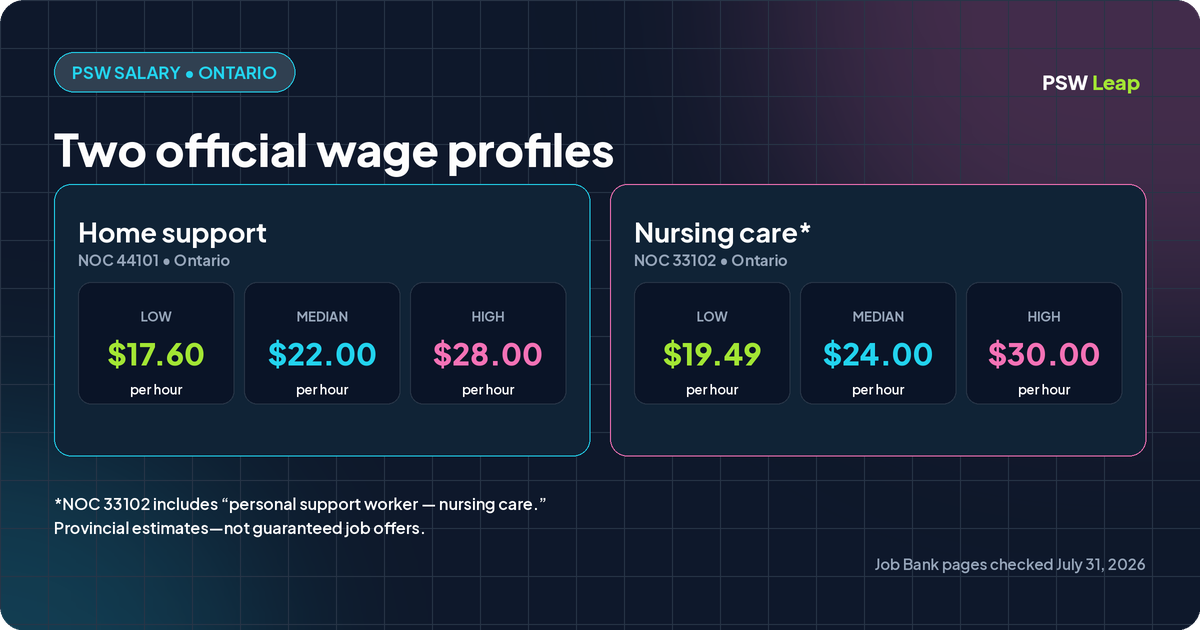
How much does a Personal Support Worker (PSW) make in Ontario? On Government of Canada Job Bank pages checked July 31, 2026, the provincial wage benchmarks were:
- Home support: $17.60 low, $22.00 median, and $28.00 high per hour.
- Nursing care: $19.49 low, $24.00 median, and $30.00 high per hour.
These are two different occupational profiles, not one guaranteed PSW pay scale. Your actual rate can depend on the job duties, work setting, employer, region, union or collective agreement, experience, shift, and whether the role is full-time, part-time, or casual.
The Job Bank wage estimates were updated November 19, 2025 and use a 2023–2024 reference period. This guide explains how to use them in 2026 without treating them as a promise about a specific job offer.
Ontario PSW wage benchmarks at a glance
| Current Job Bank profile | Ontario low | Ontario median | Ontario high |
|---|---|---|---|
| Personal support worker — home support (NOC 44101) | $17.60/hour | $22.00/hour | $28.00/hour |
| Nurse aide (NOC 33102) | $19.49/hour | $24.00/hour | $30.00/hour |
Statistics Canada's official list of titles for NOC 33102 includes “personal support worker — nursing care.” It also includes institutional titles such as hospital aide, long-term-care aide, patient care assistant, and nursing home attendant.
That classification detail matters. A job advertised as “PSW” may be grouped under home support or nursing care depending on its duties and setting. When comparing a posting with Job Bank, match the work—not only the letters “PSW” in the title.
What could the hourly rate mean per year?
An hourly rate is not the same as guaranteed annual income. To make a simple gross-pay estimate, multiply:
hourly rate × paid hours each week × paid weeks each year
| Example hourly rate | 37.5 paid hours × 52 weeks | 40 paid hours × 52 weeks |
|---|---|---|
| $22.00 | $42,900 | $45,760 |
| $24.00 | $46,800 | $49,920 |
These examples are before income tax and other deductions. They also assume 52 paid weeks and do not include overtime, shift premiums, unpaid time, changing schedules, or travel between clients. A casual role with a higher hourly rate can still produce less annual income than a lower-rate job with dependable full-time hours.
Is there a PSW wage increase in Ontario in 2026?
There are two separate facts that are easy to confuse.
1. Ontario's general minimum wage changes on October 1
Ontario's minimum-wage guide lists:
- $17.60 per hour from October 1, 2025 through September 30, 2026.
- $17.95 per hour from October 1, 2026 through September 30, 2027.
This is a province-wide minimum-wage increase. It is not a PSW-specific raise, and it does not mean every PSW receives another $0.35 on top of a rate that is already above the new legal minimum. Check how the change applies to your actual rate and employment arrangement.
2. Ontario's PSW compensation enhancement remains permanent
Ontario's Personal Support Workers and Direct Support Workers Permanent Compensation Enhancement Program began April 21, 2022. The official page says the enhancement for eligible employees is permanent.
The amount is not the same in every sector:
| Sector | Current program amount for eligible employees |
|---|---|
| Hospital | $2 per hour above base hourly pay |
| Long-term care | $3 per hour above base hourly pay |
| Home and community care | $3 per hour above base hourly pay for each hour of direct care |
| Eligible social-services roles | $3 per hour above base hourly pay |
Do not assume that every person with “PSW” in a job title automatically qualifies. The official program sets employer, employee, duty, and—in some sectors—direct-care conditions. Ask the employer or payroll contact whether the advertised rate already includes the enhancement and which hours qualify.
How much do hospital PSWs make in Ontario?
The reviewed Job Bank pages do not provide a hospital-only PSW wage. The closest province-wide institutional benchmark is the NOC 33102 nurse aide profile, which includes “personal support worker — nursing care” as an official example title. Its Ontario estimate is $19.49 low, $24.00 median, and $30.00 high per hour.
Use that as a comparison point, not as a hospital pay promise. For a specific hospital role, check:
- the exact job classification and starting step;
- the employer's current wage grid or collective agreement;
- whether the posting shows base pay or total pay;
- shift, weekend, and holiday premiums;
- guaranteed hours and casual-call requirements; and
- benefit and pension eligibility.
A hospital job can also use a title such as patient care assistant or hospital aide. Search by duties and classification as well as “PSW.”
Home-care PSW pay needs a total-compensation check
The Job Bank home-support profile reports an Ontario median of $22.00 per hour. Its Toronto-region table reports $17.60 low, $21.00 median, and $27.00 high per hour.
For home and community care, the posted hourly rate is only one part of the offer. Ask:
- Are travel time and mileage paid?
- Are visits guaranteed, or can they be cancelled?
- Are there split shifts or unpaid gaps between clients?
- Does the rate include the permanent compensation enhancement?
- Which hours count as direct-care hours?
- Are evenings, weekends, or holidays paid differently?
- What benefits are available, and when do they begin?
These questions help you compare what you may actually earn over a week—not just the largest number in a job ad.
Benefits can change the value of an offer
On the same Job Bank pages, 60.3% of Ontario workers in the home-support occupation and 76.9% in the nurse aide occupation were reported as receiving at least one non-wage benefit. Job Bank says those benefits can include an employer-sponsored pension, insurance, leave, sick days, or vacation days.
Those percentages describe occupational groups; they do not guarantee benefits in a particular job. Confirm whether the position is eligible, whether there is a waiting period, what the employee contribution is, and whether casual or part-time workers are covered.
What about overtime?
Ontario's Employment Standards Act guide to overtime pay says that, for most employees, overtime begins after 44 hours in a work week and is paid at 1.5 times the regular rate. The guide also lists exceptions, special rules, and averaging agreements.
Do not assume the general rule is the full answer for every care role or schedule. Check your employment contract, collective agreement, job-specific rules, and the current Ontario guide.
A practical checklist for comparing two PSW offers
Write the answers side by side before choosing:
- Base hourly rate: What is the starting rate, and when does it increase?
- Enhancement: Is a government-funded amount included, separate, or not applicable?
- Paid hours: How many hours are guaranteed each week?
- Premiums: What do evenings, nights, weekends, and holidays add?
- Travel: Is time between clients paid? Is mileage reimbursed?
- Benefits: When do health, dental, pension, sick-leave, and vacation benefits start?
- Employment status: Is the role permanent, temporary, part-time, or casual?
- Wage source: Can you review the current posting, wage grid, or collective agreement in writing?
If you are preparing for interviews, use these questions alongside our PSW interview guide. To compare the day-to-day realities of common settings, read long-term care vs. home care vs. hospital work.
Key takeaways
- Ontario does not have one universal PSW hourly rate.
- Current Job Bank benchmarks show a $22.00 median for home support and a $24.00 median for the nurse aide profile, which includes PSW nursing-care titles.
- The general minimum wage increases to $17.95 on October 1, 2026; that is not a PSW-specific raise.
- Ontario's permanent enhancement is $2 for eligible hospital PSWs and $3 for eligible long-term-care and home/community-care roles, subject to program conditions.
- Compare guaranteed hours, travel, premiums, benefits, and the written wage grid—not only the headline hourly rate.
Official sources reviewed
- Government of Canada Job Bank: Personal support worker — home support wages in Ontario — accessed July 31, 2026.
- Government of Canada Job Bank: Nurse aide wages in Ontario — accessed July 31, 2026.
- Statistics Canada: NOC 33102 example titles — accessed July 31, 2026.
- Ontario: Permanent Compensation Enhancement Program — accessed July 31, 2026.
- Ontario: Minimum wage guide — accessed July 31, 2026.
- Ontario: Overtime pay guide — accessed July 31, 2026.
Wage pages and laws can change. Check the linked source and the employer's written offer before making a financial or career decision.
Frequently Asked Questions
On Job Bank pages checked July 31, 2026, the Ontario low, median, and high wages are $17.60, $22.00, and $28.00 per hour for the personal support worker — home support profile, and $19.49, $24.00, and $30.00 for the nurse aide profile, which includes personal support worker — nursing care as an example title. These are provincial estimates, not a guaranteed rate for every job.
Job Bank does not provide a hospital-only PSW rate on the pages reviewed. Its Ontario nurse aide profile, which covers institutional roles and includes personal support worker — nursing care as an example title, reports $19.49 low, $24.00 median, and $30.00 high per hour. Check the employer's current posting and collective agreement for the actual hospital rate.
Ontario's general minimum wage rises from $17.60 to $17.95 per hour on October 1, 2026. That is a province-wide minimum-wage change, not a PSW-specific raise. Ontario also continues its permanent compensation enhancement for eligible roles, with amounts and conditions that differ by sector.
No. Ontario's permanent program lists $3 per hour above base pay for eligible long-term-care PSWs and $3 per direct-care hour for eligible home and community care employees, while eligible hospital PSWs receive $2 per hour above base pay. Eligibility depends on the employer, role, duties, and program conditions.
Multiply the hourly rate by paid hours per week and paid weeks per year. At 37.5 paid hours for 52 weeks, $22 per hour equals $42,900 and $24 per hour equals $46,800 before overtime, premiums, taxes, deductions, or unpaid time.
Written by Shashank Jha
Founder, PSW Leap
Shashank Jha is the founder of PSW Leap. He built this platform after going through the NACC exam prep process himself, to help fellow students study smarter with practice questions organized around the NACC PSW curriculum.
He's also the author of PSW Exam Success: The Ultimate Prep Book — the 455-page paperback PSW Leap grew out of.
Learn more about PSW LeapPSW Leap
Practice smarter for the NACC exam. 2,500 questions. Detailed rationales. $29.99 CAD one-time — everything included.
Try 10 free questions →No account needed. Ready for the full bank? Create your account.