PSW Resume Tips — Template and Examples That Work
Your Resume Is Your First Impression
As a new PSW graduate, your resume is often the only thing standing between you and an interview. Hiring managers at long-term care homes, home care agencies, and hospitals review dozens of applications for each posting. A clear, well-organized resume that highlights the right skills can put you at the top of the pile — even if you have zero paid experience in healthcare.
This guide walks you through every section of a strong PSW resume, gives you sample wording you can adapt, and addresses the biggest challenge new graduates face: writing a resume when your only experience is your clinical placement.
The Right Resume Structure
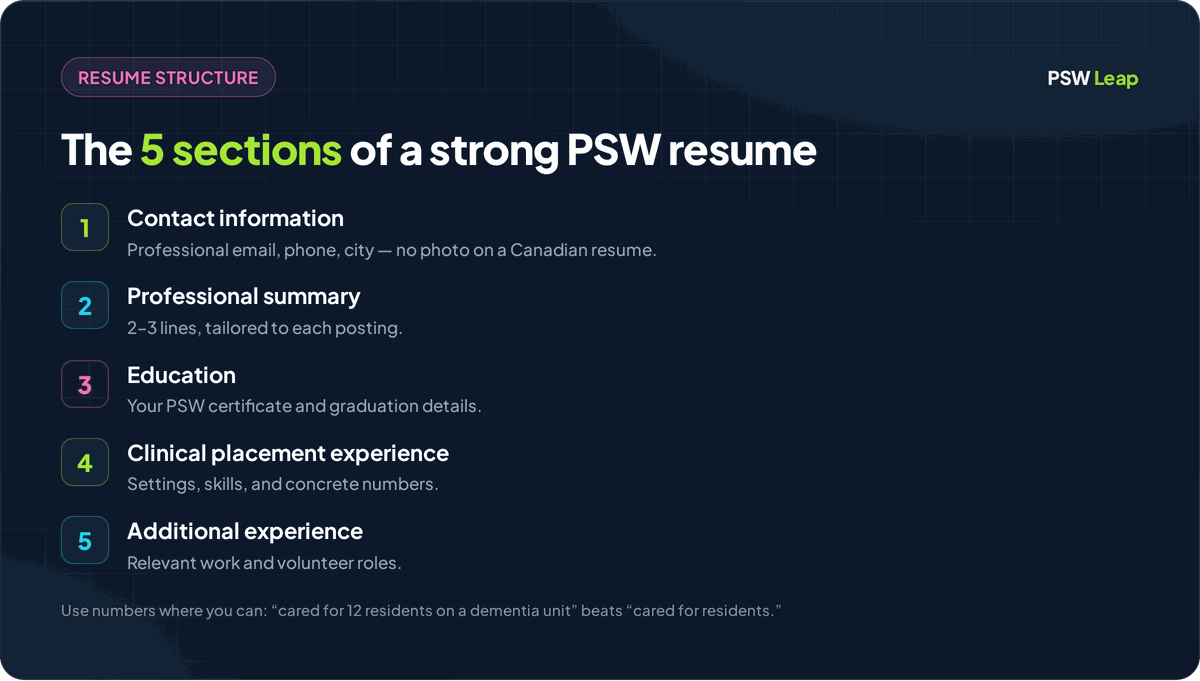
For new PSW graduates, your resume should be one page and follow this order:
- Contact Information
- Professional Summary
- Education
- Clinical Placement Experience
- Additional Experience (volunteer, caregiving, previous employment)
- Skills
- Certifications
This structure puts your education and placement — your strongest assets as a new graduate — near the top, where hiring managers see them first.
Section by Section Breakdown
Contact Information
Keep it simple and professional. Include:
- Full name
- City and province (no full street address needed)
- Phone number
- Professional email address
- LinkedIn profile (optional but increasingly valued)
Avoid: Nicknames, unprofessional email addresses (partygirl99@email.com), or a photo. Canadian resumes do not include photos.
Professional Summary
This is a two-to-three sentence snapshot of who you are and what you bring. It sits directly below your contact information and is the first thing the hiring manager reads. Make it count.
Sample for a new graduate:
Compassionate and detail-oriented PSW graduate with hands-on clinical experience in long-term care. Trained in personal care, IPAC protocols, vital signs monitoring, and dementia care. Eager to contribute to a resident-centred care team and committed to continuous learning.
Sample for a career changer:
Dedicated PSW graduate bringing 5 years of customer service experience and a genuine commitment to elder care. Completed 300+ hours of clinical placement in a 150-bed LTC facility with a focus on personal care, mobility assistance, and infection prevention. Known for patience, reliability, and clear communication.
Tip: Tailor your summary to each job you apply for. If the posting emphasizes dementia care, mention your dementia care training. If it is a home care role, highlight your independence and time management.
Education
List your PSW program first, followed by any other relevant education.
Personal Support Worker Certificate [College Name], [City, Ontario] Graduated: [Month Year]
- Completed [number] hours of in-class instruction and [number] hours of clinical placement
- Relevant coursework: anatomy and physiology, IPAC, mental health, palliative care, dementia care
If you have a degree or diploma in another field, include it below your PSW certificate. It shows breadth — many employers value mature students with diverse backgrounds.
Clinical Placement Experience
This is the most important section of your resume as a new graduate. Your placement is real, supervised clinical experience — treat it that way. Do not bury it or list it casually. Give it the same level of detail you would give a paid job.
How to format it:
Clinical Placement — Personal Support Worker [Facility Name] — [Type: Long-Term Care / Home Care / Hospital], [City, Ontario] [Start Month Year] – [End Month Year] | [Total Hours] hours
- Provided personal care to [number] residents including bathing, dressing, grooming, oral hygiene, and toileting
- Monitored and recorded vital signs (temperature, pulse, respiration, blood pressure) and reported abnormalities to nursing staff
- Assisted with safe transfers and ambulation using mechanical lifts, transfer belts, and wheelchairs
- Practised 4 Moments of Hand Hygiene and followed IPAC protocols consistently
- Supported residents living with dementia using person-centred communication techniques
- Assisted with meal service and documented food and fluid intake
- Communicated changes in resident status to RPNs and RNs in a timely manner
- Completed required documentation including progress notes and incident reports
Tip: Use numbers where possible. "Provided care to 12 residents on a dementia unit" is more concrete than "Provided care to residents."
Additional Experience
This is where you include volunteer work, caregiving experience, and previous employment — even if it was not in healthcare. The goal is to show transferable skills.
Volunteer work example:
Volunteer — Friendly Visitor Program [Organization Name], [City, Ontario] [Start Date] – [End Date]
- Visited seniors in their homes weekly, providing companionship and light assistance with daily activities
- Reported concerns about client wellbeing to the program coordinator
Previous employment example (retail):
Customer Service Associate [Company Name], [City, Ontario] [Start Date] – [End Date]
- Assisted customers with diverse needs in a fast-paced environment
- Managed multiple tasks simultaneously while maintaining attention to detail
- Resolved customer complaints calmly and professionally
- Trained two new team members on company procedures
Family caregiving example:
Primary Caregiver — Family Member [City, Ontario] [Date Range]
- Provided daily personal care, medication reminders, and meal preparation for elderly family member
- Coordinated appointments and communicated with healthcare providers
- Managed mobility support and fall prevention in a home setting
Tip: Family caregiving is legitimate experience. If you cared for a parent, grandparent, or other family member, include it.
Skills
Create a clean, scannable list of skills grouped by category. Only include skills that are relevant to PSW work.
Clinical Skills:
- Personal care (bathing, dressing, grooming, toileting, oral hygiene)
- Vital signs monitoring and documentation
- Safe transfers and lifts (mechanical lift, transfer belt, pivot transfer)
- IPAC and 4 Moments of Hand Hygiene
- Dementia care and behavioural management
- Palliative and end-of-life care support
- Meal assistance and intake documentation
- Range of motion exercises
Soft Skills:
- Clear verbal and written communication
- Cultural sensitivity and person-centred care
- Time management and prioritization
- Teamwork and interpersonal collaboration
- Patience and empathy under pressure
- Attention to detail and observation
Technical Skills:
- PointClickCare or other electronic charting systems (if applicable)
- WHMIS 2015
- Basic computer literacy
Certifications
List your certifications in a simple, scannable format:
- NACC PSW Certification (or "In Progress" if you have not yet written the exam)
- CPR Level C / AED — [Issuing Organization], [Expiry Date]
- Standard First Aid — [Issuing Organization], [Expiry Date]
- WHMIS 2015
- Vulnerable Sector Check — [Date]
- Food Handler Certification (if applicable)
Strong Action Verbs for PSW Resumes
The verbs you use matter. They make your bullet points active and specific rather than passive and vague. Here are verbs that work well for PSW resumes:
| Category | Action Verbs |
|---|---|
| Care delivery | Assisted, provided, supported, administered, facilitated, performed |
| Observation | Monitored, observed, identified, recognized, assessed, documented |
| Communication | Reported, communicated, collaborated, coordinated, educated, informed |
| Safety | Maintained, ensured, followed, implemented, adhered to, complied with |
| Organization | Prioritized, managed, scheduled, organized, tracked, completed |
What Ontario Employers Actually Look For
After reviewing job postings across Ontario LTC homes, home care agencies, and hospitals, here are the qualifications and qualities that appear most consistently:
- PSW certificate from an approved Ontario program — this is non-negotiable
- NACC certification (or willingness to obtain it) — increasingly required, especially in LTC
- Current CPR/First Aid — expired certificates are an automatic disqualification
- Vulnerable Sector Check — most employers require this before your first shift
- Availability for all shifts — evenings, nights, and weekends. Flexibility gets you hired faster
- Physical ability — the job involves lifting, bending, and being on your feet for hours
- Strong communication — especially the ability to report changes in client status clearly
- IPAC knowledge — infection prevention is a top priority in every healthcare setting
If you are preparing for the NACC exam and want to strengthen your clinical knowledge, our free practice questions cover all the core competency areas that employers expect you to know.
Common Resume Mistakes to Avoid
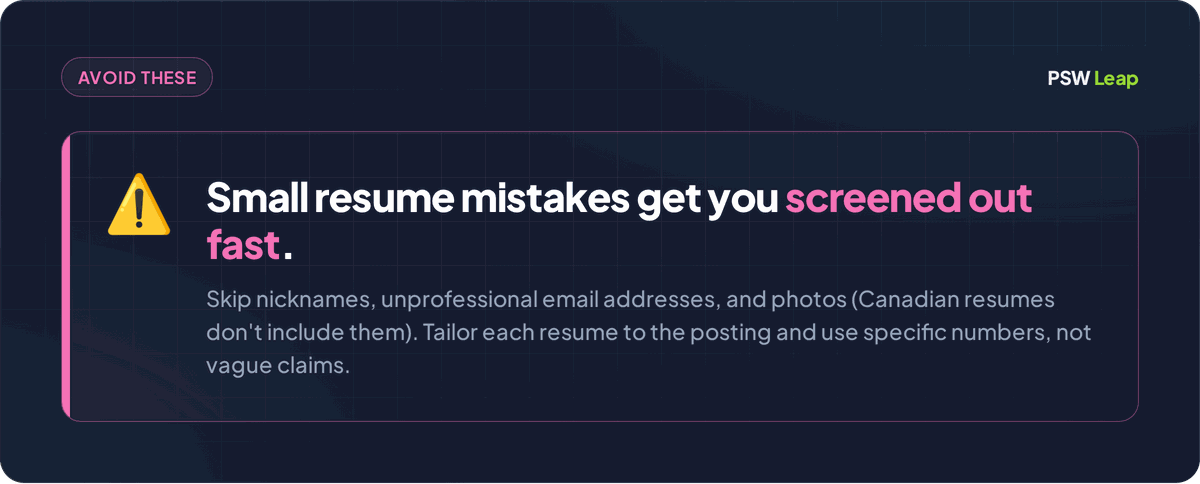
Using a generic resume for every application. Tailor your professional summary and skills section to match each job posting. If the posting mentions dementia care three times, make sure your resume does too.
Including irrelevant personal information. Do not include your age, marital status, religion, or a photo. These are not expected on Canadian resumes and can work against you.
Writing in paragraphs instead of bullet points. Hiring managers scan resumes in 15 to 30 seconds. Bullet points are faster to read and easier to compare across candidates.
Listing duties without context. "Helped residents" tells the reader nothing. "Assisted 15 residents with morning personal care routines including bathing, dressing, and oral hygiene" tells them exactly what you did and at what scale.
Typos and grammatical errors. In healthcare, attention to detail matters — and your resume is the first demonstration of it. Proofread it yourself, then have someone else read it. Run it through a spell-checker. Read it out loud.
Making it longer than one page. As a new graduate, one page is sufficient. Employers do not want to read a two-page resume from someone with one placement and no paid experience. Be concise.
A Quick Note on Cover Letters
Most PSW job postings ask for a resume and a cover letter. Keep your cover letter to three to four paragraphs:
- Opening: State the position you are applying for and where you saw it posted.
- Why you: Highlight one or two experiences that make you a strong fit for this specific role. Reference your placement, a skill the posting emphasizes, or a personal connection to the type of care they provide.
- Why them: Mention something specific about the employer that attracted you. This shows you have researched them.
- Closing: Thank them for their time, state your availability for an interview, and include your phone number.
Tip: A cover letter is not a repeat of your resume. It is your chance to tell a short story about why you and this employer are a good fit.
Final Thought
Your resume does not need to be fancy. It needs to be clear, honest, and targeted. As a new PSW graduate, your clinical placement, your education, and your genuine commitment to the role are more than enough to get you through the door. Focus on presenting them well.
Once you land the interview, preparation is everything. Our PSW interview guide walks you through the 20 most common questions with sample answers — so you can walk in feeling confident.
Ready to practice?
Preparing for the NACC exam? Practise with free questions that cover the same content areas Ontario employers test in interviews.
Try free practice questionsWritten by Shashank Jha
Founder, PSW Leap
Shashank Jha is the founder of PSW Leap. He built this platform after going through the NACC exam prep process himself, to help fellow students study smarter with practice questions organized around the NACC PSW curriculum.
He's also the author of PSW Exam Success: The Ultimate Prep Book — the 455-page paperback PSW Leap grew out of.
Learn more about PSW LeapPSW Leap
Practice smarter for the NACC exam. 2,500 questions. Detailed rationales. $29.99 CAD one-time — everything included.
Try 10 free questions →No account needed. Ready for the full bank? Create your account.