LTC vs Home Care vs Hospital: Choosing the Right PSW Work Setting

The Setting Matters More Than You Think
Your PSW certificate qualifies you to work in long-term care homes, in clients' private residences through home care agencies, on hospital units, and in several other settings. The training is the same. The certification is the same. But the day-to-day experience across these settings is remarkably different.
Where you choose to work affects your pay, your schedule, your physical demands, your level of independence, the type of patients you serve, and your overall job satisfaction. Many PSWs discover this only after starting their first position — and some end up in a setting that does not match their strengths or preferences.
This guide gives you a detailed, side-by-side comparison of the three main PSW work settings in Ontario so you can make an informed choice. We also cover other emerging settings at the end.
Quick Comparison Table
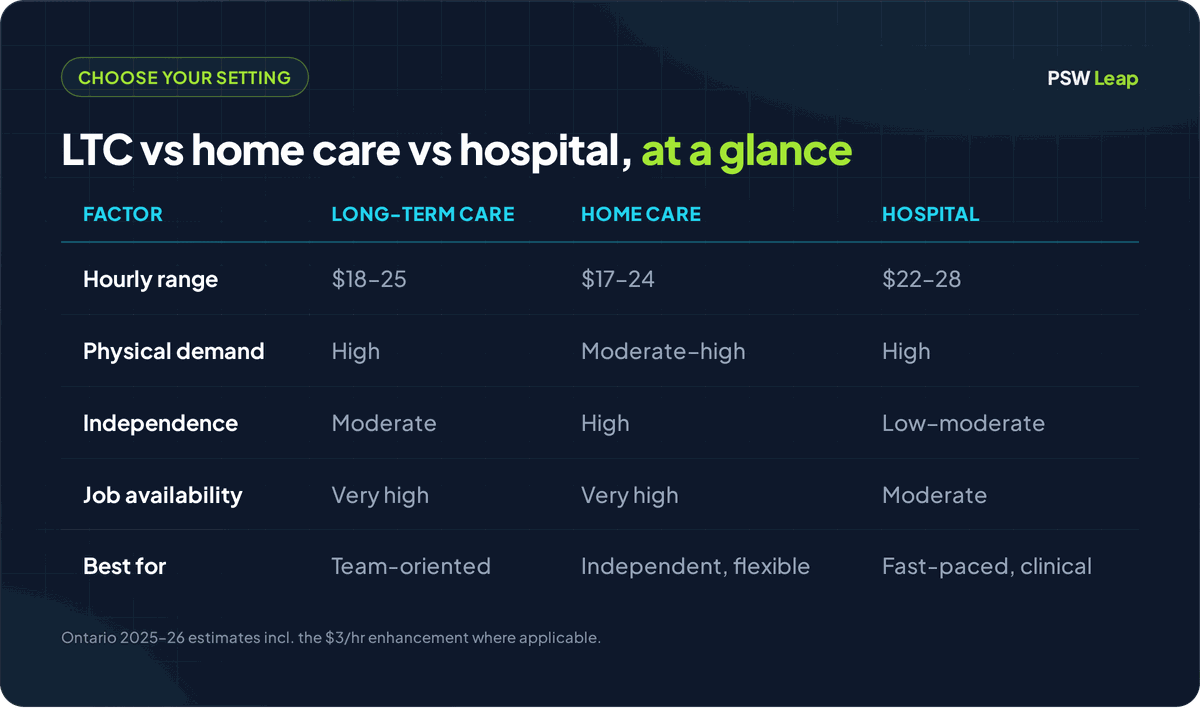
| Factor | Long-Term Care (LTC) | Home Care | Hospital |
|---|---|---|---|
| Hourly Rate | $18 – $25 | $17 – $24 | $22 – $28 |
| Shift Structure | 8 or 12-hour shifts, rotating | Visits of 30 min – 2+ hours | 8 or 12-hour shifts, rotating |
| Client Population | Elderly, chronic conditions, dementia | Varied ages, post-surgical, chronic | Acute, post-surgical, varied acuity |
| Team Structure | PSW team + RPNs + RNs on unit | Solo (with agency coordination) | Large interdisciplinary team |
| Physical Demand | High | Moderate to high | High |
| Independence | Moderate | High | Low to moderate |
| Schedule Predictability | Moderate (set rotations) | Variable (shifts may change) | Moderate (set rotations) |
| Job Availability | Very high | Very high | Moderate (competitive) |
| Best For | Team-oriented, routine-focused | Independent, flexible | Fast-paced, clinical growth |
Pay figures reflect Ontario 2025-2026 estimates including the $3/hr enhancement where applicable. See our full PSW salary breakdown for details.
Long-Term Care (LTC)
What a Typical Day Looks Like
LTC is the most common PSW work setting in Ontario. You work on a unit (sometimes called a "home area") in a long-term care facility, providing daily care to residents who live there permanently.
A typical day shift might look like this:
- 0700 – 0730: Receive report from the night shift. Review your assignment — usually 6 to 10 residents depending on staffing.
- 0730 – 0930: Morning care. Wake residents, assist with toileting, bathing, oral care, dressing, and grooming. Transfer residents from bed to wheelchair as needed.
- 0930 – 1030: Breakfast. Escort residents to the dining room, assist with feeding for those who need it, ensure dietary requirements are followed.
- 1030 – 1130: Post-breakfast care. Toileting rounds, repositioning residents in bed or wheelchair, documenting care provided.
- 1130 – 1300: Lunch routine. Similar to breakfast — escorting, assisting with meals, monitoring intake.
- 1300 – 1430: Afternoon care. Activity assistance, ambulation, restorative care programs, vitals if assigned.
- 1430 – 1500: Documentation, charting, report to the next shift.
Evening and night shifts have their own patterns — dinner, bedtime routines, and overnight checks.
Client Population
LTC residents are predominantly elderly adults with chronic health conditions including dementia (Alzheimer's and other types), stroke, Parkinson's disease, diabetes, arthritis, and heart failure. Many have complex care needs and require assistance with most or all activities of daily living. Some residents are responsive and engaged; others may be non-verbal or have significant cognitive impairment.
Team Structure
You work as part of a team. On a typical unit, you will have:
- Several PSWs sharing the resident assignments
- An RPN or RN who manages medications, assessments, and clinical decisions for the unit
- Access to a charge nurse, dietary staff, recreation staff, and other support
This team structure means you are never truly alone — there is always someone to ask for help or guidance, which is particularly valuable for new graduates.
Pros
- Team support. You are surrounded by colleagues who can help with heavy lifts, answer questions, and share the workload.
- Structured routine. Days follow a predictable pattern, which many PSWs find manageable.
- Relationship building. You care for the same residents daily, which allows you to develop meaningful connections and notice subtle changes in their condition.
- Job availability. LTC facilities are always hiring. It is the easiest setting to get into as a new graduate.
- Wage enhancement. The $3/hr Ontario PSW enhancement applies in LTC.
Cons
- Heavy physical workload. Lifting, transferring, and repositioning multiple residents per shift takes a toll on your body. Even with mechanical lifts, the work is demanding.
- Staffing shortages. Many LTC homes are understaffed, meaning you may be assigned more residents than you can comfortably care for. This is one of the top sources of burnout.
- Emotional weight. Residents pass away. You will grieve. The cumulative loss is one of the hardest parts of LTC work.
- Institutional environment. Some PSWs find the institutional setting — with its fluorescent lights, shared rooms, and rigid schedules — difficult to work in long-term.
- Pace is constant. There is rarely a slow moment during a shift. You are moving from one task to the next without much downtime.
Home Care
What a Typical Day Looks Like
Home care PSWs work in clients' private residences, visiting multiple clients throughout a shift. A typical day shift might include:
- 0730 – 0830: First client visit. Assist with morning routine — bathing, dressing, medication reminders, breakfast preparation. Document care provided.
- 0830 – 0900: Travel to next client.
- 0900 – 1030: Second client visit. Longer visit for a client with higher needs — personal care plus light housekeeping and meal prep.
- 1030 – 1100: Travel.
- 1100 – 1200: Third client visit. Quick check-in — assist with a bath, change bed linens, ensure medications are organized.
- 1200 – 1300: Break (though in practice, many home care PSWs take breaks between visits or not at all).
- 1300 – 1500: Afternoon visits. One or two more clients with varying needs.
The number of visits per day depends on your agency, the length of each visit (30 minutes to 2+ hours), and the geographic area you cover.
Client Population
Home care clients are more diverse than LTC residents. You may see:
- Elderly adults aging in place who need daily assistance with personal care
- Post-surgical patients recovering at home after hospital discharge
- Individuals with chronic disabilities who live independently with support
- Palliative care clients receiving end-of-life care at home
The variety keeps the work interesting, but it also means you need to be adaptable. Every home is different — different layout, different equipment, different family dynamics.
Team Structure
In home care, you are largely on your own. You visit clients independently, make decisions in the moment, and contact your agency's coordinator or a nurse by phone if issues arise. There is no team of PSWs down the hall to help with a difficult transfer.
This independence is one of the defining features of home care — some PSWs love it, others find it isolating.
Pros
- Autonomy. You manage your own visits, work independently, and often have more control over how you structure your care within each visit.
- One-on-one care. You give each client your full attention. There are no call bells from other rooms competing for your time.
- Variety. Different clients, different homes, different neighborhoods each day.
- Flexibility. Some agencies allow you to choose your shifts or turn down assignments that do not work for your schedule. This is especially valuable for PSWs with family obligations.
- Less institutional. You are in someone's home, not a facility. Many PSWs find the home environment more pleasant and personal.
Cons
- Lower pay. Home care typically offers the lowest base hourly rate of the three main settings. The $3/hr enhancement applies, but rates still tend to lag behind LTC and hospitals.
- Travel time. You spend a significant part of your day driving or taking transit between clients. Some agencies compensate travel time; others do not, or pay a reduced rate. Clarify this before accepting a position.
- No immediate backup. If a client falls, becomes agitated, or has a medical emergency, you are the only person there. You need to be confident in your skills and your ability to handle situations independently.
- Variable hours. Client cancellations, schedule changes, and seasonal fluctuations can make your hours (and income) unpredictable.
- Inconsistent environments. Some homes are clean, well-equipped, and welcoming. Others are not. You may encounter hoarding, pets, smoking, pest issues, or unsafe conditions. Your agency should have policies for these situations, but the reality is that you will encounter them.
Hospital
What a Typical Day Looks Like
Hospital PSWs (sometimes called Patient Care Aides or Health Care Aides in hospitals) work on specific units — medical, surgical, orthopedic, rehabilitation, palliative, or geriatric psychiatry. A typical day shift on a medical unit might look like:
- 0700 – 0730: Receive report. Review your patient assignments — usually 8 to 12 patients on a medical floor.
- 0730 – 0930: Morning care rounds. Assist patients with washing, dressing, oral care, toileting. Perform vitals (temperature, blood pressure, pulse, respirations) if part of your unit's protocol.
- 0930 – 1030: Breakfast assistance. Deliver trays, help patients eat, record intake.
- 1030 – 1200: Ongoing care. Respond to call bells, assist with ambulation, accompany patients to tests or procedures, turn and reposition bed-bound patients, support discharges and admissions.
- 1200 – 1330: Lunch assistance.
- 1330 – 1500: Afternoon care. Repositioning, vitals, documentation. Prepare for report to the next shift.
The pace in a hospital is faster than LTC. Patients come and go — admissions, discharges, and transfers happen constantly. You need to adapt quickly to new patients and changing priorities.
Client Population
Hospital patients are typically in acute or post-acute stages of illness or recovery:
- Post-surgical patients (hip replacements, abdominal surgery, cardiac procedures)
- Medical patients with pneumonia, COPD exacerbations, heart failure, infections
- Rehabilitation patients recovering from strokes or injuries
- Palliative patients in their final days
- Geriatric psychiatry patients with acute behavioral and psychological symptoms of dementia
The acuity is higher than in LTC or home care. Patients may have IV lines, wound drains, oxygen therapy, or other medical equipment that you need to work around (though as a PSW, you do not manage these devices directly).
Team Structure
Hospitals have the largest interdisciplinary teams. On a given unit, you may interact with:
- Other PSWs on the same unit
- RPNs and RNs assigned to your patient group
- Physicians and residents during rounds
- Physiotherapists, occupational therapists, social workers, dietitians
- Unit clerks, porters, and environmental services staff
The team structure means you have immediate support available, but it also means you are accountable to more people and need to communicate effectively with a wide range of professionals.
Pros
- Highest pay. Hospital PSW positions generally offer the best hourly rates, benefits packages, and pension plans in Ontario.
- Learning opportunities. You are exposed to a wide range of conditions, procedures, and clinical situations. If you plan to pursue RPN bridging, hospital experience is excellent preparation.
- Strong teams. Hospitals tend to have better staffing ratios (though this varies) and well-developed support systems.
- Career development. Large hospitals often offer in-house training, professional development, and tuition assistance programs.
- Benefits and pension. Unionized hospital positions typically come with comprehensive benefits (dental, vision, extended health) and defined benefit pension plans.
Cons
- Competitive to get into. Hospital PSW positions, especially at major urban hospitals, receive many applications. New graduates may need LTC or home care experience first before landing a hospital job.
- Faster pace. The constant turnover of patients and higher acuity level means the workload can feel relentless. There is always another call bell, another admission, another task.
- Less relationship continuity. Unlike LTC, where you care for the same residents for months or years, hospital patients may be there for days to weeks. You rarely see long-term outcomes.
- Shift work. Hospital rotations typically include days, evenings, nights, weekends, and holidays. Twelve-hour shifts are common.
- Emotional intensity. Higher acuity means more frequent exposure to acute suffering, rapid declines, and death — sometimes involving younger patients, which can be harder to process.
Other PSW Work Settings
The three settings above account for the majority of PSW positions, but they are not the only options.
Retirement Homes
Retirement homes serve seniors who are generally more independent than LTC residents. PSWs in retirement homes assist with some personal care, medication reminders, and daily activities, but the care load is typically lighter. Pay is often lower than LTC, and retirement homes are not covered by the same funding structures as publicly funded LTC.
Group Homes
Group homes for individuals with developmental disabilities or acquired brain injuries employ PSWs (sometimes under different titles like Developmental Services Worker). The work is relationship-based and focused on supporting independence. Shifts may include community outings, cooking, and skill-building activities alongside personal care.
Hospice and Palliative Care
Dedicated hospice facilities and residential hospice programs need PSWs who are comfortable providing end-of-life care. The pace is different from LTC or hospital — slower, more focused on comfort. If palliative care resonates with you, this can be deeply meaningful work, but it requires emotional resilience and comfort with death.
Community Programs
Community support agencies employ PSWs for adult day programs, caregiver respite services, and community outreach. These roles can offer more predictable hours (typically weekdays) and a different kind of work environment.
How to Choose Your Setting
If You Are a New Graduate
Start with LTC. You will have team support while you build your confidence and skills. Most LTC homes hire new graduates readily, so you can start working quickly after certification. Spend at least 6 to 12 months developing your clinical abilities before considering other settings.
If You Value Independence
Home care is your setting. You work one-on-one with clients, manage your own time, and have more control over your day. But make sure you are confident in your skills first — there is no one down the hall to ask for help.
If You Want the Best Pay and Benefits
Target hospital positions. The compensation is the strongest, and the benefits packages (including pension) are typically the best. Build your resume with LTC or home care experience first if hospitals in your area are not hiring new grads directly.
If You Want to Bridge to Nursing
Hospital experience gives you the strongest preparation for a PSW-to-RPN bridging program. The exposure to diverse conditions, medical terminology, and interdisciplinary teamwork mirrors what you will encounter in nursing school.
If You Want Flexibility
Home care offers the most scheduling flexibility, particularly with agencies that let you choose your shifts. This is a good option if you are a parent, a student, or someone who works best with a non-traditional schedule.
If You Want Relationship Continuity
LTC is where you build the deepest relationships. You see the same residents day after day, learn their preferences, celebrate their good days, and support them through their difficult ones. If long-term relationships are what drive you, LTC is your setting.
You Are Not Locked In
One of the best things about the PSW certificate is its versatility. You are not making a permanent decision when you choose your first workplace. Many PSWs work in multiple settings over their career — or even simultaneously, picking up shifts at an LTC home while working part-time for a home care agency.
Try a setting. Pay attention to what energizes you and what drains you. Talk to PSWs in other settings about their experience. Your first job does not have to be your last.
For more on PSW compensation across settings, read our salary guide for Ontario. To explore whether PSW is the right career overall, see our honest assessment: Is PSW a Good Career in Canada?
Frequently Asked Questions
Which PSW work setting pays the most?
Hospital settings generally offer the highest hourly rates for PSWs in Ontario, typically $22 to $28 per hour. Long-term care comes next at $18 to $25 per hour (including the $3/hr enhancement), while home care usually offers the lowest base rates at $17 to $24 per hour.
Is home care or LTC better for new PSW graduates?
LTC is generally better for new graduates because you work alongside a team (other PSWs, RPNs, RNs) and have immediate support available. Home care requires more independence and confidence, which most PSWs develop after gaining experience in a team-based setting first.
Can PSWs switch between work settings?
Yes. Your PSW certificate qualifies you to work in any setting. Many PSWs start in LTC, gain experience, and later move to home care for flexibility or pursue hospital positions for higher pay. Some work in multiple settings simultaneously, especially early in their career when building hours.
Written by Shashank Jha
Founder, PSW Leap
Shashank Jha is the founder of PSW Leap. He built this platform after going through the NACC exam prep process himself, to help fellow students study smarter with practice questions organized around the NACC PSW curriculum.
He's also the author of PSW Exam Success: The Ultimate Prep Book — the 455-page paperback PSW Leap grew out of.
Learn more about PSW LeapPSW Leap
Practice smarter for the NACC exam. 2,500 questions. Detailed rationales. $29.99 CAD one-time — everything included.
Try 10 free questions →No account needed. Ready for the full bank? Create your account.