Is PSW a Good Career in Ontario? An Honest 2026 Guide

Short answer: Personal Support Worker (PSW) can be a good career choice in Ontario if you value hands-on care, understand the physical and emotional demands, and find a program and workplace that fit your needs. Government of Canada Job Bank rates the Ontario outlook as Good for 2025–2027 for both home support (NOC 44101) and nursing care (NOC 33102). That labour-market outlook is encouraging, but it is not a personal job guarantee. Pay, hours, duties, benefits, and hiring requirements vary.
This guide focuses on Ontario because the current occupational outlook, training, registration, and work-setting evidence reviewed for this update is Ontario-specific. It does not turn Ontario evidence into a claim about every province or every PSW job in Canada.
Is being a PSW worth it in Ontario?
It depends on what you want from work and what you can realistically manage.
A PSW career may be worth considering if you:
- find direct personal care and practical support meaningful;
- can work respectfully with clients, families, and a care team;
- are prepared for work that may involve standing, walking, personal care, and mobility support;
- can cope with changing needs, grief, distress, and other emotionally difficult situations; and
- are willing to compare actual job offers rather than assume one setting, schedule, or pay package applies everywhere.
You may want to pause and compare alternatives if predictable weekday hours are essential, hands-on personal care is not a fit, the physical demands conflict with your needs, or the available wages and hours do not work for your budget.
There is no universal answer. A positive provincial outlook cannot tell you whether a particular employer will hire you or whether the day-to-day work will suit you.
What is the Ontario PSW job outlook for 2025–2027?
Job Bank uses two relevant occupational profiles for work that may carry a PSW title in Ontario:
| Ontario occupational profile | NOC | 2025–2027 outlook |
|---|---|---|
| Personal support worker — home support | 44101 | Good |
| Personal support worker — nursing care | 33102 | Good |
On both pages, Job Bank cites employment growth and positions becoming available due to retirements as factors in the outlook. The profiles are not interchangeable: home-support and nursing-care work can differ in duties, setting, and employer. Compare the duties in a posting with the correct occupational profile instead of relying only on the letters “PSW” in the title.
“Good” is a labour-market rating for an occupation and period. It does not promise:
- that every graduate will get a job;
- that every Ontario region or employer has the same conditions;
- full-time hours, a particular schedule, or year-round work;
- a specific wage, benefit package, or promotion; or
- that a certificate alone meets every employer's hiring requirements.
What does population aging tell us?
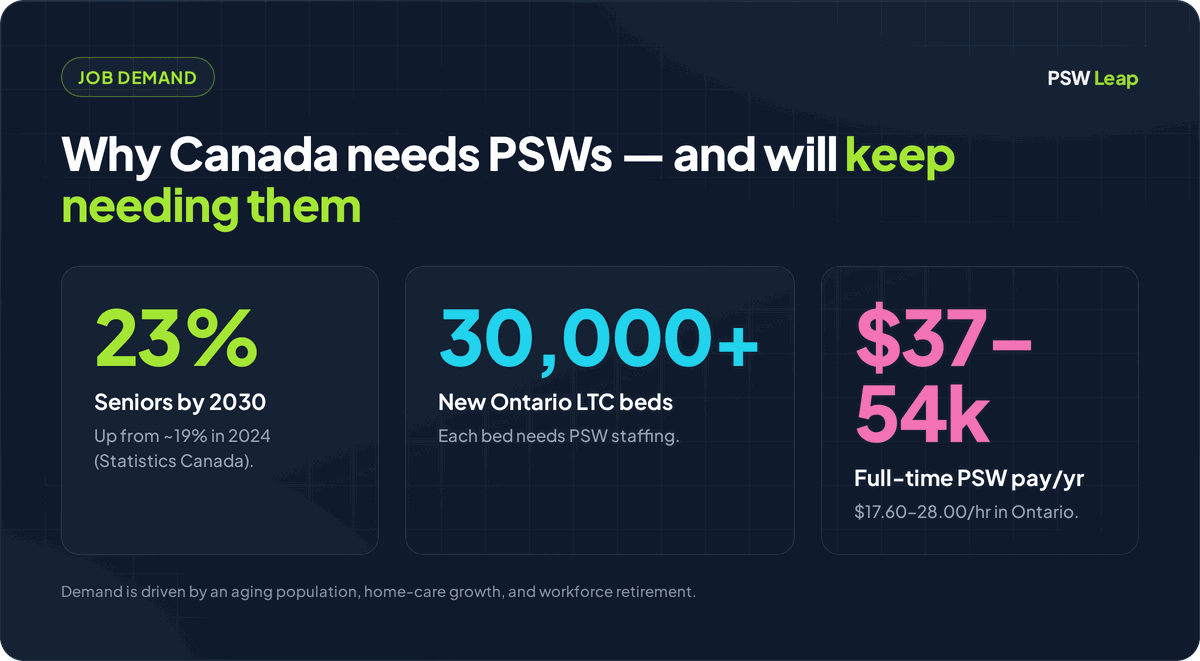
Statistics Canada's 2026 projection report estimated that people aged 65 and older made up 19.5% of Canada's population in 2025. Their share rises in every published projection scenario. Statistics Canada cautions that projections are not predictions and should be considered across several scenarios.
This is national demographic context, not proof that every older adult needs PSW care and not a forecast for one applicant's employment. The Ontario Job Bank profiles above are the more direct evidence for this Ontario career decision.
What does PSW work actually involve?
Duties depend on the client's needs, the setting, the employer, and the specific role. Work may include:
- helping with bathing, grooming, dressing, toileting, and other personal care;
- supporting meals, hydration, comfort, companionship, and daily routines;
- helping with mobility and activities of daily living;
- observing changes, documenting care, and reporting concerns through the required channel; and
- in home care, completing assigned household or meal-support tasks.
Important role and safety limits
Medication reminders or assistance are not a universal PSW duty. Neither are lifting, transfers, positioning, or wound-related activities. What you may assist with depends on your role and training, the care plan, available equipment and required help, employer policy, and client-specific restrictions.
For example, a posting may include mobility support, but that does not mean one person should improvise a lift or transfer without the equipment or assistance identified for the client. Wound-related responsibilities may involve assigned observation, protection, documentation, or reporting; do not assume that every PSW role includes wound assessment or treatment.
Follow the care plan, your training, employer policy and client-specific restrictions.
Before accepting a role, ask the employer to explain the duties, orientation, supervision, equipment, emergency process, and how staff report a change in a client's condition.
The main PSW career trade-offs
Meaning and relationships
The work can let you support people with daily needs and build trusting relationships. Some workers find that personally meaningful. It can also involve illness, disability, cognitive change, grief, death, family distress, and situations where a client is frightened or frustrated. Meaningful work and emotionally difficult work can both be true.
Physical demands
Personal care often involves time on your feet, bending, reaching, and mobility support. Some assignments use transfer devices or require help from another worker. Training in body mechanics matters, but it does not replace the care plan, correct equipment, required assistance, or a workplace's safety process.
Ask what equipment is available, how staffing works for assisted transfers, and what happens when the planned support is unavailable. Consider your own health and seek qualified advice if you are unsure whether the physical demands are suitable for you.
Schedules and work-life fit
PSW services can be delivered during days, evenings, nights, weekends, and holidays, but no single schedule applies to every job. Positions may be full-time, part-time, casual, temporary, or visit-based. Seniority, client needs, collective agreements, and employer scheduling practices can affect what is available.
Read the posting carefully. Ask about guaranteed hours, rotation, weekend or holiday expectations, shift length, cancellations, split shifts, overtime rules, and how much notice is provided when a schedule changes.
Pay, hours, and benefits
Ontario does not have one universal PSW wage or annual salary. A headline hourly rate does not show paid hours, unpaid gaps, travel arrangements, shift premiums, overtime, deductions, or benefit eligibility.
Use the Ontario PSW salary guide for the current Job Bank wage profiles and a checklist for comparing offers. For a specific job, check the current posting, written wage grid or collective agreement, employment status, guaranteed hours, and benefit rules. Do not assume that a hospital role always pays the most or that any setting automatically includes benefits.
How do PSW work settings differ?
A setting can change the pace, teamwork, travel, duties, schedule, and client relationships.
| Setting | What to investigate before applying |
|---|---|
| Long-term care | Team structure, resident assignment, transfer equipment, shift rotation, orientation, and the written wage and benefit rules |
| Home and community care | Travel area, paid travel time, visit length, cancellations, working alone, equipment in each home, and access to clinical or emergency support |
| Hospital | Actual job title and duties, required experience or certifications, unit orientation, shift rotation, wage classification, and benefit eligibility |
| Retirement, hospice, group-home, or private care | Client population, scope of assigned work, supervision, staffing, schedule, safety process, and employer-specific requirements |
A PSW certificate does not guarantee eligibility for every role or setting. Read the full comparison of long-term care vs. home care vs. hospital PSW work, then verify the details in the current posting.
How long is PSW training in Ontario?
Ontario's career page says some PSW certificate programs can be completed in as little as five months, while others take up to eight months. That is a range on the provincial page, not the duration of every program or pathway.
PSW education is available through several types of Ontario institutions. Program length, delivery format, admission rules, placement timing, tuition, assessment, and graduation requirements can differ. Before enrolling, get written answers to these questions:
- Which Ontario requirements does the program meet, and what certificate will you receive?
- How long is the classroom portion and the clinical placement?
- Where can placements occur, and what travel or schedule should you expect?
- What health, safety, language, academic, or background-check requirements apply?
- Which final assessments apply to this specific program?
- What happens if a placement or required course is delayed?
- What is the complete cost, including supplies, checks, travel, and unpaid placement time?
Do not assume every Ontario PSW program uses the National Association of Career Colleges (NACC) exam. Confirm the pathway and assessment directly with your school.
Can a PSW advance to nursing or another role?
Some Ontario colleges offer Practical Nursing pathways or advanced-standing options for eligible applicants. Availability, admission, transfer credit, scheduling, placement, and completion time vary. PSW education or work experience does not guarantee admission, a fixed amount of credit, or a shorter timeline.
If you are considering this route:
- check the college's current program page and admission requirements;
- ask for a written assessment of any transfer credit or advanced standing;
- budget for tuition, supplies, placement, and possible changes to paid work; and
- verify current nursing-registration requirements with the College of Nurses of Ontario (CNO).
CNO currently identifies the Regulatory Exam – Practical Nurse (REx-PN) as the accepted registration exam for applicants seeking registration as an RPN in the General Class. Our PSW-to-RPN bridging guide can help you organize questions, but the current college and CNO pages control your actual pathway.
Experience may also support applications for employer-specific training or different care roles. Titles, prerequisites, duties, pay, and availability vary; do not assume experience automatically produces a promotion or pay increase.
Is HSCPOA registration mandatory?
No. As of August 2, 2026, registration with the Health and Supportive Care Providers Oversight Authority (HSCPOA) is voluntary. HSCPOA's FAQ says a future decision to make it mandatory would be made by Ontario's Ministry of Health.
Voluntary status does not prevent an employer from setting its own hiring or employment requirements. Check the posting and ask the employer. For current pathway, fee, and renewal details, read the HSCPOA PSW registration guide and verify your situation on HSCPOA's official site.
A practical fit check before you enrol
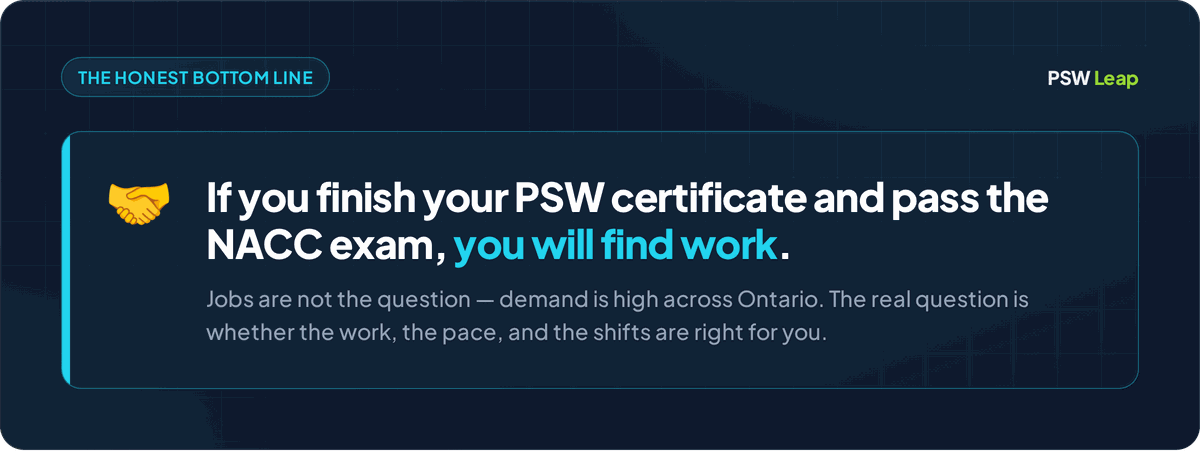
Use this process before paying a deposit or accepting a job:
- Talk to working PSWs. Ask people in more than one setting what a normal shift, difficult shift, and schedule change look like.
- Review real postings. Compare duties, required credentials, hours, location, travel, wage, and benefit eligibility.
- Check the physical reality. Ask about personal care, mobility support, equipment, staffing, and workplace safety processes.
- Check the emotional reality. Consider how you respond to grief, distress, cognitive change, and professional boundaries.
- Verify the program. Confirm the institution, certificate, placement, assessment, timeline, and complete cost in writing.
- Plan transportation and time. Account for placement travel, early or late shifts, weekends, and unpaid gaps where applicable.
- Compare your budget. Use realistic paid hours and costs, not an assumed annual salary.
- Keep alternatives open. Compare PSW with other programs or roles that may fit your health, schedule, interests, and financial needs better.
The verdict
PSW can be a good Ontario career for someone who wants direct, hands-on support work and enters with realistic expectations. The current Ontario Job Bank outlook is Good for 2025–2027 in both relevant occupational profiles. That is useful labour-market evidence, not a promise about your job search, schedule, pay, benefits, or advancement.
The best decision comes from combining the outlook with the actual work: personal care, physical demands, emotional load, employer-specific duties, variable schedules, and compensation. Compare programs and job postings, ask detailed questions, and choose the path that fits your circumstances.
If your program uses the NACC exam, explore PSW Leap for NACC exam preparation. Confirm your program's current exam and graduation requirements directly with the school.
Official sources reviewed
- Government of Canada Job Bank: Personal support worker — home support outlook in Ontario — accessed August 2, 2026.
- Government of Canada Job Bank: Personal support worker — nursing care outlook in Ontario — accessed August 2, 2026.
- Ontario: Become a personal support worker — accessed August 2, 2026.
- Statistics Canada: Population Projections for Canada (2025 to 2075), Provinces and Territories (2025 to 2050) — accessed August 2, 2026.
- HSCPOA: Applicant FAQs — accessed August 2, 2026.
- College of Nurses of Ontario: Registered Practical Nurse registration examinations — accessed August 2, 2026.
Sources and employer requirements can change. Recheck the linked official pages before making an education, registration, or employment decision.
Frequently Asked Questions
It can be. Ontario Job Bank rates both home support (NOC 44101) and nursing care (NOC 33102) as Good for 2025-2027, but that outlook is not a personal job guarantee. The role may suit people who value hands-on care and can manage its physical, emotional, and schedule demands. Pay, hours, duties, and benefits vary by employer and setting.
Ontario Job Bank rates home support workers (NOC 44101) and nurse aides, orderlies, and patient service associates (NOC 33102), which includes the PSW - nursing care title, as Good for 2025-2027. Job Bank cites employment growth and retirements as contributing factors. The rating describes an occupation at the provincial level; it does not guarantee a job for every applicant.
It often can be. Personal care, standing, walking, and mobility support may be part of the work. Assistance with lifting, transfers, and positioning depends on the role, training, care plan, required equipment and help, employer policy, and client-specific restrictions. Follow the care plan, your training, employer policy and client-specific restrictions.
No. Ontario PSW education is offered through several institution types, and program and assessment requirements differ. Ask your school which certificate, placement, and final-assessment rules apply. If your program uses the NACC exam, confirm the current requirements with the program.
Ontario does not have one universal PSW pay rate or annual salary. Pay and total earnings depend on the occupational profile, duties, employer, region, setting, experience, paid hours, employment status, premiums, travel arrangements, and benefit eligibility. Compare the current posting and written wage information for the role.
A PSW may apply to a current Practical Nursing pathway or advanced-standing option where available, but admission, transfer credit, program length, and completion requirements vary by college. The College of Nurses of Ontario currently accepts the REx-PN for applicants seeking registration as an RPN in the General Class. Verify the current college and CNO requirements before planning a timeline.
No. As of August 2, 2026, HSCPOA registration is voluntary. HSCPOA says a future decision to make registration mandatory would be made by Ontario's Ministry of Health. An employer may still set its own requirements, so check the current job posting or ask the employer.
PSW Leap is an independent exam-preparation platform. It is not affiliated with HSCPOA or NACC. This article provides general career information, not legal, clinical, financial, or employment advice.
Written by Shashank Jha
Founder, PSW Leap
Shashank Jha is the founder of PSW Leap. He built this platform after going through the NACC exam prep process himself, to help fellow students study smarter with practice questions organized around the NACC PSW curriculum.
He's also the author of PSW Exam Success: The Ultimate Prep Book — the 455-page paperback PSW Leap grew out of.
Learn more about PSW LeapPSW Leap
Practice smarter for the NACC exam. 2,500 questions. Detailed rationales. $29.99 CAD one-time — everything included.
Try 10 free questions →No account needed. Ready for the full bank? Create your account.