PSW to RPN Bridging Programs in Ontario: The Complete Guide for 2026
Why PSWs Consider Bridging
You already know how to provide hands-on care. You understand the daily realities of working with patients and residents. You have clinical experience that most first-year nursing students do not.
The PSW-to-RPN bridging pathway exists specifically for people like you — experienced care providers who want to expand their scope of practice, increase their earning power, and take on more clinical responsibility without starting a nursing education from scratch.
This guide covers everything you need to know about bridging from PSW to Registered Practical Nurse in Ontario: what bridging programs are, which colleges offer them, what you need to get in, what the program looks like, and whether it is worth the investment.
What Is a Bridging Program?
A bridging program is a condensed version of the full Practical Nursing diploma designed for students who already hold a PSW certificate (or equivalent healthcare credential). Instead of completing the standard 2-year PN program from the beginning, bridging students receive credit for their existing training and experience, which shortens the program to approximately 1.5 to 2 years.
The curriculum focuses on the knowledge and skills that differentiate an RPN from a PSW:
- Pharmacology and medication administration — RPNs administer medications, including injections, within their own scope of practice; a PSW gives an injection only through an exception in the Regulated Health Professions Act, 1991 (accessed September 26, 2026) — for example a routine activity of living that a nurse has assessed and taught the PSW to do for a specific client — or a delegation, and only as the setting's legislation, the care plan and the employer's policy allow.
- Health assessment — RPNs perform physical assessments, interpret vital signs in a clinical context, and identify changes in patient status.
- Nursing theory and clinical reasoning — The shift from following a care plan to contributing to its development.
- Advanced clinical skills — Wound care, IV therapy basics, catheterization, suctioning, and other procedures within RPN scope.
- Leadership and delegation — RPNs often supervise and delegate to PSWs, so you learn the other side of that relationship.
You still complete clinical placements — typically in multiple settings — and you must pass the REx-PN to register with the College of Nurses of Ontario (CNO) as an RPN. The REx-PN is the exam CNO accepts for applicants who want to register as a Registered Practical Nurse (RPN) in the General Class (College of Nurses of Ontario: Registered Practical Nurse (RPN) Registration Examinations, accessed September 23, 2026).
Prerequisites
Admission requirements vary by college, but most bridging programs require the following. Check with your target college directly, as specific requirements can change from year to year.
Common Requirements
- PSW certificate from a recognized Ontario program (minimum 600 hours or equivalent)
- NACC certification — not always mandatory, but having your NACC PSW certification strengthens your application and may be a requirement at some colleges
- Work experience — most programs require a minimum of 6 to 12 months of recent PSW work experience, often verified by an employer letter
- High school diploma (Grade 12) or equivalent, with credits in:
- English (Grade 12 C or U)
- Mathematics (Grade 11 C/U or Grade 12 C/U)
- Biology (Grade 11 C/U or Grade 12 U)
- Chemistry (Grade 11 C/U or Grade 12 U)
- Clear Vulnerable Sector Check (police check)
- Current immunization records and a clear TB test
- Standard First Aid and CPR (BLS level, Health Care Provider)
- English proficiency — if your first language is not English, you may need IELTS or equivalent test scores (typically IELTS Academic 6.5 overall with no band below 6.0)
If You Are Missing High School Credits
If you do not have the required science or math credits, you can complete them through adult learning centres, online through the Independent Learning Centre (ILC), or through academic upgrading programs offered by many of the same colleges that run bridging programs. This can add several months to your timeline but is a solvable problem.
Ontario Colleges Offering Bridging Programs
Several Ontario colleges have offered PSW-to-RPN bridging pathways. Program availability, structure, and admission requirements change from year to year, so always verify directly with the college before planning your application.
The following colleges have historically offered bridging or advanced-standing options for PSWs entering Practical Nursing:
Conestoga College (Kitchener)
Conestoga has offered a Practical Nursing program with advanced standing pathways for qualified PSWs. The program is well-regarded and includes clinical placements across multiple healthcare settings in the Waterloo Region.
Georgian College (Barrie/Orillia)
Georgian has offered pathways for experienced PSWs to enter the Practical Nursing program with recognition of prior learning. The Simcoe-Muskoka region provides access to diverse clinical placement opportunities.
Loyalist College (Belleville)
Loyalist has offered a bridging program specifically structured for PSWs. The smaller college setting can mean more direct support from faculty and less competition for clinical placements.
Mohawk College (Hamilton)
Mohawk's Practical Nursing program has offered advanced standing for applicants with PSW credentials and relevant experience. Hamilton's healthcare ecosystem — anchored by Hamilton Health Sciences — provides strong clinical placement opportunities.
Other Colleges
Other Ontario colleges with large Practical Nursing programs — including Fanshawe, George Brown, Humber, Centennial, and Algonquin — may offer Prior Learning Assessment and Recognition (PLAR) processes that can shorten the standard PN program for qualified PSWs, even if they do not have a formal "bridging" stream. It is worth inquiring directly.
Important note: College programs are subject to change. A program that was offered last year may not be offered this year, and new programs may launch. Always check the college's website or contact their admissions office directly for the most current information.
Program Duration and Structure
Timeline
Most bridging programs run 1.5 to 2 years of full-time study. Some colleges offer:
- Full-time accelerated: Compressed into as few as 4 semesters (roughly 18 months) with a heavier course load
- Part-time or flexible scheduling: Designed for working PSWs who cannot stop working entirely; these may extend the program to 2.5 to 3 years
- Evening or weekend components: Some colleges offer select courses in evening or weekend formats to accommodate shift workers
What a Typical Semester Looks Like
Bridging students generally enter the standard PN program at an advanced point — often in the second or third semester — after completing any bridge-specific preparatory courses. A typical week might include:
- 2 to 3 days of classroom instruction (anatomy, pharmacology, nursing theory)
- 1 to 2 days of clinical lab (skills practice in the college's simulation lab)
- Clinical placements starting mid-program (typically 2 to 3 days per week during placement blocks)
Clinical placements are a significant component and are completed in hospitals, long-term care homes, community settings, and sometimes mental health or maternal-child units. The number of clinical hours is set by each program. CNO says it does not regulate mandatory clinical hours for any nursing program (NP, RN or RPN), that this is the expertise of the faculty who develop the curriculum for entry-level programs, and that through Program Approval it ensures entry-level competencies, including clinical practicums, are integrated into the curriculum (College of Nurses of Ontario: A single classification of nurse practitioners (NPs): FAQs, accessed September 23, 2026).
How Much Does PSW-to-RPN Bridging Cost in Ontario?
Tuition and costs vary by college and year. The tuition, textbook, uniform and police-check rows below are rough approximations for domestic students from 2025-2026; confirm the current year's costs with each college before you budget. The three College of Nurses of Ontario (CNO) rows are CNO's published 2026 fees, and the REx-PN exam fee is set by the exam provider, not by CNO:
| Cost Category | Cost |
|---|---|
| Tuition (per year) | $4,500 – $7,500 |
| Total tuition (1.5–2 years) | $7,000 – $15,000 |
| Textbooks and supplies | $1,000 – $2,000 |
| Uniforms and equipment | $300 – $600 |
| REx-PN exam fee | Set by the exam provider — check the REx-PN website for the current fee. A separate fee applies to each attempt, plus an additional fee if you write outside Canada or the United States. |
| CNO application fee, General Class (2026) | $433 plus 13% HST |
| CNO jurisprudence exam fee (2026) | $40 plus 13% HST |
| CNO initial registration fee (2026), for registration until December 31 of the year you become registered | $69 plus 13% HST |
| Police check / immunizations | $100 – $300 |
The tuition, textbook, uniform and police-check figures are approximate and subject to change. The three CNO rows are CNO's published 2026 fees, in Canadian dollars and before 13% HST; CNO's fees are non-refundable unless CNO notes otherwise (College of Nurses of Ontario: Application & membership fees, accessed September 23, 2026). International student tuition is significantly higher — see individual college websites.
Financial Support Options
- OSAP: Most bridging programs are OSAP-eligible for qualifying students
- Second Career: Ontario's Second Career program may cover tuition for career changers (eligibility requirements apply)
- Employer tuition assistance: Some large healthcare employers — particularly hospital networks and LTC chains — offer tuition reimbursement or sponsorship programs for PSWs pursuing nursing education. Ask your employer's HR department.
- Bursaries and scholarships: Many colleges offer healthcare-specific bursaries. RNAO and RPNAO also offer some awards.
Which Exam Do You Write to Become an RPN in Ontario?
You write the REx-PN, which became the registration exam for Ontario practical nurses on January 4, 2022. That applies if you graduate from a practical nursing program — through a bridging pathway or the standard program — and apply to the College of Nurses of Ontario (CNO) now. The Canadian Practical Nurse Registration Exam (CPNRE) is no longer an option for Ontario applicants, and CNO treats an earlier CPNRE pass separately: if you passed the CPNRE by the end of 2021 as part of your CNO application, CNO says you meet its registration exam requirement (College of Nurses of Ontario: REx-PN FAQs, accessed September 23, 2026).
Key Facts
- Administered by: Pearson Professional Assessments (formerly Pearson VUE). You can write the REx-PN at any Pearson Professional Assessments test centre that offers the exam, but there is an additional fee if you write it outside Canada or the United States.
- Format: The REx-PN is a computerized adaptive test.
- Time limit: There is no time limit for each question, but you have four hours to complete the whole exam.
- Attempts: There is no limit on the number of times you can write the exam before you pass. You must wait at least 60 days between attempts, which allows up to six attempts per year, and each retake gives you a different set of questions from your previous attempts.
- Fees: The exam fee is set by the exam provider, not by CNO. Exam fees are non-refundable, and you pay a separate fee each time you attempt the exam.
- Your CNO application: Your application with CNO stays open for two years. If you have not passed the exam within that time, you will need to reapply to CNO.
- Test Plan: For more detail about the exam, CNO's REx-PN FAQs point candidates to the REx-PN Test Plan, including its 'Examination Length' section.
Sources for these facts: College of Nurses of Ontario, Registered Practical Nurse (RPN) Registration Examinations and REx-PN FAQs, both accessed September 23, 2026.
Your bridging program may include some preparation for the REx-PN, but what programs offer varies. Ask the college what exam preparation is included before you enrol.
The Salary Increase: PSW vs RPN
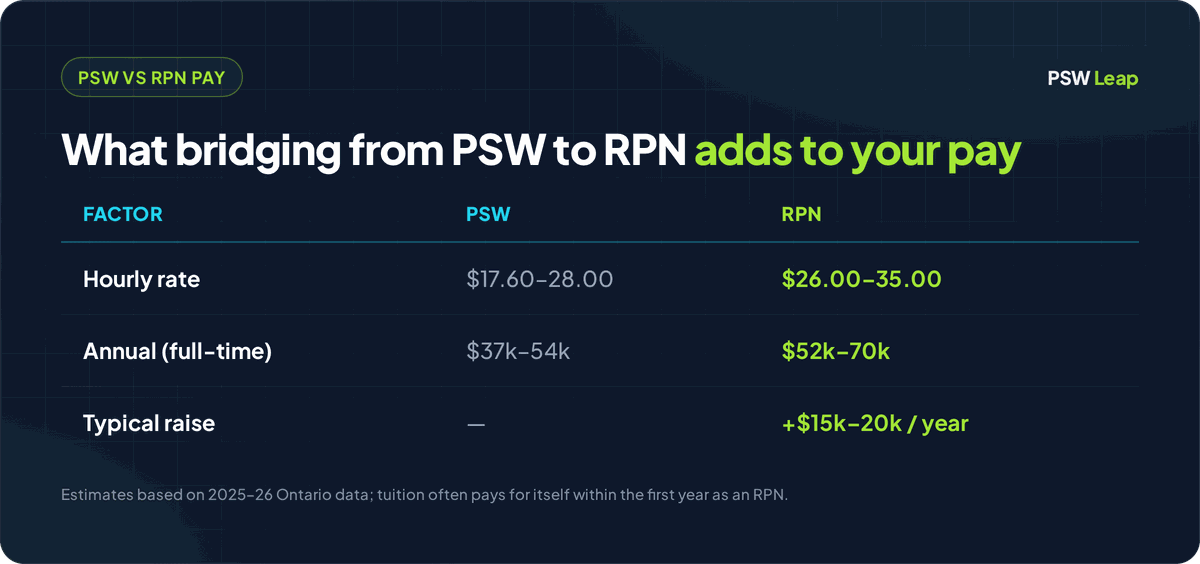
The financial case for bridging is straightforward. Here is how the two roles compare in Ontario:
| Factor | PSW | RPN |
|---|---|---|
| Hourly rate range | $17.60 – $28.00 | $26.00 – $35.00 |
| Estimated annual (FT) | $37,000 – $54,000 | $52,000 – $70,000 |
| Overtime / premium pay | Limited | More common |
| Benefits (typical) | Varies widely | Generally stronger |
| Pension | Some employers | Most hospital/LTC employers |
Figures are estimates based on 2025-2026 Ontario data. Actual compensation depends on employer, setting, and collective agreement.
For detailed PSW salary data, see our PSW salary breakdown for Ontario.
Over a career, the difference compounds significantly. Even at the conservative end, bridging from PSW to RPN could mean an additional $15,000 to $20,000 per year — which adds up to hundreds of thousands of dollars over a working career. The tuition investment typically pays for itself within the first year of working as an RPN.
How to Decide If Bridging Is Right for You
Bridging is a strong choice if:
- You enjoy the clinical aspects of your PSW work and want to do more — medication administration, assessments, care planning
- You want higher earning potential and better benefits
- You are prepared to invest 1.5 to 2 years of study (and potentially reduced income during that time)
- You can manage the academic requirements, including science courses if you need upgrading
- You are looking for a career with even more advancement potential (RPN can later bridge to RN)
Bridging may not be the right path if:
- You are content with the PSW scope of practice and the work you are doing now
- The financial cost and time commitment would create serious hardship without a realistic plan to manage it
- You struggle with academic coursework and are not sure you can manage the nursing curriculum
- You are close to retirement and the return on investment is limited
There is no wrong answer. Some PSWs have fulfilling 30-year careers without ever bridging. Others use PSW as a deliberate stepping stone to nursing. Both paths are valid.
Steps to Get Started
If you have decided that bridging is the right move, here is a practical action plan:
-
Check your high school transcripts. Do you have the required credits in English, math, biology, and chemistry? If not, start upgrading now through ILC or an adult learning centre. This is often the longest lead-time item.
-
Get your NACC certification. If you have not already passed the NACC PSW exam, do it. It strengthens your application and demonstrates competency. PSW Leap can help you prepare.
-
Accumulate work experience. Most programs want 6 to 12 months minimum. If you are a new PSW graduate, focus on gaining solid experience before applying.
-
Research programs directly. Visit the websites of the colleges listed above. Attend virtual information sessions. Contact admissions offices with specific questions about bridging pathways.
-
Apply to OSAP early. If you will need financial support, start your OSAP application as soon as you receive your letter of admission.
-
Talk to your employer. Some employers offer tuition assistance, schedule flexibility for students, or even guaranteed positions after graduation. You will not know unless you ask.
-
Connect with RPNs who bridged. Nothing replaces first-hand experience. Ask your coworkers, check professional forums, or reach out through RPNAO. People who have been through the process are usually happy to share what they learned.
The Bigger Picture
Going from PSW to RPN is one of the most practical career advancement moves in Canadian healthcare. You already have the foundation — the clinical experience, the patient interaction skills, the understanding of what care looks like in practice. A bridging program builds on that foundation with the pharmacology, assessment, and clinical reasoning skills that expand your scope.
The investment is real — 1.5 to 2 years of your life and several thousand dollars in tuition. But the return is tangible: higher pay, broader scope, better benefits, and a career with even more room to grow.
If you are a working PSW in Ontario and you have been thinking about this move, start by checking your prerequisites and researching programs. The demand for RPNs is just as strong as the demand for PSWs, and your PSW experience makes you a stronger candidate than most applicants walking in off the street.
For more on the PSW career landscape, see our guide on whether PSW is a good career in Canada.
Sources
- College of Nurses of Ontario: Registered Practical Nurse (RPN) Registration Examinations — the REx-PN as the exam CNO accepts for RPN applicants in the General Class, who administers it, the number of attempts, the 60-day wait between attempts and the two-year application window; accessed September 23, 2026.
- College of Nurses of Ontario: REx-PN FAQs — when the REx-PN became Ontario's registration exam for practical nurses, test centres, the time limit and exam fees; accessed September 23, 2026.
- College of Nurses of Ontario: Application & membership fees — CNO's 2026 application, jurisprudence exam and initial registration fees, HST, and who sets the REx-PN exam fee; accessed September 23, 2026.
- College of Nurses of Ontario: A single classification of nurse practitioners (NPs): FAQs — CNO's statement that it does not regulate mandatory clinical hours for any nursing program (NP, RN or RPN), and how Program Approval ensures entry-level competencies, including clinical practicums, are integrated into the curriculum; accessed September 23, 2026.
CNO's requirements and fees can change. Recheck the linked CNO pages before you apply or pay a fee.
Frequently Asked Questions
How long does it take to go from PSW to RPN in Ontario?
PSW-to-RPN bridging programs in Ontario typically take 1.5 to 2 years of full-time study. The exact duration depends on the college and whether you attend full-time or part-time. Some programs offer accelerated or flexible scheduling for working PSWs.
What are the prerequisites for PSW-to-RPN bridging in Ontario?
Prerequisites generally include a PSW certificate from an approved program, current NACC certification or equivalent, a minimum of 6 to 12 months of recent PSW work experience, Grade 12 or equivalent with credits in English, math, biology, and chemistry, and a clear Vulnerable Sector Check.
How much more do RPNs make compared to PSWs in Ontario?
RPNs in Ontario typically earn $26 to $35 per hour compared to $17.60 to $28.00 for PSWs. On an annual basis, a full-time RPN can expect to earn approximately $52,000 to $70,000 — a significant increase over PSW earnings of $37,000 to $54,000.
Written by Shashank Jha
Founder, PSW Leap
Shashank Jha is the founder of PSW Leap. He built this platform after going through the NACC exam prep process himself, to help fellow students study smarter with practice questions organized around the NACC PSW curriculum.
He's also the author of PSW Exam Success: The Ultimate Prep Book — the 455-page paperback PSW Leap grew out of.
Learn more about PSW LeapPSW Leap
Practice smarter for the NACC exam. 2,500 questions. Detailed rationales. $29.99 CAD one-time — everything included.
Try 10 free questions →No account needed. Ready for the full bank? Create your account.