HSCPOA PSW Registration in Ontario: Is It Mandatory? Paths & Fees
Short answer: As of July 31, 2026, HSCPOA registration is voluntary for Ontario personal support workers. There is currently no cost to apply, register or renew. Eligible applicants use one of four main routes, and the legacy Path 2 route closes on December 1, 2027.
This answer comes from current pages published by the Health and Supportive Care Providers Oversight Authority, not from assumptions about how other Ontario health professions are regulated.
Information checked: July 31, 2026. HSCPOA rules and fees can change. Confirm your own eligibility and application steps with HSCPOA before acting.
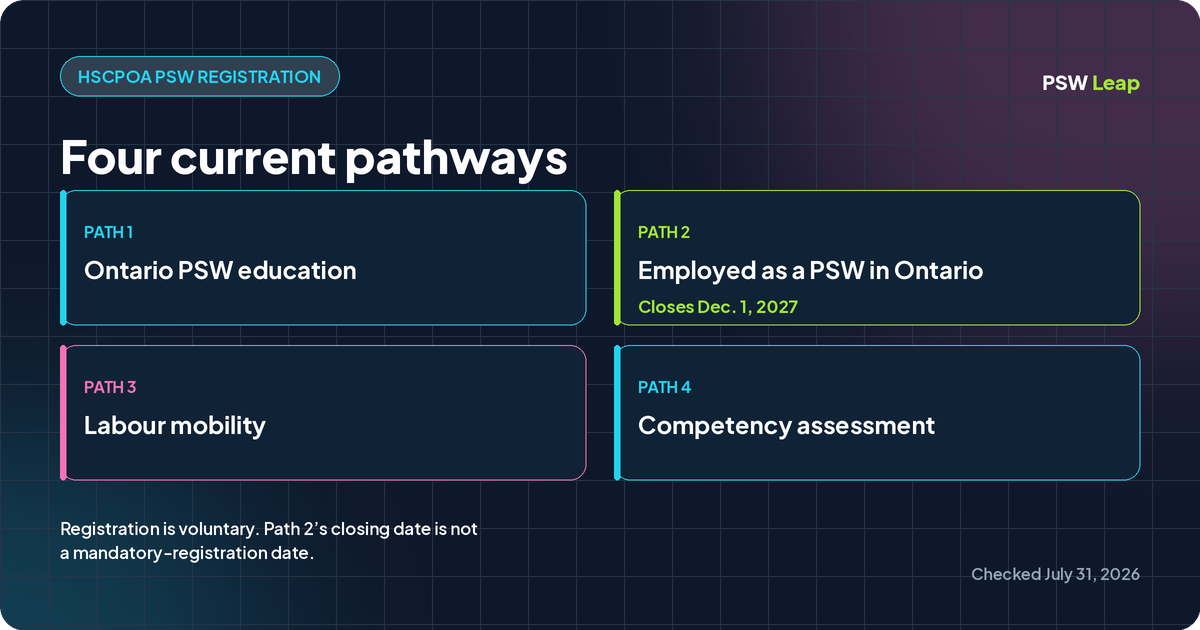
The four current HSCPOA registration pathways, checked July 31, 2026. Path 2 closes December 1, 2027; that is not a mandatory-registration date.
What is HSCPOA?
The Health and Supportive Care Providers Oversight Authority, usually shortened to HSCPOA, is the organization that registers eligible personal support workers in Ontario and maintains a public register.
HSCPOA began registering PSWs on December 1, 2024. It operates under the Health and Supportive Care Providers Oversight Authority Act, 2021 and has responsibilities related to registration, codes of ethics, standards of practice, complaints and public protection.
HSCPOA is not the same organization as the College of Nurses of Ontario. It also is not a school, an exam-preparation provider or a PSW professional association. Use HSCPOA's own website for registration decisions.
Is HSCPOA registration mandatory for PSWs?
No. HSCPOA registration is currently voluntary.
HSCPOA's official FAQ says the current Act does not:
- require someone to be registered in order to provide personal support services;
- prevent an unregistered person from using the PSW title; or
- define an exclusive PSW scope of practice.
The Ontario Ministry of Health may decide to make registration mandatory in the future. That is a possible future policy decision, not a current requirement or a confirmed phase-in schedule.
An individual employer can still set hiring or employment requirements. Ask the employer directly what it requires for the role you are considering.
Official source: Why registration is voluntary
Why might an eligible PSW register voluntarily?
HSCPOA identifies these current benefits of registration:
- being listed on HSCPOA's public register;
- showing that you have met HSCPOA's registration qualifications and are accountable to its oversight;
- being able to use the HSCPOA PSW Visual Mark; and
- distinguishing registered PSWs from unregistered PSWs who are not accountable to an oversight body.
Registration does not replace an employer's onboarding, training, care-plan or workplace-policy requirements.
Official source: Benefits to registration
The four main HSCPOA registration pathways
The correct route depends on where and when you completed PSW education, where you are registered now, and your Ontario work history.
| Path | Who it is for | Important current detail |
|---|---|---|
| Path 1: Ontario PSW education | People who graduated from qualifying Ontario PSW education on or after July 1, 2014 | The program must meet Ontario Ministry of Colleges and Universities requirements and be offered by one of HSCPOA's four listed Ontario institution types; Path 1 is not NACC-only |
| Path 2: Employed as a PSW in Ontario | Eligible people with qualifying Ontario PSW work experience, with or without specified education | A qualifying employer form is required, and this legacy route closes December 1, 2027 |
| Path 3: Labour mobility | People currently registered with one of the British Columbia, Alberta or Nova Scotia bodies named by HSCPOA | Applicants must also meet the listed recent-practice or recent-graduation condition |
| Path 4: Competency assessment | Eligible people with no Ontario PSW work experience in the previous three years who completed at least 600 hours of personal-support education outside Ontario | Phase 1 is a substantial-equivalence assessment; Phase 2 requires the online Orientation to Registered PSW Care in Ontario course and a formal registration application |
Path 1: Ontario PSW education
Path 1 may apply if you graduated on or after July 1, 2014 from an Ontario PSW program that meets the Ontario Ministry of Colleges and Universities requirements to issue a PSW certificate. HSCPOA lists four Ontario institution types:
- Indigenous Institution;
- District School Board;
- College of Applied Arts and Technology; or
- Private Career College.
HSCPOA's current Path 1 page does not list NACC accreditation or a NACC exam result among its public eligibility or documentation requirements. Check your program against HSCPOA's current Path 1 information.
Official source: Ontario PSW education — Path 1
Path 2: Employed as a PSW in Ontario
Path 2 is a time-limited route for eligible people who have been employed as PSWs in Ontario during the three years before applying. HSCPOA describes two options:
- Experience only: the applicant did not complete formal PSW education and has worked at least 600 hours as a PSW or equivalent in Ontario; or
- Experience plus education: the applicant completed a personal-support education program of at least 600 hours, either in Ontario before July 1, 2014 or outside Ontario. This option does not require 600 hours of employment, but recent Ontario PSW employment is still required.
For either option, the employer must complete HSCPOA's Confirmation of Employment and Personal Support Worker Skills Form, send it directly to HSCPOA, and fall within one of the employer categories listed on the form.
HSCPOA says Path 2 closes on December 1, 2027. That is a pathway deadline; it is not proof that registration becomes mandatory on that date.
Official source: Employed as a PSW in Ontario — Path 2
Path 3: Labour mobility
Path 3 is not a general internationally educated-applicant route. It is for eligible people currently registered with one of the Canadian bodies named by HSCPOA:
- British Columbia Care Aide & Community Health Worker Registry;
- College of Licensed Practical Nurses and Health Care Aides of Alberta; or
- Nova Scotia Continuing Care Assistant Registry.
The applicant must also have provided personal support care, or graduated from their personal care provider education program, during the three years before applying.
Official source: Labour mobility — Path 3
Path 4: Competency assessment
Path 4 may apply if you completed a personal support services education program outside Ontario that was at least 600 hours, including both class time and practical experience, and you do not have Ontario PSW work experience during the three years before applying. HSCPOA currently includes:
- internationally educated personal care providers; or
- people educated as personal care providers in Canada outside Ontario who are not eligible through Path 3.
HSCPOA currently describes two phases:
- Phase 1: a substantial-equivalence assessment comparing the applicant's previous education and training with the applicable Ontario standards; and
- Phase 2: completion of the online Orientation to Registered PSW Care in Ontario course and a formal application for HSCPOA registration.
Official source: Competency assessment — Path 4
How to apply for HSCPOA registration
Use this simple order:
- Compare the official pathways. Start with HSCPOA's How to become a registrant page.
- Open the pathway page that fits your history. Read its education, employment, registration and timing requirements.
- Use HSCPOA's application portal. Follow the link from the official pathway page rather than relying on a third-party portal link.
- Provide the evidence requested for that route. Requirements differ, so do not use a generic document checklist from another pathway.
- Respond to HSCPOA if it requests more information. Keep copies of what you submit and of any confirmation messages.
If you are unsure which route fits, contact HSCPOA before submitting. PSW Leap cannot determine your personal eligibility.
Current application and registration fees
There is currently no cost to apply or register with HSCPOA. The official FAQ also says there is currently no cost for annual renewal.
HSCPOA says fees may be introduced in the future. Do not rely on estimated fee ranges from other Ontario organizations; they do not establish HSCPOA's current or future fees.
Official source: HSCPOA fees FAQ
Annual renewal
As of July 31, 2026, HSCPOA says the 2026 annual-renewal period is closed. A registrant who missed the deadline should log in to their HSCPOA profile and complete the reinstatement form.
For later renewal cycles, HSCPOA says the portal opens on February 1 and renewal is due by March 31 each year. A certificate expires on April 1 unless it is renewed by the deadline. Anyone who became registered on or after February 1, 2026 will complete their first annual renewal in 2027.
To renew, registrants update their profile information and answer questions about their personal care provider education and work history. There is currently no annual-renewal fee. Check HSCPOA each year because the process and fee policy may change.
Official sources: HSCPOA annual renewal and annual renewal FAQs
What Ontario PSW students should know
HSCPOA says Ontario PSW students do not need to register while they are in a program. Once they complete an Ontario PSW training program, they can apply for registration. Path 1 may apply if the program meets its current requirements.
Do not assume every Ontario student needs a NACC exam result for HSCPOA registration. Ontario has several PSW education pathways, and Path 1 is not restricted to NACC-member career colleges.
If your own college tells you that the NACC final exam applies to your program, use our NACC PSW exam guide for independent study information. Confirm exam and graduation requirements with your college.
Key takeaways
- HSCPOA registration is voluntary as of July 31, 2026.
- There is currently no application, registration or renewal fee.
- HSCPOA has four main applicant routes with different education, work-history and registration criteria.
- Path 1 includes several types of qualifying Ontario PSW programs; it is not NACC-only.
- Path 2 closes on December 1, 2027.
- Path 3 is limited to the registries currently named on HSCPOA's Labour Mobility page and its recent-care or recent-graduation condition.
- Path 4 uses HSCPOA's current substantial-equivalence and orientation process for eligible applicants educated outside Ontario.
- Ontario PSW students can apply after completing their training program, subject to the applicable pathway requirements.
Frequently Asked Questions
The Health and Supportive Care Providers Oversight Authority is Ontario's oversight authority for registered personal support workers. It began registering eligible PSWs on December 1, 2024 under the Health and Supportive Care Providers Oversight Authority Act, 2021.
No. As of July 31, 2026, HSCPOA registration is voluntary. The current Act does not require a person to be registered to provide personal support services or use the PSW title. The Ministry of Health may decide to make registration mandatory in the future, but that has not happened yet.
There is currently no cost to apply, register or complete annual renewal. HSCPOA says this may change in the future, so applicants should confirm the current fee information on the official website.
Path 2 closes on December 1, 2027. It is the legacy route for eligible people who have worked as PSWs in Ontario and meet the route's education or experience requirements.
HSCPOA says Ontario PSW students do not need to register while they are in a program. Once a student completes an Ontario PSW training program, they can apply for registration. Eligibility depends on the applicable pathway requirements.
Official sources reviewed July 31, 2026:
- HSCPOA home
- Benefits to registration
- Ontario PSW education — Path 1
- How to become a registrant
- Path 2: Employed as a PSW in Ontario
- Path 3: Labour mobility
- Path 4: Competency assessment
- HSCPOA frequently asked questions
- HSCPOA annual renewal
- HSCPOA annual renewal FAQs
PSW Leap is an independent exam-preparation platform. It is not affiliated with HSCPOA or NACC. This article is general educational information, not legal advice or a determination of anyone's eligibility.
Written by Shashank Jha
Founder, PSW Leap
Shashank Jha is the founder of PSW Leap. He built this platform after going through the NACC exam prep process himself, to help fellow students study smarter with practice questions organized around the NACC PSW curriculum.
He's also the author of PSW Exam Success: The Ultimate Prep Book — the 455-page paperback PSW Leap grew out of.
Learn more about PSW LeapPSW Leap
Practice smarter for the NACC exam. 2,500 questions. Detailed rationales. $29.99 CAD one-time — everything included.
Try 10 free questions →No account needed. Ready for the full bank? Create your account.