How to Pass the NACC PSW Exam in 2026: Practice Questions, Answers & Study Method

If you are looking for NACC PSW exam questions and answers in 2026, use original practice questions with clear explanations—not material that claims to reveal a live exam. A useful study set should help you recall course knowledge, recognize a safe and role-appropriate response, and explain why the other options are weaker.
The short answer is: answer each question without notes, review the full rationale, record the reason for your mistake or uncertainty, and try a similar question later. That turns an answer key into a study method instead of a list to memorize.
Want to see what that looks like before you build a routine? Take the free PSW practice test: 10 original NACC-style questions with the rationale shown after every answer, no signup and no payment. If you would rather read first, our 15 free PSW practice questions with answers walk through IPAC, scope of practice, vital signs and medication safety items with a full rationale for every question.
PSW Leap is independent and is not affiliated with or endorsed by NACC. The examples below are original study questions, not official NACC items.
First, confirm whether the NACC exam applies to you
The National Association of Career Colleges' Personal Support Worker page says its final online theory examination evaluates the theory component of its PSW training. It also says students write the examination after both placements and should speak with their college representative to schedule it.
That description applies to the NACC program. Ontario has different PSW education and recognition pathways, so confirm your requirements and current exam instructions with your college. A page labelled “PSW exam” may target a different program, province, or credential.
What makes a useful NACC PSW practice question?
A useful question set should do more than reveal the correct letter. Look for:
- Original questions: the provider clearly says the items are for practice and are not copied from a confidential exam.
- Answer rationales: you can see why one option is stronger and why the distractors are weaker.
- Current, traceable content: factual exam claims link to NACC, your college, or another relevant authority and show when the information was checked.
- Role-aware scenarios: actions are qualified by the care plan, your training and role, employer policy, the setting, and client-specific restrictions.
- No outcome promises: practice can support preparation, but no question bank can guarantee that you will pass.
Be cautious with phrases such as “real exam questions,” “verified answers,” “100% correct,” or “guaranteed pass.” Those phrases do not establish that the material is accurate, current, ethical, or appropriate for your program.
Three original questions that test your study method
These examples test how you use practice material. They are not official exam questions or predictions of what will appear on your test.
Question 1: A correct answer that was really a guess
You choose the correct option, but you were unsure and guessed between two answers. What is the most useful next step?
- A. Mark the topic as mastered because the answer was correct
- B. Skip the rationale and move to a harder question
- C. Record the uncertainty, explain why the best answer is stronger, and retry a similar question later
- D. Memorize the correct letter in case the same question appears again
Answer: C. A correct guess does not show that you can apply the idea again. Reviewing the reasoning and re-testing later separates genuine understanding from luck.
Question 2: Two options both look reasonable
In a care scenario, two options seem possible, but one assumes you should perform a task without clear training or care-plan direction. Which review approach is strongest?
- A. Choose the most confident-sounding action
- B. Prefer the option that protects immediate safety, stays within the trained role and care plan, and uses the appropriate reporting or escalation process
- C. Choose the longest option because it contains more detail
- D. Pick the same letter that was correct in the previous question
Answer: B. Scenario review should connect the answer to immediate safety, your training and role, the care plan, employer policy, and appropriate reporting or escalation. The exact action in real care depends on the setting and client-specific directions.
Question 3: A page claims to contain the “real exam”
A third-party page advertises “real NACC questions” and a guaranteed pass. What is the best way to evaluate it?
- A. Treat it as official because the page uses the NACC name
- B. Memorize the answer key before checking where it came from
- C. Treat it as third-party material, verify current requirements with NACC or your college, and prefer transparent original practice
- D. Assume a paid answer key must be accurate
Answer: C. A marketing claim does not prove that material is official, current, accurate, or ethical. Use transparent practice resources and verify exam requirements with the organization or college responsible for your program.
How to review NACC PSW questions and answers
Do not stop when you see the score. Use this four-step review for every practice session:
- Answer from memory. Close your notes, choose the best option, and name the priority in one phrase before checking the key.
- Read every rationale. Explain why the correct option fits and why each alternative is weaker.
- Classify the miss. Was it a knowledge gap, a missed word, a role or scope error, or rushed reasoning?
- Re-test later. Try a similar question after a delay and mix it with questions from other topics.

A 2021 quasi-experimental study of 248 students in an Ontario university anatomy course found better final-exam performance among students who engaged more in retrieval practice. The paper also emphasizes feedback so learners do not reinforce an incorrect answer. It was not a study of NACC candidates and does not predict a PSW exam result. The useful principle is: retrieve first, then correct your reasoning. You can read the study through Europe PMC.
A simple review log can have four columns: topic, why I chose it, why the best answer is stronger, and what I will review next. That record is more useful than copying the correct letter.
Use a safety-and-scope filter for care scenarios
For an Ontario PSW study scenario, work through these questions:
- Is there an immediate safety threat or emergency?
- What can I recognize or observe without diagnosing?
- What does the care plan direct?
- Am I trained, authorized, and competent for the task under employer policy?
- Who must I notify, and how quickly?
- What must be reported or documented according to policy?
This is a study framework, not an official NACC scoring formula or a substitute for workplace direction. In real care, follow your training, the client's care plan, employer policy, and emergency procedures. If a client faces an immediate threat, follow the applicable emergency protocol and escalate promptly; routine reporting is not a substitute for emergency action.
Build a short practice routine you can repeat
You do not need an all-day session. Try this pattern:
- Answer a small mixed set without notes.
- Review every rationale, including correct answers you guessed.
- Choose one weak concept and return to your course material.
- Write one new question in your own words.
- Revisit the missed concepts after a delay.
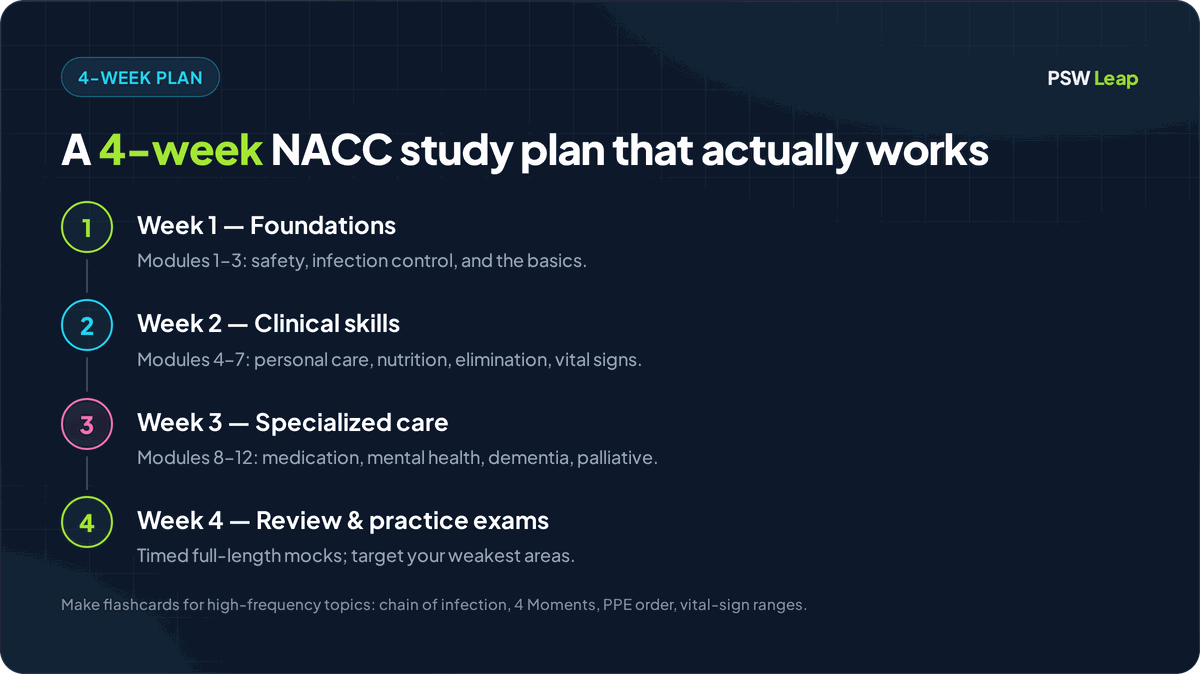
Use the NACC PSW exam guide to confirm what the examination means, the exam-format guide for details that require current verification, and the PSW study schedule to organize your review. Keep one reliable study plan rather than collecting dozens of unverified answer sheets.
Frequently Asked Questions
Do not assume they are official. Unless NACC or your college identifies the material as official, treat it as third-party practice. Ethical providers should say that their questions are original and not copied from a live exam.
NACC's student exam-system walkthrough (January 2025 edition) shows the final exam as 200 questions in 150 minutes, written at the college campus with a college proctor, and NACC's student FAQ lists the 2.5-hour length (nacc.ca, checked September 8, 2026). Neither source publishes a pass mark, so confirm that and your sitting details with your college. PSW Leap mock exams use 200 questions in 2.5 hours as our own practice setting.
No. Memorizing letters does not teach you how to handle a new scenario. Explain the principle behind the best answer and why the other choices are less appropriate.
No single statement covers every Ontario pathway. The NACC final examination applies within the NACC program described by NACC. Ask your college or program contact what applies to you.
No. Practice questions can help you retrieve information, find weak areas, and rehearse decision-making, but they cannot guarantee an exam outcome.
Practise for understanding, not for a leaked answer key
The best NACC PSW exam questions and answers help you think more clearly, not memorize someone else's claims about a confidential test. Choose transparent, original practice material; verify current exam details with your college; and review the reasoning behind every answer.
When you are ready for structured preparation, explore PSW Leap's exam-prep tools and use the same retrieve-review-retest method after each study session.
PSW Leap is an independent NACC PSW exam-prep platform for Ontario candidates. We are not affiliated with NACC, and NACC exam content and format are set by NACC and can change—confirm current requirements with your training program or member college. These are practice questions for learning, not a copy of the exam. Always follow your training, your client's care plan, and your employer's policies on the job.
Written by Shashank Jha
Founder, PSW Leap
Shashank Jha is the founder of PSW Leap. He built this platform after going through the NACC exam prep process himself, to help fellow students study smarter with practice questions organized around the NACC PSW curriculum.
He's also the author of PSW Exam Success: The Ultimate Prep Book — the 455-page paperback PSW Leap grew out of.
Learn more about PSW LeapPSW Leap
Practice smarter for the NACC exam. 2,500 questions. Detailed rationales. $29.99 CAD one-time — everything included.
Try 10 free questions →No account needed. Ready for the full bank? Create your account.