PSW Placement Tips — How to Succeed on Your Clinical Placement
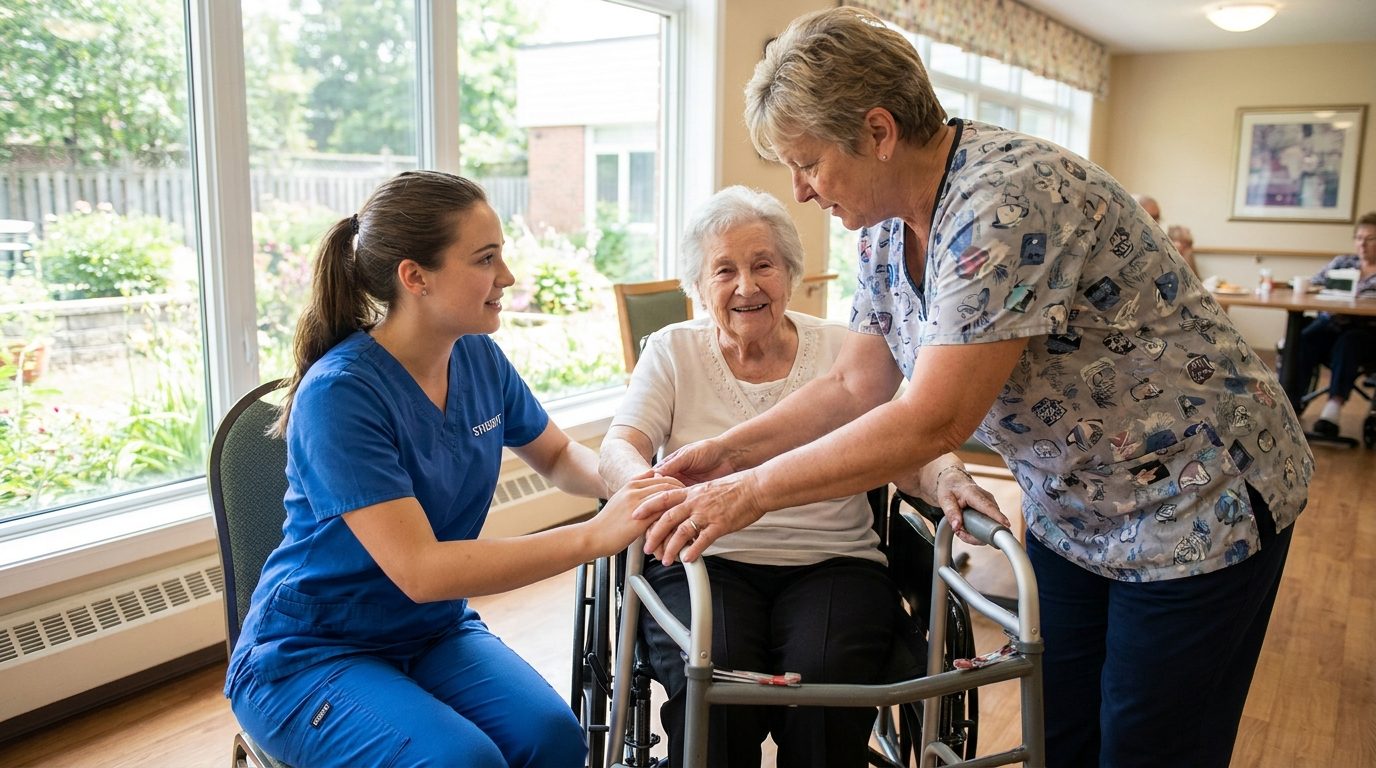
Placement Is Where It Gets Real
Your PSW clinical placement is the most important part of your training. It is where everything you learned in the classroom — personal care techniques, IPAC protocols, communication skills, vital signs — gets tested with real clients in real healthcare settings.
It is also, for most students, the most nerve-wracking part. You are walking into a working facility as a learner, surrounded by experienced staff, and expected to provide hands-on care to people who depend on you. That is a lot of pressure.
But here is what experienced PSWs and clinical instructors will tell you: placement is not about being perfect. It is about being prepared, being willing to learn, and being safe. This guide gives you practical strategies for all three.
What to Expect on Your First Placement
Most Ontario PSW programs include two placement blocks — typically one in a long-term care or retirement home and one in a community or home care setting. Total placement hours usually range from 300 to 600 hours, depending on your college.
Here is what a typical day might look like in a long-term care placement:
- Morning shift (0700–1500): Arrive, get report from the overnight staff, begin morning care routines (assisting residents with bathing, dressing, grooming, toileting), help with breakfast service, document intake, assist with mobility and activities, monitor residents throughout the shift, and complete documentation.
- You will be paired with a preceptor — an experienced PSW or nurse who supervises your work, demonstrates techniques, and provides feedback. Early in your placement, you will mostly observe and assist. As you progress, you will take on more independent responsibility.
- Your clinical instructor from your college will visit the placement site regularly to observe your performance, review your documentation, and evaluate your competencies.
The first few days will feel overwhelming. That is normal. Every PSW who has ever worked in healthcare felt the same way on day one of their placement.
How to Prepare Before Day One
Preparation reduces anxiety and sets you up for a strong start.
Review Your Clinical Skills
Before your first shift, review the skills you learned in lab:
- Proper handwashing and the 4 Moments of Hand Hygiene
- Bed-making (occupied and unoccupied)
- Bathing techniques (bed bath, tub bath, shower)
- Safe transfers (wheelchair, bed, toilet) and proper body mechanics
- Vital signs measurement (temperature, pulse, respiration, blood pressure)
- Positioning and turning for clients with limited mobility
- Peri-care and incontinence management
You do not need to memorize every step perfectly — your preceptor will guide you. But having a solid foundation means you can focus on the client rather than scrambling to remember what comes next. If you want to review clinical concepts, our IPAC guide and vital signs reference are good refreshers.
Know Your Scope of Practice
Understanding what you can and cannot do as a PSW student is critical. You are not a regulated health professional. You work under supervision and within the boundaries defined by your program, your preceptor, and the facility's policies.
When in doubt about whether a task is within your scope, ask before acting. It is always better to check than to do something you should not. For a detailed overview, see our PSW scope of practice guide.
Pack Your Essentials
Prepare your bag the night before your first shift:
- Clean, wrinkle-free uniform (as specified by your program)
- Comfortable, closed-toe, non-slip shoes (no canvas, no open backs)
- Watch with a second hand (for counting pulse and respirations — many facilities do not allow phones on the floor)
- Small notepad and pen
- Stethoscope and blood pressure cuff (if required by your program)
- Snacks and water — you will be on your feet for hours
- Your student ID and any required facility access badges
Leave at home: Strong perfume or cologne, excessive jewellery, long acrylic nails, and your phone (keep it in your locker).
Building Relationships With Staff and Clients
Your clinical skills will get you through placement. Your relationships will determine whether you thrive or merely survive.
With Your Preceptor
Your preceptor is your most important ally. They are giving up part of their workday to teach you, so respect their time and approach the relationship with gratitude and professionalism.
- Be early. Arrive at least 10 minutes before your shift starts, every time.
- Be ready to learn. Ask questions, take notes, and show genuine interest. Preceptors invest more in students who are visibly engaged.
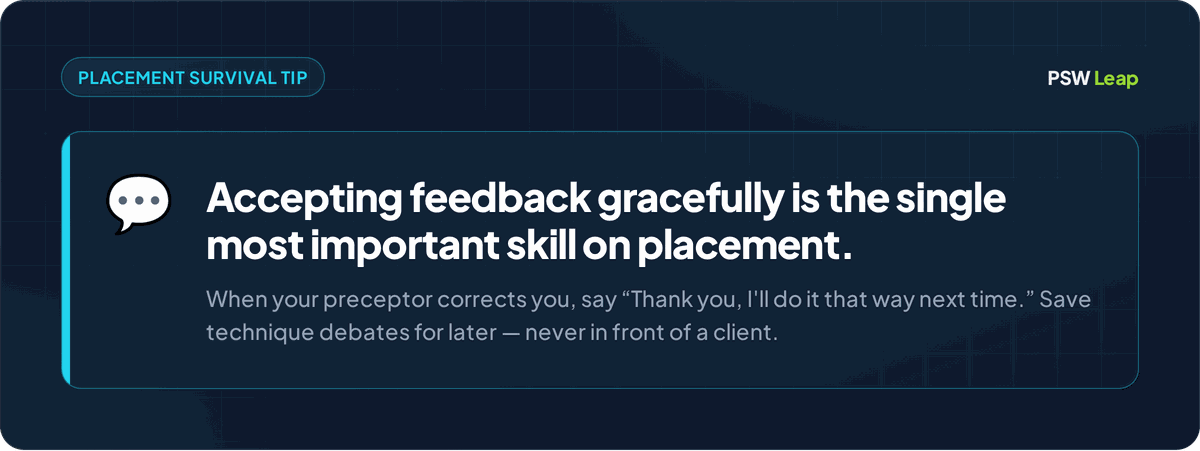
- Accept feedback gracefully. This is the single most important skill on placement. When your preceptor corrects you, say "Thank you, I will do it that way next time" — not "But in class we learned it differently." There is a time to discuss technique variations, and it is not in front of a client.
- Anticipate needs. Once you learn the routine, start anticipating what needs to happen next. If your preceptor is about to do a transfer, have the wheelchair ready. If it is almost mealtime, start setting up. This shows initiative.
With Other Staff
You are a guest in their workplace. Be polite, introduce yourself, and learn people's names. The dietary aide, the housekeeper, and the recreation therapist are all part of the care team — treat them with the same respect you give the nurses.
Do not get involved in workplace gossip or politics. You will hear things. Stay neutral and professional.
With Clients
Remember that you are entering the most personal moments of someone's day. The person you are bathing did not choose to need help. The person you are feeding may be embarrassed. Approach every interaction with dignity, patience, and warmth.
- Introduce yourself every time. "Good morning, Mrs. Chen. My name is [your name], and I am a PSW student. I am going to help you get dressed this morning. Is that okay?"
- Explain what you are doing before you do it. Never start a procedure without telling the client what to expect.
- Honour preferences. If a client likes their coffee with one sugar, remember that. If they prefer to wash their own face, let them. These small details show that you see them as a person, not a task.
- Be patient with clients who have dementia or cognitive impairment. They may not remember you from yesterday. They may resist care. They may say things that are hurtful. None of it is personal. Stay calm, redirect gently, and give them time.
Ready to practice?
Want to strengthen your clinical knowledge during placement? Practise NACC-style questions on the go.
Start free practiceCommon Mistakes New Students Make
Learning from other students' mistakes can save you from making your own.
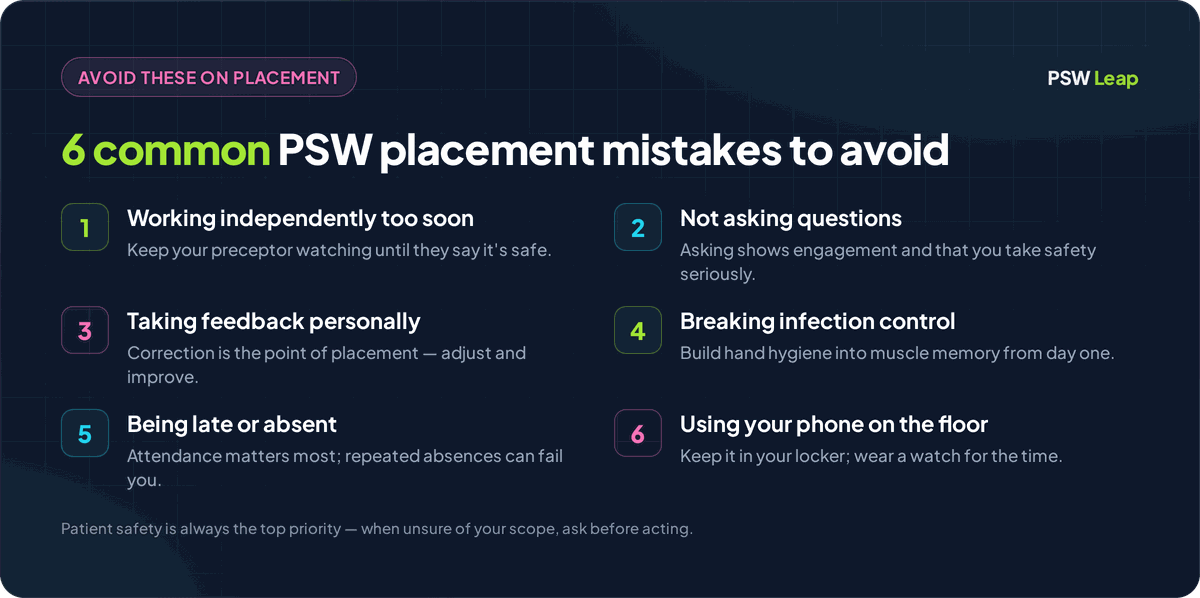
Trying to Do Everything Independently Too Soon
Confidence is good. Overconfidence on placement is dangerous. Even if you feel comfortable with a skill, continue to have your preceptor observe you until they tell you it is safe to work more independently. Rushing ahead before you are ready can put a client at risk — and that is how placement failures happen.
Not Asking Questions
Some students stay quiet because they are afraid of looking incompetent. The opposite is true. Asking questions shows that you are engaged, that you take safety seriously, and that you understand you are still learning. No experienced PSW expects a student to know everything. They expect a student to ask when they do not know.
Taking Feedback Personally
Your preceptor will correct you. Your clinical instructor will point out things you need to improve. This is not a personal attack — it is the entire point of placement. The students who succeed are the ones who listen to feedback, adjust their practice, and demonstrate improvement over time.
Breaking Infection Control Protocols
IPAC violations are taken very seriously. Forgetting to wash your hands before client contact, not wearing gloves when required, or touching your face during care might seem like small oversights — but in a healthcare setting, they can have real consequences. Build hand hygiene into your muscle memory from day one.
Being Late or Absent
Attendance matters more than almost anything else on placement. Healthcare facilities run on schedules, and when a student does not show up, real clients miss their care. If you absolutely must be absent, notify your clinical instructor and the facility as early as possible. Repeated lateness or absences can result in placement failure.
Using Your Phone on the Floor
Most facilities have strict policies about phone use in care areas. Even if you see staff checking their phones, the rules for students are different. Keep your phone in your locker. If you need to check the time, wear a watch.
Handling Difficult Situations
Placement will put you in situations that feel uncomfortable or unfamiliar. How you respond matters.
A Client Refuses Care
This will happen. A client may refuse their bath, their meal, or their medication reminder. Do not force it. Acknowledge their right to refuse, offer to come back later, and report the refusal to your preceptor or the nurse. Document what happened. Client autonomy is a core principle of person-centred care.
You Witness Something That Concerns You
If you see a staff member treating a client roughly, hear a conversation that makes you uncomfortable, or notice something that seems unsafe, talk to your clinical instructor. You are not expected to confront staff or resolve the situation yourself. But you are expected to report it through the proper channels. Your program will guide you on the process.
You Make a Mistake
You will make mistakes. The critical thing is what you do next: acknowledge the mistake immediately, report it to your preceptor or clinical instructor, and learn from it. Trying to hide a mistake is far worse than the mistake itself. Transparency and accountability are what employers look for in PSW candidates, and your preceptor will remember how you handled your errors long after they forget what the errors were.
You Feel Overwhelmed
Placement can be emotionally and physically exhausting. If you are struggling — whether it is the physical demands, the emotional weight of caring for people at the end of life, or the stress of being evaluated — talk to someone. Your clinical instructor, your college's counselling services, or a trusted classmate can help. Do not wait until you are at breaking point.
Documentation and Reporting
Documentation is a core PSW competency, and placement is where you learn to do it properly.
- Be objective. Write what you observed, not what you interpreted. "Resident ate 50% of breakfast" — not "Resident did not seem hungry."
- Be timely. Document as close to the event as possible, while the details are fresh.
- Be specific. Include quantities, times, and locations. "Small bruise (approximately 2 cm) noted on left forearm at 0900" is useful. "Noticed a mark on the resident's arm" is not.
- Report changes in client status promptly. If a resident seems more confused than usual, if their vital signs are outside their usual readings (their baseline) or the care plan's parameters, or if they complain of new pain — tell the nurse. Do not wait until the end of the shift.
- Follow the facility's charting system. Whether it is PointClickCare, paper charts, or another system, learn it and use it as instructed.
Getting a Strong Reference
Your placement is also an extended job interview. Many PSW students receive job offers directly from their placement facility, and almost all employers will ask about your placement performance when you apply elsewhere.
Here is how to earn a reference that opens doors:
- Be consistent. Show up on time, every shift, with the same level of effort and professionalism. Consistency matters more than occasional brilliance.
- Show growth. Preceptors want to see that you improve over the course of placement. Take feedback, apply it, and demonstrate that you are progressing.
- Be a team player. Help when it is not "your" client. Offer to assist a colleague who is behind. Volunteer for tasks that need doing.
- Express genuine interest. Ask your preceptor about their career path. Ask questions about the facility. Show that you are not just checking boxes — you are building a future in this field.
- Say thank you. At the end of your placement, write a short, handwritten thank-you note to your preceptor and to the unit. This is a small gesture that people remember.
When you are ready to ask for a reference, approach your preceptor or clinical instructor directly. Let them know which type of setting you are applying to, so they can tailor their reference. Give them your resume (our PSW resume guide can help you get it ready) and a list of your strongest competencies.
Self-Care During Placement
Placement demands a lot from you — physically, mentally, and emotionally. Many students underestimate how tiring it is to be on your feet for eight hours, providing intimate care to people you are still learning to support, while being observed and evaluated.
A few practical suggestions:
- Sleep. This sounds obvious, but shift work disrupts sleep patterns. If you have morning shifts, get to bed early enough to get seven to eight hours. Your clinical performance depends on it.
- Eat properly. Pack nutritious meals and snacks. You cannot provide good care if you are running on coffee and vending machine chips.
- Move your body outside of work. Even a 20-minute walk after a shift helps process the physical and emotional stress of the day.
- Set boundaries with schoolwork. Placement is the priority during placement weeks. If you have other coursework, plan ahead so you are not writing essays at midnight after a 12-hour shift.
- Talk about what you are experiencing. Placement exposes you to illness, suffering, and sometimes death. These experiences affect you whether you acknowledge them or not. Talk to classmates, family, friends, or a counsellor. Processing what you see is not weakness — it is how resilient healthcare workers sustain long careers.
Final Thought
Your PSW placement is not a test you pass or fail on a single day. It is a weeks-long demonstration of your competence, your professionalism, and your character. The clients you care for will remember how you made them feel. Your preceptor will remember your attitude. And the skills you build during these weeks will form the foundation of your entire career.
Show up prepared. Stay humble. Ask questions. Accept feedback. And take care of yourself along the way.
If you want to keep building your clinical knowledge during placement, our free NACC practice questions are designed for exactly that — short, focused review sessions you can fit in between shifts. And when placement is over and it is time to start applying for jobs, our interview prep guide and resume writing guide will help you turn your placement experience into a job offer.
Written by Shashank Jha
Founder, PSW Leap
Shashank Jha is the founder of PSW Leap. He built this platform after going through the NACC exam prep process himself, to help fellow students study smarter with practice questions organized around the NACC PSW curriculum.
He's also the author of PSW Exam Success: The Ultimate Prep Book — the 455-page paperback PSW Leap grew out of.
Learn more about PSW LeapPSW Leap
Practice smarter for the NACC exam. 2,500 questions. Detailed rationales. $29.99 CAD one-time — everything included.
Try 10 free questions →No account needed. Ready for the full bank? Create your account.