NACC Exam Day — What to Expect & How to Prepare
You have spent weeks studying modules, practising questions, and memorizing vital sign ranges. Now exam day is tomorrow — and a completely different kind of anxiety kicks in. Not "do I know the material?" but "what is actually going to happen when I get there?"
This is normal. Most of the stress students feel on exam day has nothing to do with content knowledge. It comes from uncertainty: not knowing how check-in works, what the testing interface looks like, or what happens if you run out of time. Remove the uncertainty and the anxiety drops dramatically.
This guide walks you through the entire exam day experience — from what to bring, to what the online interface looks like, to strategies for staying calm and managing your time. By the time you finish reading this, exam day will feel familiar before it even happens. If you are still fuzzy on the bigger picture, start with our guide to what the NACC PSW exam is and its 2026 dates, then come back here for the exam-day playbook.
Short answer (checked September 11, 2026): You write the NACC final on NACC's NOEL platform at your college campus or training location, with a college proctor and Proctorio monitoring. It is 200 questions in 150 minutes, no devices or paper are allowed in the room, and results reach your college typically within five business days.
Sources: NACC's student exam-system walkthrough (PDF) and college/proctor walkthrough (PDF) (January 2025 editions) and the NACC student FAQ, all checked September 11, 2026. Procedures can change and your college gives the current exam-day instructions. PSW Leap is not affiliated with NACC.
How do you book the NACC PSW exam?
You do not register for the NACC final yourself. NACC's college/proctor walkthrough shows the college creating the sitting on NACC's NOEL system, receiving login codes for each student and signing students in on campus with the college's school code (checked September 11, 2026). Ask your program coordinator for your date and window. If you need an accommodation, the walkthrough says your college must request it on your behalf before your first attempt, and writing at a different campus needs NACC's approval in advance.
What to Bring (and What to Leave Behind)
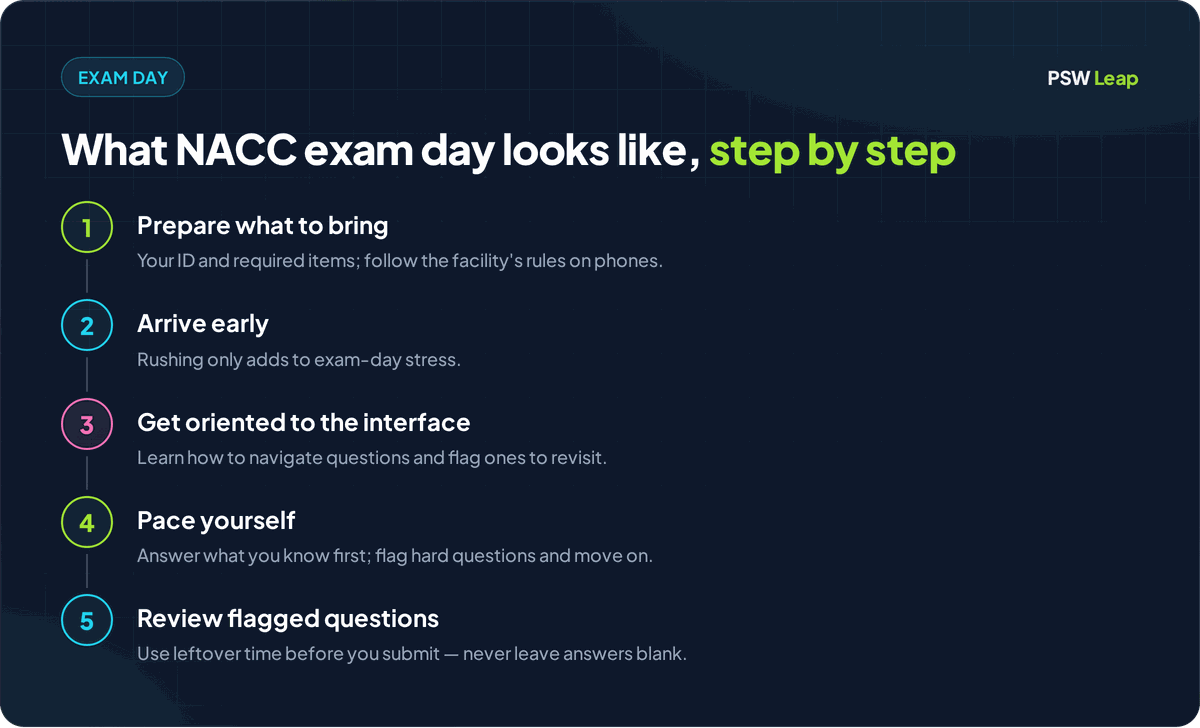
The night before your exam, pack everything you need so you are not scrambling in the morning. Here is your checklist.
Bring
- Photo ID — mandatory. NACC's student walkthrough says results are not released without student photo ID and that failing to present it at the start delays your results (checked September 11, 2026). Your college tells you which ID it accepts; make sure the name matches your college registration exactly.
- Whatever your college asks for — your college creates the sitting and the proctor signs you in, so ask your coordinator whether you need anything beyond ID.
- A water bottle — for before and after; ask your proctor about the room's policy, because you cannot leave your seat during the exam.
- A light snack — for before the exam. Avoid heavy, greasy food that will make you sluggish.
- Nothing electronic — NACC bans phones, smart watches, tablets, headsets and earbuds in the exam room, and the NOEL timer on screen counts down from 150 minutes, so you do not need a watch.
Leave Behind
- Textbooks, notes, flashcards, paper and pens — the exam is closed-book, and NACC's student walkthrough lists reference materials, papers, books, pencils and pens among prohibited items (checked September 11, 2026).
- Your phone, smart watch and every other device — the walkthrough says not to bring any electronic devices into the exam, including cell phones, smart watches, tablets, translators, headsets and earbuds. Leave them with your bag.
- Other people's stress — seriously. If classmates are panicking in the waiting area, step away from the group and run through your own mental notes. Other people's anxiety is contagious and unhelpful.
What Happens When You Arrive
NACC's student walkthrough says every NACC final is written at the college campus or the college's registered training location, with a representative of the college acting as proctor (checked September 11, 2026). Here is how the day typically unfolds; your college gives you the specifics.
Arrival and Check-In
Arrive when your college tells you to, and give yourself at least 15 to 20 minutes for sign-in and the Proctorio setup. Ask your college about its late-arrival policy in advance. When you arrive, you will typically:
- Store your bag, phone and every other device in the area the college designates
- Present your photo ID to the proctor
- Be signed into NOEL by the proctor with your college's school code and your login codes
- Run Proctorio's setup on the exam computer: show your photo ID to the camera, complete the webcam and system check, and sign the Proctorio terms and privacy agreement
- Click "Exam" when the proctor tells you to — once you start, do not log out, because leaving counts as one of your three attempts
The Testing Environment
The exam is computer-based. You will sit at a workstation with a monitor, keyboard, and mouse. The room is typically quiet and supervised. You will not be able to communicate with other test-takers during the exam.
Some important things to know about the environment:
- Proctorio provides on-screen quiz tools such as a calculator and a whiteboard; paper, pens and pencils are on NACC's prohibited list, so do your working on screen (student walkthrough, checked September 11, 2026).
- If you navigate away from the exam screen, NOEL shows a "click here to resume" prompt: if you do not resume within 2 minutes you are removed from the exam and it counts as one of your three attempts (student walkthrough, checked September 11, 2026). If the screen freezes or anything else goes wrong, tell the proctor immediately instead of trying to fix it yourself.
- Stay seated and keep your eyes on the screen for the whole exam. NACC's walkthrough says not to get up or leave your seat and to speak only to the college proctor, and only about lighting or technical issues, so use the washroom before you sign in.
What the Online Testing Interface Looks Like
The exam runs on NACC's NOEL platform with Proctorio monitoring. NACC's student walkthrough (January 2025) shows the screens you will see (checked September 11, 2026).
What you will typically see on screen:
- A timer — it starts at 150 minutes (2.5 hours) and counts down to 0
- A progress line — showing how many of the 200 questions you have answered
- The question stem — the scenario or question text
- Four answer options — labelled A, B, C, D. You click to select your answer.
- Navigation buttons — "Next" to move forward, "Previous" to go back, and sometimes a "Flag" or "Mark for Review" button
The "Flag for Review" button is your best friend. If you are unsure about a question, flag it and move on. You can come back to flagged questions at the end if time permits. This is far better than sitting on a difficult question for five minutes while easier questions wait ahead.
Time Management During the Exam
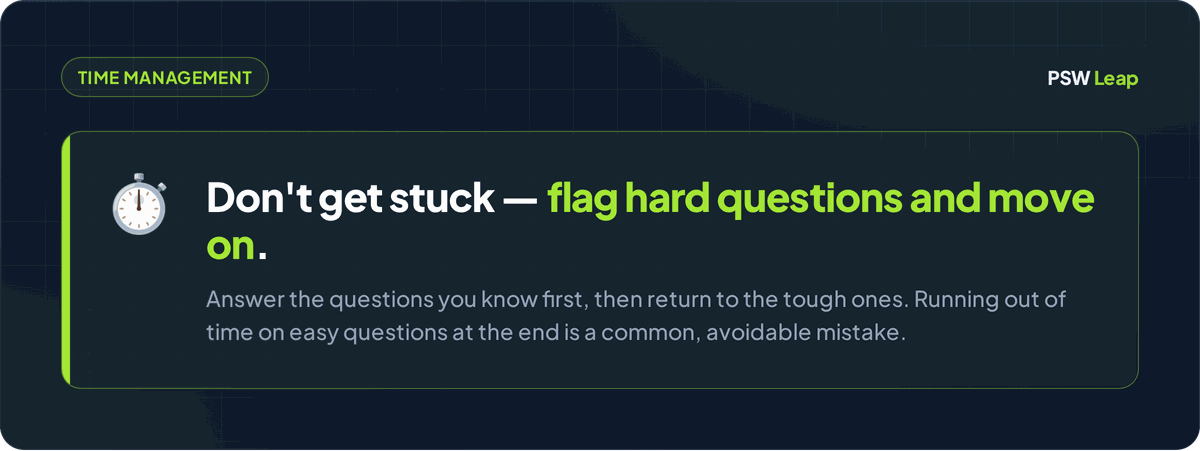
Time management is one of the most underrated exam skills. Students who know the material but manage time poorly can still fail. Here is how to stay on track.
The First-Pass Strategy
This is the single most effective time management technique for multiple-choice exams:
- First pass: Go through every question in order. Answer the ones you are confident about immediately. Flag anything you are unsure about and move on. Do not let any single question hold you up on this pass; you can come back to it.
- Second pass: Return to your flagged questions. With the pressure of the "easy" questions behind you, you can give these your full attention. Often, a later question will trigger a memory that helps you answer an earlier one.
- Final sweep: In the last few minutes, check that every question has an answer. Neither NACC's student FAQ nor its exam-system walkthrough publishes scoring rules, so unless your college tells you otherwise treat a blank as a lost mark and never leave a question unanswered.
Pacing Guidelines
NACC's student walkthrough gives you 150 minutes for 200 questions (checked September 11, 2026), which is 45 seconds per question on average; the full NACC PSW exam format, timing and scoring guide covers the rest of the packet. Use these benchmarks:
- Quick questions (15-30 seconds): You know the answer immediately. Select it and move on.
- Standard questions (30-45 seconds): You need to read the scenario and eliminate options. This is most questions.
- Difficult questions (flag and return): If a question still has no clear answer after you have read it carefully, flag it and move on — you can return to it on your second pass.
This approach ensures you never waste time on a hard question while easy marks go unanswered at the end.
During your exam, you encounter a question you are unsure about. You have been reading it for over a minute. What is the best strategy?
Strategies for Staying Calm
Some anxiety before an exam is normal and even helpful — it keeps you alert. But too much anxiety impairs your ability to think clearly, read carefully, and apply the reasoning skills you have been practising. Here are strategies that actually work.
Before the Exam
- Sleep. This is not optional. A full night of sleep does more for your exam performance than two extra hours of cramming. Your brain consolidates memories during sleep. Studying until 2 AM and showing up exhausted is a net negative.
- Eat a proper breakfast or meal. Your brain runs on glucose. A balanced meal with protein, complex carbohydrates, and some healthy fat will keep your energy stable. Avoid a sugar-heavy breakfast that will cause a crash mid-exam.
- Arrive early. Rushing in with minutes to spare puts your nervous system into fight-or-flight mode before you answer a single question. Arriving with 15 to 20 minutes in hand gives you time to settle in before the proctor signs you in.
During the Exam
- Box breathing. If you feel panic rising, try this: breathe in for 4 counts, hold for 4 counts, breathe out for 4 counts, hold for 4 counts. Repeat three times. This activates your parasympathetic nervous system and physically calms you down.
- Use the first-pass strategy. Answering easy questions first builds momentum and confidence. By the time you return to the hard ones, you have already banked a large portion of your marks.
- Ignore what other people are doing. If someone finishes early and leaves, it does not mean they did well. It might mean they rushed. Stay focused on your own screen and your own pace.
- Read every question as if it is the only one. Do not let a difficult question contaminate the next one. Each question is independent. Take a breath between questions if you need to reset.
You are halfway through the exam and realize you have spent too much time on the first 60 questions. You still have 140 questions left with less than half the time remaining. What should you do?
What to Do If You Run Out of Time
If you are running low on time and still have unanswered questions, do not panic. Here is your emergency protocol:
- Stop working on your current question. Select your best guess and move on.
- Rapidly answer every remaining question. Read the question stem, identify any obviously wrong options, and select the most likely answer. Even a 30-second read can help you make a better-than-random guess.
- Never leave a question blank. Neither NACC's student FAQ nor its walkthroughs publish scoring rules, so unless your college tells you otherwise treat a blank as a lost mark; a best guess among four options can still earn it. If time expires first, NOEL logs you out and marks the exam complete with whatever you have answered.
The first-pass strategy described above is specifically designed to prevent this situation. If you use it, you should reach the end of the exam with time to spare for your flagged questions.
When do you get your NACC PSW exam results?
Once you submit your exam, you are done. The feeling of relief is enormous — enjoy it. Here is what happens next:
- Results timeline: NACC's student walkthrough says results are provided to your college typically within five business days, and asks students not to call NACC for results (checked September 11, 2026). Your college tells you how and when you receive yours. Neither the walkthrough nor the student FAQ publishes a pass mark.
- If you pass: Congratulations. You are now a NACC-certified PSW. Your certification opens doors to employment in long-term care homes, home care agencies, hospitals, and community settings across Canada. Check out our guide on PSW career paths to explore your options.
- If you do not pass: It is not the end. NACC allows three attempts in total, all within 12 months of successfully completing your practicum (college/proctor walkthrough, checked September 11, 2026), and your college arranges the next sitting. Read our guide on what to do if you failed the NACC exam for a practical recovery plan.
Your Exam-Day Preparation Checklist
Use this checklist the night before and the morning of your exam:
Night Before:
- Pack your photo ID — NACC's walkthrough says results are not released without it
- Set two alarms (your phone and a backup)
- Lay out comfortable clothing
- Prepare a light breakfast plan
- Do a brief 20-minute review of key mnemonics — then stop studying
- Get to bed at a reasonable time
Morning Of:
- Eat a balanced meal
- Leave early — arrive when your college tells you, with 15 to 20 minutes to spare for sign-in and the Proctorio setup
- Avoid last-minute cramming in the parking lot (it increases anxiety more than it helps)
- Take three deep breaths before you walk in
During the Exam:
- Use the first-pass strategy: confident answers first, flag the rest
- Do not let any single question hold you up during your first pass — flag it and come back to it
- Use box breathing if anxiety spikes
- Never leave a question blank — unless your college says otherwise, treat a blank as a lost mark
You have done the preparation. Now trust it. For a complete study plan to make sure you are fully ready, read our guide to passing the NACC exam and our 4-week study schedule.
Ready to practice?
Build your confidence with hundreds of practice questions before exam day.
Start Practising FreeFrequently Asked Questions
The NACC final is written on NACC's online NOEL exam platform, but not from home: NACC's student walkthrough says all final exams are conducted at the college campus or the college's training location, with a college representative as proctor and Proctorio electronic proctoring (checked September 11, 2026). Your college books the sitting and signs you in.
No. NACC's student walkthrough lists reference materials, papers, books, pencils and pens among the items you cannot bring into the exam, along with phones, smart watches, tablets, headphones and earbuds (checked September 11, 2026). Proctorio provides on-screen quiz tools such as a calculator and a whiteboard, so you do not need paper.
NACC's student walkthrough says that if your time runs out before you submit, you are logged out and the exam is marked as complete, and that it records how many of the 200 questions you have answered (checked September 11, 2026). Neither NACC's student FAQ nor its walkthroughs publish scoring rules, so unless your college tells you otherwise treat a blank as a lost mark and answer every question.
You do not book it yourself. NACC's college and proctor walkthrough shows the college creating the exam sitting on NACC's NOEL system, receiving each student's login codes and signing students in on campus with its school code (checked September 11, 2026). Ask your program coordinator for your exam date and window, and request any accommodation through your college before your first attempt.
NACC's student walkthrough says results are provided to your college typically within five business days, that NACC will not release results to students directly, and that results are not released without photo ID at the exam (checked September 11, 2026). Your college tells you how and when you receive yours. Neither the walkthrough nor NACC's student FAQ publishes a pass mark.
Written by Shashank Jha
Founder, PSW Leap
Shashank Jha is the founder of PSW Leap. He built this platform after going through the NACC exam prep process himself, to help fellow students study smarter with practice questions organized around the NACC PSW curriculum.
He's also the author of PSW Exam Success: The Ultimate Prep Book — the 455-page paperback PSW Leap grew out of.
Learn more about PSW LeapPSW Leap
Practice smarter for the NACC exam. 2,500 questions. Detailed rationales. $29.99 CAD one-time — everything included.
Try 10 free questions →No account needed. Ready for the full bank? Create your account.