I Failed the NACC PSW Exam — Now What? A Re-Taker's Guide

You studied hard. You showed up. You did the exam. And it did not go the way you planned.
If you failed the NACC PSW exam, the first thing you need to hear is this: you are not alone, and this is not the end of your career. NACC's own exam system allows up to three attempts, so a first sitting that does not go to plan is a situation the program is built for. It does not mean you are not cut out for this work. It means you need a different approach — and that is exactly what this guide will help you build.
This post is a practical, honest recovery plan. No shame, no empty encouragement. Just clear steps to help you regroup, study differently, and pass the next time.
Short answer (checked September 11, 2026): NACC's exam-system walkthroughs allow three attempts in total, all within 12 months of successfully completing your practicum, with a training plan required before the third. Arrange each sitting through your college, ask about any fee, and get your results through them. NACC refers students back to their college for every question.
Can you retake the NACC PSW exam, and how many times?
Yes. NACC's college/proctor walkthrough (revised November 2024) says all three of a student's exam attempts must be completed within 12 months of successfully completing their practicum, and that a student writing the third and final attempt must have received additional preparation, including a submitted training plan (college/proctor walkthrough (PDF), p. 6, checked September 11, 2026). The student walkthrough adds that logging out mid-exam counts as one of those three attempts and that results come through your college only (student walkthrough (PDF), pp. 4–5, checked September 11, 2026).
Neither walkthrough nor NACC's student FAQ specifies a waiting period between attempts, a retake fee or a pass mark, and NACC's contact page tells students to take every question to their education institution (checked September 11, 2026). NACC's PSW curriculum page says to speak with your college representative to schedule the exam (checked September 11, 2026). Our student-life hub and NACC exam format breakdown carry the same rules.
Take a Breath — It's Not the End
Right now, you might feel embarrassed, frustrated, or even angry at yourself. Those feelings are completely valid. You invested time, energy, and money into preparing for this exam, and the result was not what you expected.
But here is what is true: not passing an exam is not the same as not being capable. Certification exams are designed to be challenging. They test not just what you know, but how you apply it under time pressure, in scenario-based questions that can be tricky even for strong students.
Your clinical placements, your classroom learning, your ability to care for people — none of that disappears because of one test result. The exam is a checkpoint, not a verdict on your worth as a future PSW.
Give yourself permission to be disappointed. Then, when you are ready, come back to this guide and start building your plan.
Why Students Don't Pass (And Why It's Normal)
Before you can fix your approach, you need to understand what went wrong. Here are the most common reasons students do not pass the NACC exam — and none of them mean you are a bad student.
1. Exam Anxiety Took Over
You may have known the material but froze during the exam. Test anxiety is real, and it affects your ability to think clearly, read questions carefully, and manage your time. If you felt panicked or rushed, anxiety may have been the main issue — not your knowledge.
2. Studying by Re-Reading Instead of Practicing
This is the single most common mistake. Many students spend weeks re-reading notes, highlighting textbooks, and reviewing slides. It feels productive, but it is a passive learning method. The NACC exam tests application — can you take what you know and use it in a real scenario? Re-reading does not build that skill. Practicing with questions does.
3. Poor Time Management During the Exam
NACC's student walkthrough gives you 150 minutes (2.5 hours) for 200 questions (checked September 11, 2026), about 45 seconds a question. If you spent too long on difficult questions at the beginning, you may have rushed through easier questions at the end — or not finished at all. Time management is a skill that needs to be practised before exam day, not figured out during it.
4. Gaps in Specific Topic Areas
Maybe you felt confident in most areas but struggled with certain modules — infection control procedures, medication safety, or dementia care scenarios. If your weak areas happened to be heavily tested, that could have made the difference.
5. Unfamiliarity with the Question Style
The NACC exam uses scenario-based multiple-choice questions. If you studied by memorizing facts but did not practise interpreting scenarios, the question format itself may have been the challenge. Many questions present a situation and ask you to decide what the PSW should do first, next, or most importantly — and that requires a different kind of thinking than simple recall.
The important thing to understand is that all of these are fixable. Every single one. You do not need to become a different person. You need to prepare differently.
Your Step-by-Step Recovery Plan
Here is a concrete, step-by-step plan to move from where you are now to being ready for your next attempt. Follow these in order.
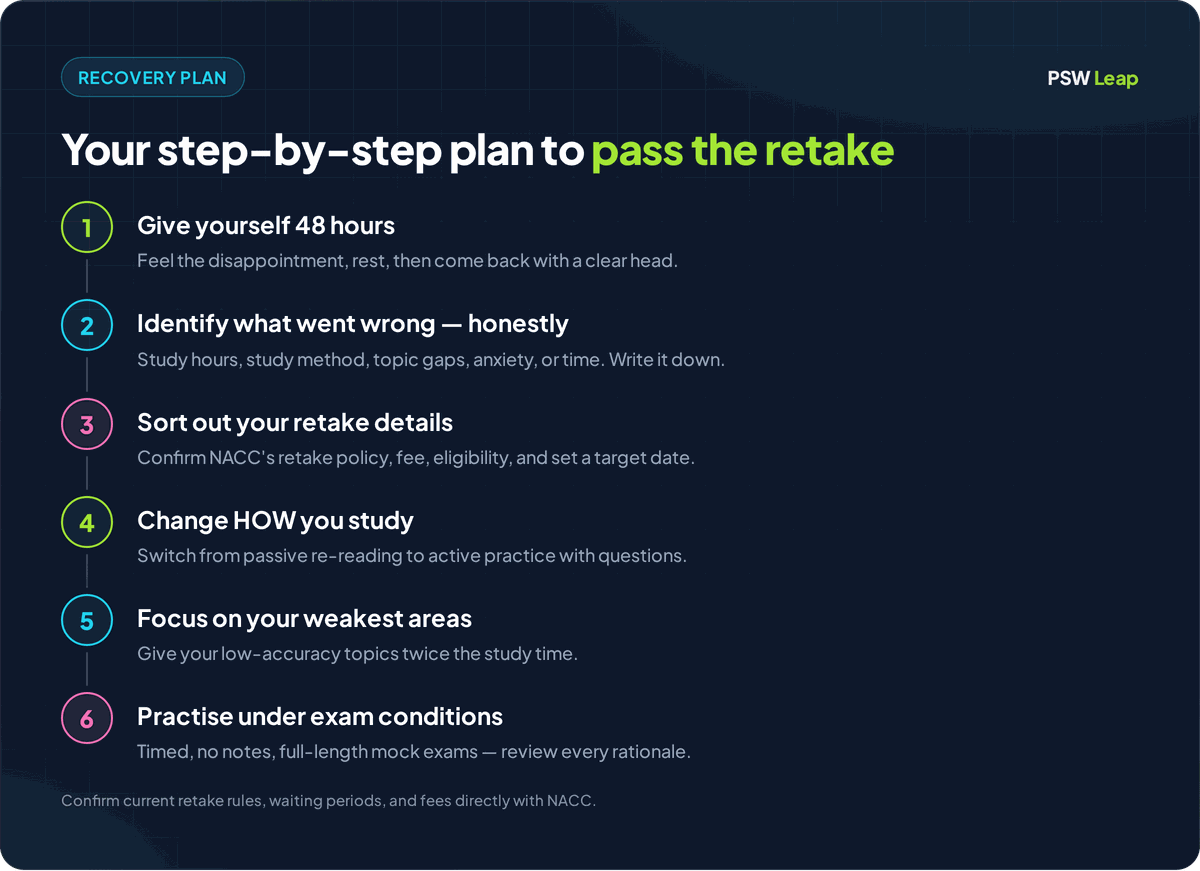
Step 1: Give Yourself 48 Hours to Feel Disappointed
This is not wasted time. This is necessary time. Trying to jump straight into studying again while you are still upset will lead to burnout, frustration, and poor retention.
Take two days. Talk to a friend, a classmate, or a family member. Go for a walk. Do something that has nothing to do with studying. You earned a break, and your brain needs it.
After 48 hours, come back with a clear head.
Step 2: Identify What Went Wrong (Honestly)
This is the hardest step, but it is the most important one. You need to be honest with yourself about what happened. Ask yourself these questions:
- Did I study enough hours? Be honest — did you put in consistent daily study time, or did you cram in the last few days?
- Did I study the right way? Were you actively practising with questions, or mostly re-reading notes and watching videos?
- Did I cover all the topics? Did you skip any modules or skim through areas you found boring or difficult?
- Did anxiety affect my performance? Did you feel prepared going in but struggled to think clearly during the exam?
- Did I run out of time? Were there questions you did not get to, or questions you rushed through?
Write your answers down. Not in your head — actually write them down. This self-assessment becomes the foundation of your new study plan.
Step 3: Get Your Retake Details Sorted
Before you start studying again, make sure you understand the logistics of retaking the exam.
- Ask your college, not NACC. NACC's contact page says students must contact their education institution for any questions, and the student walkthrough says results are available through your college only (NACC contact page, checked September 11, 2026)
- Know the attempt limit. NACC allows three attempts in total, all within 12 months of successfully completing your practicum, and requires additional preparation, including a submitted training plan, before a third attempt (college/proctor walkthrough, p. 6, checked September 11, 2026)
- Ask about the fee and the date. NACC's walkthroughs and student FAQ do not specify a retake fee or a waiting period between attempts; arrange the sitting through your college and ask about any cost, so you can budget for it
- Confirm your eligibility — the 12-month window runs from the successful completion of your practicum, so check the date with your program coordinator
- Set a target date for your next attempt so you have a clear timeline to work toward
Having a specific date gives your study plan structure. Without a deadline, it is easy to keep pushing preparation off.
Step 4: Change HOW You Study (Not Just Study More)
This is where most re-takers go wrong. They do the same thing they did before, just more of it. More re-reading. More highlighting. More hours staring at the same notes.
If your study method did not work the first time, doing more of it will not work the second time.
You need to change your approach. The single most effective change you can make is this: switch from passive review to active practice. We will cover exactly what this means in the next section.
Step 5: Focus on Your Weakest Areas
When you think back to the exam, which topics felt the hardest? Where were you guessing instead of confident?
Make a list of your weak areas. Common ones include:
- Infection prevention and control (IPAC) — chain of infection, when to use which type of PPE, hand hygiene protocols
- Scope of practice — what PSWs can and cannot do, when to report to a supervisor
- Medication safety — the rights of medication administration, what is within PSW scope
- Dementia and mental health care — communication strategies, responsive behaviours, person-centred approaches
- Vital signs — normal ranges, what to report, how to measure accurately
Your weak areas should get twice the study time as your strong areas. It is tempting to review topics you already know well because it feels good, but your score will improve most by improving where you are weakest.
Step 6: Practise Under Exam Conditions
Before your next attempt, you need to simulate the real exam environment at least three to four times. This means:
- Timed sessions — set a timer and answer questions within the same time limit as the real exam
- No notes, no pausing — close your textbooks, put your phone away, and work through the questions without stopping
- Full-length practice — do not just practise 10 questions at a time. Build up to full-length mock exams
- Review every answer — after each practice session, go through every question (including the ones you got right) and read the rationale
This builds two critical skills: time management and confidence. By exam day, the format should feel familiar, and you should know your pacing.
Study Differently, Not Harder
This section is the heart of this guide. If you take one thing away from this entire post, let it be this: the way you study matters more than how many hours you study.
Passive Study vs. Active Practice
Here is the difference:
| Passive Study | Active Practice |
|---|---|
| Re-reading notes | Answering practice questions |
| Watching lecture recordings | Explaining concepts in your own words |
| Highlighting textbooks | Working through scenario-based problems |
| Copying definitions | Testing yourself without looking at notes |
| Reading summaries | Doing timed mock exams |
Passive study feels productive because you are spending time with the material. But research consistently shows that active recall — forcing your brain to retrieve information — builds stronger, longer-lasting memory than passive review.
Why Practice Questions Are the Best Study Tool
When you answer a practice question, your brain has to do several things at once:
- Recall the relevant knowledge from memory
- Apply that knowledge to a specific scenario
- Evaluate multiple options and decide which is best
- Reason through why the other options are wrong
This is exactly what the NACC exam asks you to do. Every practice question is a mini-rehearsal for the real thing.
When you re-read your notes, your brain only has to recognize information — not retrieve it, apply it, or evaluate it. That is why you can re-read something ten times and still get it wrong on the exam. Recognition is not the same as recall.
How to Use Practice Questions Effectively
Not all question practice is equal. Here is how to get the most out of it:
- Read every rationale — even for questions you answered correctly. The rationale explains the why, which deepens your understanding
- Track your accuracy by topic — if you are getting 90% right on safety questions but 50% on medication questions, you know where to focus
- Do not memorize questions — the point is to understand the underlying concept, not remember the specific answer. The real exam will use different scenarios
- Space it out — practise a little every day rather than doing hundreds of questions in one sitting. Spaced practice builds stronger memory than marathon sessions
- Simulate real conditions — at least once a week, do a timed practice session with no notes
The 70/30 Rule for Re-Takers
As a re-taker, consider spending your study time this way:
- 70% on active practice — answering questions, doing mock exams, explaining concepts out loud
- 30% on targeted review — going back to your notes only for topics where your practice accuracy is low
This is the opposite of what most students do. Most students spend 70% of their time reviewing and 30% practising. Flip it.
Ready to practice?
PSW Leap has 2,500 practice questions with detailed rationales for every answer. If you're studying differently this time, start here.
Start Practicing →Building Confidence for Your Next Attempt
Beyond study strategy, your mindset matters. Here are a few things that can help:
Talk to Other Students
You are not the only person who has been through this. If you have classmates or connections from your PSW program, reach out. Chances are, someone else is in the same situation — and studying together can help both of you.
Set Small, Measurable Goals
Instead of "study everything," set goals like:
- "Complete 30 practice questions on IPAC this week"
- "Score 75% or higher on a timed 50-question practice set"
- "Review all rationales from yesterday's practice session"
Small wins build momentum. Momentum builds confidence.
Manage Test Anxiety
If anxiety was a factor in your first attempt, take it seriously this time:
- Practise breathing techniques — slow, deep breaths can lower your heart rate and help you think more clearly
- Simulate the pressure — the more you practise under timed, exam-like conditions, the less stressful the real exam will feel
- Arrive early on exam day — rushing increases anxiety
- Read each question twice — if you catch yourself speeding through questions, slow down deliberately
Remember Your Why
You chose to become a PSW for a reason. Maybe you want to help people. Maybe you want a stable career in healthcare. Maybe someone in your life inspired you to pursue this path. Whatever your reason, it has not changed.
One exam result does not define your future. Your response to it does.
Key Takeaways
- Not passing on the first attempt is built into the system — NACC allows up to three attempts within 12 months of your practicum, and one result says nothing about your ability to be an excellent PSW
- Identify what went wrong honestly — whether it was study method, time management, anxiety, or weak topic areas, you cannot fix what you do not acknowledge
- Change your study method, not just your study hours — switch from passive re-reading to active practice with questions and mock exams
- Focus on your weakest areas — your score improves most where you currently score lowest, so give those topics extra attention
- Simulate exam conditions — practise under timed, no-notes conditions so the real exam feels familiar and manageable
You have already proven you can commit to a program and complete clinical placements. You have the knowledge — now you need the right strategy to show it on exam day. Your next attempt can be different, and this time, you will be ready.
For a complete study strategy, see our guide to passing the NACC PSW exam. If you need help building a study schedule, check out our PSW study schedule guide. And if you want to understand the exam structure in detail, read about how the NACC exam is structured.
Frequently Asked Questions
Yes. NACC's exam-system walkthroughs (January 2025 editions) allow three attempts in total, all within 12 months of successfully completing your practicum, and require extra preparation, including a submitted training plan, before the third and final attempt (nacc.ca, checked September 11, 2026). Arrange the sitting through your college and ask about any fee.
NACC's exam-system walkthroughs and student FAQ do not specify a waiting period between attempts (checked September 11, 2026). One published limit is that all three attempts must be completed within 12 months of successfully completing your practicum. Arrange the sitting through your college, and ask your program coordinator how soon you can rebook.
NACC's student FAQ and exam-system walkthroughs do not publish pass or fail rates (checked September 11, 2026). NACC's exam system allows up to three attempts in the program, so one result does not end your path. What matters is how you prepare for your next try.
Written by Shashank Jha
Founder, PSW Leap
Shashank Jha is the founder of PSW Leap. He built this platform after going through the NACC exam prep process himself, to help fellow students study smarter with practice questions organized around the NACC PSW curriculum.
He's also the author of PSW Exam Success: The Ultimate Prep Book — the 455-page paperback PSW Leap grew out of.
Learn more about PSW LeapPSW Leap
Practice smarter for the NACC exam. 2,500 questions. Detailed rationales. $29.99 CAD one-time — everything included.
Try 10 free questions →No account needed. Ready for the full bank? Create your account.