10 Common NACC Exam Mistakes (And How to Avoid Every One)
You have studied for weeks. You know the material. You walk into the exam feeling prepared — and then the results come back lower than expected. What happened?
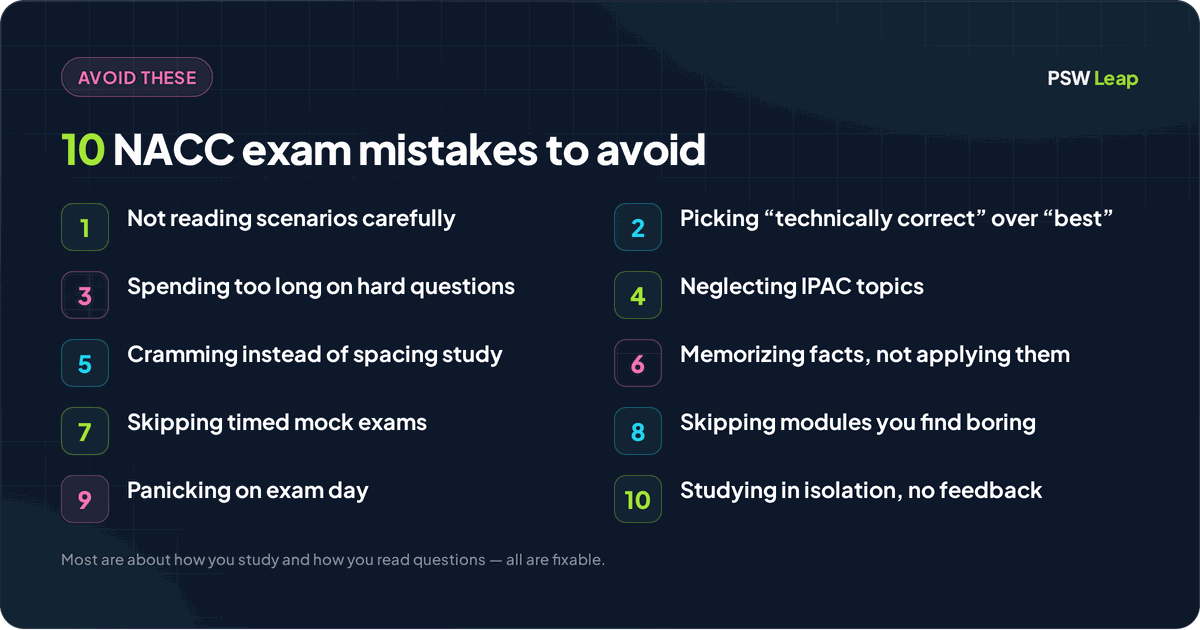
Sometimes the problem is not a lack of knowledge but a pattern of avoidable mistakes that quietly cost marks across the entire exam. These are not obscure pitfalls, and every single one of them is fixable once you know what to watch for.
This guide covers ten common mistakes that can cost you marks on the NACC PSW certification exam. For each one, we explain why it costs you marks and give you a concrete strategy to avoid it. If you are new to the exam itself, our guide to what the NACC PSW exam is and its 2026 dates covers the fundamentals first. And if you are still building your study plan, start with our complete guide to passing the NACC exam and come back here to fine-tune your approach.
Mistake 1: Not Reading Scenarios Carefully
This mistake is easy to prevent once you slow down. A scenario question might describe a client with specific symptoms, a particular care setting, and a set of circumstances that narrow down the correct response. Miss one detail and you can choose the wrong answer.
Why it costs marks
Scenario questions are designed to test whether you can apply knowledge in context. The details matter. A question about a client who is "confused and restless" requires a different response than one about a client who is "confused and lethargic." Students who skim the scenario and jump to the answer options often pick a response that would be correct in a slightly different situation — but not this one.
How to avoid it
Read every scenario twice before looking at the answers. On the first pass, identify the key facts: Who is the client? What is their condition? What is happening right now? What are you being asked to do? On the second pass, look for qualifying words like "first," "best," "most appropriate," or "immediately." These words tell you the exam is looking for a specific priority, not just any acceptable action. Only then should you read the answer options.
This takes an extra 15-20 seconds per question. That investment pays for itself many times over.
Mistake 2: Choosing "Technically Correct" Instead of "Best"
This mistake can feel unfair. You read a question, evaluate the options, and pick one that is correct — genuinely correct — but it is not the best answer. When a question asks for the best or most appropriate action, that distinction matters.
Why it costs marks
A scenario question can offer four options where two or even three are technically acceptable actions. When it asks for the best or most appropriate response, it is not asking "which of these is wrong?" It is asking "which is the most appropriate response in this specific situation?" If you pick an answer that is safe and reasonable but not the best choice for that situation, it is not the answer the question is looking for.
For example, a question might ask what to do when a client with dementia becomes agitated during a transfer. "Stop the transfer and call the nurse" is a defensible action. But "pause, speak calmly to the client, and try a different approach before escalating" might be the better answer because it honours the client's dignity and promotes independence while still keeping everyone safe.
How to avoid it
Use the DIPPS framework (Dignity, Independence, Preferences, Privacy, Safety) to evaluate every option. When two answers seem equally correct, compare each one against all five principles in that client's situation and choose the one that respects them best — unless the finding or the client's condition needs immediate reporting or emergency action, in which case report or act first. Eliminate any option that forces care on a client who refuses. Our exam format guide covers what NACC's own sources say about the exam.
Mistake 3: Spending Too Long on Hard Questions
You hit a question you are not sure about. You reread it. You reread it again. You eliminate two options but cannot decide between the remaining two. Three minutes pass. Now you are behind schedule, rushing through the next ten questions, and making careless errors on questions you actually know.
Why it costs marks
Time is a finite resource on the NACC exam. Every minute you spend agonizing over one difficult question is a minute you cannot spend on easier questions later in the exam — including the easy one you might rush through and get wrong because you are panicking about the clock.
How to avoid it
Know the average pace. NACC's student exam-system walkthrough gives you 150 minutes for 200 questions (NACC walkthrough PDF, checked September 23, 2026) — about 45 seconds per question on average — and lets you flag a question and come back to it later. So when a question stalls you, make your best guess, flag it, and move on. Once you have completed the rest of the exam, go back to your flagged questions with whatever time you have left. You will often find that the answer comes more easily on a second pass, because your brain has been working on it in the background.
Practise this discipline during your study sessions. Every time you do a timed practice exam, watch your average pace and flag hard questions to come back to instead of getting stuck on them. It will feel uncomfortable at first, but by exam day it will be second nature.
Mistake 4: Neglecting IPAC Topics
Infection Prevention and Control (IPAC) is a foundation that many care tasks rely on, and it is easy to underestimate how much time to spend on it. It is tempting to treat IPAC as "basic" material that does not need much review. That assumption is expensive.
Why it costs marks
IPAC knowledge is not confined to one topic. A question about personal care might test your understanding of when to apply additional precautions. A question about wound care might hinge on the correct PPE sequence. If your IPAC knowledge is shaky, you can lose marks across many topics, not just one.
Make sure you know the chain of infection (all six links), the 4 Moments of Hand Hygiene, the correct order for donning and doffing PPE, the difference between routine practices and additional precautions (contact, droplet, airborne), and WHMIS symbols.
How to avoid it
Dedicate at least two full study sessions to IPAC, even if you feel confident in it. Make flashcards for the chain of infection, the 4 Moments, and the PPE sequence. Test yourself until you can recall them without hesitation. Then, when you encounter IPAC elements in questions about other topics, you will recognize them immediately.
If you want to test your IPAC knowledge right now, try our free PSW practice questions — several of them are IPAC-focused.
Mistake 5: Cramming Instead of Spacing Your Study
The night-before cram session is a tradition for students everywhere. It is also one of the least effective ways to prepare for the NACC exam. Cramming creates the illusion of knowledge — you recognize terms when you see them, but you cannot apply them under pressure in a scenario-based question.
Why it costs marks
Cramming fills your short-term memory with facts, but NACC's student FAQ says the final exam "tests the students on all components of the program in detail" (NACC's student FAQ, checked September 23, 2026) — far more than one late night can hold. Scenario questions also require you to connect concepts across topics, weigh competing priorities, and choose the best action in a new situation. That kind of thinking requires deep understanding, not surface-level recognition.
Students who cram also tend to arrive at the exam exhausted and anxious, which further degrades their performance. Sleep deprivation impairs the kind of reasoning scenario questions ask for.
How to avoid it
Start studying at least four weeks before your exam date. Spread your study across daily sessions of 60-90 minutes rather than marathon sessions of four or more hours. This approach — called spaced repetition — forces your brain to retrieve information repeatedly over time, which strengthens long-term retention dramatically.
If you are not sure how to structure your study time, our PSW study schedule gives you a week-by-week plan, topic by topic.
Mistake 6: Memorizing Facts Instead of Applying Them
You can define "aspiration" perfectly. You know the IDDSI framework levels. You can list the six links in the chain of infection from memory. But when a scenario question asks what you should do when a client with dysphagia begins coughing during a meal, you freeze — because you have memorized the what but not the what-to-do.
Why it costs marks
Knowing definitions and lists is necessary but not sufficient. Scenario questions ask you to take that knowledge and use it to make safe, client-centred decisions in realistic situations — and so does the job. Practise applying what you know, not just recalling it.
How to avoid it
For every concept you study, ask yourself: "How would this show up in a real care situation? What would I do?" Then practise answering scenario-based questions that force you to apply the concept. When you review a question you got wrong, do not just memorize the correct answer — understand the reasoning behind it. What principle was being tested? What made the correct option better than the others?
This shift from passive memorization to active application is the single most important change you can make to your study approach.
Mistake 7: Not Practising with Timed Mock Exams
You have been studying consistently. You feel confident about the material. But you have never sat down and completed a full-length practice exam under timed conditions. On exam day, you discover that knowing the material and performing under time pressure are two very different things.
Why it costs marks
The NACC exam has a fixed time limit. If you have never practised working within that limit, you do not know your natural pace. You do not know which question types slow you down. You do not know how fatigue affects your accuracy in the final third of the exam. All of these factors cost marks, and none of them are about knowledge — they are about exam-taking skills that can only be developed through practice.
How to avoid it
Complete at least two full-length timed practice exams before exam day. Simulate real conditions as closely as possible: sit at a desk, close all other tabs, set a timer, and do not pause until you are finished. After each practice exam, review every question you got wrong and every question you were unsure about, even if you guessed correctly.
Timed practice exams also reveal your weak topics. If you consistently lose marks on dementia care or medication safety questions, you know exactly where to focus your remaining study time. Start building your exam stamina with our free practice questions.
Mistake 8: Skipping Topics You Find Boring
Everyone has a topic they dread. For some students, it is body systems and medical terminology. For others, it is nutrition and hydration. The temptation is to spend minimal time on these topics and focus on the ones you find more interesting or more "important."
Why it costs marks
NACC's student FAQ says the final exam tests students on all components of the program in detail, so every part of your program is testable. There is no guarantee that the topic you find boring will be a small part of your exam. If nutrition and hydration is your weakest area, every question on it is a mark at risk. The exam does not care about your preferences.
Skipping topics also creates blind spots that affect your performance on scenario questions that combine several topics. A question about personal care might require knowledge of skin integrity, IPAC, and nutrition simultaneously. Weakness in any one of those areas can lead you to the wrong answer.
How to avoid it
Allocate study time to every topic, even the ones you dislike. You do not need to spend equal time on every topic — the weak areas your practice results reveal deserve more attention. But every topic should get at least one dedicated study session. If you find a topic boring, try studying it with practice questions instead of notes. Active problem-solving is more engaging than passive reading and more effective for retention.
Mistake 9: Panicking on Exam Day
You sit down, read the first question, and your mind goes blank. The question seems harder than anything you studied. Your heart rate spikes. You start doubting everything you know. By the time you settle down — if you settle down — you have wasted precious minutes and made several anxious mistakes on the opening questions.
Why it costs marks
Exam anxiety directly impairs cognitive function. When you are in a panic state, your working memory shrinks, your ability to reason through scenarios drops, and you default to impulsive answers instead of thoughtful ones. The first 10-15 minutes of the exam set the tone for the rest. If you spend those minutes in a state of panic, the damage cascades.
The first few questions on any exam often feel disproportionately hard — not because they are, but because your brain has not warmed up yet. Students who mistake this normal difficulty spike for evidence that they are unprepared can spiral into a full anxiety response that affects their entire exam.
How to avoid it
Build an exam-day routine that minimizes anxiety triggers. Arrive early. Bring whatever identification and materials you need so you are not scrambling. Do not study in the waiting area — at that point, you know what you know.
When the exam begins, take three slow, deep breaths before reading the first question. If the first question is hard, skip it and start with question two or three. Build momentum on questions you feel confident about, then return to the tough ones. Remind yourself that feeling unsure about some questions is normal — it does not mean you are failing.
The best antidote to exam-day panic is preparation. If you have followed a structured study plan and completed timed practice exams, you will walk in knowing that you have done the work. Confidence comes from evidence, not hope. Our complete NACC exam guide walks you through the full preparation process.
Mistake 10: Studying in Isolation Without Feedback
You study alone, answer practice questions alone, and have no way to know if your reasoning is correct until you see the final answer. When you get a question wrong, you read the correct answer and move on. You never investigate why your reasoning was flawed, which means you are likely to make the same error again.
Why it costs marks
Without feedback on your reasoning process, you cannot correct the underlying thinking patterns that lead to wrong answers. You might consistently misapply a principle like scope of practice or client rights without realizing it. Each individual mistake seems like a one-off, but the pattern continues because you never identified the root cause.
How to avoid it
When you review practice questions, do not just check whether you got the right answer. For every question — right or wrong — read the explanation and compare it to your reasoning. If you got the right answer for the wrong reason, that is still a problem. If you got the wrong answer, identify which principle you misapplied or which detail you missed.
Study groups can also help here. Explaining your reasoning to another student forces you to articulate your thinking, which exposes gaps you might not notice on your own. If a study group is not an option, try writing a one-sentence explanation for why each answer is correct or incorrect. The act of putting your reasoning into words makes it more rigorous.
A Quick Checklist Before Exam Day
Before you walk into the NACC exam, run through this list. If you can check every item, you are in strong shape.
- I have studied every part of my program, with extra time on the topics my practice results showed were weakest
- I have completed at least two full-length timed practice exams and reviewed every question I got wrong
- I can apply the DIPPS framework (Dignity, Independence, Preferences, Privacy, Safety) to scenario questions
- I have a time management strategy: an average of about 45 seconds per question (150 minutes for 200 questions), flag and move on, return to flagged questions at the end
- I know the exam format, including the number of questions, time limit, and what to expect from the online interface
- I have an exam-day routine that minimizes anxiety: arrive early, bring required materials, take a few deep breaths before starting
For a full breakdown of the exam structure, read our NACC exam format guide.
The Bottom Line
None of these mistakes are about intelligence or effort. They are about approach. Studying hard is not enough on its own if you study in ways that do not prepare you to apply what you know — reasoning through realistic scenarios and identifying the best action, not just an acceptable one.
The good news is that every mistake on this list is correctable. Read scenarios carefully. Choose best over correct. Manage your time. Cover every topic. Practise under timed conditions. Apply frameworks like DIPPS. And start early enough that you never need to cram.
If you are still building your study plan, start with our guide to passing the NACC exam. If you want to test yourself right now, try our free PSW practice questions. And if you are ready to commit to a structured preparation approach, explore the full PSW Leap question bank — 2,500 exam-style questions with detailed explanations for every answer.
You have put in the work. Now make sure your approach matches your effort.
Written by Shashank Jha
Founder, PSW Leap
Shashank Jha is the founder of PSW Leap. He built this platform after going through the NACC exam prep process himself, to help fellow students study smarter with practice questions organized around the NACC PSW curriculum.
He's also the author of PSW Exam Success: The Ultimate Prep Book — the 455-page paperback PSW Leap grew out of.
Learn more about PSW LeapPSW Leap
Practice smarter for the NACC exam. 2,500 questions. Detailed rationales. $29.99 CAD one-time — everything included.
Try 10 free questions →No account needed. Ready for the full bank? Create your account.