Free NACC Practice Questions on Restraints & Least Restraint (Ontario PSW Exam Prep)
If you are studying for the NACC Personal Support Worker (PSW) exam in Ontario, restraints and the least-restraint principle are a high-yield safety topic — Ontario law tightly limits when a client can be restrained, and the PSW is expected to know exactly where their scope ends. This free practice set gives you real NACC-style questions on the PSW's role with restraints, the least-restraint rule, restraint versus PASD, safe monitoring, and the dangers to watch for, each with a clear answer. Work through them, then keep going with the full question bank at pswleap.com/learn. A quick way to warm up before this set is the free 10-question NACC-style practice test, with an explanation after every answer and no signup.
What does restraint use involve on the NACC PSW exam?
For the exam, restraint use is about protecting the client's safety and dignity by using the least restraint possible — observing, supporting, and reporting, never deciding to restrain or applying a restraint yourself. A restraint is anything that limits a client's free movement or behaviour, whether it is a device, a medication, or a locked space. In Ontario, restraining a client is a controlled action: it requires a physician's order, the client's consent (or the substitute decision-maker's), and a written care plan.
The exam tests it heavily because the PSW is at the bedside every shift, is often first to notice a restrained client is in trouble, and is the one most likely to be pressured into stepping outside their scope. The "right answer" almost always combines trying least-restrictive alternatives first, staying within scope, keeping the client safe and dignified, and reporting to the nurse.
The one rule the exam wants first: a PSW never decides on or applies a restraint
A PSW does not choose to restrain a client and does not apply, adjust, or remove a restraint on their own — full stop. That decision belongs to the care team: a physician orders it, a regulated nurse (RN or RPN) assesses and applies it and oversees the monitoring, and the client or their substitute decision-maker must consent under the Health Care Consent Act, 1996. If a client seems unsafe and no restraint is ordered, the in-scope response is to:
- Try the least-restrictive option first — reposition, redirect, offer the washroom, reduce noise, or stay and reassure.
- Keep the client and others safe while you get help — never leave a client at risk alone.
- Report to the nurse right away so the team can reassess the plan.
When a restraint is already ordered and in the care plan, the PSW's job is the safety and comfort work around it: assist as directed, monitor closely, meet the client's needs, protect their dignity, and report any change.
Quick terms to know: Restraint = anything that limits a client's free movement or behaviour. Least restraint = use the least restrictive measure, only as a last resort. Physical restraint = a device or hold (lap belt, vest, some bed-rail use). Chemical restraint = a medication used to control behaviour. Environmental restraint = limiting where a client can go (a locked unit). PASD = a personal assistance services device that helps with a routine activity of living — a restraint only if its purpose is to limit movement. SDM = substitute decision-maker, who consents when the client cannot.
Free NACC-style practice questions: restraints & least restraint
Each question below mirrors the scenario-based, multiple-choice style of the NACC PSW exam. Try to answer before you read the explanation.
Q1. A client keeps trying to stand from their wheelchair. A coworker says, "Just put a vest on them so they stay put." What should the PSW do?
Answer: Do not apply any restraint — try least-restrictive options and report to the nurse. A restraint needs an order, consent, and a care plan; a coworker's request is none of those. Check for an unmet need (washroom, pain, boredom), reposition or redirect the client, and tell the nurse the client is unsafe so the team can reassess.
Q2. A restraint is already ordered and written in a client's care plan. What is the PSW's role?
Answer: Assist and monitor as the care plan directs — the PSW does not decide on it. The physician ordered it, the nurse assessed and applied it, and the client or SDM consented. The PSW keeps the client safe, checks them frequently, meets their needs, and reports changes.
Q3. A confused client is at risk of falling. Which action best reflects the least-restraint principle?
Answer: Try alternatives first — lower the bed, use a non-slip floor mat, offer toileting, and stay with the client — and report. Least restraint means a restraint is a last resort, used only to prevent serious harm after alternatives have been tried.
Q4. A client uses a wheelchair seatbelt. When is that belt a restraint rather than a PASD?
Answer: When its purpose is to stop the client from getting up, not to keep them safely upright. A personal assistance services device (PASD) helps with a routine activity, such as supporting safe posture. The same belt is a restraint when it is used to limit movement — the difference is the intent, and either way it must be the least restrictive option.
Q5. A PSW hears a coworker suggest giving a client an extra sedative "to keep them calm and still." What kind of restraint is this, and what should the PSW do?
Answer: A chemical restraint — and the PSW does not give or suggest it. Medication used to control behaviour rather than treat a condition is a chemical restraint. A PSW never administers medication; keep the client safe and report the concern to the nurse.
Q6. A client has an ordered lap belt. What must the PSW do while the client is restrained?
Answer: Check the client frequently, release and reposition them regularly per the care plan, and meet their needs. Watch skin, circulation, and breathing, make sure the device has not slipped or tightened, offer toileting and fluids, provide range of motion, and report any problem.
Q7. A PSW finds a client slumped down in their lap belt with the belt riding up toward the chest. What is the safest action?
Answer: Reposition the client to relieve the pressure, stay with them, and call the nurse immediately. A client who slides down in a belt or vest can be strangled or have their breathing blocked — this is an emergency. Get help; do not leave the client.
Q8. A team wants to keep a client who wanders on a locked unit. What is this, and what is the PSW's part?
Answer: This is an environmental restraint, and it is not the PSW's decision. Limiting where a client can go is a restraint that needs the least-restraint rule, an order, and consent. The PSW supports the plan, watches for the unmet need behind the wandering, and reports — they do not lock a client in on their own.
Q9. A family member asks the PSW to "tie Mom into bed at night so she doesn't get up." How should the PSW respond?
Answer: Explain kindly that restraints are a last resort that needs an order, consent, and a care plan — then report the request to the nurse. A PSW cannot restrain a client on a family's request. Talk through least-restrictive options (a low bed, a night light, a toileting routine) and let the care team decide through the proper process.
Q10. After helping with a client who refused care and became unsafe, what should the PSW document?
Answer: The facts, objectively — what happened, what the client did and said in their own words, what the PSW tried, and that it was reported. Avoid labels like "aggressive" or "non-compliant." Clear, objective notes protect the client and the PSW and guide the least-restrictive next step. (See our fall prevention practice questions.)
Common restraint mistakes to avoid on the NACC exam
- Applying a restraint on your own judgement — or because a coworker or family member asks — instead of trying alternatives and reporting. A PSW never decides to restrain.
- Reaching for a device first instead of trying least-restrictive options (repositioning, toileting, redirection, reassurance).
- Giving or suggesting a sedative "to keep a client still" — that is a chemical restraint, and medication is never the PSW's to give.
- Leaving a restrained client unchecked instead of monitoring closely and releasing and repositioning them regularly.
- Treating a wandering or "difficult" client as a behaviour to control instead of an unmet need to investigate.
- Raising full bed rails to keep a client in without an order and care plan — clients are injured climbing over them.
Notice the pattern: the correct option always uses least restraint, stays within scope, keeps the client safe and dignified, and reports.
The restraint facts the NACC exam expects you to know
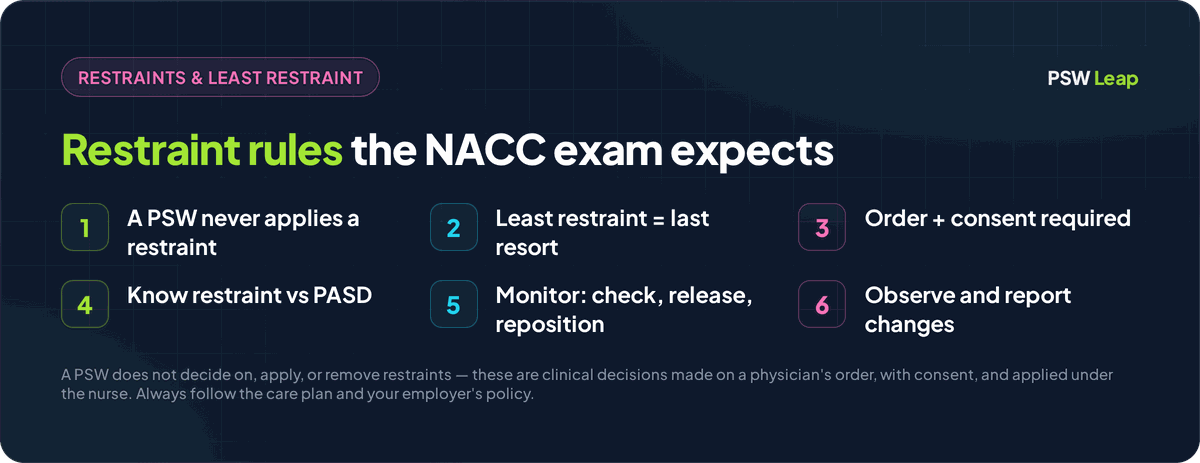
Use these one-line facts as a final review:
- A PSW never decides on, applies, or removes a restraint — that needs an order, consent, and a care plan.
- Least restraint is the rule — a last resort, only to prevent serious harm, after alternatives are tried.
- Three types: physical, chemical, environmental — a PSW applies none of them on their own.
- Restraint vs PASD — same device, different purpose; intent decides, and least restrictive wins.
- Monitor closely — check skin, breathing, and circulation; release and reposition regularly.
- Know the dangers — strangulation, falls, pressure injuries, deconditioning, lost dignity.
- A PSW observes and reports; the team decides — escalate, don't restrain.
Remember: PSW practice in Ontario always follows the client's individual care plan and your employer's policies. This article is exam-prep study material, not medical or legal advice — confirm current requirements with your program and employer.
Practice more free NACC questions
You just answered 10 restraint and least-restraint questions — and the NACC PSW exam spans every module, from safety and client rights to mental health and fall prevention. The fastest way to find your weak spots is to keep practising with instant feedback.
👉 Start practising free at pswleap.com/learn — a large bank of NACC-style questions, full timed mock exams, and a Duolingo-style study path built specifically for Ontario PSW students. No subscription, and you can start with sample questions before you pay.
Closely related topics worth reviewing next: Free NACC Practice Questions on Fall Prevention (least restraint and fall risk go hand in hand) and Free NACC Practice Questions on Dementia Care (where restraint pressure most often comes up).
PSW Leap is an independent NACC PSW exam-prep platform for Ontario candidates. We are not affiliated with NACC. Always follow your training, your client's care plan, and your employer's policies on the job.
Published by PSW Leap
Independent NACC PSW exam prep
PSW Leap articles are written and maintained by the platform's founder, Shashank Jha, and checked against publicly available PSW curriculum standards. Found an error? Email hello@pswleap.com and we'll fix it.
Read our content methodologyPSW Leap
Practice smarter for the NACC exam. 2,500 questions. Detailed rationales. $29.99 CAD one-time — everything included.
Try 10 free questions →No account needed. Ready for the full bank? Create your account.