Free NACC Practice Questions on Dementia Care & Responsive Behaviours (Ontario PSW Exam Prep)
If you are studying for the NACC Personal Support Worker (PSW) exam in Ontario, dementia care is one of the highest-yield clinical topics you can prepare — because PSWs support clients living with dementia on almost every shift, and the exam tests how you respond to confusion, agitation, and responsive behaviours. This free practice set gives you real NACC-style questions on dementia care, responsive behaviours, communication, and the PSW's scope, each with a clear answer and a plain-language explanation. Work through them, check your reasoning, then keep going with the full question bank at pswleap.com/learn.
What is dementia, and why does the NACC PSW exam test it?
Dementia is a progressive loss of memory, thinking, language, and judgment caused by changes in the brain. Alzheimer's disease is the most common type. As dementia advances, a person may become confused about time and place, lose words, and find everyday care frightening or overwhelming. They communicate distress through actions — what the exam calls responsive behaviours.
The NACC PSW exam tests dementia care because Personal Support Workers in Ontario provide most of the hands-on, day-to-day support these clients receive. You are not expected to diagnose dementia, prescribe or give medication, or apply restraints. You are expected to communicate calmly and clearly, recognize the unmet need behind a behaviour, use non-pharmacological, least-restrictive approaches first, keep the person safe and dignified, and report changes to the nurse.
Quick concepts to memorize: Responsive behaviour = communication of an unmet need (the preferred term over "challenging behaviour"). Validation = acknowledge the feeling instead of correcting the fact. Least-restrictive = try the gentlest approach first; restraints and medication are a last resort and a nurse/physician decision. Sundowning = late-day confusion and agitation.
Free NACC-style practice questions: dementia care & responsive behaviours
Each question below mirrors the scenario-based, multiple-choice style of the NACC PSW exam. Try to answer before you read the explanation.
Q1. What is a "responsive behaviour," and what does it tell you?
Answer: A responsive behaviour is the person's way of communicating an unmet need. Wandering, agitation, calling out, resisting care, and repetitive questions all have a trigger — pain, hunger, needing the toilet, fear, boredom, or overstimulation. The NACC exam prefers the term "responsive behaviour" over "challenging behaviour." Your job is to look for the need behind the behaviour, not to control or punish it.
Q2. A client with dementia becomes agitated during personal care. What should the PSW do first?
Answer: Stop, stay calm, and check for the unmet need or trigger. Approach from the front at eye level, use a calm warm tone and short simple sentences, and look for the cause — is the client in pain, needing the toilet, cold, or overwhelmed by noise? De-escalate and gently redirect. Do not argue, rush, or restrain. Report new or ongoing agitation to the nurse.
Q3. A client with dementia insists it is 1985 and asks for her mother. Should the PSW correct her?
Answer: No — use validation, not reality orientation. Arguing with a distressed false belief almost always increases agitation. Acknowledge the feeling first — "You miss your mother — tell me about her" — then gently redirect to a comforting activity. Meeting the person's emotional reality is kinder and far more effective than insisting on the facts.
Q4. The NACC exam asks what to try BEFORE medication for a responsive behaviour. What is the answer?
Answer: Non-pharmacological, least-restrictive approaches — every time. Identify and remove the trigger, use validation and redirection, try familiar music, keep a predictable routine, and meet physical needs like pain relief, toileting, or rest. Medication (including antipsychotics) and any restraint are a last resort decided by the physician or nurse — never the PSW. When an answer choice pairs a non-drug approach against a drug or a restraint, choose the non-drug, least-restrictive option.
Q5. What communication techniques work best with a person who has dementia?
Answer: Approach from the front, get to eye level, and keep it simple and calm. Make eye contact, use the person's preferred name, give one idea at a time in short sentences, and allow extra time to respond. Keep a warm tone — tone is received even when words are lost. Use gestures and visual cues. Avoid quizzing ("Do you remember me?"), arguing, or speaking about the person as if they are not there.
Q6. A client with dementia keeps wandering toward an exit. What is the safest PSW response?
Answer: Walk with the client and gently redirect — do not physically block or restrain. Wandering usually has a purpose: looking for a bathroom, restlessness, or boredom. Keep the environment safe with door alarms, secured exits, and an ID or SafelyHome bracelet, and report the pattern. Physical or chemical restraint is a last-resort, physician-directed measure, not a PSW decision.
Q7. A client becomes much more confused and restless every evening. What is happening, and what can help?
Answer: This is sundowning — late-day confusion and agitation. It tends to appear in the late afternoon and evening. Help by keeping a predictable routine, increasing light in the late afternoon, lowering noise and stimulation, limiting caffeine, encouraging daytime activity, and giving calm reassurance. Report worsening patterns to the nurse so the care plan can be adjusted.
Q8. How should a PSW support a person with dementia at mealtimes?
Answer: Reduce distractions, simplify the task, and watch for swallowing problems. Serve one course at a time, offer simple choices, use verbal cues or hand-over-hand assistance, and allow plenty of time. Keep the client sitting upright, and watch for coughing or holding food in the mouth. Finger foods help clients who can no longer use utensils. Report poor intake or any new swallowing difficulty — see our dysphagia practice questions for more.
Q9. Is it acceptable to restrain or lock in a client with dementia who is agitated?
Answer: No. Restraints are a last resort, require a physician's order, and are never a PSW's decision alone. The guiding principle is least-restrictive: try environmental changes, redirection, and meeting the person's needs first. Improper restraint use is a safety and rights violation. The PSW reports safety concerns and follows the care plan and the employer's restraint policy.
Q10. A family caregiver seems exhausted and short-tempered with a client who has dementia. What is the PSW's role?
Answer: Acknowledge the burnout, share your observations, and report any safety concern. Validate without judgment — "This is hard work; how are you holding up?" — tell the nurse or care team what you have observed, and point the family to respite resources such as adult day programs or the Alzheimer Society. If you ever suspect abuse or neglect, remember that a PSW in Ontario is a mandatory reporter and must tell a supervisor immediately.
The dementia care facts the NACC exam expects you to know
Use these one-line facts as a final review — they are the kind of definitive statements the exam rewards:
- A responsive behaviour communicates an unmet need — it is the preferred NACC term over "challenging behaviour."
- Non-pharmacological, least-restrictive approaches come first — always, on the NACC exam.
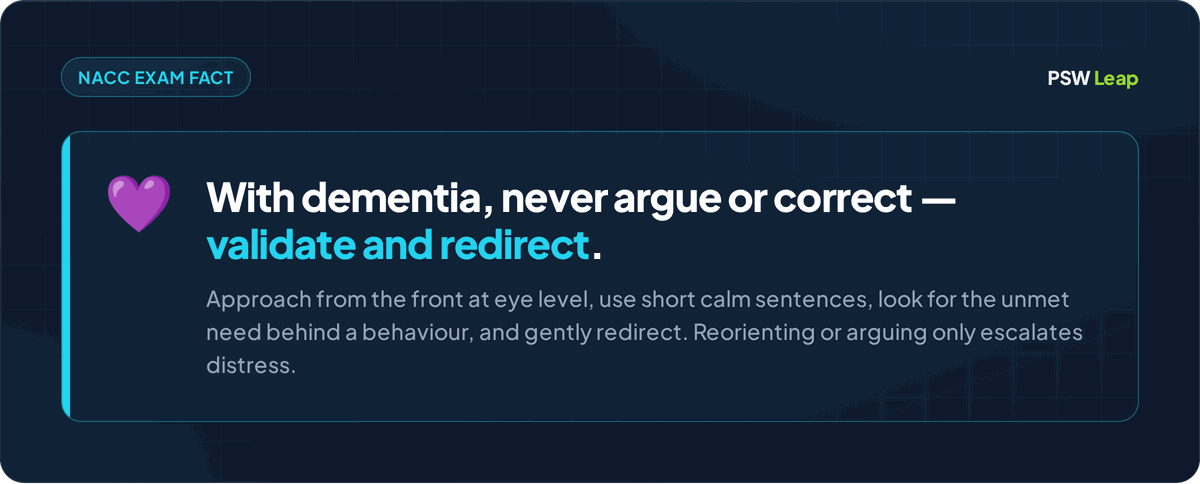
- Use validation, not reality orientation, when a false belief is distressing the client.
- Communicate from the front, at eye level, one idea at a time, with a calm tone and extra response time.
- Restraints and antipsychotic medication are a last resort — a physician/nurse decision, never the PSW alone.
- For wandering, walk with the client and redirect; keep the environment safe rather than blocking or restraining.
- Sundowning is late-day confusion — routine, light, calm, and less stimulation reduce it.
- The PSW observes, communicates, supports, and reports — diagnosis and treatment belong to the regulated care team.
- In Ontario, the PSW is a mandatory reporter of suspected abuse or neglect.
Remember: PSW practice in Ontario always follows the client's individual care plan and your employer's policies. This article is exam-prep study material, not medical advice.
Practice more free NACC questions
You just answered 10 dementia care questions — the NACC PSW exam can include questions on all of the PSW modules, from cognitive and mental health to nutrition, safety, infection control, and vital signs. The fastest way to find your weak spots is to keep practising with instant feedback.
👉 Start practising free at pswleap.com/learn — 2,500 NACC-style questions, full timed mock exams, and a Duolingo-style study path built specifically for Ontario PSW students. No subscription, and you can start with sample questions before you pay.
You can also brush up on a related high-yield topic next: Free NACC Practice Questions on Dysphagia & Safe Swallowing.
PSW Leap is an independent NACC PSW exam-prep platform for Ontario candidates. We are not affiliated with NACC. Always follow your training, your client's care plan, and your employer's policies on the job.
Published by PSW Leap
Independent NACC PSW exam prep
PSW Leap articles are written and maintained by the platform's founder, Shashank Jha, and checked against publicly available PSW curriculum standards. Found an error? Email hello@pswleap.com and we'll fix it.
Read our content methodologyPSW Leap
Practice smarter for the NACC exam. 2,500 questions. Detailed rationales. $29.99 CAD one-time — everything included.
Try 10 free questions →No account needed. Ready for the full bank? Create your account.