Free NACC Practice Questions on Mental Health, Delirium & Depression (Ontario PSW Exam Prep)
If you are studying for the NACC Personal Support Worker (PSW) exam in Ontario, mental health is a high-yield clinical topic — older adults commonly experience delirium, dementia, and depression, these conditions look alike but are managed very differently, and a PSW is often the first person to notice the change. This free practice set gives you real NACC-style questions on telling the "3 D's" apart, spotting delirium as an emergency, depression and self-harm reporting, scope of practice, least restraint, and Behavioural Supports Ontario, each with a clear answer and explanation. Work through them, check your reasoning, then keep going with the full question bank at pswleap.com/learn. If you would prefer a mixed set, the free 10-question practice test has 10 NACC-style sample questions, each with its explanation, and asks for no signup.
What does mental health look like on the NACC PSW exam?
On the exam, mental health is about observing the client, recognizing a change, supporting them with a calm and person-centred approach, and reporting — not diagnosing or treating. A PSW notices shifts in mood, thinking, and behaviour, tries non-medication approaches, keeps the client safe, and passes accurate observations to the nurse.
The exam tests it heavily because mental-health changes in older adults are common, easy to miss, and sometimes urgent. The "right answer" almost always pairs a person-centred, least-restraint approach with prompt, objective reporting — never the PSW stepping outside scope to diagnose, medicate, or restrain on their own.
Quick terms to know: Responsive behaviour = an action (agitation, wandering, calling out) that communicates an unmet need. Person-centred care = responding to the individual and their history, not just the behaviour. Least restraint = using the fewest restrictions possible, only as a last resort.
The "3 D's": delirium vs dementia vs depression
The single most testable idea in this topic is telling the three D's apart, because they overlap but are handled very differently:
- Delirium — sudden onset (hours to days), awareness that fluctuates, and usually a reversible cause such as infection (a urinary tract infection is a classic trigger in older adults), dehydration, constipation, pain, low oxygen, or a new medication. Delirium is treated as a medical emergency — the cause needs to be found and fixed quickly.
- Dementia — gradual onset over months to years, progressive, and generally not reversible. Memory and thinking decline slowly while the person usually stays alert.
- Depression — a mood disorder with persistent low mood, loss of interest, withdrawal, and changes in sleep or appetite. It is common but not normal in older adults, often missed or mistaken for dementia, and it is treatable.
The exam clue that matters most is onset and speed: a sudden change points to delirium and is reported urgently; a slow decline over months fits dementia; a weeks-long change in mood and interest fits depression. A sudden worsening in someone who already has dementia is usually delirium on top of dementia — and it still needs prompt reporting.
Is recognizing and managing mental illness in the PSW's scope in Ontario?
A PSW observes, supports, and reports — a PSW does not diagnose mental illness, prescribe or adjust psychiatric medication, or provide therapy. What you do every shift is build trust, use a calm and person-centred approach, encourage participation, keep the client safe, and report changes to the regulated team.
Two Ontario specifics are worth knowing because they show up as the "best answer":
- Least restraint is the law, not just a value. Ontario long-term care homes operate under a least-restraint approach required by the Fixing Long-Term Care Act, 2021, which obliges homes to minimize restraining residents. Restraints are a last resort — used only when ordered and after alternatives have failed — and a PSW never applies one on their own initiative.
- Behavioural Supports Ontario (BSO) places specialized behavioural-support staff in long-term care and the community to help older adults with responsive behaviours linked to dementia, mental health, substance use, or other conditions. Your employer may also train you in approaches such as Gentle Persuasive Approaches (GPA).
As always, follow your training, the client's care plan, and your employer's policy.
Free NACC-style practice questions: mental health & the 3 D's
Each question below mirrors the scenario-based, multiple-choice style of the NACC PSW exam. Try to answer before you read the explanation.
Q1. Why does the NACC PSW exam test mental health and the "3 D's"?
Answer: Because delirium, dementia, and depression are common in older adults, look alike, and are managed very differently — and the PSW is often the first to notice the change. The exam expects you to observe and report, not to diagnose or treat.
Q2. What is the key difference between delirium and dementia?
Answer: Delirium comes on suddenly (hours to days) and is usually reversible; dementia comes on gradually (months to years) and is progressive and not reversible. Delirium often has a treatable cause like infection or dehydration, so a sudden change is reported urgently, while dementia's slow decline is managed with consistent, person-centred care.
Q3. A client with dementia is suddenly far more confused and drowsy than yesterday. What should the PSW suspect and do?
Answer: Suspect delirium and report it to the nurse right away. A sudden change in a person's usual mental state is treated as delirium until proven otherwise — commonly from a UTI, dehydration, constipation, pain, or a new medication. Keep the client safe and do not assume it is "just the dementia"; acting fast lets the team find and fix a reversible cause.
Q4. Is depression something a PSW should accept as a normal part of getting old?
Answer: No — depression is common in older adults but never a normal part of aging, and it is treatable. Dismissing low mood, withdrawal, or poor appetite as "old age" misses a treatable condition and can be mistaken for dementia. The PSW notices the change in mood or interest and reports it.
Q5. A client says, "I'd be better off dead — there's no point anymore." What must the PSW do?
Answer: Take it seriously and report it to the nurse or supervisor immediately; stay with the client and listen without judgment. Never keep a statement about self-harm or wanting to die secret, and never treat it as attention-seeking. Any expression of suicidal thinking is always reported right away.
Q6. What is the PSW's scope when it comes to mental health in Ontario?
Answer: Observe, support, and report — a PSW does not diagnose, medicate, or provide therapy. You support the client with a calm, person-centred approach, encourage participation, and report changes in mood, thinking, or behaviour to the regulated team. Stepping outside that scope is the wrong answer on the exam.
Q7. A client is anxious and pacing the hallway. What should the PSW try first?
Answer: Use non-medication, person-centred approaches — a calm voice, a quieter environment, reassurance, simple choices, and meeting any unmet need. Behaviour is communication: pain, hunger, fear, or needing the toilet can all drive agitation. Medication and restraint are never the PSW's first move.
Q8. Are restraints an acceptable way to manage a distressed client in Ontario?
Answer: No — Ontario uses a least-restraint approach required by law, so restraints are a last resort, only when ordered and after alternatives fail, never for convenience or punishment. The PSW tries person-centred alternatives, reports the behaviour, and follows the care plan — never applying a restraint on their own.
Q9. What is Behavioural Supports Ontario (BSO), and how does it help a PSW?
Answer: BSO is an Ontario program that puts specialized behavioural-support staff in long-term care and the community to help older adults with responsive behaviours. For a PSW it is a resource — you report your observations and the BSO team helps build a person-centred behavioural care plan for behaviours linked to dementia, mental health, or other conditions.
Q10. How should a PSW document a change in a client's mood or thinking?
Answer: Record exactly what you observed in objective, factual terms, and report it promptly. Write "ate nothing at three meals and stayed in bed all morning," not "seems depressed" — note what the client said or did, when it started, and how it differs from their usual self. Objective observation and prompt reporting are exactly what the exam rewards.
Common mental-health mistakes to avoid on the NACC exam
- Assuming a sudden change is "just the dementia" instead of suspecting delirium and reporting it fast.
- Dismissing low mood as normal aging instead of reporting possible depression.
- Keeping a comment about self-harm secret or treating it as attention-seeking instead of reporting it immediately.
- Reaching for medication or restraint first instead of trying calm, person-centred approaches.
- Applying a restraint on your own initiative instead of following the least-restraint approach and the care plan.
- Diagnosing or "talking the client out of" a mental illness instead of observing, supporting, and reporting.
- Charting opinions ("seems depressed") instead of objective, factual observations.
Each of these matches the single-best-answer logic the NACC exam uses: the correct option is the gentlest, person-centred action that keeps the client safe, stays within the PSW's scope, and reports the change.
The mental-health facts the NACC exam expects you to know
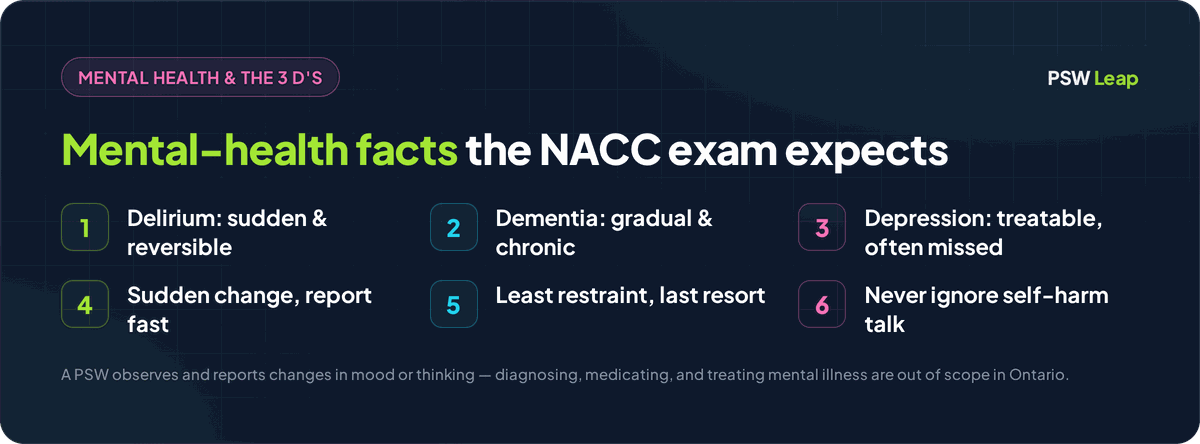
Use these one-line facts as a final review — they are the kind of definitive statements the exam rewards:
- Delirium is sudden and usually reversible; dementia is gradual and chronic; depression is treatable and often missed.
- A sudden change in thinking or alertness is delirium until proven otherwise — report it fast.
- Depression is common but not normal aging — report a change in mood or interest.
- Never ignore or keep secret any talk of self-harm — report it immediately and stay with the client.
- Try non-medication, person-centred approaches first for anxiety and agitation; least restraint, last resort.
- A PSW observes, supports, and reports — diagnosing, medicating, and treating are out of scope.
Remember: PSW practice in Ontario always follows the client's individual care plan and your employer's policies. This article is exam-prep study material, not medical advice.
Practice more free NACC questions
You just answered 10 mental-health questions — the NACC PSW exam can include questions across all of its modules, from cognitive and mental health to safe transfers, nutrition, infection prevention, and vital signs. The fastest way to find your weak spots is to keep practising with instant feedback.
👉 Start practising free at pswleap.com/learn — a large bank of NACC-style questions, full timed mock exams, and a Duolingo-style study path built specifically for Ontario PSW students. No subscription, and you can start with sample questions before you pay.
Closely related topics worth reviewing next: Free NACC Practice Questions on Dementia Care & Responsive Behaviours (the dementia-specific behaviours) and PSW Scope of Practice in Ontario (what a PSW can and cannot do).
PSW Leap is an independent NACC PSW exam-prep platform for Ontario candidates. We are not affiliated with NACC. Always follow your training, your client's care plan, and your employer's policies on the job.
Published by PSW Leap
Independent NACC PSW exam prep
PSW Leap articles are written and maintained by the platform's founder, Shashank Jha, and checked against publicly available PSW curriculum standards. Found an error? Email hello@pswleap.com and we'll fix it.
Read our content methodologyPSW Leap
Practice smarter for the NACC exam. 2,500 questions. Detailed rationales. $29.99 CAD one-time — everything included.
Try 10 free questions →No account needed. Ready for the full bank? Create your account.