Free NACC Practice Questions on Fall Prevention (Ontario PSW Exam Prep)
If you are studying for the NACC Personal Support Worker (PSW) exam in Ontario, fall prevention is one of the highest-yield safety topics on the test — and one you will use on every single shift. Roughly one in three adults over 65 falls each year, and falls are a leading cause of injury-related hospitalization among Ontario seniors. A single fall can cost an older client their independence, so the NACC exam treats fall prevention as core PSW knowledge. This free practice set gives you real NACC-style questions on fall risk assessment, safe environments, footwear and mobility aids, the post-fall response, and restraints, each with a clear answer and a plain-language explanation. Work through them, check your reasoning, then keep going with the full question bank at pswleap.com/learn. For a mixed-topic check, try the 10-question PSW practice test: 10 NACC-style questions with an explanation after each answer, no signup and no payment.
What is fall prevention, and why does the NACC PSW exam test it?
Fall prevention is the set of practices that keep clients from falling and reduce harm when a fall does happen. For a Personal Support Worker in Ontario, that means spotting who is at risk, keeping the environment safe, helping clients move and transfer safely, and responding correctly after a fall.
The NACC PSW exam tests fall prevention heavily because PSWs provide hands-on care — transferring, toileting, walking, and repositioning clients — and are usually the first person to notice that someone is unsteady. You are not expected to diagnose why a client falls or to order assessments. You are expected to follow the fall-prevention measures in the care plan, keep the space hazard-free, use the correct footwear and equipment, respond safely after a fall, and report changes to the nurse.
Quick definitions to memorize: Intrinsic risk factors = inside the client (weakness, dizziness, confusion, medications). Extrinsic risk factors = in the environment (clutter, poor lighting, wet floors, bad footwear). Orthostatic (postural) hypotension = a blood-pressure drop on standing that causes dizziness. Least-restrictive approach = always try the safest, least-limiting option before any restraint.
How a PSW assesses a client's fall risk
Fall prevention starts with knowing who is most likely to fall. A PSW contributes to this in three practical ways:
- Read the care plan and chart first. Note any history of falls, the client's mobility level, cognitive status, continence, and high-risk medications (sedatives, diuretics, blood-pressure drugs). The care plan tells you what supervision and equipment each client needs before you walk into the room.
- Observe every transfer and every walk. Watch for unsteadiness, shuffling, reaching for furniture, leaning to one side, or sudden dizziness. These are the early warnings that something has changed — and your observation is often the first sign the care team gets.
- Understand the screening tools. Many Ontario facilities score fall risk with a standardized tool such as the Morse Fall Scale. A PSW does not complete the assessment alone, but you should know that a high score drives extra precautions — and that your day-to-day observations feed that score.
The exam loves the intrinsic vs extrinsic distinction: intrinsic factors come from the client (weakness, dizziness, confusion, vision loss, medication effects), while extrinsic factors come from the environment (clutter, poor lighting, wet floors, unsafe footwear, wrong-height or unlocked equipment). Good fall prevention addresses both.
Free NACC-style practice questions: fall prevention
Each question below mirrors the scenario-based, multiple-choice style of the NACC PSW exam. Try to answer before you read the explanation.
Q1. Why does the NACC PSW exam test fall prevention so heavily?
Answer: Because falls are common and serious — and the PSW is usually the first to spot the risk. Roughly one in three adults over 65 falls each year, and falls are a leading cause of injury-related hospitalization among Ontario seniors. PSWs provide hands-on care all day, so the exam expects you to keep the environment safe, follow the fall-prevention care plan, respond correctly after a fall, and report changes to the nurse. A fall can also trigger a long decline in an older client's health, which is why prevention matters so much.
Q2. What is the PSW's role in fall prevention?
Answer: Observe, follow the care plan, keep the space safe, and report — not diagnose. A PSW watches the client and environment, follows the fall-prevention measures already in the care plan, and reports any new dizziness, weakness, near-fall, or change in mobility to the nurse. PSWs do not independently diagnose the cause of falls, order assessments, or apply restraints on their own — those require a regulated professional and an order. When the exam asks what the PSW should do, the answer stays inside this observe-and-report scope.
Q3. What is the strongest single predictor that a client will fall?
Answer: A history of a previous fall. Once a client has fallen, they are much more likely to fall again, so a previous fall should immediately raise the level of caution and prompt closer supervision. Other intrinsic risk factors include weakness or poor balance, dizziness, vision problems, confusion or dementia, and incontinence. If an exam scenario mentions a recent fall, that detail is almost always relevant to the correct answer.
Q4. Which medications should make a PSW watch a client more closely for falls?
Answer: Sedatives, blood-pressure medications, and diuretics — among others. Sleeping pills, anti-anxiety and antipsychotic medications, some antidepressants, opioids, diuretics (water pills), and blood-pressure medications all raise fall risk through drowsiness, dizziness, low blood pressure, or urgent trips to the bathroom. A PSW does not adjust medications, but should know when doses were given so they can supervise more closely and report unsteadiness to the nurse.
Q5. A client becomes dizzy every time they stand up. What is happening, and what should the PSW do?
Answer: Likely orthostatic (postural) hypotension — have the client rise slowly. This is a sudden blood-pressure drop on standing. Help the client change position slowly: sit up first, sit on the edge of the bed and dangle the legs for a minute or two, then stand with support. Never rush the client to their feet, and report repeated dizziness on standing to the nurse, since it may mean a medication or health change.
Q6. What environmental changes most reduce a client's fall risk?
Answer: Clear the path, fix the lighting, and keep grab bars and the call bell in reach. Remove cords, clutter, and throw rugs; wipe up spills right away; add night lights in the bathroom, hallway, and bedroom; keep grab bars and the call bell within reach; and lock the brakes on the bed and wheelchair before transfers. Re-check the space every shift — new hazards appear overnight, and a tidy room is one of the cheapest, most effective fall-prevention tools there is.
Q7. What footwear is safest for a client at risk of falling?
Answer: Well-fitting, non-slip footwear with backs. Proper shoes or non-slip slippers with a firm back are safest. Avoid bare feet, socks on tile, and loose, backless slippers — they slide and catch. Mobility aids such as walkers and canes must be the correct height for the client and kept within reach so the client never has to stretch or lunge for them.
Q8. Before transferring a client from the bed to a wheelchair, what must the PSW always check?
Answer: That the brakes on the bed and wheelchair are locked. An unlocked wheelchair or bed can slide out from under the client mid-transfer, causing a fall and a possible injury to both the client and the PSW. Lock the brakes every single time, position the chair close, lower the bed to a safe height, and use the gait belt or transfer aid set out in the care plan.
Q9. A PSW finds a client on the floor. What is the FIRST thing they should do?
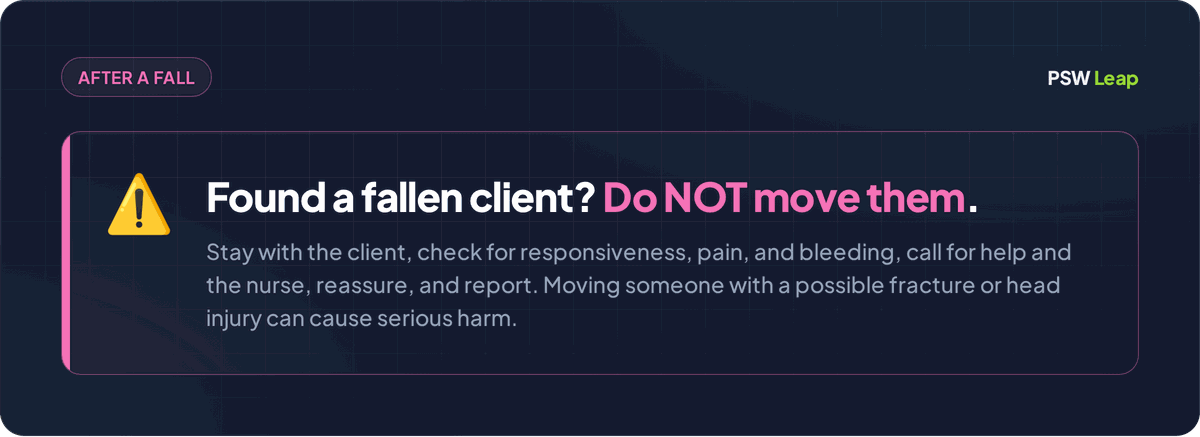
Answer: Do NOT move the client — stay, assess, and call for help. Moving a client who may have a fracture or head injury can make the injury far worse. Stay with the client, stay calm, check for pain, bleeding, deformity, or signs of a head injury, then call for help and notify the nurse immediately. Reassure the client and keep them still until the nurse arrives. The safe order is: do not move, assess, call for help, reassure.
Q10. After the fall, the client says "I'm fine — please don't tell anyone." What should the PSW do?
Answer: Report the fall to the nurse anyway, and document it objectively. Every fall is reported, even when the client feels fine, because internal injuries and head injuries are not always visible right away. Document the date and time, where it happened, what the client was doing, how they were found, the client's own words in quotation marks, and any injuries or complaints of pain. Reporting protects the client — it is never optional, and "the client asked me not to" is never a valid reason to skip it.
Helping a client move and walk safely
Most falls in long-term care happen during transfers and trips to the bathroom, so safe movement is where a PSW prevents the most harm:
- Set up before you start. Raise the bed to a safe working height, clear the path, and lock the brakes on the bed and wheelchair. A 30-second setup prevents most transfer falls.
- Use the gait belt and the right technique. Apply the gait belt as set out in the care plan, stand the client slowly, and pause to let any dizziness pass before you begin walking.
- Stand on the client's weaker side. Stay slightly behind and to the side with one hand on the gait belt, so you can steady the client if they lean or buckle.
- Never rush, and never go it alone when unsure. If a client is heavy, unsteady, or the move is complex, call for a two-person assist before you begin — not after the transfer is already underway.
A toileting schedule is one of the most effective fall-prevention measures of all: offering regular trips to the bathroom prevents the rushed, unassisted trips where so many falls happen.
Common fall-prevention mistakes to avoid on the NACC exam
- Choosing to move a client who has just fallen — the safe answer is almost always do not move, assess, and call the nurse.
- Picking a restraint as a fall-prevention measure — restraints increase injury risk and are never the first choice.
- Forgetting to lock the brakes before a transfer.
- Standing a dizzy client up quickly instead of letting them dangle their legs first.
- Deciding not to report a fall because the client "seems fine."
- Leaving the bed raised or the call bell out of reach after finishing care, so the client tries to get up or call for help on their own.
Each of these matches the single-best-answer logic the NACC exam uses: the correct option is the safest, least-restrictive action that stays within the PSW scope.
The fall-prevention facts the NACC exam expects you to know
Use these one-line facts as a final review — they are the kind of definitive statements the exam rewards:
- One in three adults over 65 falls each year — a previous fall is the strongest predictor of the next one.
- The PSW's job is to follow the care plan, keep the space safe, and report — not to diagnose or apply restraints on their own.
- Lock the brakes on the bed and wheelchair before every transfer.
- Use non-slip, well-fitting footwear — never bare feet, socks on tile, or loose slippers.
- For dizziness on standing (orthostatic hypotension): sit up, dangle the legs, then stand slowly with support.
- Keep the call bell and grab bars within reach, add night lights, and clear clutter, cords, and throw rugs.
- Watch clients on sedatives, diuretics, and blood-pressure medications more closely.
- After a fall: do not move the client, assess for injury, call for help, then document and report — even if the client says they are fine.
- Restraints do not prevent falls and increase the risk of serious injury; always use the least-restrictive approach, and never apply a restraint without an order.
Remember: PSW practice in Ontario always follows the client's individual care plan and your employer's policies. This article is exam-prep study material, not medical advice.
Practice more free NACC questions
You just answered 10 fall-prevention questions — the NACC PSW exam covers every part of your program, from safety and fall prevention to nutrition, dementia care, and vital signs. To find your weak spots, keep practising with instant feedback. PSW Leap's 12 study modules follow the NACC PSW curriculum.
👉 Start practising free at pswleap.com/learn — 2,500 NACC-style questions, full timed mock exams, and a Duolingo-style study path built specifically for Ontario PSW students. No subscription, and you can start with sample questions before you pay.
You can also keep working through the free series next: Free NACC Practice Questions on Dysphagia & Safe Swallowing.
PSW Leap is an independent NACC PSW exam-prep platform for Ontario candidates. We are not affiliated with NACC. Always follow your training, your client's care plan, and your employer's policies on the job.
Published by PSW Leap
Independent NACC PSW exam prep
PSW Leap articles are written and maintained by the platform's founder, Shashank Jha, and checked against publicly available PSW curriculum standards. Found an error? Email hello@pswleap.com and we'll fix it.
Read our content methodologyPSW Leap
Practice smarter for the NACC exam. 2,500 questions. Detailed rationales. $29.99 CAD one-time — everything included.
Try 10 free questions →No account needed. Ready for the full bank? Create your account.