Free NACC Practice Questions on Range of Motion & Positioning (Ontario PSW Exam Prep)
If you are studying for the NACC Personal Support Worker (PSW) exam in Ontario, range of motion and positioning are among the most practical clinical topics you can review — so many long-term care and home-care clients in Ontario have limited mobility, and the PSW carries out their movement and keeps them safely positioned every shift. This free practice set gives you real NACC-style questions on passive versus active range of motion, supporting the joint and never forcing it, repositioning every two hours, the common positions, preventing contractures, and the changes to report, each with a clear answer. Work through them, then keep going with the full bank at pswleap.com/learn. If you would rather start with a mixed set, the free 10-question sample test gives you 10 NACC-style sample questions with an explanation after each answer, no signup needed.
What is range of motion and positioning on the NACC PSW exam?
For the exam, range of motion (ROM) is moving a joint through its normal directions — bending, straightening, rotating — to keep it mobile, and positioning is placing and turning the client to keep the body aligned and pressure off bony areas, both carried out by the PSW exactly as the care plan directs. A client who lies still loses joint movement and risks skin breakdown fast, so the PSW's careful, routine movement and turning is genuine prevention — it heads off contractures and pressure injuries before they start.
Passive, active, and active-assisted ROM: who moves the joint?
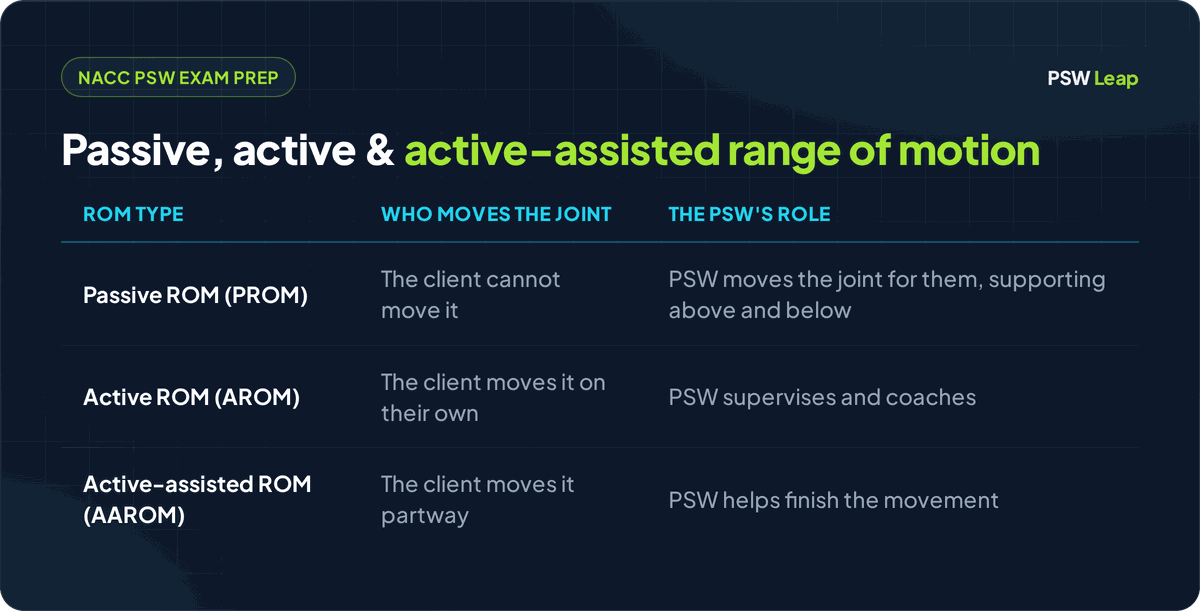
The difference between the three types of ROM is simply who does the moving. In passive ROM (PROM) the client cannot move the joint, so the PSW moves it for them. In active ROM (AROM) the client moves the joint on their own while the PSW supervises and coaches. In active-assisted ROM (AAROM) the client moves as far as they can and the PSW helps finish the movement. The exam loves to test whether you can match the term to the scenario.
Whichever type it is, the technique is the same: move slowly and smoothly, only to the point of gentle resistance — never past pain — support the limb above and below the joint, and do the number of repetitions in the care plan, not a fixed number you decide. The hard rule the exam never bends on is never force a joint. New resistance, swelling, redness, or pain means stop and report.
Common positions, the every-two-hours rule, and body alignment
The PSW should reposition a client who cannot move themselves at least every two hours, using pillows and aids to keep the body in proper alignment and to offload bony prominences. The positions the exam expects are supine (on the back), lateral (side-lying), Fowler's, semi-Fowler's, and high-Fowler's (degrees of semi-sitting, for comfort and easier breathing), and Sims' (semi-prone side-lying). Prone — face-down — is rarely used with frail older adults.
Good positioning is also skin protection: keep the heels off the bed, and when side-lying use about a 30-degree tilt so the client's weight does not press directly on the hip bone. This is where ROM and positioning meet pressure-injury prevention — for staging and full skin care, see the pressure-injuries practice set.
The PSW's role in Ontario: carry out the plan, support alignment, report changes
A physiotherapist or occupational therapist assesses the client and prescribes the ROM program; the PSW carries out that prescribed ROM and positioning per the care plan and reports any change. In Ontario, ROM and positioning are routine, care-plan-directed PSW tasks — not controlled acts under the Regulated Health Professions Act, 1991. The PT's or OT's prescription is the design of the program — which joints, which type of ROM, how many repetitions.
Two scope points the exam rewards. First, the PSW carries out the plan but does not assess the joint, change the program, or push a client further "to help them progress" — that is the therapist's call. Second, the PSW observes and reports: new pain, swelling, redness, increased stiffness, or any change in how far the client can move all go to the nurse promptly. Carrying out the plan and changing it are two different jobs.
Quick terms to know: PROM = the PSW moves it for a client who can't. AROM = the client moves it themselves. AAROM = the client moves with some help. Contracture = a permanent shortening of a muscle or tendon from not moving. Bony prominence = a spot where bone is close to the skin (heel, hip, tailbone) that needs pressure offloaded.
Free NACC-style practice questions: range of motion and positioning
Each question mirrors the scenario-based, multiple-choice style of the NACC PSW exam. Try to answer before you read the explanation.
Q1. A client cannot move her left arm after a stroke, and the care plan has the PSW move the joint. What type of ROM is this?
Answer: Passive ROM (PROM). When the client cannot move the joint and the PSW does all the movement, that is passive ROM — done slowly, supporting the arm above and below the joint.
Q2. During ROM on a client's knee, the PSW feels new resistance and the client winces in pain. What should the PSW do?
Answer: Stop at once, do not force the joint, and report the pain and resistance to the nurse. ROM is only ever taken to gentle resistance, never through pain.
Q3. How often should a PSW reposition a client who cannot move independently?
Answer: At least every two hours. Turning on that schedule relieves pressure on bony prominences and lets you check the skin; the care plan may call for more often.
Q4. A client lifts his leg partway but needs a little help to finish the movement. What type of ROM is this?
Answer: Active-assisted ROM (AAROM). The client moves as far as he can and the PSW helps finish it. Done entirely alone, it would be active ROM (AROM).
Q5. The PSW is positioning a client on their side. How should they do it to protect the skin?
Answer: Use about a 30-degree side-lying tilt with pillows, so weight does not press directly on the hip bone. A full 90-degree side-lying position puts the body's weight right on the hip, raising risk.
Q6. A client's ankle is stiffening from lying in bed. What is it at risk of becoming, and how is that prevented?
Answer: A contracture — prevented by regular range of motion and good positioning. A contracture is a permanent shortening of muscle or tendon from not moving; ROM and proper foot support also help prevent footdrop.
Q7. Who decides which ROM exercises a client does and how many repetitions?
Answer: The physiotherapist or occupational therapist, written into the care plan. The PT or OT assesses and prescribes the program; the PSW carries it out as written, never changing the exercises.
Q8. A PSW helps turn a client who has spinal precautions. What is the correct approach?
Answer: Log-roll the client as one unit, following the care plan and nurse direction. Spinal precautions mean turning the body all at once to keep the spine aligned — not something the PSW decides alone.
Q9. A PSW notices a client's shoulder now moves less far than last week. How should the PSW report it?
Answer: Tell the nurse objectively — what the client could do before, what they can do now, when you first noticed it, and the client's own words about any pain. A new decrease in joint movement is exactly what the PSW observes and reports; it is never something to "fix" by pushing harder.
Q10. A PSW is doing morning care for a client on bed rest and wants to work in some range of motion. What is a practical way to do it?
Answer: Fold the prescribed ROM into the care you are already giving — move the shoulder through its range while putting on the gown, the wrist and fingers during washing — moving slowly to gentle resistance. Combining ROM with ADLs is gentler than a separate session, as long as you stay within the care plan.
Common range-of-motion and positioning mistakes to avoid on the NACC exam
- Forcing a joint past resistance or through pain instead of stopping at gentle resistance and reporting it.
- Doing your own number of repetitions rather than the number written in the care plan.
- Leaving a client in one position too long — someone who can't move themselves needs repositioning at least every two hours.
- Positioning a side-lying client flat on the hip at 90 degrees instead of a 30-degree tilt.
- Changing or "progressing" the exercise program yourself — assessing and prescribing ROM belongs to the PT or OT, not the PSW.
The range-of-motion and positioning facts the NACC exam expects you to know
Use these one-line facts as a final review:
- PROM, AROM, AAROM — the PSW moves it, the client moves it, or the client moves it with help.
- Move slowly to gentle resistance, never past pain — support the limb above and below the joint, and never force it.
- Do the repetitions in the care plan — not a fixed number you choose.
- Reposition at least every two hours for a client who can't move themselves, checking the skin each time.
- Keep alignment and offload bony prominences — heels off the bed, a ~30-degree tilt when side-lying.
- ROM and positioning prevent contractures and support pressure-injury prevention.
- PT/OT assess and prescribe; the PSW carries out and reports — new pain, swelling, redness, stiffness, or reduced movement.
Remember: PSW practice in Ontario always follows the client's care plan and your employer's policies, within the controlled-acts limits of the Regulated Health Professions Act, 1991. Carrying out prescribed range of motion and positioning and reporting changes is within a PSW's role; assessing the joint, prescribing the program, and deciding on spinal precautions are not. This article is exam-prep study material, not medical advice.
Practice more free NACC questions
You just answered 10 range-of-motion and positioning questions, and the NACC exam spans every module. The fastest way to find your weak spots is to keep practising with instant feedback.
👉 Start practising free at pswleap.com/learn — a large bank of NACC-style questions, full timed mock exams, and a Duolingo-style study path built for Ontario PSW students. No subscription, and you can start with sample questions before you pay.
Closely related topics worth reviewing next: Free NACC Practice Questions on Pressure Injuries (where positioning and skin protection meet) and Free NACC Practice Questions on Body Mechanics (turning clients safely).
PSW Leap is an independent NACC PSW exam-prep platform for Ontario candidates. We are not affiliated with NACC. Always follow your training, your client's care plan, and your employer's policies on the job.
Published by PSW Leap
Independent NACC PSW exam prep
PSW Leap articles are written and maintained by the platform's founder, Shashank Jha, and checked against publicly available PSW curriculum standards. Found an error? Email hello@pswleap.com and we'll fix it.
Read our content methodologyPSW Leap
Practice smarter for the NACC exam. 2,500 questions. Detailed rationales. $29.99 CAD one-time — everything included.
Try 10 free questions →No account needed. Ready for the full bank? Create your account.