Free NACC Practice Questions on Body Mechanics & Safe Transfers (Ontario PSW Exam Prep)

If you are studying for the NACC Personal Support Worker (PSW) exam in Ontario, body mechanics and safe client handling are among the highest-yield topics on the test — and the skills that protect your own back over a long career. PSWs have one of the highest injury rates in health care, and most of those injuries happen during ordinary transfers and repositioning, not heavy lifting. This free practice set gives you real NACC-style questions on body-mechanics principles, safe transfers, gait belts, mechanical lifts, repositioning, and what to do when a client starts to fall, each with a clear answer and explanation. Work through them, check your reasoning, then keep going with the full question bank at pswleap.com/learn. For a quick mixed-topic check first, try the free NACC-style practice test: 10 questions, an explanation after every answer, no signup.
What is body mechanics, and why does the NACC PSW exam test it?
Body mechanics is the safe, efficient use of your body to move, lift, and reposition a client without injuring yourself or them. It is the practical side of the NACC "safety" and "mobility" content, and it shows up in scenario questions throughout the exam.
The exam tests it heavily because PSWs in Ontario transfer, turn, and reposition clients many times a shift, and unsafe technique causes both client falls and worker back injuries. You are expected to apply the principles, follow the care plan, use ordered equipment, and recognize when a transfer is not safe to attempt alone.
Quick terms to memorize: Base of support = how your feet are positioned. Centre of gravity = the point your weight balances around — lower is more stable. Pivot = turning by stepping your feet, not twisting your spine.
The body-mechanics principles to memorize
These are the most "quotable" facts on the topic — the exam expects you to apply them without hesitating:
- Wide base of support: feet about shoulder-width apart, one foot slightly ahead.
- Bend at the knees and hips, not the waist — let your strong leg muscles do the work.
- Keep the load close to your body; every inch of distance multiplies the strain on your spine.
- Keep your back in neutral alignment — natural curve, not rounded or arched.
- Push or pull rather than lift when you can, and pivot with your feet — never twist.
- Face the direction you are moving before you start.
The PSW's role: plan, follow the care plan, get help
A PSW's job in safe client handling lives inside a few clear rules:
- Plan the move — assess the client, prepare the environment, and explain before you touch the client.
- Follow the care plan — use exactly the assist level and equipment that has been ordered.
- Get help — when a two-person assist or mechanical lift is required, never transfer alone.
PSWs do not exceed the ordered assist level, skip ordered equipment, or "make do" when a safe transfer is not possible. When a scenario asks what to do and a safe transfer cannot be done with the help on hand, the correct answer is almost always to stop and get assistance — never to risk it.
Free NACC-style practice questions: body mechanics & safe transfers
Each question below mirrors the scenario-based, multiple-choice style of the NACC PSW exam. Try to answer before you read the explanation.
Q1. Why does the NACC PSW exam test body mechanics so heavily?
Answer: Because PSWs have one of the highest injury rates in health care, and most injuries happen during routine transfers. Safe body mechanics protect both the client and the worker on tasks that happen many times a shift. The exam expects you to apply the principles, follow the care plan, and use ordered equipment — not to rely on strength.
Q2. What gives a PSW the most stable position before assisting with a transfer?
Answer: A wide base of support — feet about shoulder-width apart, with one foot slightly ahead. A wide base lowers your centre of gravity and gives you balance before any movement begins. Add bent knees and a neutral back, and your leg muscles do the work instead of your spine.
Q3. A client needs to be moved up in bed. What should the PSW do first?
Answer: Lower the head of the bed flat, raise the bed to hip height, and get a second person plus a slide or draw sheet. Repositioning is safest with two caregivers using a slide sheet so the client is shifted, not dragged. Dragging causes skin shearing for the client and back strain for the PSW. Bed at working height keeps you out of the postures that cause injury.
Q4. How should a PSW apply and use a gait (transfer) belt?
Answer: Snug around the waist over clothing, with an underhand grip — never lift by the arms or armpits. The belt should be tight enough that only two fingers fit underneath. Lifting a client by the arms or under the armpits can dislocate a shoulder or injure the skin. The belt gives a central, secure grip so you guide the client rather than lift them.
Q5. The care plan says a client is a two-person assist, but the PSW's coworker is on break. What should the PSW do?
Answer: Wait for help — never attempt a two-person transfer alone. A transfer ordered as a two-person assist must not be done by one person, even if the client seems cooperative. The PSW waits for the second caregiver or asks another team member, because attempting it alone risks a fall for the client and a serious injury for the PSW. Following the assist level is non-negotiable.
Q6. When should a PSW use a mechanical lift?
Answer: Whenever the care plan orders it — usually when a client cannot bear weight or is fully dependent. Using an ordered mechanical lift is not optional, and most lifts require two trained caregivers. Choosing to do a manual transfer instead, because it is faster, is unsafe and outside the PSW's scope. The lift exists to protect both the client and the worker.
Q7. Which way should a PSW position a wheelchair for a stand-and-pivot transfer?
Answer: On the client's stronger side, so they lead with their strongest limb. Moving a client toward their strong side gives them more control and reduces the load on the PSW. Have the client lean forward — "nose over toes" — with feet flat before standing. Lock the wheelchair brakes first, every time.
Q8. A client suddenly loses their balance and begins to fall during a transfer. What should the PSW do?
Answer: Do not try to catch them — widen your stance and ease them to the floor, protecting their head. Trying to hold an adult upright injures both people. Lower the client down along your body in a controlled way, protect the head, then stay with them and call for help. Do not move the client until a nurse has assessed them for injury.
Q9. Why is twisting at the waist while moving a client dangerous?
Answer: Rotational force concentrates stress on the lumbar discs and is a leading cause of back injury. Instead of twisting, pivot with your feet and square your shoulders and hips toward the destination before you move. Twisting injuries build up gradually, so the safe habit matters on every routine transfer — not only the heavy ones.
Q10. A client's mobility has clearly declined since their last transfer. What should the PSW do?
Answer: Report the change to the nurse and follow the updated plan — do not keep using the old transfer method. A PSW observes and reports changes in a client's ability to move, bear weight, or follow instructions, because the safe level of assistance may need to change. Continuing with a method that is no longer safe risks a fall. Measure your actions against the current care plan, and report anything new.
Common body-mechanics mistakes to avoid on the NACC exam
- Lifting with the back by bending at the waist instead of the knees.
- Twisting the spine to move a client instead of pivoting with the feet.
- Lifting a client by the arms or armpits instead of using a gait belt with an underhand grip.
- Doing a two-person or mechanical-lift transfer alone to save time.
- Dragging a client up in bed instead of using a slide sheet with help.
- Trying to catch a falling client instead of easing them to the floor.
Each of these matches the single-best-answer logic the NACC exam uses: the correct option is the safest action that protects both the client and the PSW and stays within the care plan.
The body-mechanics facts the NACC exam expects you to know
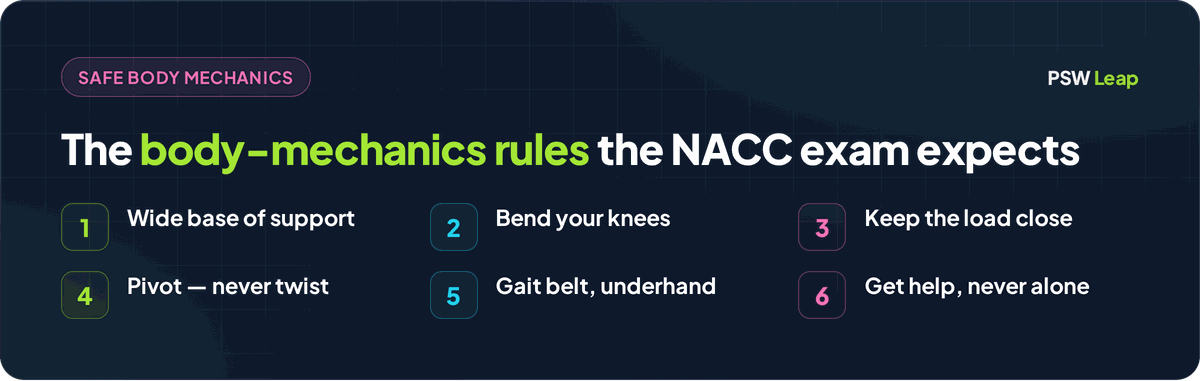
Use these one-line facts as a final review — they are the kind of definitive statements the exam rewards:
- Keep a wide base of support, bend your knees, and keep the load close.
- Pivot with your feet — never twist your spine while bearing a load.
- Apply a gait belt snugly over clothing and grip it underhand; never lift by the arms or armpits.
- A two-person assist is never done alone, and an ordered mechanical lift is not optional.
- Reposition with a slide or draw sheet and a second person — never drag the client.
- Transfer the client toward their stronger side, with brakes locked and the bed at hip height.
- If a client falls, ease them to the floor, protect the head, and do not move them until assessed.
- The PSW's job is to plan, follow the care plan, and get help — and to report any change in mobility.
Remember: PSW practice in Ontario always follows the client's individual care plan and your employer's policies. This article is exam-prep study material, not medical advice.
Practice more free NACC questions
You just answered 10 body-mechanics questions — the NACC PSW exam covers every part of your program, from safe handling and falls to vital signs, nutrition, and infection control. To find your weak spots, keep practising with instant feedback. PSW Leap's 12 study modules follow the NACC PSW curriculum.
👉 Start practising free at pswleap.com/learn — 2,500 NACC-style questions, full timed mock exams, and a Duolingo-style study path built specifically for Ontario PSW students. No subscription, and you can start with sample questions before you pay.
Closely related topics worth reviewing next: Free NACC Practice Questions on Fall Prevention (transfers are where most falls happen) and Free NACC Practice Questions on Personal Care & Hygiene.
PSW Leap is an independent NACC PSW exam-prep platform for Ontario candidates. We are not affiliated with NACC. Always follow your training, your client's care plan, and your employer's policies on the job.
Published by PSW Leap
Independent NACC PSW exam prep
PSW Leap articles are written and maintained by the platform's founder, Shashank Jha, and checked against publicly available PSW curriculum standards. Found an error? Email hello@pswleap.com and we'll fix it.
Read our content methodologyPSW Leap
Practice smarter for the NACC exam. 2,500 questions. Detailed rationales. $29.99 CAD one-time — everything included.
Try 10 free questions →No account needed. Ready for the full bank? Create your account.