Free NACC Practice Questions on Pressure Injuries & Skin Care (Ontario PSW Exam Prep)
If you are studying for the NACC Personal Support Worker (PSW) exam in Ontario, pressure injuries and skin care are among the highest-yield clinical topics you can prepare — preventing skin breakdown is daily PSW work, and the exam wants to know you can do it safely. This free practice set gives you real NACC-style questions on pressure injuries (bedsores) and skin care, each with a clear answer and a plain-language explanation. Work through them, then keep going with the full question bank at pswleap.com/learn. If you want a mixed set first, the free NACC-style PSW practice test has 10 sample questions with explanations and asks for no signup.
What is a pressure injury, and why does the NACC PSW exam test it?
A pressure injury is localized damage to the skin and the tissue underneath it, caused by sustained pressure — usually over a bony area. It is also called a pressure ulcer, pressure sore, or bedsore. When a client stays in one position too long, body weight cuts off blood flow to the squeezed tissue until it is injured.
The NACC PSW exam tests this because Ontario PSWs reposition clients, give personal care, and do incontinence care every shift — so the PSW is usually the first to see skin breaking down. You are not expected to diagnose, stage, or treat a pressure injury; you are expected to prevent them, observe the skin, document objectively, and report changes to the nurse.
Quick definitions to memorize: Bony prominence = where bone sits close to the skin with little padding. Offloading = relieving pressure from an at-risk area. Non-blanchable redness = skin that stays red when pressed — the earliest warning sign.
Free NACC-style practice questions: pressure injuries & skin care
Each question below mirrors the scenario-based, multiple-choice style of the NACC PSW exam. Try to answer before you read the explanation.
Q1. What is a pressure injury?
Answer: Localized damage to the skin and underlying tissue caused by sustained pressure, usually over a bony prominence. Pressure cuts off blood supply to the squeezed tissue until it is injured.
Q2. Which body areas are most at risk for pressure injuries?
Answer: Bony prominences — the sacrum and tailbone, heels, hips, elbows, shoulder blades, the back of the head, and the sit bones (ischial tuberosities). These spots have little padding, so tissue breaks down fastest there.
Q3. How often should a PSW reposition a client to prevent pressure injuries?
Answer: Follow the care plan — commonly at least every 2 hours in bed and at least every 1 hour in a chair. Regular position changes relieve pressure before tissue is damaged; some clients need it more often, so always follow the care plan.
Q4. A client has been lying on their back. You notice a red area over the tailbone that does not turn white when you press it. What does this most likely indicate?
Answer: This is the earliest sign of a pressure injury (non-blanchable redness). Skin over a bony area that stays red and does not blanch when pressed is a warning that tissue is being damaged — reposition the client off it and report it to the nurse.
Q5. On a client with darker skin, how might an early pressure injury look different?
Answer: It may not look red — the area may appear purple, blue, or darker than the surrounding skin, and may feel warmer, cooler, or firmer. Early injuries are easy to miss on darker skin, so the PSW checks temperature, firmness, and the client's reports of pain, not just colour.
Q6. Should a PSW massage a reddened bony area to "get the circulation going"?
Answer: No — never massage or rub a reddened bony prominence. Massage can damage the already-fragile tissue underneath. Instead, take the pressure off the area and report the change to the nurse.
Q7. Which of the following is the strongest single risk factor a PSW can act on to prevent pressure injuries?
Answer: Immobility — so frequent repositioning is the most powerful prevention tool. Other major risk factors include moisture from incontinence, poor nutrition and dehydration, friction and shear, reduced sensation, and poor circulation.
Q8. What is the difference between friction and shear, and how does a PSW reduce them?
Answer: Friction is skin rubbing against a surface; shear is layers of skin sliding in opposite directions (as when a client slides down in bed). Reduce both by lifting rather than dragging the client, using a slide sheet, and keeping the head of the bed at 30 degrees or lower.
Q9. How should a PSW protect the skin of a client who is incontinent?
Answer: Keep the skin clean and dry — check and change after every episode, cleanse gently, pat (don't rub) dry, and apply a barrier cream only if it is in the care plan. Moisture breaks skin down quickly, so prompt, gentle incontinence care is one of the most important skin-protection tasks a PSW does.
Q10. A PSW notices a small open area with broken skin over a client's heel. Is it within the PSW's scope to decide the stage and apply a dressing?
Answer: No. The PSW observes, documents, and reports — staging and dressing the wound are done by the nurse (RPN or RN). The PSW should offload the heel (a pillow under the calf so it floats), keep the area clean and dry, and report it right away.
The pressure injury and skin care facts the NACC exam expects you to know
Use these one-line facts as a final review:
- Highest-risk sites are bony prominences — most often the sacrum/tailbone, heels, hips, and elbows.
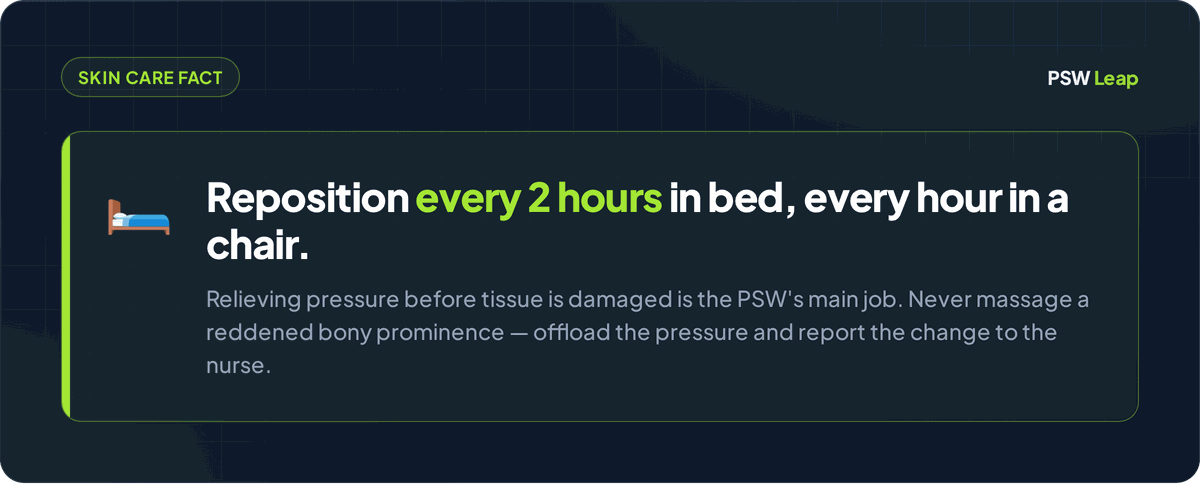
- Reposition a client in bed at least every 2 hours and in a chair at least every 1 hour — always per the care plan.
- The earliest sign is non-blanchable redness (or a darker/purple area, or changes in temperature, firmness, or pain on darker skin).
- Never massage a reddened bony prominence; keep skin clean and dry, reduce shear (head of bed ≤30°, lift don't drag), and float the heels.
- A PSW observes, documents, and reports — a nurse stages and dresses pressure injuries.
Remember: PSW practice in Ontario always follows the client's individual care plan and your employer's policies. This article is exam-prep study material, not medical advice.
Practice more free NACC questions
You just answered 10 pressure-injury and skin-care questions — but the NACC PSW exam covers every part of your program. To find your weak spots, keep practising with instant feedback. PSW Leap's 12 study modules follow the NACC PSW curriculum.
👉 Start practising free at pswleap.com/learn — 2,500 NACC-style questions, full timed mock exams, and a Duolingo-style study path built for Ontario PSW students. Start with free sample questions before you pay.
Next, brush up on what's in and out of your role: PSW Scope of Practice in Ontario.
PSW Leap is an independent NACC PSW exam-prep platform for Ontario candidates. We are not affiliated with NACC. Always follow your training, your client's care plan, and your employer's policies on the job.
Published by PSW Leap
Independent NACC PSW exam prep
PSW Leap articles are written and maintained by the platform's founder, Shashank Jha, and checked against publicly available PSW curriculum standards. Found an error? Email hello@pswleap.com and we'll fix it.
Read our content methodologyPSW Leap
Practice smarter for the NACC exam. 2,500 questions. Detailed rationales. $29.99 CAD one-time — everything included.
Try 10 free questions →No account needed. Ready for the full bank? Create your account.