Free NACC Practice Questions on Hearing & Vision Loss (Sensory Care for Ontario PSWs)
If you are studying for the NACC Personal Support Worker (PSW) exam in Ontario, hearing and vision loss is one of the most overlooked clinical topics — and one of the easiest to get wrong. So many long-term care and home-care clients have age-related sensory loss, and the PSW is the daily set of eyes and ears keeping them safe and connected. This free practice set gives you real NACC-style questions on guiding a client who can't see, communicating with one who can't hear, caring for hearing aids and glasses, and the PSW's scope — each with a clear answer. Work through them, then keep going with the full bank at pswleap.com/learn.
What are hearing and vision loss on the NACC PSW exam?
For the exam, caring for hearing and vision loss means adapting how you communicate, keeping the environment safe and predictable, looking after the client's hearing aids and glasses, and reporting any change — all within the care plan. Age-related sensory loss is everywhere in Ontario care: presbycusis (gradual hearing loss), cataracts, glaucoma, and macular degeneration are common in older clients. The exam treats the PSW as the person most likely to notice a client who has withdrawn or seems "confused" — and the one who knows the real problem may be a dead hearing-aid battery or missing glasses, not the mind.
Caring for a client with vision loss
Identify yourself by name every time you enter, approach within the client's view, explain before you touch, and never rearrange their space. A client with low vision is startled easily: say who you are as you come in, tell them what you are about to do, and let them know when you leave. Approach from the front or within whatever field of vision they have left — never silently from behind.
To help a client walk, use the sighted-guide technique: offer your arm, let them hold just above your elbow, walk half a step ahead, and describe what is coming — a step, a curb, a doorway. Keep the space consistent and clutter-free: leave furniture, the call bell, and the walker exactly where the client expects them, because vision loss is a major reason clients fall. At meals, use the clock method — "potatoes at three o'clock, chicken at nine" — so the client can eat independently. Keep glasses clean, the right pair, and within reach, with good, glare-free lighting.
Caring for a client with hearing loss
Get the client's attention before you speak, face them in good light so they can see your lips, speak clearly without shouting, and cut background noise. Move into view or gently touch their arm first so you don't startle them, then face them directly with your face well-lit — many people with hearing loss lip-read, so don't cover your mouth, chew gum, or turn away as you talk.
Speak at a normal or slightly slower pace and lower your pitch rather than raise your volume; shouting distorts speech and can hurt through a hearing aid. Turn off the TV and have one person talk at a time. If the client doesn't understand, rephrase in shorter, different words rather than repeat them louder, and add gestures, writing, or a picture board. Always confirm they actually understood — never just nod along, and never talk about the client as if they weren't in the room.
Hearing aids, glasses, and the PSW's scope in Ontario
Putting in, cleaning, and checking hearing aids and glasses are routine PSW tasks; assessing hearing or vision, removing earwax, and changing prescriptions are not. The PSW inserts and removes hearing aids, cleans them, checks each is on with a working battery, and stores it safely — a hearing aid is expensive, and losing one is reportable. A high-pitched whistle (feedback) usually means the aid isn't seated properly, the volume is too high, or there is earwax; you reseat it, lower the volume, and report it — you do not dig in the ear.
The scope line here is exactly what the exam tests. The PSW does not assess how well a client sees or hears — an optometrist, audiologist, or nurse does that — and does not remove earwax or irrigate the ear, a clinical task for the nurse. Assisting with prescribed eye or ear drops is allowed only as medication assistance under the care plan and your employer's policy, never something a PSW decides to do alone. Clients may also have outside support such as CNIB services or white-cane training; the PSW works alongside that plan, carries it out, and reports.
Quick terms to know: Presbycusis = gradual, age-related hearing loss. Feedback = the whistle a hearing aid makes when it isn't seated right or the volume is too high. Sensory loss = reduced hearing, vision, or both — easily mistaken for confusion.
Free NACC-style practice questions: hearing and vision loss
Each question mirrors the scenario-based, multiple-choice style of the NACC PSW exam. Try to answer before you read the explanation.
Q1. A PSW walks into the room of a client with severe vision loss. What should they do first?
Answer: Greet the client by name and say who you are. A client who can't see you needs to know who has entered so they aren't startled, and you explain before you touch.
Q2. How should a PSW guide a client with vision loss when walking?
Answer: Offer your arm and let the client hold just above your elbow, walking half a step ahead. This sighted-guide technique lets the client feel your movements; describe steps and curbs as you reach them.
Q3. A client with hearing loss keeps misunderstanding the PSW. What is the best next step?
Answer: Rephrase the sentence in shorter, different words — don't just repeat it louder. Face the client in good light, lower your pitch, and add gestures or writing if needed.
Q4. Why should a PSW avoid shouting at a client who wears a hearing aid?
Answer: Shouting distorts speech and can be painful through the aid. Speak clearly at a normal pace and lower your pitch instead; the hearing aid is already amplifying sound.
Q5. A client's hearing aid is whistling. What does this usually mean, and what should the PSW do?
Answer: It usually isn't seated properly, the volume is too high, or there is earwax — reseat it, lower the volume, and report it. The PSW does not remove earwax or dig in the ear.
Q6. A normally alert client suddenly seems "confused" and unresponsive at breakfast. What should the PSW check first?
Answer: Whether the client has their glasses on and their hearing aids in and working. Sensory loss is often mistaken for confusion; check the aids before assuming the mind has changed, and report it.
Q7. How should a PSW set up a meal for a client who can't see the tray?
Answer: Describe the food using the clock method — "potatoes at three o'clock." This lets the client eat independently rather than being fed.
Q8. A client with low vision asks the PSW not to move anything in the room. Why does this matter?
Answer: A consistent, clutter-free layout lets the client move safely from memory. Rearranging furniture or belongings raises fall risk — keep the call bell, walker, and items where the client expects them.
Q9. Can a PSW put in a client's prescribed eye drops?
Answer: Only as medication assistance under the care plan and the employer's policy — not as an independent decision. The PSW follows the plan; assessing the eye and prescribing the drops belong to the nurse.
Q10. A PSW notices new drainage and redness from a client's ear, and the client is rubbing it. What should they do?
Answer: Report it to the nurse and do not put anything in the ear. New ear pain, drainage, or a sudden drop in hearing are changes the PSW observes and reports, not assesses.
Common hearing- and vision-loss mistakes to avoid on the NACC exam
- Approaching or touching a client with vision loss without speaking first — always identify yourself before you touch.
- Shouting or repeating the same words louder at a client with hearing loss, instead of facing them, lowering your pitch, cutting background noise, and rephrasing.
- Assuming a quiet or "confused" client has declined mentally without first checking their glasses and hearing aids.
- Rearranging a low-vision client's room or moving their call bell, walker, or belongings.
- Trying to remove earwax or irrigate the ear — a clinical task for the nurse, never the PSW.
The hearing- and vision-loss facts the NACC exam expects you to know
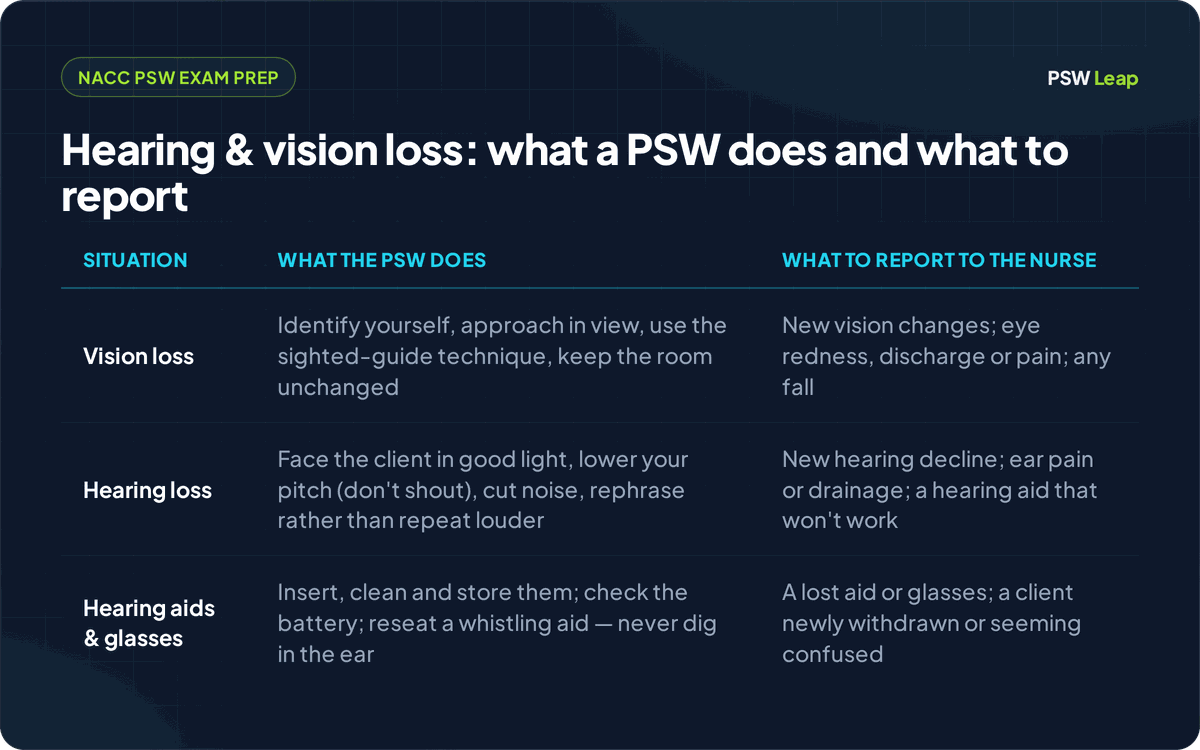
Use these one-line facts as a final review:
- Identify yourself by name when you approach a client with vision loss, and explain before you touch.
- Use the sighted-guide technique and keep the space consistent and clutter-free — vision loss is a major fall risk.
- At meals, use the clock method so a low-vision client can eat independently.
- For hearing loss, face the client in good light, lower your pitch (don't shout), cut background noise, and rephrase rather than repeat louder.
- Insert, clean, and store hearing aids; check the battery; a whistle means reseat and report, never dig in the ear.
- Check glasses and hearing aids before assuming confusion — sensory loss is the great imitator — and report new vision or hearing changes, ear pain or drainage, or a lost aid.
Remember: PSW practice in Ontario follows the client's care plan and your employer's policies, within the controlled-acts limits of the Regulated Health Professions Act, 1991. Adapting communication, caring for hearing aids and glasses, and observing and reporting are within a PSW's role; assessing hearing or vision and removing earwax or irrigating the ear are not. This article is exam-prep study material, not medical advice.
Practice more free NACC questions
You just answered 10 hearing- and vision-loss questions, but the NACC PSW exam spans every module — keep practising with instant feedback to find your weak spots fast.
👉 Start practising free at pswleap.com/learn — a large bank of NACC-style questions, full timed mock exams, and a Duolingo-style study path built for Ontario PSW students. No subscription, and you can start with sample questions before you pay.
Closely related topics worth reviewing next: Free NACC Practice Questions on Dementia Care (where sensory loss and confusion overlap) and Free NACC Practice Questions on Stroke Care (vision and communication deficits post-stroke).
PSW Leap is an independent NACC PSW exam-prep platform for Ontario candidates. We are not affiliated with NACC. Always follow your training, your client's care plan, and your employer's policies on the job.
Published by PSW Leap
Independent NACC PSW exam prep
PSW Leap articles are written and maintained by the platform's founder, Shashank Jha, and checked against publicly available PSW curriculum standards. Found an error? Email hello@pswleap.com and we'll fix it.
Read our content methodologyPSW Leap
Practice smarter for the NACC exam. 2,500 questions. Detailed rationales. $29.99 CAD one-time — everything included.
Try 10 free questions →No account needed. Ready for the full bank? Create your account.