Free NACC Practice Questions on Stroke Care (Ontario PSW Exam Prep)
If you are studying for the NACC Personal Support Worker (PSW) exam in Ontario, stroke care is a high-yield clinical topic — stroke is a leading cause of adult disability, and many long-term care and home-care clients are stroke survivors. This free practice set gives you real NACC-style questions on hemiplegia and dressing, safe transfers and positioning, post-stroke swallowing and communication, and recognizing a new stroke, each with a clear answer. Work through them, then keep going with the full question bank at pswleap.com/learn.
What does stroke care involve on the NACC PSW exam?
For the exam, stroke care is about supporting the client's daily living, protecting the weak side, reinforcing the rehab plan, and reporting changes — not diagnosing, treating, or designing therapy. A stroke (a CVA, or cerebrovascular accident) damages part of the brain, and the effects depend on where: most often one side becomes weak or paralyzed (hemiplegia), and swallowing, vision, or language can be affected.
The exam tests it heavily because PSWs do the dressing, bathing, feeding, and transfers every shift — so the PSW applies the affected-side rules, follows the texture-modified diet, and is usually first to spot a new or worsening stroke. The "right answer" almost always combines protecting the weak side, encouraging the client's own ability, staying within scope, and reporting promptly.
Which side do you dress first? Stroke care rules for Ontario PSWs
Dress the affected (weak) side first and undress the strong side first — "dress the worst, undress the best." Putting the weak limb in first avoids forcing a stiff joint through a half-on sleeve. The same logic shapes the rest of stroke care:
- Transfers go toward the strong side. Position the wheelchair on the strong side, lock the brakes, and stand on the weak side to guard. Never pull the weak arm — the shoulder can dislocate.
- Protect the affected side. Support a weak arm on a pillow, reposition often (reduced sensation raises pressure-injury risk), and test water temperature — the client may not feel heat on that side.
- Encourage independence. Let the client do what they safely can with the strong side. Rehab in Ontario is led by the physiotherapist, occupational therapist, and speech-language pathologist (SLP); the PSW reinforces that plan and reports changes rather than inventing exercises.
A new or sudden stroke is a medical emergency. If you see the FAST signs — Face drooping, Arm weakness, Speech trouble, Time to call 911 — get emergency help immediately, note when the symptoms started (it decides which treatments are still possible), stay with the client, and give nothing to eat or drink.
Quick terms to know: Hemiplegia = paralysis on one side of the body; hemiparesis = weakness on one side. Aphasia = difficulty with language (speaking or understanding), not a hearing problem. Dysphagia = difficulty swallowing. Unilateral neglect = being unaware of the affected side of the body or space.
Free NACC-style practice questions: stroke care
Each question below mirrors the scenario-based, multiple-choice style of the NACC PSW exam. Try to answer before you read the explanation.
Q1. A client has left-sided weakness after a stroke. The PSW is helping them put on a shirt. Which arm should go into the sleeve first?
Answer: The left (weak/affected) arm first — "dress the worst, undress the best." Threading the weak arm first avoids forcing a stiff limb through a half-on sleeve and protects the shoulder. When undressing, free the strong side first.
Q2. A PSW is transferring a client with right-sided weakness from bed to wheelchair. Where should the wheelchair be placed?
Answer: On the client's strong (left) side, brakes locked. Transfers move toward the strong side so the client leads with the limb that works. The PSW stands on the weak side to guard, and never pulls the weak arm.
Q3. While repositioning a stroke client, the PSW notices the weak arm hanging off the side of the bed. What should the PSW do?
Answer: Support the affected arm on a pillow in good alignment. A weak shoulder can dislocate (subluxation) under the arm's own weight. Never lift or pull by the weak arm; support also reduces swelling and pain.
Q4. During lunch, a stroke client coughs repeatedly, and their voice sounds wet and gurgly after swallowing. What should the PSW do?
Answer: Stop the meal, keep the client upright, and report to the nurse. These are signs of swallowing trouble (dysphagia) and possible aspiration. The PSW does not push the next bite or change the diet — only the textures and thickened fluids ordered by the SLP. (See our dysphagia practice questions.)
Q5. A client with expressive aphasia knows what they want to say but cannot get the words out, and is becoming frustrated. The best PSW response is to:
Answer: Give them time, stay calm, and do not finish their sentences. Use short sentences, one yes-or-no question at a time, and a picture board or gestures. Aphasia is a language problem, not a hearing or intelligence problem — shouting or talking down only makes frustration worse.
Q6. At meals, a stroke client always leaves the food on the left side of the plate untouched and seems unaware of it. What does this suggest, and what should the PSW do?
Answer: This is one-sided (unilateral) neglect — cue the client to scan toward the neglected side and turn the plate so they see all the food. Report poor intake, and keep the call bell on the strong side so help is in reach.
Q7. A PSW is helping a client when the client's face suddenly droops on one side, their speech slurs, and one arm goes weak. What is the PSW's priority action?
Answer: Call 911 immediately (or activate the facility emergency protocol) — this is a stroke (FAST signs). Note the time the symptoms started, stay with the client, and give nothing by mouth. A stroke is time-critical; fast action can save brain tissue.
Q8. Before a bed bath, why must a PSW check the water temperature especially carefully for a client with stroke-related weakness on one side?
Answer: The affected side may have reduced sensation, so the client may not feel water that is too hot. Test the temperature on your inner wrist and protect the weak side from hot surfaces — reduced sensation also hides injuries and pressure areas.
Q9. A stroke client is slowly buttoning their shirt with their strong hand. They are managing, but slowly. What should the PSW do?
Answer: Allow the time and encourage the client to finish what they can do themselves. Doing tasks for a client who is able slows recovery and lowers dignity. The PSW supports independence, stepping in only for what the client genuinely cannot manage safely.
Q10. A stroke client suddenly starts crying during care, then stops just as quickly, and seems puzzled by it. What is the most likely explanation, and how should the PSW respond?
Answer: This is likely emotional lability (sudden emotions that don't match the situation), common after a stroke — respond with calm patience. Do not assume it reflects the client's true mood or that you caused it. Stay supportive and continue care gently, and report a marked change in mood.
Common stroke-care mistakes to avoid on the NACC exam
- Dressing the strong side first instead of the weak side first ("dress the worst, undress the best").
- Pulling on or lifting by the weak arm instead of supporting the shoulder — it can dislocate.
- Transferring toward the weak side instead of leading with the strong side.
- Pushing the next bite when a client coughs or sounds gurgly instead of stopping and reporting.
- Upgrading the diet texture or thinning the fluids on your own judgement instead of following the SLP's order.
- Shouting at or finishing sentences for a client with aphasia instead of giving time and using yes/no questions.
- Treating sudden FAST signs as "wait and see" instead of calling 911 and noting the time of onset.
These match the single-best-answer logic the exam uses: the correct option protects the weak side, supports the client's ability, stays within scope, and reports changes.
The stroke-care facts the NACC exam expects you to know
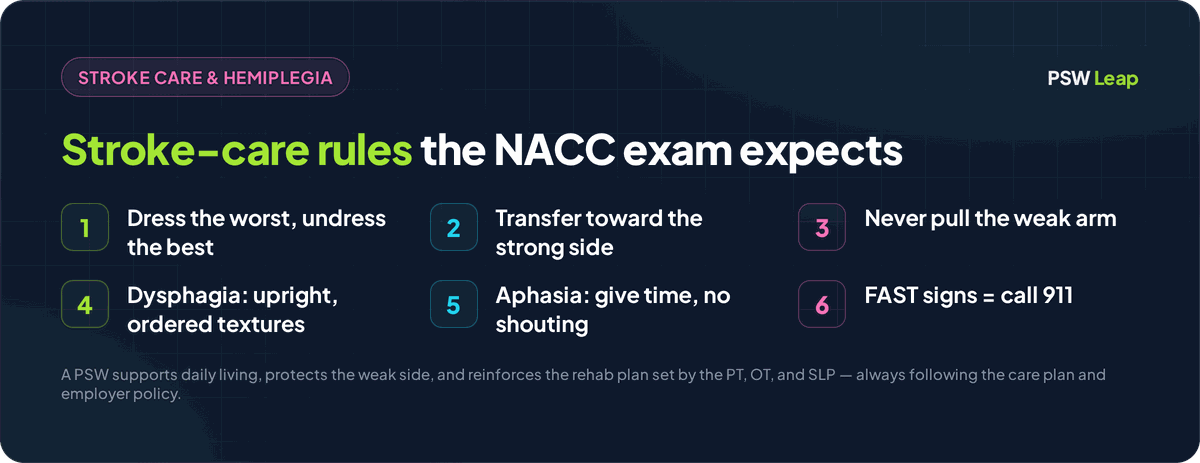
Use these one-line facts as a final review:
- Dress the worst, undress the best — affected side into clothing first, strong side out first.
- Transfer toward the strong side — wheelchair on the strong side, brakes locked, guard the weak side.
- Never pull the weak arm — support the shoulder on a pillow to prevent dislocation.
- Dysphagia: upright, chin tuck, ordered textures only — stop and report coughing or a wet voice.
- Aphasia is a language problem — give time, short yes/no questions, no shouting.
- One-sided neglect — cue scanning to the weak side; keep the call bell on the strong side.
- FAST = emergency — face, arm, speech, time; call 911 and note the onset time.
- PSWs reinforce rehab, they don't design it — follow the PT, OT, and SLP plan; report changes.
Remember: PSW practice in Ontario always follows the client's individual care plan and your employer's policies. This article is exam-prep study material, not medical advice.
Practice more free NACC questions
You just answered 10 stroke care questions — the NACC PSW exam spans all of its modules, from stroke and mobility to swallowing, communication, and emergency response. The fastest way to find your weak spots is to keep practising with instant feedback.
👉 Start practising free at pswleap.com/learn — a large bank of NACC-style questions, full timed mock exams, and a Duolingo-style study path built specifically for Ontario PSW students. No subscription, and you can start with sample questions before you pay.
Closely related topics worth reviewing next: Free NACC Practice Questions on Dysphagia & Swallowing Safety (so common after a stroke) and Free NACC Practice Questions on Fall Prevention (one-sided weakness raises fall risk).
PSW Leap is an independent NACC PSW exam-prep platform for Ontario candidates. We are not affiliated with NACC. Always follow your training, your client's care plan, and your employer's policies on the job.
Published by PSW Leap
Independent NACC PSW exam prep
PSW Leap articles are written and maintained by the platform's founder, Shashank Jha, and checked against publicly available PSW curriculum standards. Found an error? Email hello@pswleap.com and we'll fix it.
Read our content methodologyPSW Leap
Practice smarter for the NACC exam. 2,500 questions. Detailed rationales. $29.99 CAD one-time — everything included.
Try 10 free questions →No account needed. Ready for the full bank? Create your account.