Free NACC Practice Questions on Compression Stockings & Circulation Care (Ontario PSW Exam Prep)
If you are studying for the NACC Personal Support Worker (PSW) exam in Ontario, compression stockings and circulation care are a quietly high-yield clinical topic — so many long-term care and home-care clients wear prescribed stockings, and the PSW is the one who puts them on each morning and checks the legs. This free practice set gives you real NACC-style questions on anti-embolic versus graduated stockings, applying them the right way, checking the toes, edema and pitting edema, DVT warning signs, and the changes to report, each with a clear answer. Work through them, then keep going with the full bank at pswleap.com/learn.
What are compression stockings and circulation care on the NACC PSW exam?
For the exam, compression stockings are prescribed elastic stockings that support blood flow in the legs, and circulation care is putting them on correctly, checking the legs and toes, and reporting any change — all carried out by the PSW exactly as the care plan directs. A stocking only helps when it is applied smoothly; one with a wrinkle or a rolled-down top can do harm instead. Because the PSW is the daily set of eyes on a client's legs, the exam treats you as the person most likely to catch a cold toe, a new swelling, or a leg that suddenly looks wrong — and the one who knows to report it.
Anti-embolic vs compression stockings: who they are for
Anti-embolic stockings prevent clots in clients who are not moving much; graduated compression stockings treat ongoing leg and vein problems in clients who are up and about. Anti-embolic stockings — often called TED stockings and usually white — are prescribed to help prevent deep vein thrombosis (DVT) in clients who are non-ambulatory, on bed rest, or recovering from surgery; they support the circulation of someone who is lying still but do not replace movement.
Graduated compression stockings are tighter at the ankle and looser up the leg, which gently pushes blood back up toward the heart. They are prescribed for chronic venous insufficiency, leg edema, or varicose veins — very common in ambulatory home-care clients, who often put their own on but may need a hand on a hard morning. Both types are prescribed by a physician or nurse practitioner, with circulation assessed by the nurse or therapist; the PSW applies the type the plan names. In a scenario, the cues usually tell you which is which: a white stocking on a post-surgical client on bed rest is anti-embolic; a beige graduated stocking on a client heading out to her garden is for venous problems.
Applying stockings the right way, and checking circulation
Apply compression stockings in the morning before the client rises, easing them on smoothly with no wrinkles, twists, or rolled-down tops. The legs are least swollen first thing, which is exactly why the routine in long-term care is to put stockings on before the client gets up for the day. If a client has already been up for hours and the legs are swollen, the stocking will not go on properly — report it rather than fighting it on.
The technique the exam expects is simple and worth memorizing: turn the stocking partly inside-out down to the heel, fit the heel into the heel pocket, then ease and roll it up the leg so it lies flat the whole way. Make sure any toe-inspection hole sits under the toes, line up the seam, and never fold the top over to "make it fit." Some clients need a donning aid or a second pair of hands for a snug stocking — that is normal, not a failure. The point the exam never lets go of: a bunched, twisted, or rolled-down stocking acts like a tourniquet and can cut off circulation, so you smooth out every wrinkle every time, and if it won't lie flat you take it off and reapply.
The stockings also come off on a schedule. Remove them per the care plan to give the skin a break, wash and dry the legs, and look the skin over. After applying (and whenever you check), look at the toes for colour, warmth, and swelling, and confirm the client can feel and move them; note capillary refill if you were taught how. Cold, pale, blue, numb, or painful toes, or new redness, blisters, or pressure marks where the band sits, all go to the nurse.
Edema, DVT warning signs, and what to report
Edema is fluid swelling, and a sudden, one-sided, warm, painful, swollen leg may signal a DVT — which the PSW reports immediately and never massages. Edema shows up most in the legs, ankles, and feet: the skin can look stretched and shiny, socks and shoes leave deep marks, and pressing a swollen spot leaves a dent that stays for a moment — that lasting dent is pitting edema. The PSW elevates the legs if the care plan calls for it, watches the swelling day to day, and reports increases, sudden weight gain, or footwear that suddenly feels tight — without ever trying to diagnose what is causing it.
A DVT is the emergency to know cold. The warning signs are sudden swelling in one leg or calf, warmth, redness, and pain or tenderness — and the "one leg" part is the giveaway, since both legs swelling together is more often ordinary edema. A DVT matters because a clot can break loose and travel to the lungs, so the response is urgent and specific: report it to the nurse at once, keep the leg still, and never rub or massage it. Do not apply a stocking to a suspected-DVT leg, and never apply one over broken skin or a wound without direction. When in doubt, the safe answer on the exam is almost always to stop, leave the leg alone, and report.
The PSW's role in Ontario: carry out the plan, observe, report
Applying prescribed stockings and observing and reporting circulation are routine, care-plan-directed PSW tasks — not controlled acts under the Regulated Health Professions Act, 1991. The nurse, therapist, or physician assesses circulation and prescribes the stocking type and the therapy; the PSW carries out that plan, applies the stocking correctly, checks the legs, and reports back. None of that crosses into a controlled act — but the boundary is real, and the exam tests whether you can see it.
Two everyday Ontario examples make the line concrete. A home-care client asks you to bring her a tighter pair because her legs still feel heavy — you don't decide that; you report the question to the nurse, who has the prescriber adjust it. An LTC client's leg looks worse than yesterday and you wonder if you should just leave the stocking off — again, you don't make that call on your own; you put on what the plan says (or hold off only where a hard rule says not to apply — a suspected DVT or broken skin) and report what you saw. The pattern is the same every time: the PSW carries out the plan and observes and reports; the PSW does not assess circulation status, decide to start, stop, or change compression, or apply a stocking to a leg the plan does not cover. Carrying out the plan and changing it are two different jobs, and knowing the difference is exactly what the exam is checking.
Quick terms to know: Anti-embolic stocking = a usually-white stocking (TED) to help prevent clots in a client who isn't moving much. Compression / graduated stocking = tighter at the ankle, looser up the leg, for vein and edema problems. Edema = swelling from fluid in the tissues. Pitting edema = swelling that leaves a dent when pressed. DVT = a deep vein thrombosis, a clot in a leg vein. Capillary refill = how fast colour returns to a nail bed after you press it, a quick circulation check.
Free NACC-style practice questions: compression stockings and circulation
Each question mirrors the scenario-based, multiple-choice style of the NACC PSW exam. Try to answer before you read the explanation.
Q1. The care plan says to apply a client's anti-embolic stockings. When is the best time to put them on?
Answer: In the morning, before the client gets out of bed. The legs are least swollen first thing, so the stocking goes on smoothly and gives the right support; once the legs swell, it won't fit properly.
Q2. While putting on a stocking, the PSW notices the top has rolled down into a tight band. What should the PSW do?
Answer: Smooth it flat with no roll, or take it off and reapply. A rolled-down or bunched stocking acts like a tourniquet and can cut off circulation — it is never left in place.
Q3. A client is on bed rest after surgery and has white stockings prescribed. What type are they, and why?
Answer: Anti-embolic (TED) stockings, to help prevent a deep vein thrombosis. They are for non-ambulatory or post-surgery clients who are not moving much and so are at higher risk of a clot.
Q4. After applying stockings, the PSW checks the client's toes. What are they looking for?
Answer: Colour, warmth, swelling, and that the client can feel and move the toes. Cold, pale, or blue toes, or new numbness, mean circulation may be affected — report it to the nurse.
Q5. A client's calf has suddenly become swollen, warm, red, and painful in one leg. What should the PSW do?
Answer: Report it to the nurse immediately and do not rub or massage the leg. These are warning signs of a DVT, and massaging could dislodge the clot.
Q6. The client has a suspected DVT in the right leg. Should the PSW apply the prescribed stocking to that leg?
Answer: No — do not apply a stocking to a leg with a suspected DVT, and report it. A stocking is never put on a newly red, swollen, painful leg until the nurse has assessed it.
Q7. A PSW presses on a client's swollen ankle and the dent stays for a moment. What is this called?
Answer: Pitting edema. Edema is fluid swelling, and when pressing leaves a lasting dent it is pitting edema. The PSW elevates the legs per the plan and reports any increase.
Q8. The client's legs are already swollen from being up for hours, and the stocking won't go on. What should the PSW do?
Answer: Do not force the stocking on — report it. Stockings go on best in the morning before swelling; one jammed onto an already-swollen leg can constrict and harm circulation.
Q9. While removing a stocking to wash the leg, the PSW finds a new blister and broken skin. What is the right action?
Answer: Protect the area, do not reapply the stocking over it, and report it to the nurse. A stocking is never applied over broken skin or a wound; the nurse decides what happens next.
Q10. A home-care client manages her own graduated stockings but asks the PSW whether to switch to a tighter pair. What is the best response?
Answer: Tell her the prescriber decides the stocking type, and report her question to the nurse. The PSW does not change or recommend compression therapy — that is outside the PSW's scope.
Common compression-stocking and circulation mistakes to avoid on the NACC exam
- Leaving a wrinkled, twisted, or rolled-down stocking in place — a rolled top acts like a tourniquet; smooth it flat or reapply.
- Applying stockings after the legs have swollen, or forcing one onto a swollen leg, instead of applying in the morning and reporting if it won't fit.
- Massaging a suddenly swollen, painful leg — a suspected DVT is never rubbed; keep the leg still and report it immediately.
- Applying a stocking over broken skin, a wound, or a suspected DVT instead of reporting and waiting for direction.
- Deciding to start, stop, or change compression yourself — assessing circulation and prescribing belong to the nurse, therapist, or prescriber.
The compression-stocking and circulation facts the NACC exam expects you to know
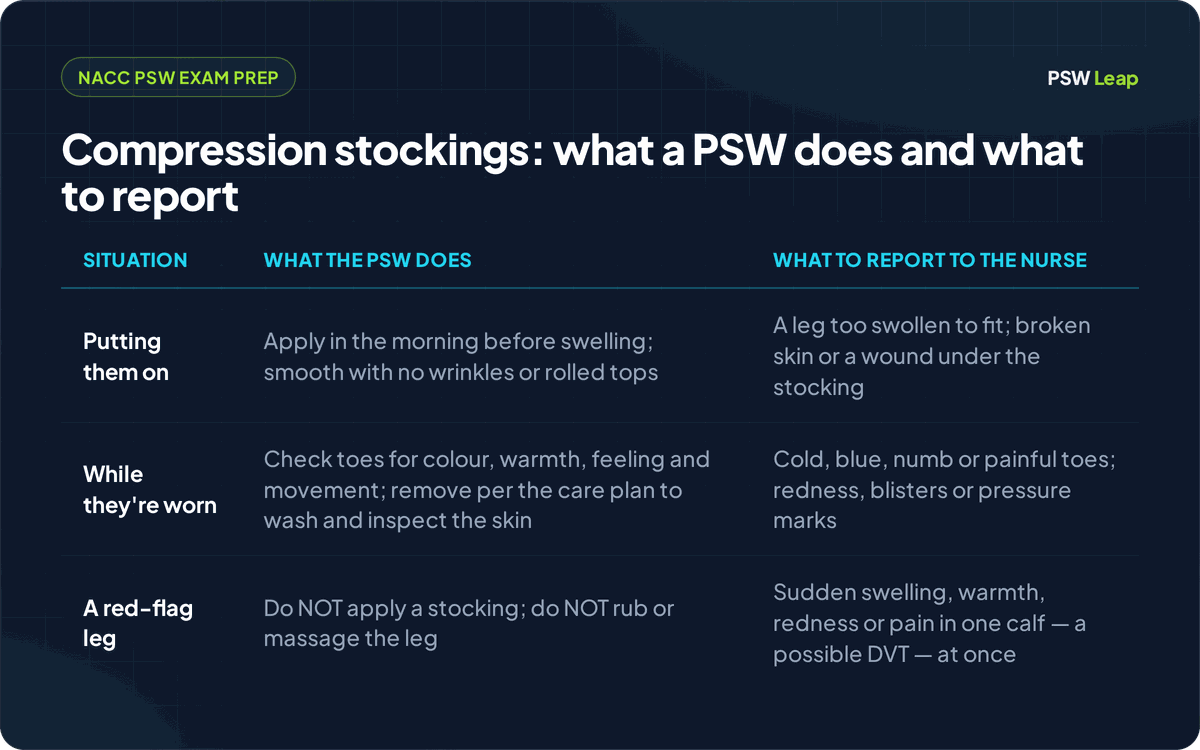
Use these one-line facts as a final review:
- Anti-embolic (TED) stockings prevent clots in non-ambulatory or post-surgery clients; graduated stockings treat edema, varicose veins, and venous insufficiency.
- Apply in the morning before the client rises — least swelling, best fit; if the leg is already swollen, report it.
- No wrinkles, twists, or rolled-down tops — a bunched stocking is a tourniquet that can cut off circulation.
- Check toes for colour, warmth, swelling, feeling, and movement; report cold or blue toes or numbness.
- Remove and inspect the skin per the care plan — report redness, broken skin, blisters, or tingling.
- Pitting edema leaves a dent; elevate per the plan, observe, and report increased swelling or sudden weight gain.
- A sudden one-sided, warm, painful, swollen leg may be a DVT — report at once, never massage, never apply a stocking to it.
Remember: PSW practice in Ontario follows the client's care plan and your employer's policies, within the controlled-acts limits of the Regulated Health Professions Act, 1991. Applying prescribed stockings and observing and reporting circulation changes is within a PSW's role; assessing circulation and prescribing or changing compression therapy are not. This article is exam-prep study material, not medical advice.
Practice more free NACC questions
You just answered 10 compression-stocking and circulation questions, and the NACC PSW exam spans every module. The fastest way to find your weak spots is to keep practising with instant feedback.
👉 Start practising free at pswleap.com/learn — a large bank of NACC-style questions, full timed mock exams, and a Duolingo-style study path built for Ontario PSW students. No subscription, and you can start with sample questions before you pay.
Closely related topics worth reviewing next: Free NACC Practice Questions on Foot Care (the feet that poor circulation puts at risk) and Free NACC Practice Questions on Pressure Injuries (protecting fragile skin).
PSW Leap is an independent NACC PSW exam-prep platform for Ontario candidates. We are not affiliated with NACC. Always follow your training, your client's care plan, and your employer's policies on the job.
Published by PSW Leap
Independent NACC PSW exam prep
PSW Leap articles are written and maintained by the platform's founder, Shashank Jha, and checked against publicly available PSW curriculum standards. Found an error? Email hello@pswleap.com and we'll fix it.
Read our content methodologyPSW Leap
Practice smarter for the NACC exam. 2,500 questions. Detailed rationales. $29.99 CAD one-time — everything included.
Try 10 free questions →No account needed. Ready for the full bank? Create your account.