Free NACC Practice Questions on Foot Care (Ontario PSW Exam Prep)
If you are studying for the NACC Personal Support Worker (PSW) exam in Ontario, foot care is a quietly high-yield clinical topic — many long-term care and home-care clients are older adults or people living with diabetes, and the PSW who provides their daily care is usually the first to notice a problem foot. This free practice set gives you real NACC-style questions on daily foot hygiene, drying between the toes, when a PSW may trim nails and when to refer, the diabetic foot, heat and water-temperature safety, and the changes to report, each with a clear answer. Work through them, then keep going with the full question bank at pswleap.com/learn.
What does foot care involve on the NACC PSW exam?
For the exam, foot care is about keeping a client's feet clean, dry, protected, and observed every day — and knowing exactly where routine care ends and the nurse or foot specialist begins. The "right answer" almost always combines gentle daily hygiene done well, staying within scope, protecting fragile skin, and reporting changes promptly. Foot care lives inside personal care and hygiene, but it carries its own scope-of-practice rules that the exam likes to test, because a small mistake on a high-risk foot can cause real harm.
The reason it matters: the feet are far from the heart and easy to ignore, so on an older adult or a client with diabetes a stone in the shoe or a tiny crack can quietly become a deep wound — and the PSW is the daily set of eyes that catches it early.
The PSW's scope with foot care in Ontario
A trained PSW provides routine daily foot care; corns, calluses, wounds, and the nails of high-risk clients go to the nurse or a foot specialist. In Ontario, a PSW's task list is set by the employer and the client's care plan, within the controlled-acts limits of the Regulated Health Professions Act, 1991. Washing, drying, inspecting, moisturizing, and choosing safe footwear are routine personal-care tasks a PSW can do when they are in the care plan — and basic nail filing or trimming for a healthy, low-risk client is possible when the PSW has had proper foot-care training and the employer allows it.
The important exam point is when a PSW must not cut nails. A PSW does not cut or trim the toenails of a client who has diabetes, poor circulation (peripheral vascular disease), reduced sensation (neuropathy), or who takes blood thinners. This is not because nail-cutting is a "controlled act" — it isn't one under the Act. It is because the risk is too high: on those feet a small nick can become an infection or an ulcer that heals badly. For those clients, nail care is referred to a nurse, a chiropodist or podiatrist, or a specialized foot-care nurse.
Quick terms to know: Neuropathy = nerve damage that dulls feeling in the feet, so an injury isn't felt. Peripheral vascular disease = poor blood flow to the feet, so injuries heal slowly. Chiropodist / podiatrist = a regulated foot-care specialist who assesses and treats the feet. Maceration = skin gone soft and broken down from staying wet. Corn / callus = thickened skin from pressure or rubbing — not for a PSW to cut.
Free NACC-style practice questions: foot care
Each question below mirrors the scenario-based, multiple-choice style of the NACC PSW exam. Try to answer before you read the explanation.
Q1. A PSW is washing the feet of a client who has diabetes. After washing, what is the most important step?
Answer: Pat the feet completely dry, especially between the toes. Damp skin between the toes stays warm and moist, softens, and invites fungal infection and breakdown. Drying gently between every toe is the small habit that prevents a common, avoidable problem.
Q2. A client with diabetes has thick, overgrown toenails. The care plan does not mention nail trimming. What should the PSW do?
Answer: Do not cut the nails — report it so a nurse or foot-care specialist can do it. A PSW does not cut the nails of a client with diabetes, poor circulation, neuropathy, or who is on blood thinners, because a small nick can become a serious infection. The PSW reports the overgrown nails and they are referred to the nurse, a chiropodist or podiatrist, or a foot-care nurse.
Q3. A client asks the PSW to shave down a painful callus on the bottom of their foot. What is the best response?
Answer: Do not cut or shave the callus; report it to the nurse. Cutting corns or calluses is outside a PSW's scope and can open the skin and cause infection. The PSW protects the area, reduces the pressure if possible (well-fitting footwear, repositioning), and reports it for the nurse or a foot specialist to manage.
Q4. Before applying lotion to a client's feet, where should the PSW avoid putting it?
Answer: Between the toes. Lotion keeps dry skin on the tops and bottoms of the feet from cracking, but lotion left between the toes keeps that skin damp and macerated — the same setup that leads to fungal infection. Moisturize the foot, keep between the toes dry.
Q5. A client with reduced feeling in their feet says their feet are cold and asks for a heating pad. What should the PSW do?
Answer: Do not use a heating pad or hot water bottle — offer warm socks and report it. A client who cannot feel heat well can be burned without knowing it, and a burn on a poorly healing foot is dangerous. Keep the feet warm with socks, never direct heat, and report the cold feet to the nurse.
Q6. What is the safest way to check the water temperature before washing a client's feet?
Answer: Test it with a bath thermometer or your inner wrist, and keep it comfortably warm — never hot. Never rely on the client's own sense of temperature if they have neuropathy. Comfortably warm water protects fragile skin and prevents burns.
Q7. While drying a client's foot, the PSW notices a small red, broken area on the heel. What should the PSW do?
Answer: Protect the area and report it to the nurse promptly; do not treat it. A break in the skin on the foot — a crack, blister, or sore — is an early warning, especially with diabetes or poor circulation. The PSW keeps it clean and protected, keeps pressure off it, and reports it so the nurse can assess before it becomes a wound.
Q8. A client's feet have a corn that the family bought an over-the-counter corn remover for. What should the PSW do?
Answer: Do not apply it — report to the nurse. Over-the-counter corn and wart removers contain acid that can burn the skin and cause an ulcer, especially on a diabetic or poorly circulated foot. Their use is not a PSW task; the corn is referred to the nurse or a foot specialist.
Q9. Before putting a client's shoes on, what should the PSW always do?
Answer: Check inside each shoe for stones, folds, or objects, and make sure socks are smooth. A client with neuropathy may not feel a pebble or a wrinkled sock, and that constant pressure can cause a blister or sore. Smooth socks and well-fitting, closed-toe footwear protect the feet; the exam expects this simple check.
Q10. A PSW notices one of a client's feet has become pale, cool, and the client reports new numbness. What is the best action?
Answer: Report it to the nurse promptly. A foot that turns pale or cool with new numbness can signal poor blood flow and needs the nurse's assessment — this is not "wait and see." The PSW keeps the client comfortable, does not apply heat or massage, and escalates.
Common foot-care mistakes to avoid on the NACC exam
- Cutting the nails of a high-risk client (diabetes, poor circulation, neuropathy, blood thinners) instead of reporting and referring to the nurse or a foot specialist.
- Cutting or shaving corns and calluses, or using over-the-counter corn removers — both are outside scope and can open the skin.
- Leaving the skin between the toes damp, or putting lotion there, instead of drying it gently and keeping it dry.
- Using a heating pad or hot water bottle on feet that may not feel heat, or skipping the water-temperature check — use warm socks and always test the water.
- Skipping the daily look, instead of inspecting for redness, cracks, blisters, and colour or temperature changes, and checking inside the shoes before they go on.
The foot-care facts the NACC exam expects you to know
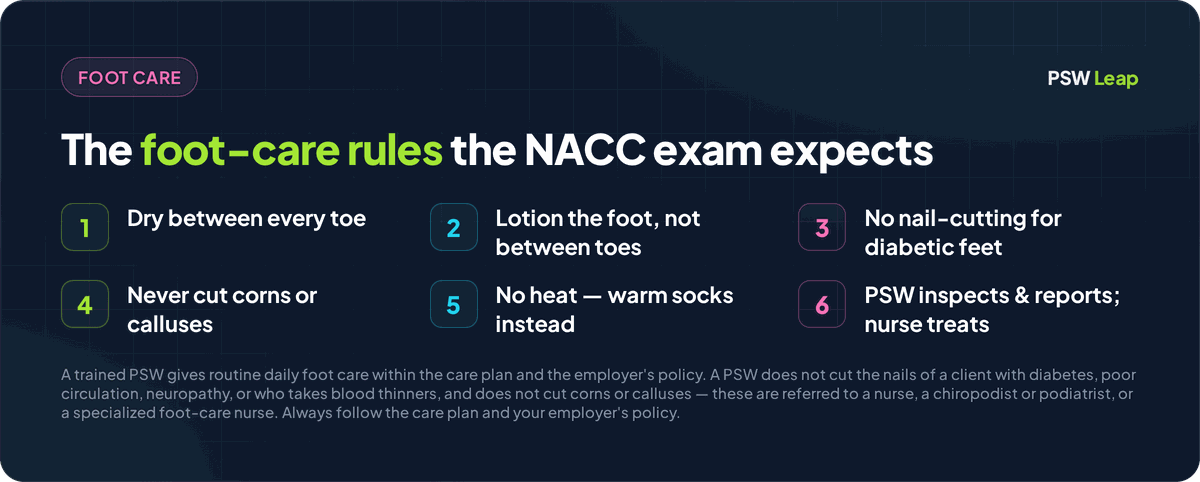
Use these one-line facts as a final review:
- Dry between the toes — never leave them damp; that is where breakdown starts.
- Lotion the foot, not between the toes — keep that skin dry.
- No nail-cutting for diabetes, poor circulation, neuropathy, or blood thinners — refer to the nurse or a foot specialist.
- Never cut corns or calluses, and never use over-the-counter corn removers.
- No heating pads or hot water bottles — use warm socks; check water temperature every time.
- Inspect feet daily and report redness, cracks, blisters, colour or temperature changes early.
- Check inside shoes and smooth the socks before footwear goes on.
- A PSW washes, dries, inspects, and reports — the nurse or foot specialist assesses and treats.
Remember: PSW practice in Ontario always follows the client's individual care plan and your employer's policies, within the controlled-acts limits of the Regulated Health Professions Act, 1991. Whether a trained PSW may trim a low-risk client's nails depends on that care plan and policy. This article is exam-prep study material, not medical advice.
Practice more free NACC questions
You just answered 10 foot care questions — the NACC PSW exam spans all of its modules, from foot and skin care to vital signs, mobility, and emergencies. The fastest way to find your weak spots is to keep practising with instant feedback.
👉 Start practising free at pswleap.com/learn — a large bank of NACC-style questions, full timed mock exams, and a Duolingo-style study path built specifically for Ontario PSW students. No subscription, and you can start with sample questions before you pay.
Closely related topics worth reviewing next: Free NACC Practice Questions on Diabetes Care (the condition behind most high-risk feet) and Free NACC Practice Questions on Pressure Injuries (protecting fragile skin everywhere else).
PSW Leap is an independent NACC PSW exam-prep platform for Ontario candidates. We are not affiliated with NACC. Always follow your training, your client's care plan, and your employer's policies on the job.
Published by PSW Leap
Independent NACC PSW exam prep
PSW Leap articles are written and maintained by the platform's founder, Shashank Jha, and checked against publicly available PSW curriculum standards. Found an error? Email hello@pswleap.com and we'll fix it.
Read our content methodologyPSW Leap
Practice smarter for the NACC exam. 2,500 questions. Detailed rationales. $29.99 CAD one-time — everything included.
Try 10 free questions →No account needed. Ready for the full bank? Create your account.