Free NACC Practice Questions on Vital Signs (Ontario PSW Exam Prep)
If you are studying for the NACC Personal Support Worker (PSW) exam in Ontario, vital signs are one of the highest-yield clinical topics on the test — and a skill you will use on almost every shift. Temperature, pulse, respiration, blood pressure, and oxygen saturation are the quick measurements that tell the care team how a client's body is working, and a PSW is usually the first person to notice when a number has changed. This free practice set gives you real NACC-style questions on the normal adult ranges, measurement technique, the red flags to report, and how to document, each with a clear answer and a plain-language explanation. Work through them, check your reasoning, then keep going with the full question bank at pswleap.com/learn.
What are vital signs, and why does the NACC PSW exam test them?
Vital signs are the basic measurements of how the body is functioning — temperature (T), pulse (P), respiration (R), blood pressure (BP), and oxygen saturation (SpO2). Pain is often called the "fifth vital sign" and is rated on a 0–10 scale.
The NACC PSW exam tests vital signs heavily because Personal Support Workers in Ontario measure and record these numbers every day. You are not expected to diagnose what an abnormal reading means or to change a client's treatment. You are expected to measure accurately, know the normal adult ranges cold, recognize a value that is outside the range, compare it to the client's baseline, document it clearly, and report anything abnormal to the nurse.
Quick definitions to memorize: Baseline = the client's own usual numbers. Tachycardia = pulse over 100; bradycardia = pulse under 60. Tachypnea = fast breathing; bradypnea = slow breathing. SpO2 = oxygen saturation measured with a pulse oximeter. Fever = a temperature of 38°C or higher.
The normal adult ranges to memorize
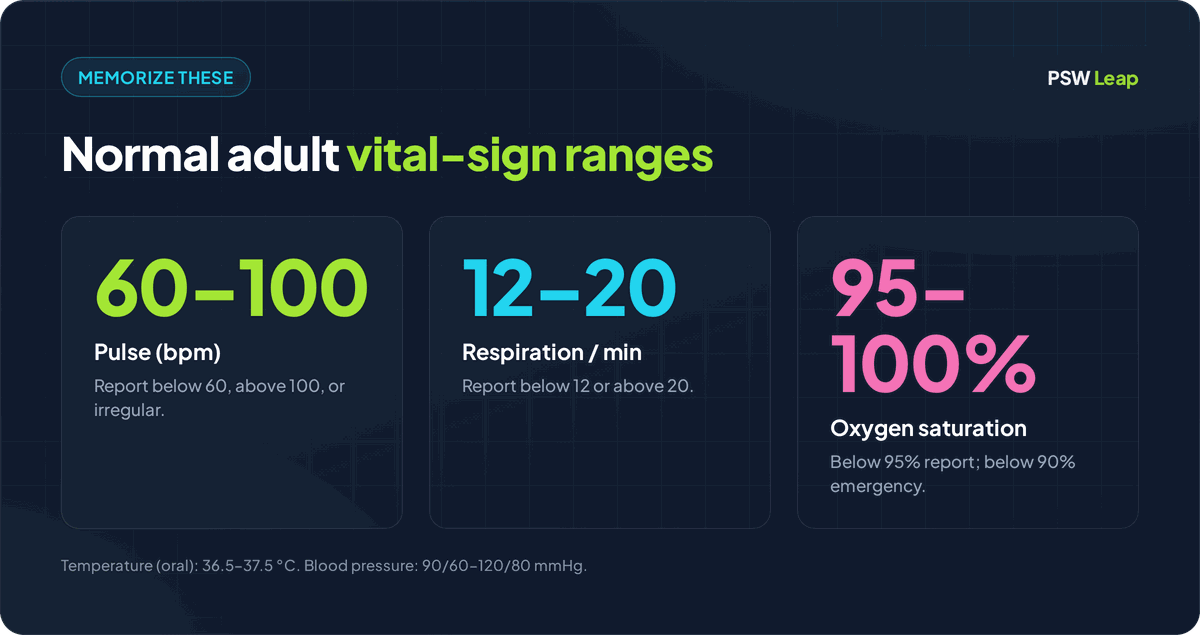
These are the single most "quotable" facts on the whole topic — the exam expects you to know them without hesitating:
- Temperature: 36.5–37.5°C (oral). Fever ≥ 38°C; hypothermia < 35°C.
- Pulse: 60–100 beats per minute (resting adult).
- Respiration: 12–20 breaths per minute (adult).
- Blood pressure: under 120/80 mmHg is normal; 130/80 mmHg or higher suggests hypertension.
- Oxygen saturation (SpO2): 95–100%; below 90% is low and should be reported.
Routes change the temperature reading: rectal reads about 0.5°C higher than oral, axillary reads about 0.5°C lower, and tympanic reads close to oral. Knowing the route is part of knowing the number.
The PSW's role: measure, record, report
A PSW's job with vital signs lives inside three verbs:
- Measure accurately, using the right technique, the right equipment, and the right route for the client.
- Record the result immediately and completely — time, value, route or site, and the client's position.
- Report any abnormal reading, or any sharp change from the client's baseline, to the nurse.
PSWs do not diagnose the cause of an abnormal vital sign, adjust medications, or change the care plan — those require a regulated professional. When an exam scenario asks what the PSW should do about a worrying number, the correct answer almost always stays inside measure, record, and report — never treat.
Free NACC-style practice questions: vital signs
Each question below mirrors the scenario-based, multiple-choice style of the NACC PSW exam. Try to answer before you read the explanation.
Q1. Why does the NACC PSW exam test vital signs so heavily?
Answer: Because PSWs measure and record them every shift and are first to spot a change. Vital signs are the earliest warning the care team gets that something is wrong. The exam expects you to measure accurately, know the normal adult ranges, record the result, and report anything abnormal to the nurse — not to diagnose or treat. If a scenario gives you a number, the relevant skill is recognizing whether it is normal and what to do about it.
Q2. What are the normal adult ranges for temperature, pulse, respiration, blood pressure, and oxygen saturation?
Answer: T 36.5–37.5°C, P 60–100, R 12–20, BP under 120/80, SpO2 95–100%. For a resting adult: temperature about 36.5–37.5°C oral, pulse 60–100 beats per minute, respiration 12–20 breaths per minute, blood pressure under 120/80 mmHg, and oxygen saturation 95–100%. These are the ranges the exam expects you to recognize instantly, because every "is this normal?" question depends on them.
Q3. A PSW takes a client's blood pressure and gets 158/96. What should the PSW do?
Answer: Record it and report it to the nurse — do not treat it. A reading of 158/96 is above the normal range, so the PSW documents the value, the arm, and the client's position, then reports it to the nurse. A PSW does not give or adjust blood-pressure medication or decide what the reading means — that is outside the PSW scope. Re-checking after a couple of minutes on the same arm is reasonable, but the abnormal number is still reported.
Q4. What oral temperature is considered a fever, and what should the PSW do?
Answer: 38°C or higher is a fever — report it. A temperature of 38°C or above should be reported to the nurse; a temperature below 35°C is hypothermia and a medical emergency. Remember that a hot or cold drink throws off an oral reading for about 15 minutes, so wait before measuring. The PSW records the temperature and route (for example, "38.2°C oral") and reports it — the PSW does not give medication for the fever.
Q5. A client's pulse feels irregular. How should the PSW count it?
Answer: Count the full 60 seconds. When a pulse is irregular (or weak, or the client is an infant), count for a full minute rather than counting for 15 or 30 seconds and multiplying — short counts miss the irregularity and give a wrong rate. Use the radial pulse at the wrist for routine checks, note that the rhythm is irregular, and report a new or changed irregular pulse to the nurse, since it can be an important finding.
Q6. How should a PSW count a client's respirations?
Answer: Count without telling the client, watching the chest rise and fall. People change their breathing when they know it is being measured, so keep your fingers on the wrist as if still taking the pulse and quietly count the breaths for a full minute. A normal adult rate is 12–20 breaths per minute. Also note the quality — shallow, laboured, or noisy breathing — and report a rate under 12 or over 20, or any difficulty breathing, to the nurse.
Q7. Which cuff problem makes a blood-pressure reading falsely high?
Answer: A cuff that is too small. A blood-pressure cuff that is too small for the client's arm reads falsely high, while a cuff that is too large reads falsely low. The bladder should cover about 80% of the upper arm. For an accurate reading, seat the client with the back supported and feet flat, rest the arm at heart level, and avoid taking the pressure right after activity. The right cuff and the right position are what make the number trustworthy.
Q8. A pulse oximeter reads 88% on a client who is short of breath. What should the PSW do?
Answer: Report it to the nurse right away. A reading of 88% in a client who is short of breath — especially if it is lower than their usual reading or outside the care plan's reporting parameters — is a finding to report immediately. Report the breathing difficulty and the reading right away, and if the distress is severe or gets worse, call for help and for first responders as your employer's emergency protocol sets out. A cold hand, nail polish or a poorly placed probe can give a falsely low reading, so you can recheck the probe after you have reported — never let a recheck delay the report or the call for help. A PSW does not decide to start or change oxygen; where helping with a client's oxygen means administering it, a PSW does so only through an exception in the Regulated Health Professions Act, 1991 (accessed September 26, 2026), such as a routine activity of living that a nurse has assessed and taught the PSW to do for this client, or a delegation, and only as the setting's legislation, the care plan, their training and the employer's policy allow.
Q9. A client's vital signs are all within normal ranges but every number has shifted from their usual baseline. What does this tell the PSW?
Answer: A change from baseline matters even when the numbers are still "normal." Trends matter more than a single reading. A blood pressure or pulse that is technically inside the normal range can still be abnormal for that client if it has moved sharply from their baseline. Several vital signs drifting together is a pattern worth reporting. The PSW documents the readings with times and reports the change from baseline to the nurse.
Q10. How should a PSW document a set of vital signs?
Answer: Record the time, value, route or site, and position — immediately and exactly. Good documentation is specific: "37.8°C oral, P 92 radial, R 18, BP 138/84 right arm sitting, SpO2 96%, at 0815." Vague notes like "vitals a little off" are not useful and do not hold up. Record exact numbers and units right after you take them, so the nurse can see the trend — accurate, timely charting is exactly what the NACC exam rewards.
Common vital-signs mistakes to avoid on the NACC exam
- Choosing to treat an abnormal reading (giving medication, adjusting oxygen) instead of reporting it — that is outside the PSW scope.
- Counting an irregular pulse for 15 or 30 seconds and multiplying, instead of a full minute.
- Telling the client you are counting their breaths, which changes the result.
- Ignoring a number because it is "still in the normal range" when it has changed from the client's baseline.
- Using the wrong cuff size and trusting the reading anyway.
Each of these matches the single-best-answer logic the NACC exam uses: the correct option is the safest, most accurate action that stays within the PSW scope — measure, record, report.
The vital-signs facts the NACC exam expects you to know
Use these one-line facts as a final review — they are the kind of definitive statements the exam rewards:
- Normal adult ranges: T 36.5–37.5°C, P 60–100, R 12–20, BP under 120/80, SpO2 95–100%.
- A temperature of 38°C or higher is a fever; below 35°C is hypothermia and an emergency.
- Tachycardia = pulse over 100; bradycardia = pulse under 60 — both are reported.
- Count an irregular pulse for a full 60 seconds.
- Count respirations without telling the client, and note the quality, not just the rate.
- A cuff too small reads high; too large reads low — and the arm sits at heart level.
- An SpO2 below 90% is reported right away, especially with shortness of breath.
- A sharp change from the client's baseline is reported even if the number is still "normal."
- The PSW's job is to measure, record, and report — never to diagnose or treat.
Remember: PSW practice in Ontario always follows the client's individual care plan and your employer's policies. This article is exam-prep study material, not medical advice.
Practice more free NACC questions
You just answered 10 vital-signs questions — the NACC PSW exam covers every part of your program, from vital signs and safety to nutrition, dementia care, and infection control. To find your weak spots, keep practising with instant feedback. PSW Leap's 12 study modules follow the NACC PSW curriculum.
👉 Start practising free at pswleap.com/learn — 2,500 NACC-style questions, full timed mock exams, and a Duolingo-style study path built specifically for Ontario PSW students. No subscription, and you can start with sample questions before you pay.
Want the deeper reference on the numbers? Read Vital Signs Normal Ranges for PSWs, or keep working through the free series with Free NACC Practice Questions on Dysphagia & Safe Swallowing.
PSW Leap is an independent NACC PSW exam-prep platform for Ontario candidates. We are not affiliated with NACC. Always follow your training, your client's care plan, and your employer's policies on the job.
Published by PSW Leap
Independent NACC PSW exam prep
PSW Leap articles are written and maintained by the platform's founder, Shashank Jha, and checked against publicly available PSW curriculum standards. Found an error? Email hello@pswleap.com and we'll fix it.
Read our content methodologyPSW Leap
Practice smarter for the NACC exam. 2,500 questions. Detailed rationales. $29.99 CAD one-time — everything included.
Try 10 free questions →No account needed. Ready for the full bank? Create your account.