Free NACC Practice Questions on Wound Care & Skin Tears (Ontario PSW Exam Prep)
If you are studying for the NACC Personal Support Worker (PSW) exam in Ontario, wound care and skin tears are a high-yield clinical topic — PSWs handle frail skin every shift, so they are usually the first to spot a new tear or a wound starting to get infected. This free practice set gives you real NACC-style questions on skin tears, signs of wound infection, scope of practice, diabetic foot wounds, and what to report, each with a clear answer and explanation. Work through them, then keep going with the full question bank at pswleap.com/learn.
What does wound care involve on the NACC PSW exam?
For the exam, wound care is about observing, protecting, and reporting — not assessing, staging, or deciding on treatment. A PSW notices a wound or a change, protects the surrounding skin, keeps the area clean and dry within the care plan, and reports to the nurse, who assesses and dresses it.
The exam tests it heavily because PSWs do the bathing, dressing, repositioning, and transfers — so a skin tear, leaking dressing, or foot sore usually shows up in front of the PSW first, and in Ontario care settings a prompt, accurate report is often what gets a wound treated before it becomes a serious infection. The "right answer" almost always combines protecting the client, staying within scope, and reporting promptly.
Quick terms to know: Skin tear = a wound where friction or shear separates the skin layers, common in frail older skin. Purulent drainage = thick, cloudy, yellow or green pus — a sign of infection. Controlled act = a task Ontario law restricts to regulated professionals unless it is properly delegated.
Is changing a dressing part of the PSW's scope in Ontario?
Usually not on your own judgement — a sterile or complex dressing change is a controlled act under Ontario's Regulated Health Professions Act. A PSW only performs one if they are specifically trained, the task is delegated by a regulated professional such as an RN or RPN, it is written into the client's care plan, and the employer's policy permits it.
What a PSW does every shift is observe wounds, protect the skin around them, keep areas clean and dry, and report. A PSW never starts, stops, or changes a wound treatment, and never applies a medicated cream or ointment on their own decision — that is medication assistance and treatment. If a dressing is loose, soiled, or leaking, the PSW reports it rather than redoing it unsupervised. Knowing the line between "observe and report" and "assess and treat" is one of the most reliable scope questions on the exam. As always, follow your training, the client's care plan, and your employer's policy.
Free NACC-style practice questions: wound care & skin tears
Each question below mirrors the scenario-based, multiple-choice style of the NACC PSW exam. Try to answer before you read the explanation.
Q1. While helping a frail client put on a sweater, the skin on their forearm tears and a flap of skin lifts up. What should the PSW do first?
Answer: Stay calm, apply gentle pressure for any bleeding, and do not pull off the flap. If the flap is still attached, gently roll it back over the wound — it can still help the skin heal. Cover it loosely only if that is within your training and care plan, then report to the nurse so it can be assessed and dressed. Removing the flap or scrubbing the area is wrong.
Q2. A client's lower-leg wound now has spreading redness, warmth, swelling, and thick yellow-green drainage with a bad smell. What does this most likely indicate, and what should the PSW do?
Answer: These are signs of a wound infection — report to the nurse promptly. The PSW does not diagnose the infection, apply cream, or change the treatment. The right move is an accurate, prompt report (with what was seen) so the nurse can assess and the team can act before it worsens.
Q3. Is it within a PSW's scope to change the sterile dressing on a client's surgical wound in Ontario?
Answer: Not on their own judgement. A sterile or complex dressing change is a controlled act under the Regulated Health Professions Act. A PSW performs one only when trained, delegated by a regulated professional, written into the care plan, and allowed by employer policy. Otherwise the PSW keeps the area clean and dry and reports.
Q4. A PSW notices a small open sore on the sole of a client's foot. The client has diabetes and says they didn't feel it. The PSW should:
Answer: Keep the foot clean and dry, apply no treatment of their own, and report it the same shift. Diabetes can dull foot sensation and slow healing, so a small sore can become a serious infection fast. This is an urgent observe-and-report situation — not something to "watch and see."
Q5. Which action best helps PREVENT skin tears in a frail older client?
Answer: Handle the client gently — lift rather than drag, support limbs, and keep skin moisturized. Padding bed rails and footplates, long sleeves or limb protectors, short fingernails, and good lighting all help too. Most skin tears happen during transfers and personal care, so careful technique prevents them.
Q6. During care, a PSW sees a reddened area over a client's tailbone that does not turn white when pressed. Should the PSW clean and dress it as a wound?
Answer: No — this is a possible pressure injury; offload the area, keep it clean and dry, and report it. Staging and dressing are the nurse's job. (For prevention details, see our pressure injuries practice questions.) The PSW's job here is to protect and report.
Q7. What should a PSW observe and report about a client's wound?
Answer: Location, size compared with before, colour, the amount and colour and smell of drainage, the surrounding skin, and any pain. Objective detail is what the nurse needs — for example, "2 cm skin tear, left forearm, small amount of blood, flap intact." Vague notes like "wound looks bad" are not useful.
Q8. A client asks the PSW to "just dab some antibiotic cream on and put a fresh bandage on" their wound. What should the PSW do?
Answer: Do not apply the cream or treat the wound — report the request to the nurse. Applying a medicated cream is treatment and medication assistance, outside a PSW's independent scope. The PSW reassures the client, keeps the area clean per the care plan, and lets the nurse decide.
Q9. While giving care, a PSW accidentally causes a small skin tear on a client's arm. What is the right thing to do?
Answer: Provide first aid within scope, then report and document it honestly. Apply gentle pressure, do not remove the flap, and tell the nurse what happened. Hiding an injury is unsafe — honest reporting protects the client and is part of accountable practice.
Q10. A client's long-standing leg ulcer looks about the same, but today the client has a new fever and feels generally unwell. The PSW should:
Answer: Report the change promptly — whole-body signs can mean the wound is infecting. Fever, chills, or feeling unwell can signal infection even when the wound looks similar. The PSW reports the change in the whole person, not just the appearance of the wound, so it can be assessed.
Common wound-care mistakes to avoid on the NACC exam
- Removing or trimming a skin-tear flap instead of rolling attached skin back and reporting.
- Applying cream, ointment, or a new dressing on your own judgement instead of reporting.
- Treating a diabetic foot sore as minor instead of reporting it the same shift.
- Cleaning or dressing a pressure injury instead of offloading and reporting it to the nurse.
- Charting "wound looks bad" instead of objective detail (size, colour, drainage, surrounding skin).
- Ignoring fever or feeling unwell when a wound looks unchanged — whole-body signs still count.
- Not reporting a wound you caused — honest reporting is part of safe, accountable practice.
Each of these matches the single-best-answer logic the NACC exam uses: the correct option is the action that protects the client, stays within the PSW's scope, and reports the wound or change.
The wound-care facts the NACC exam expects you to know
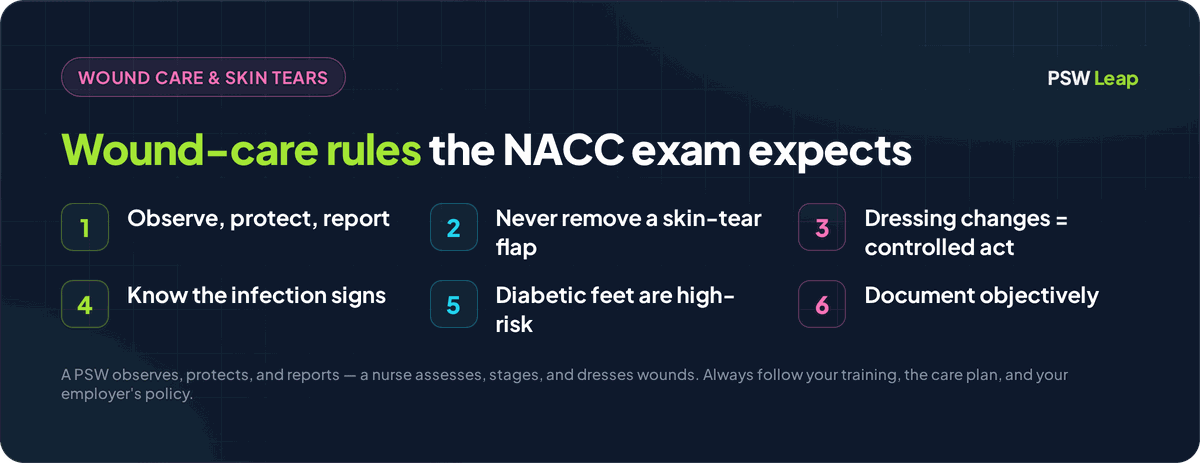
Use these one-line facts as a final review — they are the kind of definitive statements the exam rewards:
- A PSW observes, protects, and reports — a nurse assesses, stages, and dresses wounds.
- Never remove a skin-tear flap — gently roll attached skin back and report.
- Sterile or complex dressing changes are controlled acts — only with training, delegation, and a care-plan order.
- Infection signs — spreading redness, warmth, swelling, increasing pain, pus, odour, fever.
- Diabetic feet are high-risk — report any new sore the same shift; never cut nails or calluses.
- Prevent skin tears — gentle handling, moisturized skin, padding, long sleeves, short nails.
- Document objectively — location, size, colour, drainage, surrounding skin, pain, and that you reported.
Remember: PSW practice in Ontario always follows the client's individual care plan and your employer's policies. This article is exam-prep study material, not medical advice.
Practice more free NACC questions
You just answered 10 wound care questions — the NACC PSW exam can include questions across all of its modules, from skin and wound care to infection control, diabetes, and personal care. The fastest way to find your weak spots is to keep practising with instant feedback.
👉 Start practising free at pswleap.com/learn — a large bank of NACC-style questions, full timed mock exams, and a Duolingo-style study path built specifically for Ontario PSW students. No subscription, and you can start with sample questions before you pay.
Closely related topics worth reviewing next: Free NACC Practice Questions on Pressure Injuries & Skin Care (preventing skin breakdown) and Free NACC Practice Questions on Infection Control (stopping wounds from getting infected).
PSW Leap is an independent NACC PSW exam-prep platform for Ontario candidates. We are not affiliated with NACC. Always follow your training, your client's care plan, and your employer's policies on the job.
Published by PSW Leap
Independent NACC PSW exam prep
PSW Leap articles are written and maintained by the platform's founder, Shashank Jha, and checked against publicly available PSW curriculum standards. Found an error? Email hello@pswleap.com and we'll fix it.
Read our content methodologyPSW Leap
Practice smarter for the NACC exam. 2,500 questions. Detailed rationales. $29.99 CAD one-time — everything included.
Try 10 free questions →No account needed. Ready for the full bank? Create your account.