Free NACC Practice Questions on Infection Control & PPE (Ontario PSW Exam Prep)
If you are studying for the NACC Personal Support Worker (PSW) exam in Ontario, infection prevention and control (IPAC) is one of the highest-yield topics you can master — it shows up across the exam and you will use it on every single shift. This free practice set gives you real NACC-style questions on hand hygiene, PPE, routine practices, and isolation precautions, each with a clear answer and a plain-language explanation. Work through them, check your reasoning, then keep going with the full question bank at pswleap.com/learn.
What is infection prevention and control, and why does the NACC PSW exam test it?
Infection prevention and control (IPAC) is the set of practices that stop germs from spreading between clients, staff, and the environment. For a Personal Support Worker in Ontario, that means clean hands, the right personal protective equipment (PPE), and following the precautions a client is placed on.
The NACC PSW exam tests IPAC heavily because PSWs provide hands-on care all day — bathing, feeding, toileting, and transferring clients — and are often the person whose actions either break or complete the chain of infection. You are not expected to diagnose infections or order precautions. You are expected to perform hand hygiene correctly, put on and remove PPE in the right order, apply routine practices to every client, and follow the isolation precautions set by the care team while reporting changes to the nurse.
Quick definitions to memorize: Routine practices = basic precautions used for every client. Additional (transmission-based) precautions = extra steps on top of routine practices — contact, droplet, or airborne. Donning = putting PPE on. Doffing = taking PPE off. PPE = gloves, gown, mask/respirator, and eye protection.
Free NACC-style practice questions: infection control & PPE
Each question below mirrors the scenario-based, multiple-choice style of the NACC PSW exam. Try to answer before you read the explanation.
Q1. What is the single most important way for a PSW to prevent the spread of infection?
Answer: Hand hygiene. Cleaning your hands is the single most effective action a PSW can take to prevent infection. Use alcohol-based hand rub for at least 15 seconds, or wash with soap and water for at least 20 seconds, covering all surfaces — palms, backs of the hands, between the fingers, the thumbs, and under the nails. No piece of PPE replaces clean hands.
Q2. What are the "4 moments for hand hygiene"?
Answer: Before client contact, before an aseptic procedure, after body-fluid exposure risk, and after client contact. The four moments are: (1) before initial client contact, (2) before an aseptic or clean procedure, (3) after a body-fluid exposure risk, and (4) after client contact and contact with the client's environment. These four moments are commonly tested — memorize them in order.
Q3. A client has C. difficile, and the PSW's hands are not visibly soiled. Should the PSW use alcohol-based hand rub or soap and water?
Answer: Soap and water. Alcohol-based hand rub does not kill C. difficile spores — only physically washing with soap and water removes them. Always wash with soap and water when hands are visibly soiled, after using the washroom, and after caring for a client with C. difficile or norovirus. For routine care with hands that are not soiled, alcohol rub is faster and acceptable.
Q4. What are "routine practices," and which clients do they apply to?
Answer: The basic precautions used for every client, every time — regardless of diagnosis. Routine practices treat all blood and body fluids as potentially infectious. They include hand hygiene, a point-of-care risk assessment, choosing PPE to match the task, and respiratory etiquette. You do not need a diagnosis or a positive test to use routine practices — they are the baseline of safe care for everyone.
Q5. In what order should a PSW put on (don) PPE?
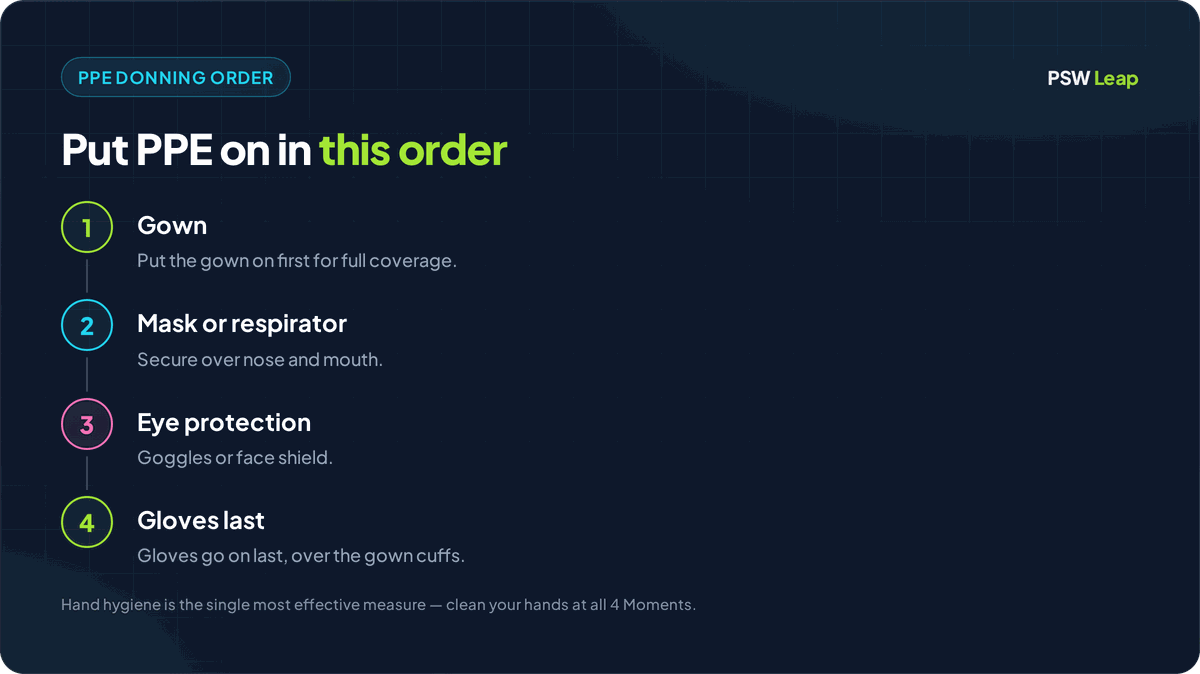
Answer: Gown → mask/respirator → eye protection → gloves. Put the gown on first, then the mask or respirator, then eye protection (goggles or face shield), and gloves last so they cover the cuffs of the gown. Always perform hand hygiene before donning PPE.
Q6. In what order should a PSW take off (doff) PPE?
Answer: Gloves → eye protection → gown → mask/respirator ("dirtiest first"). Remove gloves first because they are the most contaminated, then eye protection, then the gown, and the mask or respirator last — it protects you until you have left the room. Perform hand hygiene immediately after doffing, and again after removing the mask.
Q7. A client is on contact precautions for MRSA. What PPE does the PSW wear for direct care?
Answer: Gloves and a gown, on top of routine practices. Contact precautions require gloves and a gown for direct client care, with dedicated equipment kept in the room when possible. Contact precautions are used for MRSA, VRE, C. difficile, and scabies. Remember the C. difficile exception: wash with soap and water, because alcohol rub does not kill the spores.
Q8. A client has influenza. Which precautions and PPE are required?
Answer: Droplet precautions — a surgical mask within 2 metres of the client. Droplet precautions add a surgical mask (worn within about 2 metres) to routine practices. They are also used for pertussis (whooping cough), mumps, and bacterial meningitis. Because droplets travel only short distances, a surgical mask — not an N95 — is the standard requirement here.
Q9. A client has active tuberculosis (TB). What type of precautions are needed?
Answer: Airborne precautions — a fit-tested N95 respirator and a negative-pressure room. Airborne precautions require an N95 respirator (fit-tested to your face) and, where available, a negative-pressure room with the door kept closed. They are also used for measles and chickenpox (varicella). These germs stay suspended in the air, so a surgical mask is not enough.
Q10. What is the "chain of infection," and where can a PSW break it most effectively?
Answer: The six links a pathogen needs to spread — and the PSW breaks it best at the "mode of transmission." The chain of infection is: infectious agent → reservoir → portal of exit → mode of transmission → portal of entry → susceptible host. PSWs have the most power at the mode of transmission link — through hand hygiene, PPE, cleaning and disinfecting shared equipment, and safe handling of linens and waste. Break one link and the infection cannot spread.
The infection control facts the NACC exam expects you to know
Use these one-line facts as a final review — they are the kind of definitive statements the exam rewards:
- Hand hygiene is the single most important infection-prevention measure: alcohol rub for 15 seconds or soap and water for 20 seconds.
- Use soap and water (not alcohol rub) for visibly soiled hands and after caring for C. difficile or norovirus — alcohol does not kill the spores.
- Routine practices apply to every client, regardless of diagnosis; treat all body fluids as infectious.
- Donning order: gown → mask → eye protection → gloves last.
- Doffing order: gloves first → eye protection → gown → mask last ("dirtiest first").
- Contact precautions = gloves + gown (MRSA, VRE, C. difficile, scabies).
- Droplet precautions = surgical mask within 2 m (influenza, pertussis, mumps, meningitis).
- Airborne precautions = N95 + negative-pressure room (TB, measles, chickenpox).
- After a needlestick or splash, wash the area, report to your supervisor immediately, and follow your employer's post-exposure protocol — and never recap a needle.
Remember: PSW practice in Ontario always follows the client's individual care plan and your employer's IPAC policies. This article is exam-prep study material, not medical advice.
Practice more free NACC questions
You just answered 10 infection control questions — the NACC PSW exam covers every part of your program, from infection control and safety to nutrition, dementia care, and vital signs. To find your weak spots, keep practising with instant feedback. PSW Leap's 12 study modules follow the NACC PSW curriculum.
👉 Start practising free at pswleap.com/learn — 2,500 NACC-style questions, full timed mock exams, and a Duolingo-style study path built specifically for Ontario PSW students. No subscription, and you can start with sample questions before you pay.
You can also go deeper on this topic next: IPAC Infection Control for PSWs.
PSW Leap is an independent NACC PSW exam-prep platform for Ontario candidates. We are not affiliated with NACC. Always follow your training, your client's care plan, and your employer's policies on the job.
Published by PSW Leap
Independent NACC PSW exam prep
PSW Leap articles are written and maintained by the platform's founder, Shashank Jha, and checked against publicly available PSW curriculum standards. Found an error? Email hello@pswleap.com and we'll fix it.
Read our content methodologyPSW Leap
Practice smarter for the NACC exam. 2,500 questions. Detailed rationales. $29.99 CAD one-time — everything included.
Try 10 free questions →No account needed. Ready for the full bank? Create your account.