Free NACC Practice Questions on Diabetes Care (Ontario PSW Exam Prep)
If you are studying for the NACC Personal Support Worker (PSW) exam in Ontario, diabetes care is one of the highest-yield clinical topics you can prepare — because PSWs support clients with diabetes on almost every shift, and a missed low blood sugar can become an emergency in minutes. This free practice set gives you real NACC-style questions on diabetes care, hypoglycemia, hyperglycemia, and the PSW's scope, each with a clear answer and a plain-language explanation. Work through them, check your reasoning, then keep going with the full question bank at pswleap.com/learn.
What is diabetes, and why does the NACC PSW exam test it?
Diabetes is a condition in which the body cannot properly control the amount of glucose (sugar) in the blood. In type 1 diabetes the body makes little or no insulin; in type 2 diabetes the body does not use insulin well. Either way, blood glucose can swing too low (hypoglycemia) or too high (hyperglycemia), and both states can harm the client.
The NACC PSW exam tests diabetes care because Personal Support Workers in Ontario are often the first person to notice a client becoming shaky, confused, or unusually thirsty. You are not expected to diagnose diabetes, or to decide on or change an insulin dose or any other medication. You are expected to recognize the signs of high and low blood sugar, respond correctly and quickly to a conscious client who is low, follow the ordered diet, support safe foot care, and report changes to the nurse.
Quick definitions to memorize: Hypoglycemia = low blood sugar, below 4.0 mmol/L. Hyperglycemia = high blood sugar. Normal target range = about 4.0–7.0 mmol/L before meals. The 15-15 rule = 15 g of fast-acting carbohydrate, wait 15 minutes, recheck. DKA (diabetic ketoacidosis) = a dangerous high-sugar emergency, signalled by fruity breath and deep, rapid breathing.
Free NACC-style practice questions: diabetes care
Each question below mirrors the scenario-based, multiple-choice style of the NACC PSW exam. Try to answer before you read the explanation.
Q1. What is a normal blood glucose range, and what counts as hypoglycemia?
Answer: A normal target range is about 4.0–7.0 mmol/L before meals; hypoglycemia is a reading below 4.0 mmol/L. A simple cue is "4 is the floor" — once blood sugar drops below 4.0 mmol/L, a conscious client needs fast-acting sugar and you should report it. Readings stay close to this range when meals, activity, and medication are balanced.
Q2. A client suddenly becomes shaky, sweaty, pale, and confused. What does this most likely indicate?
Answer: These are warning signs of hypoglycemia (low blood sugar). Low blood sugar comes on fast — within minutes — and produces shakiness, sweating, cold and clammy skin, paleness, dizziness, a fast heartbeat, sudden hunger, and confusion or irritability. A common memory cue is "cold and clammy — need some candy." Treat a conscious client right away and report it.
Q3. What are the signs of hyperglycemia (high blood sugar)?
Answer: Excessive thirst, frequent urination, increased hunger, fatigue, blurred vision, and dry, flushed skin. Unlike hypoglycemia, hyperglycemia develops gradually over hours or days. Fruity-smelling breath with deep, rapid breathing points to diabetic ketoacidosis (DKA), a serious emergency the PSW must report to the nurse immediately.
Q4. A conscious client with diabetes becomes shaky and confused before lunch. What should the PSW do first?
Answer: Treat for hypoglycemia using the 15-15 rule. Give 15 grams of fast-acting carbohydrate — for example, 3–4 glucose tablets, or about 175 mL (¾ cup) of juice or regular pop — then wait 15 minutes and recheck or reassess. If the client is still symptomatic, repeat the 15 g, then offer a snack or the meal. Report the episode to the nurse.
Q5. That same client is now found unresponsive. Should the PSW give juice or glucose gel?
Answer: No — never give food or fluid by mouth to an unconscious or unresponsive client. Anything in the mouth of an unresponsive client can cause choking and aspiration. Call for help or 911 right away, do not leave the client, and follow your first-aid training and your employer's emergency protocol. If the client's plan or the employer's emergency protocol provides glucagon rescue medication, only a person it names who has been trained to give it gives it — that never replaces calling for help and 911.
Q6. Can a PSW in Ontario give a client's insulin injection or adjust the dose?
Answer: Not on their own decision — and the dose is never the PSW's to decide or change. Giving the injection is a controlled act under the Regulated Health Professions Act, so a PSW gives it only through an exception the Act sets out or through a delegation. The College of Nurses of Ontario works through this case for a nurse in a retirement home whose client receives daily insulin injections: a regular dose (not a sliding scale) can count as a routine activity of living when, over time, its need, response and outcome are known and the client's condition is predictable, and then a nurse who has assessed it as routine for that client can teach a PSW to give it; in CNO's words, "If the insulin injection for this client does not meet the criteria of a routine activity of living, the UCP requires delegation in order to perform it." Either way, the setting's legislation, the care plan and the employer's policy must allow it, and the PSW must have been taught for this client and found competent; where no exception or delegation applies, the PSW reports that the dose is due. The PSW supports the care plan, helps with meals and routine care, watches for high and low blood sugar, and reports changes. Some employers delegate blood glucose checks to trained PSWs, but never dose decisions.
Sources for Q5 and Q6: the Regulated Health Professions Act, 1991, s. 27 (2) para 5 and s. 29 (1) (accessed September 26, 2026); College of Nurses of Ontario, Teaching an unregulated care provider (accessed September 26, 2026). See also when a PSW can give an insulin injection in Ontario.
Q7. Which is more immediately life-threatening — hypoglycemia or hyperglycemia?
Answer: Hypoglycemia. Low blood sugar can cause unconsciousness within minutes, while high blood sugar usually develops over hours or days. So when you are unsure whether a conscious client is high or low, treat for low (give fast-acting sugar) and report. A brief rise in blood sugar is far safer than leaving a true low untreated.
Q8. A client misses a meal but has already taken their diabetes medication. What should the PSW do?
Answer: Report it to the nurse right away and watch the client closely. Skipping food after taking insulin or an oral diabetes medication raises the risk of hypoglycemia. Monitor for shakiness, sweating, or confusion, follow the care plan, and be ready to treat a low in a conscious client.
Q9. What is the PSW's role in diabetic foot care?
Answer: Inspect the feet daily, keep them clean and dry, and report any wounds — but never cut the toenails. Check for cuts, blisters, redness, swelling, or sores, dry carefully between the toes, and ensure footwear fits. A PSW must not cut a diabetic client's toenails; poor circulation and reduced sensation make small injuries dangerous, so nail care is done by a nurse or foot-care specialist.
Q10. What kind of diet supports most clients with diabetes, and what is the PSW's role?
Answer: A consistent-carbohydrate diet with regular meal timing — and the PSW follows it, never changes it. Steady carbohydrate amounts at steady times keep blood sugar stable. The PSW serves the ordered meals on schedule, encourages the client to eat, records intake, and reports missed meals or appetite changes. The PSW does not decide or alter a therapeutic diet.
The diabetes facts the NACC exam expects you to know
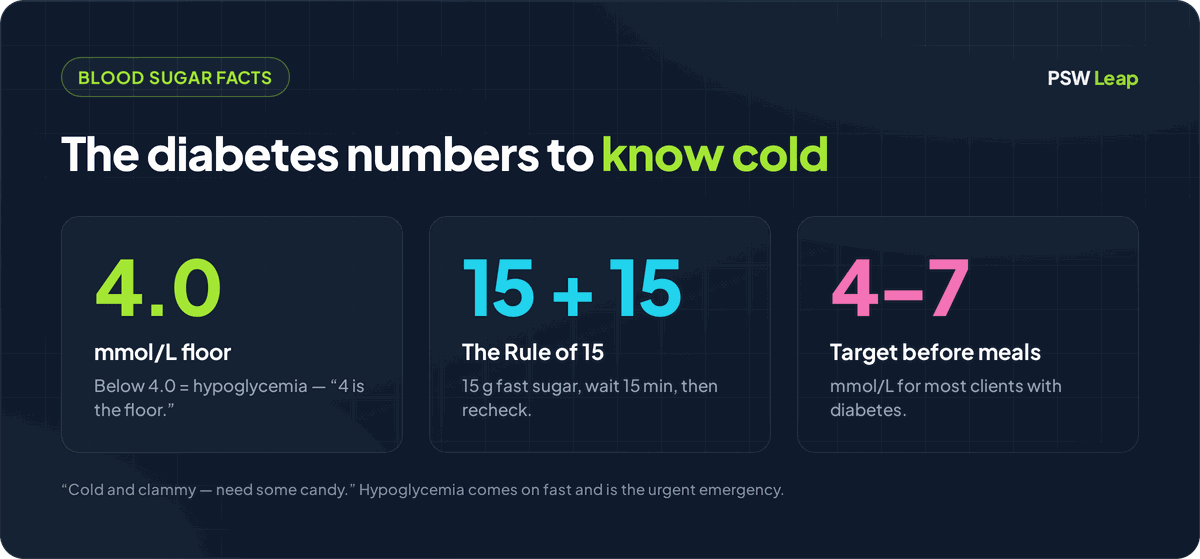
Use these one-line facts as a final review — they are the kind of definitive statements the exam rewards:
- A normal target blood glucose range is about 4.0–7.0 mmol/L before meals; hypoglycemia is below 4.0 mmol/L ("4 is the floor").
- Hypoglycemia is fast and the more urgent emergency; hyperglycemia is gradual. When unsure, treat for low.
- Hypoglycemia signs: shaky, sweaty, cold and clammy, pale, dizzy, confused, fast heartbeat ("cold and clammy — need some candy").
- Hyperglycemia signs: excessive thirst, frequent urination, hunger, fatigue, blurred vision; fruity breath + deep rapid breathing = DKA, report it.
- The 15-15 rule: 15 g fast-acting carbohydrate (3–4 glucose tablets or ¾ cup juice/regular pop), wait 15 minutes, recheck.
- Never give food or fluid by mouth to an unresponsive client — call for help and follow the emergency protocol.
- A PSW never decides on or adjusts an insulin dose; giving the injection needs an RHPA exception (a routine activity of living a nurse has assessed and taught for this client) or a delegation, as the care plan and employer policy allow — otherwise report that it is due.
- A PSW never cuts a diabetic client's toenails — inspect, keep clean and dry, and report any wounds.
- Report a missed meal when the client has already taken diabetes medication.
Remember: PSW practice in Ontario always follows the client's individual care plan and your employer's policies. This article is exam-prep study material, not medical advice.
Practice more free NACC questions
You just answered 10 diabetes care questions — the NACC PSW exam covers every part of your program, from nutrition and safety to infection control, dementia care, and vital signs. To find your weak spots, keep practising with instant feedback. PSW Leap's 12 study modules follow the NACC PSW curriculum.
👉 Start practising free at pswleap.com/learn — 2,500 NACC-style questions, full timed mock exams, and a Duolingo-style study path built specifically for Ontario PSW students. No subscription, and you can start with sample questions before you pay.
You can also brush up on a related high-yield topic next: Free NACC Practice Questions on Dysphagia & Safe Swallowing.
PSW Leap is an independent NACC PSW exam-prep platform for Ontario candidates. We are not affiliated with NACC. Always follow your training, your client's care plan, and your employer's policies on the job.
Published by PSW Leap
Independent NACC PSW exam prep
PSW Leap articles are written and maintained by the platform's founder, Shashank Jha, and checked against publicly available PSW curriculum standards. Found an error? Email hello@pswleap.com and we'll fix it.
Read our content methodologyPSW Leap
Practice smarter for the NACC exam. 2,500 questions. Detailed rationales. $29.99 CAD one-time — everything included.
Try 10 free questions →No account needed. Ready for the full bank? Create your account.