Free NACC Practice Questions on Dysphagia & Safe Swallowing (Ontario PSW Exam Prep)
If you are studying for the NACC Personal Support Worker (PSW) exam in Ontario, dysphagia is one of the highest-stakes clinical topics you can be tested on — because getting it wrong on the job can cost a client their life. This free practice set gives you real NACC-style questions on dysphagia, safe swallowing, and aspiration prevention, each with a clear answer and a plain-language explanation. Work through them, check your reasoning, then keep going with the full question bank at pswleap.com/learn.
What is dysphagia, and why does the NACC PSW exam test it?
Dysphagia is difficulty swallowing. It means food, fluids, or saliva do not move safely from the mouth to the stomach, which raises the risk that they enter the airway instead. When food or liquid enters the airway below the vocal cords, it is called aspiration, and aspiration is the leading cause of aspiration pneumonia — a serious, sometimes fatal infection in older and frail clients.
The NACC PSW exam tests dysphagia because Personal Support Workers in Ontario assist clients with eating and drinking every shift, and the PSW is often the first person to notice that a client is no longer swallowing safely. You are not expected to diagnose or treat dysphagia. You are expected to position the client safely, follow the care plan and the texture-modified diet ordered by the team, recognize the warning signs, and report changes to the nurse.
Quick definitions to memorize: Dysphagia = difficulty swallowing. Aspiration = food, liquid, or saliva entering the airway. Aspiration pneumonia = a lung infection caused by aspirated material. Silent aspiration = aspiration that happens without any coughing or obvious distress.
Free NACC-style practice questions: dysphagia & safe swallowing
Each question below mirrors the scenario-based, multiple-choice style of the NACC PSW exam. Try to answer before you read the explanation.
Q1. What is the safest position for a client with dysphagia during a meal?
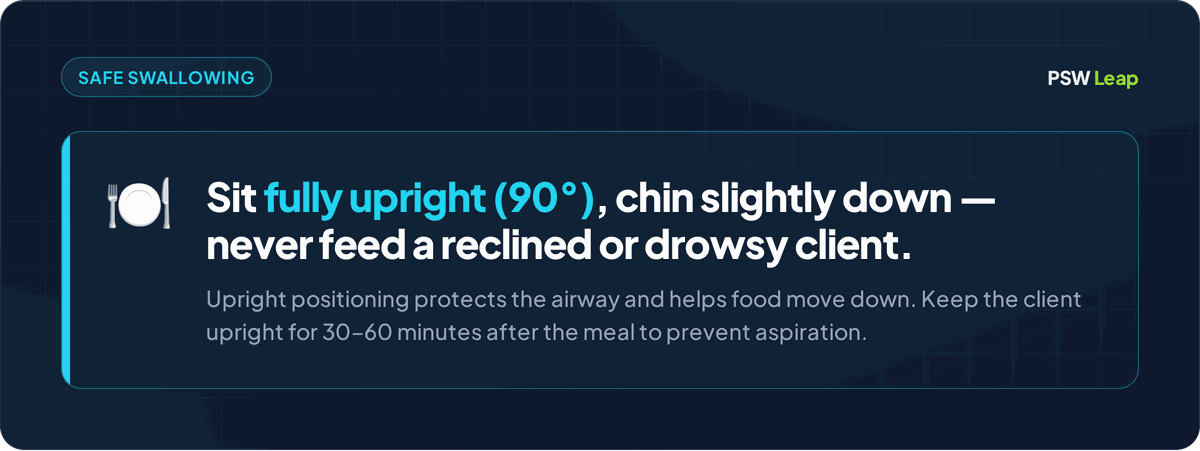
Answer: Sitting fully upright at a 90-degree angle. A client with dysphagia should eat sitting upright at 90 degrees, with the head slightly forward (chin-down), never lying back or reclined. Upright positioning uses gravity to help food move down the esophagus and keeps the airway protected. Never feed a client who is lying flat or who is drowsy.
Q2. How long should a client with dysphagia stay upright after eating?
Answer: At least 30 to 60 minutes after the meal. Keeping the client upright for 30–60 minutes after eating reduces the risk of reflux and aspiration once the meal is finished. Laying a client down immediately after eating is a common cause of after-meal aspiration.
Q3. A client coughs, chokes, and has a "wet" or gurgly voice during meals. What does this most likely indicate?
Answer: These are warning signs of aspiration or unsafe swallowing. Coughing, choking, throat clearing, watery eyes, and a wet or gurgly voice during or right after eating are classic signs that food or liquid is entering the airway. The PSW should stop feeding, keep the client upright, ensure the airway is clear, and report the changes to the nurse so the swallowing plan can be reassessed.
Q4. What is "silent aspiration," and why is it dangerous?
Answer: Silent aspiration is aspiration that happens without coughing or any obvious sign of distress. It is dangerous precisely because there is no cough to warn you — the client may aspirate small amounts at every meal. Suspect silent aspiration when a client has recurrent chest infections, a low-grade fever, a wet-sounding voice, or unexplained weight loss. Always report these patterns, even if the client never appears to choke.
Q5. A speech-language pathologist has ordered thickened fluids for a client. The client asks for a glass of regular water. What should the PSW do?
Answer: Follow the care plan — provide thickened fluids, and report the client's request to the nurse. A PSW must never change a client's prescribed diet or fluid texture, even when the client asks. Thickened fluids move more slowly and are easier to control in the mouth, lowering aspiration risk. The PSW provides the ordered texture, explains kindly that it is for the client's safety, and passes the request to the regulated team.
Q6. Which member of the care team assesses swallowing and recommends a texture-modified diet?
Answer: The speech-language pathologist (SLP), often with a dietitian. The SLP assesses the client's swallowing and recommends the safe food and fluid textures (for example, pureed or minced-and-moist foods, or thickened liquids). The PSW's role is to follow that plan exactly, not to decide or alter the texture.
Q7. What should a PSW do before feeding a client with dysphagia?
Answer: Confirm the client is fully awake, alert, and sitting upright, and minimize distractions. Never feed a client who is drowsy or not fully alert — an unalert client cannot protect their airway. Reduce distractions (turn off the TV, sit at eye level), confirm the correct diet texture, and make sure proper-fitting dentures are in place if the client uses them.
Q8. How should a PSW pace a meal for a client with dysphagia?
Answer: Offer small bites and sips, one at a time, and allow plenty of time between swallows. Encourage the client to swallow each mouthful completely before the next bite, alternate solids and liquids only if the care plan allows, and never rush. Check the mouth for "pocketed" food held in the cheeks before offering more.
Q9. After a meal, what care helps reduce the risk of aspiration pneumonia?
Answer: Provide oral hygiene and check the mouth for pocketed food. Good mouth care after meals lowers the amount of bacteria in the mouth, which reduces the severity of aspiration pneumonia if any aspiration occurs. Clearing pocketed food from the cheeks also prevents the client from aspirating leftover food later.
Q10. A client with dysphagia begins choking and cannot cough, speak, or breathe. What is the correct first action?
Answer: Treat it as a complete airway obstruction — begin abdominal thrusts (the Heimlich manoeuvre) and call for help/emergency services. If the client can still cough forcefully, encourage them to keep coughing and do not intervene. If they cannot cough, speak, or breathe, the airway is fully blocked: start abdominal thrusts and get emergency help immediately. If the client becomes unconscious, lower them to the floor, call 911, and begin CPR. Follow your employer's emergency policy.
The dysphagia facts the NACC exam expects you to know
Use these one-line facts as a final review — they are the kind of definitive statements the exam rewards:
- A client with dysphagia should always eat sitting upright at 90 degrees and stay upright 30–60 minutes after eating.
- Aspiration is food or liquid entering the airway; aspiration pneumonia is the infection that can follow.
- A PSW never changes a prescribed diet or fluid texture, even at the client's request — report it instead.
- The speech-language pathologist assesses swallowing and orders the texture-modified diet.
- Coughing, choking, a wet/gurgly voice, watery eyes, and throat clearing during meals are signs of unsafe swallowing — stop and report.
- Silent aspiration has no cough; suspect it with recurrent chest infections or a wet-sounding voice.
- Never feed a client who is drowsy or not fully alert.
- Mouth care after meals lowers the risk and severity of aspiration pneumonia.
Remember: PSW practice in Ontario always follows the client's individual care plan and your employer's policies. This article is exam-prep study material, not medical advice.
Practice more free NACC questions
You just answered 10 dysphagia questions — the NACC PSW exam covers every part of your program, from nutrition and safety to infection control, dementia care, and vital signs. To find your weak spots, keep practising with instant feedback. PSW Leap's 12 study modules follow the NACC PSW curriculum.
👉 Start practising free at pswleap.com/learn — 2,500 NACC-style questions, full timed mock exams, and a Duolingo-style study path built specifically for Ontario PSW students. No subscription, and you can start with sample questions before you pay.
You can also brush up on a related high-yield topic next: Vital Signs Normal Ranges for PSWs.
PSW Leap is an independent NACC PSW exam-prep platform for Ontario candidates. We are not affiliated with NACC. Always follow your training, your client's care plan, and your employer's policies on the job.
Published by PSW Leap
Independent NACC PSW exam prep
PSW Leap articles are written and maintained by the platform's founder, Shashank Jha, and checked against publicly available PSW curriculum standards. Found an error? Email hello@pswleap.com and we'll fix it.
Read our content methodologyPSW Leap
Practice smarter for the NACC exam. 2,500 questions. Detailed rationales. $29.99 CAD one-time — everything included.
Try 10 free questions →No account needed. Ready for the full bank? Create your account.