Free NACC Practice Questions on UTIs & Bladder Infections (Ontario PSW Exam Prep)

If you are studying for the NACC Personal Support Worker (PSW) exam in Ontario, urinary tract infections are a high-yield clinical topic — UTIs are among the most common infections in long-term care and home care, they often show up as a change in behaviour rather than obvious pain, and the PSW who gives daily care is usually the first to notice. This free practice set gives you real NACC-style questions on typical and atypical UTI signs, why a UTI can look like sudden confusion, prevention through hydration and peri care, catheter-associated infection, scope of practice, and what to report, each with a clear answer. Work through them, then keep going with the full question bank at pswleap.com/learn.
What is a UTI on the NACC PSW exam?
For the exam, a urinary tract infection is an infection in the urinary system — usually the bladder — that a PSW helps prevent, watches for, and reports, without diagnosing or treating it. The "right answer" in a UTI question almost always combines prevention (fluids, peri care, toileting), noticing a change from the client's normal baseline, and reporting promptly to the nurse.
The reason it matters: UTIs are common and largely preventable, yet in older adults they hide behind vague, easily-missed signs — so the PSW's daily watchfulness is what catches them early.
Why UTIs look different in older adults
The single most important thing the exam wants you to know is that a UTI in an older adult often does not look like a "textbook" UTI. A younger person usually feels the classic signs — burning, urgency, frequency, and lower belly discomfort. An older adult may have none of that.
Instead, the first sign is often a change in the person, not the bladder: sudden confusion, a new fall, new or worsening incontinence, eating and drinking less, being unusually drowsy or withdrawn, or becoming agitated and "not themselves." Fever may be low-grade or absent. Because aging changes how the body fights infection — and a client with dementia may not be able to describe pain — behaviour change is often the earliest clue.
This connects UTIs to another high-yield topic: a UTI is a common, treatable cause of sudden confusion, or delirium, in older adults. The exam trap is to shrug a sudden change off as "just old age" or "just the dementia" — the right move is to treat it as a possible infection and report it.
The PSW's role in Ontario: prevent, observe, report
A PSW helps prevent UTIs, observes the client, and reports changes; the nurse assesses, and the nurse, nurse practitioner, or physician diagnoses and treats. In Ontario, a PSW works from the client's individual care plan and the employer's policies, within the controlled-acts limits of the Regulated Health Professions Act, 1991.
Here is where the scope line falls, because the exam loves to test it:
- Within a PSW's role: encouraging fluids within the care plan, providing perineal care (a routine personal-care task, not a controlled act), supporting regular toileting, changing incontinence products and keeping skin clean and dry, giving catheter care and keeping a closed system, and observing and reporting any change.
- Outside a PSW's role: diagnosing a UTI, interpreting a urine dipstick or lab result, and deciding on, prescribing, or being responsible for antibiotics. Those belong to the nurse and prescriber.
- The grey area — collecting a urine sample: in some settings a trained PSW may collect a routine or clean-catch urine specimen when the task has been assigned to them, the care plan includes it and the employer's policy allows; in others, nursing does it. Follow your training, the care plan, and your employer's policy rather than assuming, and never interpret the result yourself.
Two habits the exam rewards: a sudden mental-status change is never "wait and see" — it is reported promptly; and hydration to help prevent a UTI is always within the client's care plan, because clients with heart failure or kidney disease may have a fluid restriction.
Quick terms to know: UTI = an infection in the urinary tract, most often the bladder. Cystitis = a bladder infection. Pyelonephritis = a kidney infection (more serious). CAUTI = a catheter-associated urinary tract infection. Flank pain = pain in the lower back over the kidneys. Baseline = what is normal for this client. Delirium = sudden, often reversible confusion.
Free NACC-style practice questions: UTIs
Each question below mirrors the scenario-based, multiple-choice style of the NACC PSW exam. Try to answer before you read the explanation.
Q1. A normally-alert 84-year-old client becomes suddenly confused and drowsy over an afternoon, with no obvious injury. What should the PSW consider and do?
Answer: A UTI is a common cause of sudden confusion in older adults — report the change to the nurse. In seniors, infection often shows as a mental-status change before any burning or fever. The PSW keeps the client safe and reports promptly.
Q2. Which of these is a classic ("textbook") sign of a UTI?
Answer: Burning or pain when urinating, along with urgency and frequency. These are the typical signs in younger adults; the exam wants you to remember that older adults may show none of them — which is why behaviour change matters.
Q3. A female client needs perineal care after a bowel movement. Which direction should the PSW wipe, and why?
Answer: Always front to back. Wiping from the urethra toward the anus prevents bacteria from the bowel being carried to the urethra, a direct cause of UTIs — a small, high-yield detail.
Q4. What everyday care measures help prevent UTIs?
Answer: Encourage fluids within the care plan, provide good peri care, support regular toileting, change incontinence products promptly, and wash hands before and after care. These simple habits are a PSW's strongest tools against infection — and the exam's expected answer.
Q5. A client with a urinary catheter is being transferred to a wheelchair. Where must the drainage bag stay?
Answer: Below the level of the bladder at all times. Keeping the bag low stops already-drained urine from flowing back toward the bladder, a major cause of catheter-associated UTI (CAUTI). Keep the system closed and never raise the bag above the bladder.
Q6. A PSW notices a client's urine is cloudy and strong-smelling. What should the PSW do?
Answer: Record what was observed and report it to the nurse. Cloudy, foul-smelling, dark, or bloody urine can be a sign of infection — the PSW reports the facts, and the nurse assesses.
Q7. Can a PSW start the client on antibiotics for a suspected UTI?
Answer: No. Deciding on and prescribing antibiotics is outside a PSW's scope — it belongs to the nurse practitioner or physician. A PSW prevents, observes, and reports; it does not diagnose or treat.
Q8. A nurse asks a trained PSW to collect a routine (clean-catch) urine sample, and the employer's policy allows it. Is this within scope?
Answer: It can be, when the task is assigned, the care plan includes it, and the employer's policy and the PSW's training support it. Specimen collection varies by setting, so follow your policy and training — and never interpret the result yourself.
Q9. A client reports lower-back (flank) pain along with a fever and chills. Why does this matter more?
Answer: Flank pain with fever can point to a kidney infection (pyelonephritis), which is more serious than a bladder infection — report it promptly. The PSW does not diagnose, but knowing this combination is a red flag helps the team act quickly.
Q10. A client with dementia becomes newly agitated and is eating far less than usual. What should the PSW keep in mind?
Answer: A sudden change like this can be an early sign of infection, including a UTI — report it rather than writing it off as "the dementia." In clients who cannot describe how they feel, a change in behaviour or appetite is often the only clue.
Common UTI mistakes to avoid on the NACC exam
- Waiting for "textbook" burning and frequency in an older adult, when confusion, a fall, or reduced eating may be the only sign.
- Dismissing a sudden change as "just aging" or "just the dementia" instead of reporting a possible infection.
- Wiping back to front during peri care, which carries bowel bacteria toward the urethra.
- Raising a catheter drainage bag above the bladder or breaking the closed system during a transfer.
- Interpreting a urine dipstick, diagnosing, or "starting" treatment — that belongs to the nurse and prescriber, not the PSW.
- Pushing fluids past a client's fluid restriction — hydration to prevent a UTI always stays within the care plan.
The UTI facts the NACC exam expects you to know
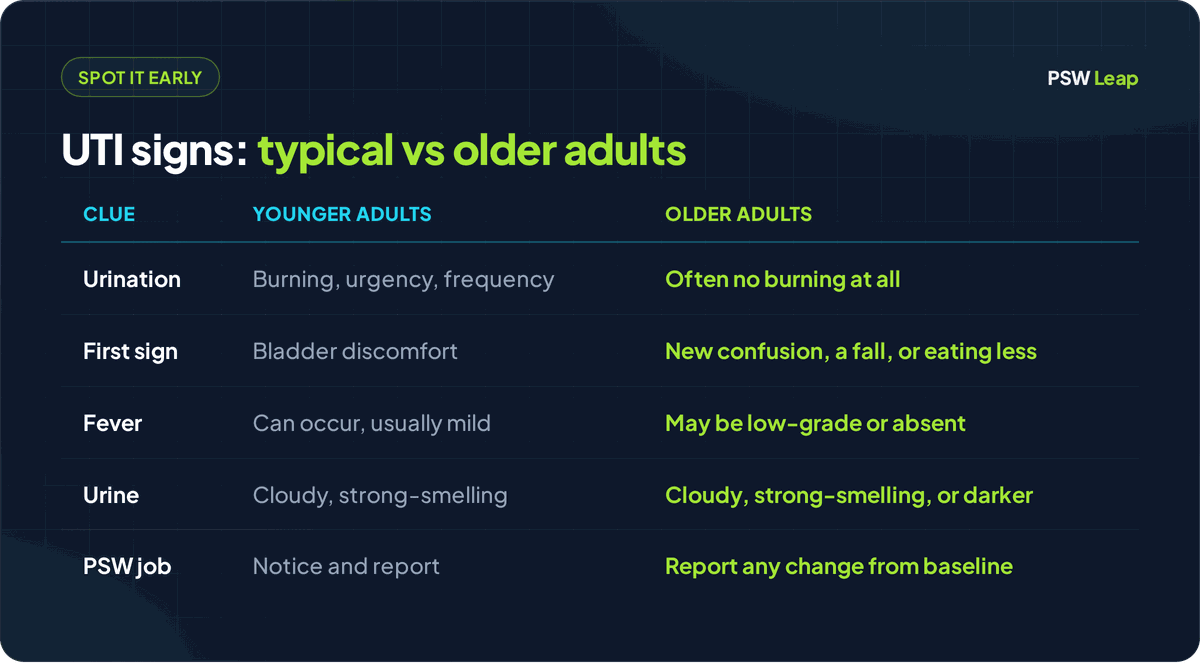
Use these one-line facts as a final review:
- In older adults, infection often shows as a change in the person, not the bladder — sudden confusion, falls, or eating less can be the first sign.
- A sudden change from baseline = report now — never "wait and see," and never "just old age."
- Prevent with the basics — fluids within the care plan, front-to-back peri care, regular toileting, prompt product changes, and hand hygiene.
- Keep the catheter bag below the bladder and the system closed to help prevent CAUTI.
- Report cloudy, foul, dark, or bloody urine; burning or frequency; fever; flank pain; and new confusion, incontinence, or poor intake.
- A PSW prevents, observes, and reports — the nurse assesses, and the prescriber diagnoses and treats.
Remember: PSW practice in Ontario always follows the client's individual care plan and your employer's policies, within the controlled-acts limits of the Regulated Health Professions Act, 1991. Preventing infection, observing the client, and reporting changes are within a PSW's role; diagnosing a UTI, interpreting tests, and prescribing antibiotics are not. This article is exam-prep study material, not medical advice.
Practice more free NACC questions
You just answered 10 UTI questions, and the NACC exam spans every module. The fastest way to find your weak spots is to keep practising with instant feedback.
👉 Start practising free at pswleap.com/learn — a large bank of NACC-style questions, full timed mock exams, and a Duolingo-style study path built specifically for Ontario PSW students. No subscription, and you can start with sample questions before you pay.
Closely related topics worth reviewing next: Free NACC Practice Questions on Delirium (the sudden confusion a UTI can cause) and Free NACC Practice Questions on Catheter & Continence Care (where keeping a closed system prevents infection).
PSW Leap is an independent NACC PSW exam-prep platform for Ontario candidates. We are not affiliated with NACC. Always follow your training, your client's care plan, and your employer's policies on the job.
Published by PSW Leap
Independent NACC PSW exam prep
PSW Leap articles are written and maintained by the platform's founder, Shashank Jha, and checked against publicly available PSW curriculum standards. Found an error? Email hello@pswleap.com and we'll fix it.
Read our content methodologyPSW Leap
Practice smarter for the NACC exam. 2,500 questions. Detailed rationales. $29.99 CAD one-time — everything included.
Try 10 free questions →No account needed. Ready for the full bank? Create your account.