Free NACC Practice Questions on Catheter & Continence Care (Ontario PSW Exam Prep)
If you are studying for the NACC Personal Support Worker (PSW) exam in Ontario, catheter and continence care is a high-yield clinical topic — it appears in scenario questions, it is one of the most common day-to-day tasks in long-term care, and the safe-technique details are easy to test. This free practice set gives you real NACC-style questions on urinary catheters, drainage-bag safety, peri care, reporting signs of infection, scope of practice, and dignity in continence care, each with a clear answer and explanation. Work through them, check your reasoning, then keep going with the full question bank at pswleap.com/learn.
What does catheter and continence care involve on the NACC PSW exam?
For the exam, catheter and continence care is about maintaining the system safely, protecting the skin, observing the client, and reporting changes — not about inserting or treating. A PSW empties and measures the drainage bag, gives catheter and perineal care, keeps a closed system, supports continence with toileting routines, and reports anything abnormal to the nurse.
The exam tests it heavily because urinary catheters are everywhere in long-term care and are a leading source of preventable infection, and because incontinence care is where a client's dignity is most at risk. The "right answer" almost always combines safe technique, infection prevention, dignity, and reporting.
Quick terms to know: Indwelling (Foley) catheter = a tube held in the bladder by a small balloon, draining into a bag. Closed system = catheter and bag stay connected to keep germs out. CAUTI = catheter-associated urinary tract infection, the infection good technique prevents.
Is inserting or removing a catheter part of the PSW's scope in Ontario?
Inserting an indwelling urinary catheter is a controlled act in Ontario and is generally outside a PSW's routine scope — it is done by a nurse, or by a specially trained PSW only when the task has been delegated and the employer's policy permits it. The same caution applies to removing, changing, or irrigating a catheter.
What a PSW does do every shift is maintain the catheter and watch the client: empty and measure the bag, give peri care, keep the bag below the bladder and the system closed, secure the tubing, and report problems. Knowing the line between "maintain and report" and "insert and treat" is one of the most reliable scope questions on the exam. As always, follow your training, the client's care plan, and your employer's policy.
The catheter-care rules to memorize
These are the most "quotable" facts on the topic — the exam expects you to apply them without hesitating:
- Keep the drainage bag below the bladder at all times, including during transfers — never on the floor, never above the bladder.
- Keep the system closed — do not disconnect the catheter from the bag.
- Secure the catheter to the thigh or abdomen so it cannot pull on the bladder.
- Peri care daily and after every bowel movement, cleaning from the urethra outward; for females, always front to back.
- Empty and measure the bag regularly; record intake and output.
- Encourage fluids unless the care plan restricts them — good hydration supports urinary health.
- Observe and report — cloudy, bloody, or foul urine, no output, leakage, pain, or fever.
Free NACC-style practice questions: catheter & continence care
Each question below mirrors the scenario-based, multiple-choice style of the NACC PSW exam. Try to answer before you read the explanation.
Q1. Where should a PSW keep a client's urinary drainage bag?
Answer: Below the level of the bladder at all times, and off the floor. Keeping the bag low lets urine drain down and away; if the bag is raised above the bladder, already-drained urine can flow back and cause infection. Hang it on the bed frame or wheelchair below hip level, and keep it low during transfers too.
Q2. A PSW notices the catheter has stopped draining. What should they do first?
Answer: Check for kinks, loops, or the client lying on the tubing, and confirm the bag is below the bladder. Most "no drainage" problems are mechanical and fixable without opening the system. Do not disconnect or irrigate the catheter. If urine still does not drain after correcting the obvious causes, report it — a true blockage needs nursing assessment.
Q3. Can a PSW in Ontario insert a new urinary catheter when the old one falls out?
Answer: No — inserting a catheter is a controlled act, generally outside the PSW's scope. A PSW reports the dislodged catheter to the nurse and keeps the client comfortable; a nurse (or a specially trained, delegated PSW under employer policy) replaces it. Acting outside your scope is always the wrong answer on the exam.
Q4. How should a PSW perform catheter (perineal) care for a female client?
Answer: With soap and water, cleaning from the urethral opening outward along the catheter, wiping front to back. Front-to-back cleaning keeps bowel bacteria away from the urethra, and cleaning along the catheter away from the body removes the secretions where infection starts. Do peri care at least daily and after every bowel movement.
Q5. Which urine change should a PSW report right away?
Answer: Cloudy, foul-smelling, or blood-tinged urine. These can signal a urinary tract or catheter-associated infection, which is common and serious in older adults. The PSW observes and reports to the nurse — never diagnoses or starts any treatment. New confusion or a fever alongside the urine change makes reporting even more urgent.
Q6. Why must the catheter be secured to the client's leg or abdomen?
Answer: To stop the tubing from pulling and tugging on the bladder, which causes pain and tissue injury. A catheter that drags can damage the urethra and bladder neck and can be pulled out. Securing it with a leg strap or anchor device keeps it stable so the client can move without traction on the bladder.
Q7. A client with a catheter says it "burns" and feels pressure. The PSW should:
Answer: Reassure the client, check for kinks or pulling, and report the symptoms to the nurse. Burning and pressure can mean infection, a blocked or displaced catheter, or traction on the tubing. The PSW relieves any obvious mechanical cause, keeps the client comfortable, and reports — assessment and any treatment are the nurse's role.
Q8. Is incontinence something a PSW should accept as "just part of getting old"?
Answer: No — incontinence is common but not a normal part of aging, and new or worsening incontinence should be reported. Dismissing it as old age misses treatable causes like infection and leads to skin breakdown and lost dignity. The PSW supports the client with a toileting routine and good skin care, and reports the change to the team.
Q9. How can a PSW best protect a client's dignity during continence care?
Answer: Provide privacy, explain each step, work calmly, and never shame the client for an accident. Use respectful language — "incontinence product" or "brief," not "diaper" — and follow the client's toileting schedule and preferences. Dignity is not separate from good care; on the exam, the option that preserves it is usually correct.
Q10. After continence care, what skin problem must the PSW prevent?
Answer: Moisture-associated skin damage (incontinence-associated dermatitis) and pressure injuries. Skin left wet with urine or stool breaks down quickly. The PSW cleans the area promptly and gently, dries it well, applies a barrier cream if the care plan calls for it, and changes products often — the same vigilance that prevents pressure injuries.
Common catheter & continence-care mistakes to avoid on the NACC exam
- Raising the drainage bag above the bladder or resting it on the floor during a transfer.
- Disconnecting or irrigating the catheter instead of keeping a closed system and reporting.
- Inserting or removing a catheter when it is outside your scope — replace "fix it yourself" with "report to the nurse."
- Wiping back to front during female peri care, dragging bowel bacteria toward the urethra.
- Ignoring cloudy or foul urine, or new confusion, instead of reporting possible infection.
- Leaving skin wet after continence care instead of cleaning, drying, and using a barrier as ordered.
- Treating incontinence as untreatable old age instead of reporting a change.
Each of these matches the single-best-answer logic the NACC exam uses: the correct option is the safest action that prevents infection, protects skin and dignity, stays within the PSW's scope, and reports changes.
The catheter and continence care facts the NACC exam expects you to know
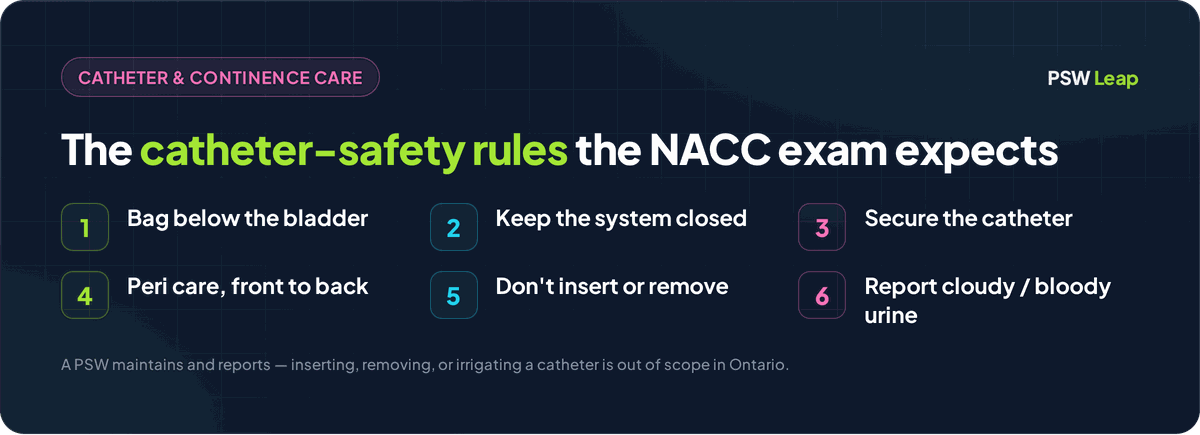
Use these one-line facts as a final review — they are the kind of definitive statements the exam rewards:
- Keep the drainage bag below the bladder, off the floor, and low during transfers.
- Keep a closed system — never disconnect or irrigate the catheter.
- Secure the catheter so it cannot pull on the bladder.
- Give peri care daily and after every bowel movement, cleaning front to back for females.
- Inserting, removing, or changing a catheter is generally outside the PSW's scope in Ontario — report instead.
- Report cloudy, bloody, or foul urine, no output, leakage, pain, fever, or new confusion.
- Incontinence is not normal aging — support with toileting routines and report changes.
- Protect dignity and skin — privacy, respectful language, prompt cleaning, and a barrier cream if ordered.
Remember: PSW practice in Ontario always follows the client's individual care plan and your employer's policies. This article is exam-prep study material, not medical advice.
Practice more free NACC questions
You just answered 10 catheter and continence care questions — the NACC PSW exam can include questions across all of its modules, from infection prevention and skin care to safe transfers, nutrition, and vital signs. The fastest way to find your weak spots is to keep practising with instant feedback.
👉 Start practising free at pswleap.com/learn — a large bank of NACC-style questions, full timed mock exams, and a Duolingo-style study path built specifically for Ontario PSW students. No subscription, and you can start with sample questions before you pay.
Closely related topics worth reviewing next: Free NACC Practice Questions on Personal Care & Hygiene (peri care and dignity) and Free NACC Practice Questions on Pressure Injuries (the skin breakdown that incontinence causes).
PSW Leap is an independent NACC PSW exam-prep platform for Ontario candidates. We are not affiliated with NACC. Always follow your training, your client's care plan, and your employer's policies on the job.
Published by PSW Leap
Independent NACC PSW exam prep
PSW Leap articles are written and maintained by the platform's founder, Shashank Jha, and checked against publicly available PSW curriculum standards. Found an error? Email hello@pswleap.com and we'll fix it.
Read our content methodologyPSW Leap
Practice smarter for the NACC exam. 2,500 questions. Detailed rationales. $29.99 CAD one-time — everything included.
Try 10 free questions →No account needed. Ready for the full bank? Create your account.