Free NACC Practice Questions on Parkinson's Disease Care (Ontario PSW Exam Prep)
If you are studying for the NACC Personal Support Worker (PSW) exam in Ontario, Parkinson's disease is one of the conditions you are most likely to meet on the job and on the test — it is common in Ontario long-term care and home care, and the PSW is the daily set of hands keeping the client safe, mobile, and independent. This free practice set gives you real NACC-style questions on cueing a client through a "frozen" step, preventing falls, communicating around a masked face and soft voice, the on/off medication windows, and the PSW's scope — each with a clear answer. Work through them, then keep going at pswleap.com/learn.
What is Parkinson's disease care on the NACC PSW exam?
For the exam, caring for a client with Parkinson's means supporting safe movement, allowing extra time for slow tasks, helping medication happen on schedule, watching for swallowing and falls, and reporting changes — all within the care plan. Parkinson's comes from a loss of dopamine in the brain, and its four classic signs are a resting tremor, rigidity (stiffness), bradykinesia (slowness), and postural instability (an unsteady, stooped posture). The exam treats the PSW as the one who notices the client struggling to start a step or coughing at meals — and knows the answer is patience and reporting.
Helping with movement, walking, and falls
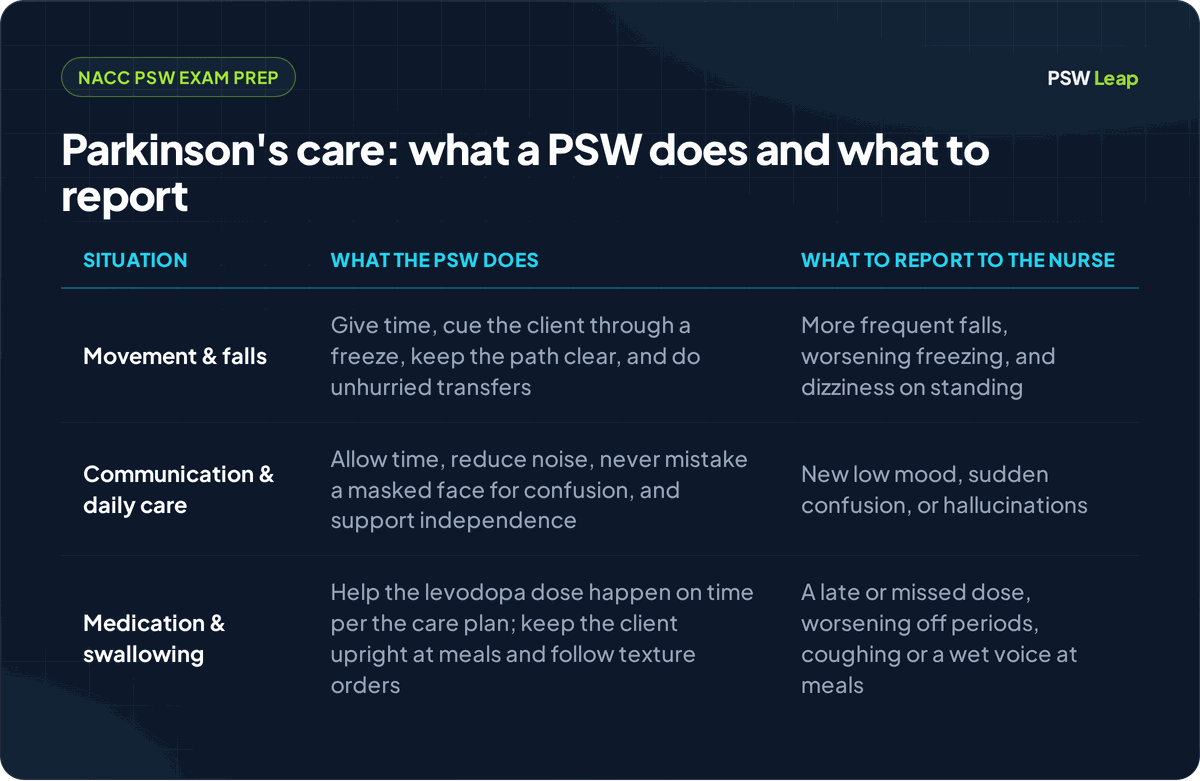
Never rush or pull a client with Parkinson's; give them time, cue them through a freeze, and keep the path clear — falls are one of the biggest dangers in Parkinson's care. Movement is slow and effortful, and a client may suddenly "freeze" — their feet feel stuck to the floor and they cannot take the next step, most often at doorways, when turning, and in tight spaces. Pulling them along makes a fall more likely; instead, stay calm and cue them: ask them to stand tall, rock their weight side to side, "step over" your foot or a line on the floor, or march to a rhythm you count out loud — "one, two, one, two."
The walk adds risk too: a Parkinson's gait is often short and shuffling, then speeds into hurried steps the client can't stop (a festinating gait), and the stooped posture can tip them backward. Keep the path clear and well-lit, use non-slip footwear, do transfers slowly with the brakes locked, and plan care for the client's best-moving times. Many clients also feel dizzy on standing (postural hypotension) — have them rise slowly.
Communication and everyday care
Allow extra time, reduce noise, and never mistake a masked face or a soft voice for confusion or disinterest — the client's mind is usually clear even when their body and face are not. Parkinson's often flattens facial expression into a "masked face" and weakens the voice to a soft, flat near-whisper, so a client can look bored or "out of it" while following every word. Face them, cut background noise, give them time to answer, don't finish their sentences, and use short yes-or-no questions when you can't hear.
Dressing and eating are slow too, so allow time. Watch for drooling (from slower swallowing) and small, cramped handwriting (micrographia), and offer adaptive utensils if the plan includes them. Constipation is very common in Parkinson's — encourage fluids and fibre as the care plan allows, and report it.
Medication timing, swallowing, and the PSW's scope in Ontario
Parkinson's medication is time-critical and swallowing is risky — but the PSW assists within the care plan and reports changes; the PSW does not change the medication schedule or assess the swallow. The main drug, carbidopa-levodopa (Sinemet), works in windows: when it is "on," the client moves well; when it wears "off," they can become suddenly rigid and unable to move. A late or missed dose can trigger an off period, so it must happen on time. The PSW may help with medication only as the care plan and employer policy allow; the role is to help the dose happen on schedule and report a late or missed dose or worsening off periods to the nurse.
What a PSW never does is decide the dose, change the timing, or crush a controlled-release levodopa tablet alone — crushing can change how the drug releases, a decision for the nurse, prescriber, or pharmacist. Swallowing problems (dysphagia) are common and raise the risk of food or fluid entering the lungs (aspiration). The PSW keeps the client sitting fully upright at meals, allows plenty of time, follows any texture or thickened-fluid order exactly, and watches for coughing, choking, or a wet, gurgly voice — but does not assess the swallow or change the diet; the nurse and speech-language pathologist do that. Clients and families may also lean on supports such as Parkinson Canada for education and community; the PSW works alongside that plan, carries it out, and reports.
Quick terms to know: Bradykinesia = slowness of movement. Freezing = feet feel stuck to the floor mid-walk. Festinating gait = short, shuffling steps that speed up. On/off = the working and worn-off windows of levodopa.
Free NACC-style practice questions: Parkinson's disease care
Each question mirrors the scenario-based, multiple-choice style of the NACC PSW exam. Try to answer before you read the explanation.
Q1. A client with Parkinson's freezes in a doorway and cannot move their feet. What should the PSW do?
Answer: Stay calm and cue the client — ask them to step over your foot or march to a counted rhythm. Never pull or rush them.
Q2. Why should a PSW avoid hurrying a client with Parkinson's during dressing?
Answer: Movement is slow (bradykinesia), so rushing causes frustration and falls — allow extra time and let the client do what they can.
Q3. A client with Parkinson's has a blank facial expression and a very soft voice. What should the PSW conclude?
Answer: Nothing about their thinking — a masked face and soft voice are part of Parkinson's, not signs of confusion, so face the client, cut noise, and give them time.
Q4. A client's levodopa dose is due but the PSW is busy with another task. Why does the timing matter?
Answer: Levodopa is time-critical; a late dose can leave the client suddenly rigid and unable to move (an "off" period). Help it happen on time and report any delay.
Q5. Can a PSW change the time a client takes their Parkinson's medication to fit the routine?
Answer: No — the PSW assists only as the care plan and employer policy allow and reports concerns; changing the schedule belongs to the nurse or prescriber.
Q6. A client with Parkinson's coughs and has a wet, gurgly voice during lunch. What should the PSW do?
Answer: Stop the meal, keep the client upright, and report it — these are signs of swallowing trouble and aspiration risk. The nurse and speech-language pathologist assess the swallow, not the PSW.
Q7. A client with Parkinson's walks with short steps that speed up and can't easily stop. What is this, and what is the risk?
Answer: A festinating gait — it raises the risk of a forward fall. Keep the path clear and stay close.
Q8. A client with Parkinson's becomes dizzy each time they stand up from bed. What should the PSW do?
Answer: Have the client rise slowly, sit on the edge of the bed first, and report the dizziness. Postural hypotension is common in Parkinson's — and a fall risk.
Q9. A client can only swallow a thickened fluid per the care plan, but asks for a glass of water. What should the PSW do?
Answer: Follow the care plan — offer the thickened fluid and report the request to the nurse. The PSW does not change a texture or fluid order on their own.
Q10. A PSW notices a client's controlled-release levodopa tablet is hard for them to swallow whole. What should the PSW do?
Answer: Report it to the nurse — do not crush the tablet on your own. Crushing a controlled-release pill can change how it works.
Common Parkinson's care mistakes to avoid on the NACC exam
- Pulling or rushing a frozen client instead of staying calm and cueing them to step over a line.
- Taking over slow tasks like dressing or eating, instead of allowing time and supporting independence.
- Mistaking a masked face or soft voice for confusion or assuming the client can't follow you.
- Changing or skipping medication timing — levodopa is time-critical, and timing is the nurse's and prescriber's call.
- Continuing a meal through coughing or a wet voice, or changing a diet texture yourself, instead of stopping, sitting the client upright, and reporting.
The Parkinson's facts the NACC exam expects you to know
Use these one-line facts as a final review:
- Never rush or pull a frozen client — cue them to step over a line or march to a counted rhythm, and allow extra time for all slow movement.
- A masked face and soft voice are Parkinson's, not confusion — give the client time and don't take over.
- Levodopa is time-critical — help the dose happen on schedule and report a late or missed dose or worsening "off" periods; never change the timing yourself.
- Keep the client upright at meals and follow texture orders — report coughing or a wet voice; don't assess the swallow or change the diet.
- Watch for falls, dizziness on standing, and constipation — common in Parkinson's, and all reportable.
Remember: PSW practice in Ontario follows the client's care plan and your employer's policies, within the controlled-acts limits of the Regulated Health Professions Act, 1991. Supporting movement, allowing time, assisting with medication as the care plan directs, and observing and reporting are within a PSW's role; changing medication timing, crushing controlled-release tablets, and assessing movement or swallowing are not. This article is exam-prep study material, not medical advice.
Practice more free NACC questions
You just answered 10 Parkinson's care questions, but the NACC PSW exam spans every module — keep practising to find your weak spots fast.
👉 Start practising free at pswleap.com/learn — a large bank of NACC-style questions, full timed mock exams, and a Duolingo-style study path built for Ontario PSW students. No subscription needed to start.
Closely related topics worth reviewing next: Free NACC Practice Questions on Fall Prevention and Free NACC Practice Questions on Dysphagia — the falls and the swallowing risk that run alongside Parkinson's.
PSW Leap is an independent NACC PSW exam-prep platform for Ontario candidates. We are not affiliated with NACC or Parkinson Canada. Always follow your training, your client's care plan, and your employer's policies on the job.
Published by PSW Leap
Independent NACC PSW exam prep
PSW Leap articles are written and maintained by the platform's founder, Shashank Jha, and checked against publicly available PSW curriculum standards. Found an error? Email hello@pswleap.com and we'll fix it.
Read our content methodologyPSW Leap
Practice smarter for the NACC exam. 2,500 questions. Detailed rationales. $29.99 CAD one-time — everything included.
Try 10 free questions →No account needed. Ready for the full bank? Create your account.