Free NACC Practice Questions on Pain Management (Ontario PSW Exam Prep)
If you are studying for the NACC Personal Support Worker (PSW) exam in Ontario, pain management is a high-yield clinical topic — it shows up in scenario questions, it is part of everyday care in long-term care and home settings, and it is one of the areas where a PSW's observation matters most. This free practice set gives you real NACC-style questions on believing the client's report, recognizing pain in clients who cannot tell you, comfort measures, scope of practice, and what to report, each with a clear answer and explanation. Work through them, check your reasoning, then keep going with the full question bank at pswleap.com/learn.
What does pain management involve on the NACC PSW exam?
For the exam, pain management is about observing, believing, comforting, and reporting — not assessing, diagnosing, or treating. A PSW notices signs of pain, takes the client's report seriously, offers comfort measures within the care plan, and reports pain and any change to the nurse.
The exam tests it heavily because pain is common and frequently under-recognized in older adults, and because so many clients — those with dementia, after a stroke, or near the end of life — cannot clearly say that they hurt. The PSW is often at the bedside the longest, so the PSW's observation is the care team's earliest warning. The "right answer" almost always combines believing the client, a comfort measure within scope, and prompt reporting.
Quick terms to know: Acute pain = sudden, short-term, often from injury or surgery. Chronic pain = lasting, ongoing pain. PRN = an "as-needed" medication order. Non-verbal cues = the behaviours (grimacing, guarding, restlessness) that show pain when a client cannot say it.
Is giving pain medication part of the PSW's scope in Ontario?
No — a PSW does not decide on, administer, or adjust pain medication. Administering medication is a controlled act in Ontario. Depending on the setting, the PSW's training, and the employer's policy, a PSW may only assist a client with their own medication — and never changes a dose or gives a PRN analgesic on their own judgement.
What a PSW does every shift is watch for pain, believe the client, provide non-medication comfort, and report. If a client's pain is not relieved after their medication, the PSW does not give more — the PSW reports it so the nurse can reassess. Knowing the line between "comfort and report" and "medicate and treat" is one of the most reliable scope questions on the exam. As always, follow your training, the client's care plan, and your employer's policy.
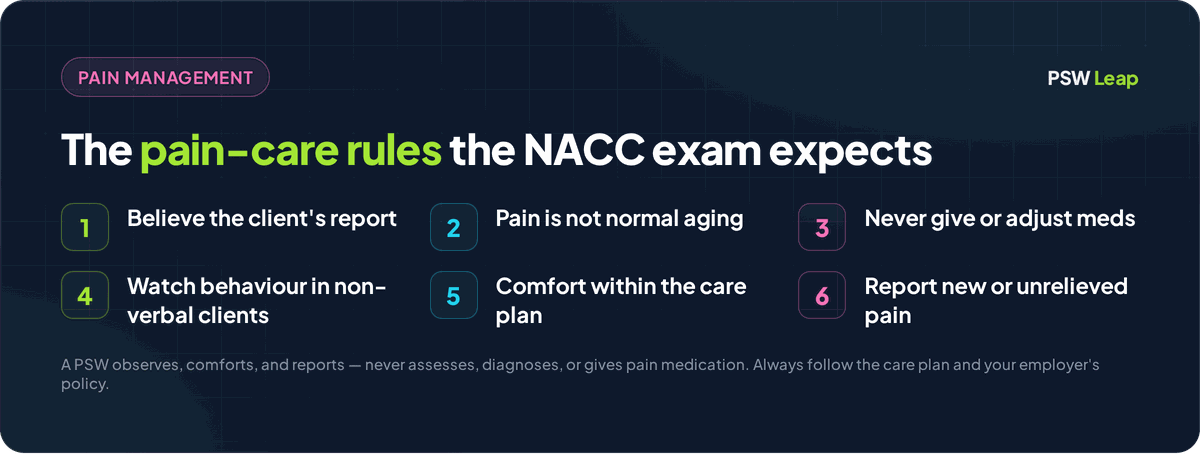
The pain-care rules to memorize
These are the most "quotable" facts on the topic — the exam expects you to apply them without hesitating:
- Pain is whatever the client says it is — believe the report and never judge it.
- Pain is not a normal part of aging — new or worsening pain is always reported.
- A PSW never gives or adjusts pain medication — observe, comfort, and report.
- Watch behaviour — grimacing, guarding, moaning, restlessness, and new agitation can be pain in a client who cannot speak.
- A sudden behaviour change in a client with dementia — suspect pain first.
- Offer comfort measures within the care plan — repositioning, warmth or cold if ordered, calm, presence.
- Report unrelieved pain, new pain, or pain that disturbs sleep, eating, or movement.
Free NACC-style practice questions: pain management
Each question below mirrors the scenario-based, multiple-choice style of the NACC PSW exam. Try to answer before you read the explanation.
Q1. A client rates their pain 8 out of 10, but they are smiling and chatting. What should the PSW do?
Answer: Believe the client's report and tell the nurse the pain is 8/10. Pain is whatever the client says it is — people cope, mask, and distract in many ways, and a calm face does not mean low pain. The PSW does not decide the client is exaggerating; the PSW records the rating in the client's own words and reports it.
Q2. A client's pain is still severe after the nurse gave their medication. What should the PSW do?
Answer: Report the unrelieved pain to the nurse — do not give anything more. A PSW never administers or adds pain medication. Persisting pain after a dose is important information the nurse needs to reassess the plan, so the PSW reports it promptly and keeps the client comfortable in the meantime.
Q3. A non-verbal client with advanced dementia is suddenly grimacing, guarding their hip, and refusing care. The PSW should:
Answer: Suspect pain, provide gentle comfort, and report it to the nurse. In a client who cannot speak, behaviour is the message — grimacing, guarding, and new resistance to care are classic pain cues. The right move is never to label it "difficult behaviour"; it is to consider pain first and report so it can be assessed.
Q4. How should a PSW measure pain in a client who finds numbers confusing?
Answer: Use a faces pain scale and describe the client's behaviour. A faces scale lets the client point to how they feel when a 0-to-10 number is too abstract. The PSW also records observed cues — grimacing, restlessness, guarding — so the team has a full picture, and reports what was seen.
Q5. A family member says, "She's old, of course her knees hurt — don't make a fuss." How should the PSW respond?
Answer: Treat the pain as real and report it — pain is not a normal part of aging. Dismissing pain as "just old age" leaves treatable suffering unmanaged. The PSW reassures the family, takes the pain seriously, offers comfort within the care plan, and reports the pain to the nurse for assessment.
Q6. Which non-medication comfort measure is within a PSW's scope?
Answer: Careful repositioning and a calm, supported environment. Repositioning, supporting a painful limb, distraction, music, presence, and warmth or cold if it is ordered are all within scope. They support the medical plan rather than replacing it, and the PSW reports whether they helped.
Q7. A client asks the PSW for "one of my extra pain pills." What should the PSW do?
Answer: Do not give the medication — report the request to the nurse. Giving or adjusting an as-needed medication is outside the PSW's scope. The PSW listens, reassures the client, offers comfort measures, and tells the nurse, who decides on medication.
Q8. What should the PSW document after caring for a client in pain?
Answer: The client's own words, where it hurts, the cues observed, the comfort measures tried, and that the nurse was told. Objective, specific documentation — "Client stated 'my back is killing me,' rated 7/10, grimacing while turning; repositioned and reported to RN at 1410" — is what protects the client and the team. Avoid labels like "attention-seeking."
Q9. A palliative client seems restless and tearful but denies physical pain. The PSW should:
Answer: Recognize this as possible total pain and report the emotional distress too. Near the end of life, pain is more than physical — emotional, social, and spiritual distress are part of it and can make physical pain worse. The PSW offers calm presence and dignity, and reports the distress so the whole team can respond.
Q10. A client who usually sleeps well has been awake, irritable, and eating little for two days. The PSW should:
Answer: Consider unrecognized pain, and report the change to the nurse. Disturbed sleep, poor appetite, and new irritability are common signs of pain that a client may not name directly. The PSW does not wait for the client to "complain enough" — a change from the client's normal pattern is itself worth reporting.
Common pain-management mistakes to avoid on the NACC exam
- Deciding a client is exaggerating instead of believing the report — pain is whatever the client says it is.
- Giving or adding a pain medication instead of reporting unrelieved pain to the nurse.
- Calling a non-verbal client's grimacing or guarding "behaviour" instead of suspecting pain.
- Dismissing pain as normal aging rather than reporting it for assessment.
- Assuming a sleeping or quiet client has no pain — quiet is not the same as comfortable.
- Ignoring emotional distress in palliative care instead of treating it as part of total pain.
- Labelling a client "drug-seeking" instead of reporting the request and offering comfort.
Each of these matches the single-best-answer logic the NACC exam uses: the correct option is the action that believes the client, stays within the PSW's scope, comforts safely, and reports the pain.
The pain-management facts the NACC exam expects you to know
Use these one-line facts as a final review — they are the kind of definitive statements the exam rewards:
- Pain is whatever the client says it is — believe it, never judge it.
- Pain is not normal aging — report new or worsening pain every time.
- A PSW never gives or adjusts pain medication — observe, comfort, report.
- In non-verbal clients, behaviour is the signal — grimacing, guarding, restlessness, new agitation.
- Sudden change in a client with dementia — suspect pain first.
- Comfort within the care plan — repositioning, ordered heat or cold, calm, presence.
- Total pain — emotional, social, and spiritual distress count, especially near end of life.
- Document objectively — the client's words, the cues, what you did, and that you reported.
Remember: PSW practice in Ontario always follows the client's individual care plan and your employer's policies. This article is exam-prep study material, not medical advice.
Practice more free NACC questions
You just answered 10 pain management questions — the NACC PSW exam can include questions across all of its modules, from comfort and end-of-life care to medication assistance, dementia, and vital signs. The fastest way to find your weak spots is to keep practising with instant feedback.
👉 Start practising free at pswleap.com/learn — a large bank of NACC-style questions, full timed mock exams, and a Duolingo-style study path built specifically for Ontario PSW students. No subscription, and you can start with sample questions before you pay.
Closely related topics worth reviewing next: Free NACC Practice Questions on Palliative & End-of-Life Care (total pain and comfort) and Free NACC Practice Questions on Dementia Care (recognizing distress in clients who cannot tell you).
PSW Leap is an independent NACC PSW exam-prep platform for Ontario candidates. We are not affiliated with NACC. Always follow your training, your client's care plan, and your employer's policies on the job.
Published by PSW Leap
Independent NACC PSW exam prep
PSW Leap articles are written and maintained by the platform's founder, Shashank Jha, and checked against publicly available PSW curriculum standards. Found an error? Email hello@pswleap.com and we'll fix it.
Read our content methodologyPSW Leap
Practice smarter for the NACC exam. 2,500 questions. Detailed rationales. $29.99 CAD one-time — everything included.
Try 10 free questions →No account needed. Ready for the full bank? Create your account.