Free NACC Practice Questions on Oxygen Therapy & Respiratory Care (Ontario PSW Exam Prep)
If you are studying for the NACC Personal Support Worker (PSW) exam in Ontario, oxygen therapy is a high-yield clinical topic — many long-term care and home-care clients have chronic lung or heart conditions and use oxygen every day. This free practice set gives you real NACC-style questions on the PSW's scope around oxygen, fire safety, cannula skin care, positioning for shortness of breath, and recognizing respiratory distress, each with a clear answer. Work through them, then keep going with the full question bank at pswleap.com/learn. For a broader warm-up, the free NACC-style practice test runs 10 sample questions with an explanation after each one, no signup or payment.
What does oxygen therapy involve on the NACC PSW exam?
For the exam, oxygen therapy is about keeping the client safe and comfortable, observing their breathing, and reporting changes — not setting the flow rate, diagnosing, or treating. Oxygen is treated as a prescribed therapy: a physician orders it, and a regulated nurse (RN or RPN) or respiratory therapist sets and adjusts how much the client gets. The PSW's job is the everyday support around that order.
The exam tests it heavily because the PSW is at the bedside every shift — so the PSW is usually first to notice that a client is working harder to breathe, that a cannula has slipped, or that someone has lit a cigarette near the oxygen. The "right answer" almost always combines keeping oxygen safe, staying within scope, positioning the client to breathe easier, and reporting promptly.
The one rule the exam wants first: a PSW never changes the flow rate
A PSW does not turn the oxygen up or down — full stop. Setting and changing the litres-per-minute is a controlled responsibility that belongs to the nurse or respiratory therapist, on a physician's order. If a client says "I can't breathe, turn it up," the safe and in-scope response is to:
- Stay calm and sit the client upright so the lungs have room to expand.
- Check the equipment — is the cannula in the nose, are the prongs pointing in, is the tubing kinked or trapped under a wheelchair, is the concentrator or cylinder actually running?
- Report to the nurse right away and stay with the client.
Around the equipment, the PSW does own the safety basics: keep flames and smoking away, watch the skin where the tubing rests, keep nostrils and lips moist with a water-based product, and position the client to make breathing easier.
Quick terms to know: Hypoxia = too little oxygen reaching the body's tissues. Cyanosis = a bluish or grey colour of the lips, skin, or nail beds from low oxygen. Dyspnea = shortness of breath. Nasal cannula = the two-pronged tube that delivers oxygen into the nose. Concentrator = a machine that makes oxygen from room air (it needs electricity). Flow rate = how much oxygen is delivered, set by the nurse or therapist — never the PSW.
Free NACC-style practice questions: oxygen therapy
Each question below mirrors the scenario-based, multiple-choice style of the NACC PSW exam. Try to answer before you read the explanation.
Q1. A client on a nasal cannula tells the PSW, "I feel short of breath — turn my oxygen up." What should the PSW do?
Answer: Do not change the flow rate — sit the client upright, check the cannula and tubing, make sure the oxygen is running, and report to the nurse. Adjusting the flow is outside the PSW scope; only the nurse or respiratory therapist changes it. The PSW's job is to keep the client calm and safe and to escalate.
Q2. A client on home oxygen wants to light a candle on the kitchen table. What is the PSW's best response?
Answer: Explain that open flames are not safe near oxygen, and keep the candle away. Oxygen makes fire spread faster and hotter, so no candles, smoking, lighters, or gas burners near the source. Redirect the client kindly and report any ongoing safety concern.
Q3. Where should the PSW check the skin on a client who wears a nasal cannula for most of the day?
Answer: Behind and over the tops of the ears, the cheeks, and the nostrils. The tubing presses on the same spots for hours and can redden or break the skin. Pad or reposition the tubing, keep the nares moist with a water-based product, and report any sore or broken skin.
Q4. A PSW notices a client's nasal cannula prongs are pointing straight out, not into the nose. What should the PSW do?
Answer: Reposition the prongs so they curve downward into the nostrils, with the tubing resting comfortably over the ears. Correctly placed prongs deliver the oxygen as intended. Check that the tubing is not kinked or trapped, and report if the client keeps pulling it off.
Q5. Which sign in a client on oxygen is an early warning of low oxygen that the PSW should report?
Answer: New restlessness or confusion. Before the lips turn bluish, low oxygen often shows up as restlessness, agitation, or confusion. The PSW sits the client upright, checks the oxygen is flowing, stays with them, and reports to the nurse — these are not signs to "wait and see."
Q6. A client's lips and nostrils are dry and cracked from the oxygen. Which product is safe to use?
Answer: A water-based (water-soluble) lubricant. Never use petroleum jelly or other petroleum-based products near oxygen — they are a fire risk and can irritate the airway. If dryness keeps recurring, report it so the care team can consider humidification.
Q7. A client with a chronic lung condition becomes very short of breath. Which position should the PSW help them into?
Answer: Upright and leaning slightly forward — sitting up in high Fowler's or resting forward on an over-bed table. This gives the lungs room to expand and eases the work of breathing. Loosen tight clothing, stay calm, keep the oxygen flowing, and report. Never lay a breathless client flat.
Q8. A home-care client uses an oxygen concentrator. The PSW notices it is plugged into a crowded power bar with several other devices. What should the PSW do?
Answer: Make sure the concentrator has a safe, working power source and report the concern. A concentrator needs reliable electricity to run; an overloaded bar is a fire and power risk. Keep the air intake unblocked, know where the backup cylinder is, and report any power or low-battery problem so it can be fixed.
Q9. A client wearing an oxygen mask wants it taken off so they can eat lunch. What is the safest PSW action?
Answer: Do not simply remove it on your own — check the care plan and ask the nurse. A client who needs a mask may have a plan to switch to a nasal cannula for meals, or may need supervision while eating. Removing prescribed oxygen is a clinical decision; the PSW follows the plan and reports.
Q10. While taking routine observations, the PSW reads a low number on the client's pulse oximeter. What should the PSW do?
Answer: Look at the whole client and report the reading to the nurse — do not adjust the oxygen. A pulse oximeter measures oxygen saturation, but the PSW does not diagnose or change therapy from the number. Check the client's colour, breathing effort, and alertness, make sure the probe and cannula are positioned well and the tubing is connected, sit them upright, and report. (See our vital signs practice questions.)
Common oxygen-therapy mistakes to avoid on the NACC exam
- Turning the oxygen up or down because the client asks or seems breathless — instead, position, check the equipment, and report. The flow rate is never the PSW's to change.
- Allowing smoking, candles, or a gas burner near the oxygen instead of keeping all flames and ignition sources well away.
- Using petroleum jelly on dry lips or nostrils instead of a water-based product.
- Laying a short-of-breath client flat instead of sitting them upright and leaning forward.
- Ignoring restlessness or new confusion as "just mood" instead of treating it as a possible early sign of low oxygen.
- Removing a prescribed oxygen mask on your own judgement instead of checking the care plan and the nurse.
- Letting the cannula tubing kink, trap under a wheelchair, or press on the skin instead of checking it and protecting the ears, cheeks, and nares.
These match the single-best-answer logic the exam uses: the correct option keeps oxygen safe, stays within scope, helps the client breathe easier, and reports changes.
The oxygen-therapy facts the NACC exam expects you to know
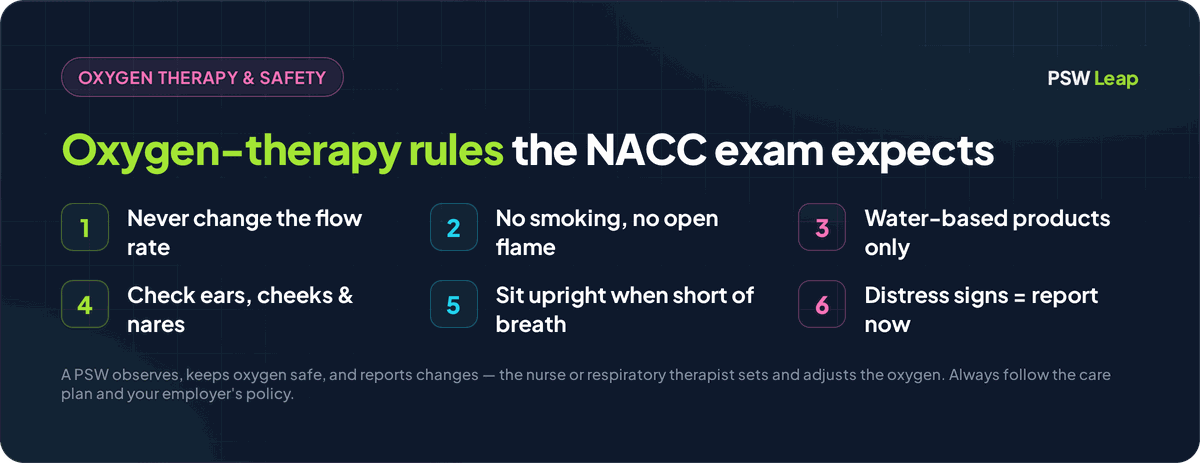
Use these one-line facts as a final review:
- Never change the flow rate — the nurse or respiratory therapist sets it on a physician's order.
- No smoking, no open flame — oxygen makes fire spread faster; keep all ignition sources away.
- Water-based products only — never petroleum jelly on lips or nose near oxygen.
- Check ears, cheeks, and nares — the cannula can break down skin where it rests.
- Prongs curve down, tubing kink-free — and never trapped under the body or a wheelchair.
- Sit upright and lean forward when a client is short of breath — never flat.
- Restlessness, confusion, or bluish lips — early distress signs; position, check, and report.
- A PSW observes and reports; the nurse adjusts — escalate, don't change the oxygen.
Remember: PSW practice in Ontario always follows the client's individual care plan and your employer's policies. This article is exam-prep study material, not medical advice.
Practice more free NACC questions
You just answered 10 oxygen therapy questions — the NACC PSW exam spans all of its modules, from oxygen and respiratory care to vital signs, emergencies, and skin care. The fastest way to find your weak spots is to keep practising with instant feedback.
👉 Start practising free at pswleap.com/learn — a large bank of NACC-style questions, full timed mock exams, and a Duolingo-style study path built specifically for Ontario PSW students. No subscription, and you can start with sample questions before you pay.
Closely related topics worth reviewing next: Free NACC Practice Questions on Emergency Response (respiratory distress can become an emergency) and Free NACC Practice Questions on Vital Signs (counting respirations and reading oxygen saturation).
PSW Leap is an independent NACC PSW exam-prep platform for Ontario candidates. We are not affiliated with NACC. Always follow your training, your client's care plan, and your employer's policies on the job.
Published by PSW Leap
Independent NACC PSW exam prep
PSW Leap articles are written and maintained by the platform's founder, Shashank Jha, and checked against publicly available PSW curriculum standards. Found an error? Email hello@pswleap.com and we'll fix it.
Read our content methodologyPSW Leap
Practice smarter for the NACC exam. 2,500 questions. Detailed rationales. $29.99 CAD one-time — everything included.
Try 10 free questions →No account needed. Ready for the full bank? Create your account.