Free NACC Practice Questions on Emergency Response & First Aid (Ontario PSW Exam Prep)

If you are studying for the NACC Personal Support Worker (PSW) exam in Ontario, emergency response and first aid are among the highest-stakes topics on the test — the ones where the right action in the first minute genuinely saves a life. A PSW is often the only person in the room when a client chokes, collapses, falls, or shows signs of a stroke, so the NACC exam expects you to recognize the emergency, call for help, act within your scope, and report what happened. This free practice set gives you real NACC-style questions on choking, cardiac arrest and CPR, fire safety (RACE and PASS), falls, stroke (FAST), and seizures, each with a clear answer. Work through them, then keep going with the full question bank at pswleap.com/learn.
What is emergency response, and why does the NACC PSW exam test it?
Emergency response is the set of immediate, learned actions a PSW takes when a client's life or safety is suddenly at risk — before the nurse or paramedics arrive. For a Personal Support Worker in Ontario, that means staying calm, keeping the scene safe, calling for help, and giving only the first aid you are trained and certified to provide.
The NACC PSW exam tests emergencies heavily because PSWs provide hands-on care at the bedside and are usually the first to witness a sudden event. You are not expected to diagnose or prescribe, and you perform a controlled act only where an exception in the Regulated Health Professions Act applies — such as first aid or temporary assistance in an emergency, within your training and your employer's emergency protocol — or where it has been delegated to you, as the setting's legislation, the care plan and the employer's policy allow. You are expected to recognize the emergency, take the correct first action, summon the regulated team immediately, and report and document afterward. On the exam, the best answer is almost always the safest action that calls for help and stays within your role.
Sources: the Regulated Health Professions Act, 1991, s. 27 and s. 29 (1) (a) (accessed September 26, 2026); Ontario's Personal Support Worker Program Standard, January 2022 (PDF), vocational learning outcome 7, elements E and F, printed pp. 25–26 (accessed September 26, 2026); see also what is within a PSW's scope in Ontario.
Quick definitions to memorize: RACE = Rescue, Alarm, Confine, Extinguish/Evacuate (fire). PASS = Pull, Aim, Squeeze, Sweep (fire extinguisher). FAST = Face, Arms, Speech, Time (stroke). Abdominal thrusts (Heimlich) = inward-and-upward thrusts for a severe choke. Recovery position = on the side, used to keep the airway open after a seizure or in an unconscious-but-breathing client. Chain of survival = early call for help, early CPR, early defibrillation, advanced care.
The PSW's role in an emergency
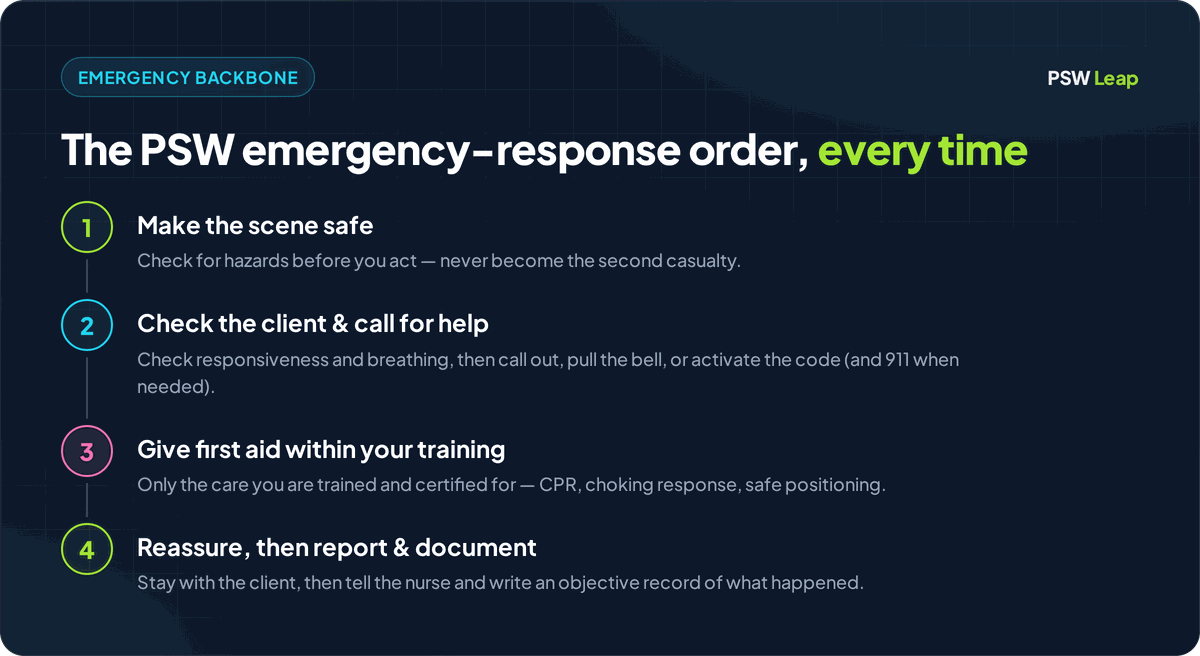
Every emergency on the exam follows the same backbone, no matter the specific event:
- Stay calm and check the scene is safe. You cannot help anyone if you become the second casualty — look for hazards (spills, fire, electrical risk) before you act.
- Check the client and call for help immediately. Check responsiveness and breathing, then call out, pull the call bell, or activate your facility's emergency code, and phone 911 when needed. In long-term care, follow the facility code system (for example, Code Red for fire, Code Blue for a cardiac or medical emergency).
- Act within your scope. Give only the first aid and CPR you are trained and currently certified for; a PSW does not diagnose or decide on treatment, and performs a controlled act only as described above — within their training and the employer's emergency protocol, or by delegation.
- Stay with the client, reassure them, then report and document. Do not leave a client alone in a crisis if you can send someone for help; afterward, tell the nurse right away and write an objective record of what happened.
Free NACC-style practice questions: emergency response
Each question below mirrors the scenario-based, single-best-answer style of the NACC PSW exam. Try to answer before you read the explanation.
Q1. Why does the NACC PSW exam test emergency response so heavily?
Answer: Because the PSW is usually first on the scene, and the first minute decides the outcome. PSWs provide hands-on care all day and are often the only person present when a client chokes, collapses, or has a stroke. The exam expects you to recognize the emergency, call for help, give first aid within your training, and report — not to diagnose or treat. The correct option is always the safe, in-scope action that gets the regulated team involved fast.
Q2. A client is eating and suddenly cannot speak, cough, or breathe, and is clutching their throat. What should the PSW do?
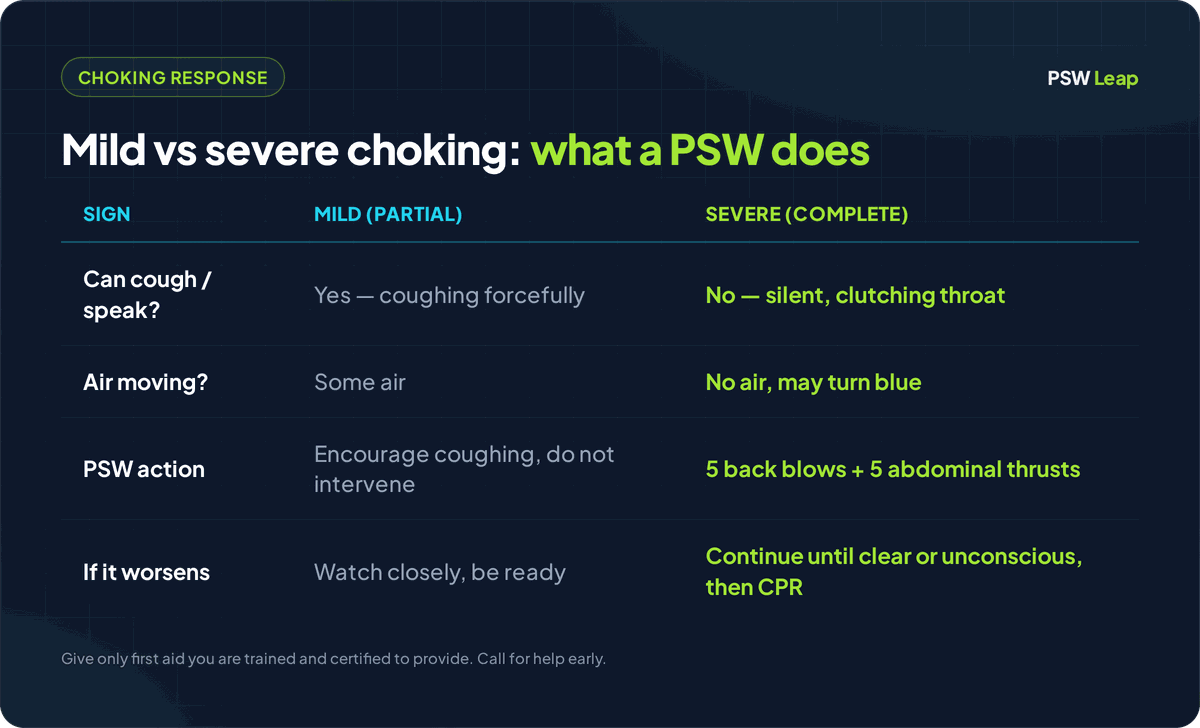
Answer: Treat it as a severe airway obstruction — give 5 back blows, then 5 abdominal thrusts. Silence, no air, and hands at the throat signal a complete obstruction. Stand behind the client, deliver 5 firm back blows between the shoulder blades, then 5 abdominal thrusts (the Heimlich manoeuvre), and alternate until the object clears or the client becomes unconscious. Call for help right away.
Q3. A different client is coughing forcefully and can still gasp out a few words. What is the correct action?
Answer: Encourage the client to keep coughing — do not intervene. A client who can cough, speak, or breathe has a mild (partial) obstruction, and their own cough is the most effective tool to clear it. Back blows or abdominal thrusts now can drive the object deeper. Stay close, keep them calm, and be ready to act if the cough weakens and the obstruction becomes severe.
Q4. A choking client goes limp and unconscious. What does the PSW do next?
Answer: Lower them to the floor, call 911, and begin CPR if trained. Once the client is unconscious, ease them safely to the floor, activate the emergency code and have someone call 911, and start CPR. Chest compressions may help dislodge the object as well as circulate blood. Continue until the airway clears, the client recovers, or paramedics take over.
Q5. A client is found unresponsive and not breathing normally. What is the PSW's FIRST action?
Answer: Call for help first, then start CPR. The "call first" rule means you immediately call out, activate the code, and have someone phone 911 and bring the AED — then begin chest compressions if trained. Getting defibrillation on the way is the single biggest factor in survival, because every minute of delay lowers the chance of recovery. This is the chain of survival the exam wants you to know.
Q6. There is a small fire in a client's room. In what order should the PSW act?
Answer: Follow RACE — Rescue, Alarm, Confine, Extinguish/Evacuate. First Rescue anyone in immediate danger, then sound the Alarm (pull the fire alarm and alert staff), Confine the fire by closing doors and windows, and only then Extinguish a small fire or Evacuate. People always come before property, and you never put yourself at serious risk to fight a fire.
Q7. The PSW decides to use a fire extinguisher on a small, contained fire. How is it used?
Answer: Use PASS — Pull, Aim, Squeeze, Sweep. Pull the safety pin, Aim at the base of the flames (not the top), Squeeze the handle, and Sweep from side to side. Only attempt this on a small fire with a clear exit behind you — if the fire is spreading, leave and let the fire department handle it.
Q8. A client's face is drooping on one side, one arm drifts down, and their speech is slurred. What should the PSW do?
Answer: Recognize a possible stroke with FAST and call 911 immediately. Face drooping, Arm weakness, and Speech difficulty mean it is Time to call 911. Note the time the symptoms started, because that time guides emergency treatment. Stroke care is extremely time-sensitive — "time is brain" — so a fast call gives the client the best chance of recovery. Do not give the client food or drink.
Q9. A PSW finds a client on the floor after an apparent fall. What is the FIRST thing they should do?
Answer: Do NOT move the client — stay, assess, and call for help. Moving a client who may have a fracture or head or neck injury can make the injury far worse. Stay with the client, check for responsiveness, pain, bleeding, or deformity, then call for help and the nurse immediately. Reassure the client and keep them still until help arrives. The safe order is: do not move, assess, call for help, reassure.
Q10. A client begins to have a seizure. What should the PSW do?
Answer: Protect the client from injury, time the seizure, and never restrain them or put anything in their mouth. Ease the client to the floor if possible, cushion and protect the head, move hazards away, and loosen tight clothing at the neck. Do not hold the client down and never place anything in the mouth. When the seizure ends, roll the client into the recovery position, stay with them, and report. Call 911 if the seizure lasts more than 5 minutes, repeats, or the client is injured or does not wake up.
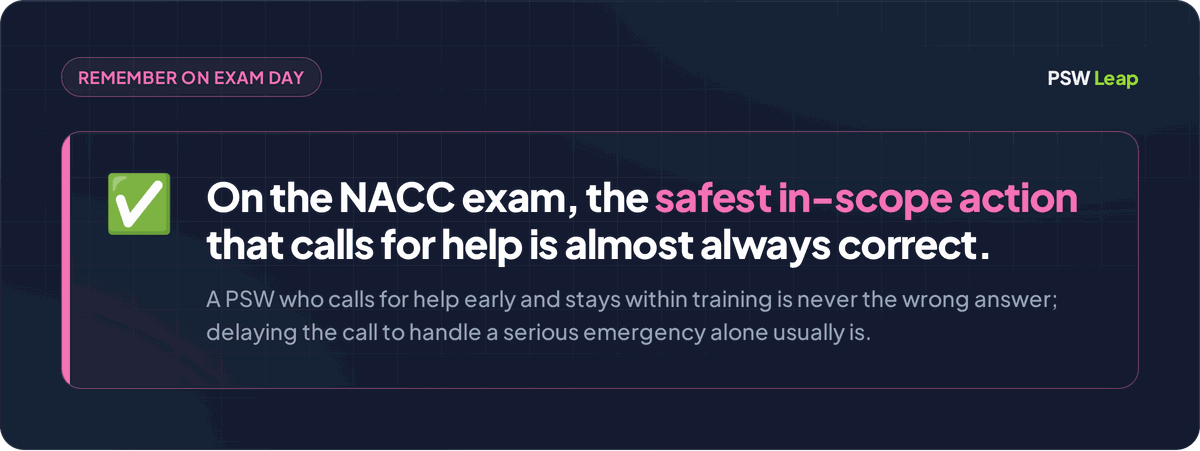
When a scenario question stumps you, fall back on the backbone above: safe scene → check the client → call for help early → first aid within your training → reassure → report. A PSW who calls for help early and stays within scope is never the wrong answer; a PSW who delays the call to handle a serious emergency alone usually is.
Common emergency-response mistakes to avoid on the NACC exam
- Doing abdominal thrusts on a client who can still cough — a mild obstruction means encourage coughing, not intervene.
- Starting CPR before calling for help in an adult cardiac arrest — the rule is call first, then compress.
- Moving a client who has just fallen instead of assessing and calling for help.
- Restraining a seizing client or putting something in their mouth — both cause injury.
- Giving a stroke client food or water, or failing to note the time symptoms started.
- Fighting a spreading fire instead of Rescue–Alarm–Confine–Evacuate and getting people out.
- Forgetting to report and document once the emergency is over.
Each of these matches the single-best-answer logic the NACC exam uses: the correct option is the safest, in-scope action that calls for help and protects the client.
The emergency-response facts the NACC exam expects you to know
Use these one-line facts as a final review — they are the kind of definitive statements the exam rewards:
- Choking: if the client can cough, encourage — do not intervene. Silent and no air → 5 back blows + 5 abdominal thrusts, alternating.
- Cardiac arrest: call for help first, then start CPR — early defibrillation drives survival (the chain of survival).
- Fire: RACE = Rescue, Alarm, Confine, Extinguish/Evacuate. PASS = Pull, Aim, Squeeze, Sweep. People before property.
- Stroke: FAST = Face, Arms, Speech, Time — call 911 and note the start time. Time is brain.
- Fall: do not move the client — assess, call for help, reassure, then report.
- Seizure: protect the head, never restrain or put anything in the mouth, time it, then recovery position.
- A PSW gives first aid and CPR only within their training and current certification, and always calls for help and reports.
- Many Ontario employers require a valid Standard First Aid + CPR certificate to work as a PSW.
Remember: PSW practice in Ontario always follows the client's individual care plan, your employer's emergency policies, and the limits of your training and certification. This article is exam-prep study material, not medical advice or a substitute for hands-on first aid training.
Practice more free NACC questions
You just answered 10 emergency-response questions — the NACC PSW exam covers every part of your program, from safety and emergencies to vital signs, nutrition, and dementia care. To find your weak spots, keep practising with instant feedback. PSW Leap's 12 study modules follow the NACC PSW curriculum.
👉 Start practising free at pswleap.com/learn — 2,500 NACC-style questions, full timed mock exams, and a Duolingo-style study path built specifically for Ontario PSW students. No subscription, and you can start with sample questions before you pay.
You can also keep working through related free questions next: Free NACC Practice Questions on Dysphagia & Safe Swallowing — the choking and aspiration topic that pairs directly with emergency response.
PSW Leap is an independent NACC PSW exam-prep platform for Ontario candidates. We are not affiliated with NACC. Always follow your training, your client's care plan, and your employer's policies on the job.
Published by PSW Leap
Independent NACC PSW exam prep
PSW Leap articles are written and maintained by the platform's founder, Shashank Jha, and checked against publicly available PSW curriculum standards. Found an error? Email hello@pswleap.com and we'll fix it.
Read our content methodologyPSW Leap
Practice smarter for the NACC exam. 2,500 questions. Detailed rationales. $29.99 CAD one-time — everything included.
Try 10 free questions →No account needed. Ready for the full bank? Create your account.