Free NACC Practice Questions on Ostomy Care (Ontario PSW Exam Prep)
If you are studying for the NACC Personal Support Worker (PSW) exam in Ontario, ostomy care is a high-yield clinical topic — many long-term care and home-care clients live with a colostomy, ileostomy, or urostomy, and the PSW is the person with them every day. This free practice set gives you real NACC-style questions on what a healthy stoma looks like, when to empty the pouch, the difference between a colostomy and an ileostomy, caring for the skin around the stoma, the PSW's scope of practice, and the changes to report, each with a clear answer. Work through them, then keep going with the full question bank at pswleap.com/learn.
What does ostomy care involve on the NACC PSW exam?
For the exam, ostomy care is about supporting a client who already has an ostomy — keeping the pouch emptied, the skin protected, and the client comfortable — while observing and reporting changes. It is not about assessing a new stoma, diagnosing, or treating. An ostomy is a surgically created opening (a stoma) that lets stool or urine leave the body into a pouch worn on the abdomen. The surgeon and nurses set it up and manage problems; the PSW provides the steady, everyday support around it.
The exam tests it heavily because the PSW is at the bedside every shift — so the PSW is usually first to notice that a stoma has changed colour, that the skin around it is breaking down, or that a pouch keeps leaking. The "right answer" almost always combines routine care done well, staying within scope, protecting the client's dignity, and reporting changes promptly.
The PSW's scope with an ostomy in Ontario
A PSW supports an established, stable ostomy; the nurse assesses and manages problems. In Ontario, a PSW's task list is set by the employer and the client's care plan, within the controlled-acts limits of the Regulated Health Professions Act, 1991. Emptying a drainable pouch, cleaning and drying the skin, and observing the stoma are routine personal-care tasks a PSW can do when they are in the care plan and the PSW has been trained — they are not controlled acts. What is outside the PSW role is anything that breaks the skin, assessing a new or problem stoma, and deciding on or changing treatment.
When a stoma or the skin around it is not behaving — recurring leaks, breakdown, a stoma that looks wrong — the nurse takes over, and complex cases are referred to a Nurse Specialized in Wound, Ostomy and Continence (NSWOC), the Canadian specialty nurse for ostomy and skin problems. The PSW's job is to keep the routine care safe and to escalate early.
Quick terms to know: Stoma = the visible opening on the abdomen where stool or urine exits. Ostomy = the surgical opening itself; the pouch is the bag worn over it. Colostomy = opening from the large intestine (more formed stool). Ileostomy = opening from the small intestine (liquid, enzyme-rich output that irritates skin). Urostomy = drains urine. Peristomal skin = the skin around the stoma. Skin barrier (flange/wafer) = the adhesive ring that sticks the pouch to the skin and protects it. Output = what drains into the pouch.
Free NACC-style practice questions: ostomy care
Each question below mirrors the scenario-based, multiple-choice style of the NACC PSW exam. Try to answer before you read the explanation.
Q1. A PSW is providing care and notices a client's colostomy stoma is pink-red, moist, and shiny. What should the PSW do?
Answer: Nothing is wrong — a pink-red, moist, shiny stoma is healthy. A normal stoma looks much like the inside of the cheek and sits slightly raised. Continue routine care, keep observing, and document as usual.
Q2. A client's drainable colostomy pouch is about half full. What is the best action?
Answer: Empty the pouch now. Empty a drainable pouch when it is about one-third to one-half full, before the weight pulls on the skin barrier and breaks the seal. Waiting until it is full invites leaks, odour, and skin breakdown.
Q3. A PSW sees a small amount of blood when gently cleaning around a client's stoma. What does this most likely mean?
Answer: A little oozing can be normal because the stoma has a rich blood supply. The stoma has no nerve endings, so cleaning it is not painful, and slight bleeding from the surface during care is usually nothing to worry about. Steady or heavy bleeding, however, is not normal and should be reported to the nurse.
Q4. A client has an ileostomy. Compared with a colostomy, what should the PSW expect from the output?
Answer: More liquid, more frequent output that irritates the skin quickly. An ileostomy drains from the small intestine, so the output is watery to pasty and full of digestive enzymes. Protecting the skin around the stoma and keeping the barrier well-fitted matters most here, and a sudden change to very heavy, watery output is a dehydration risk worth reporting.
Q5. Before applying a fresh skin barrier and pouch, the skin around the stoma is still slightly damp. What should the PSW do?
Answer: Pat the skin completely dry first. Adhesive does not stick to wet skin, so a damp surface leads to a poor seal and a leak. Clean gently, pat fully dry, then apply the new barrier fitted closely around the stoma.
Q6. A PSW notices the skin around a client's stoma is red, raw, and weepy. What is the best response?
Answer: Report it to the nurse and protect the area; do not try to treat it. Peristomal skin breakdown usually means output is leaking onto the skin or the barrier no longer fits. The PSW keeps the area clean and dry, makes sure the pouch is emptied and seated well, and reports — the nurse or NSWOC decides on any treatment or a new appliance.
Q7. A client with a new colostomy turns away and says, "I can't even look at it." What is the PSW's best response?
Answer: Respond with empathy, protect privacy and dignity, and support the client at their pace. Adjusting to an ostomy affects body image and confidence. The PSW provides care matter-of-factly without showing disgust, keeps the client covered and the door closed, listens, and lets the nurse know the client may need more support or teaching.
Q8. A client's ileostomy has had no output for several hours and the client now has cramping and a swollen, hard abdomen. What should the PSW do?
Answer: Report to the nurse promptly — this can signal a blockage. No output together with cramping, nausea or vomiting, and a swollen, hard belly can mean the ostomy is obstructed. This is not "wait and see": the PSW keeps the client comfortable, does not give food or fluids on their own judgement, and escalates to the nurse right away.
Q9. Which task related to a client's ostomy is outside a PSW's scope of practice?
Answer: Assessing a problem stoma and deciding on treatment. Routine emptying, cleaning, drying, and observing are within the PSW role when they are in the care plan. Assessing a new or troubled stoma, managing complications such as a hernia, retraction, or prolapse, and any task that breaks the skin belong to the nurse.
Q10. A client's urostomy pouch needs to be connected to a drainage bag overnight. What should guide the PSW?
Answer: Follow the care plan and the employer's policy, and ask the nurse if anything is unclear. A urostomy drains urine continuously and is often linked to a night drainage bag to keep urine flowing and protect sleep. The PSW connects and positions it as the care plan directs, keeps the system clean and below bladder level so urine does not flow back, and reports any leaking, no drainage, or cloudy or bloody urine.
Common ostomy-care mistakes to avoid on the NACC exam
- Letting the pouch get full before emptying it, instead of emptying at about one-third to one-half full to protect the seal and the skin.
- Applying a barrier to damp skin instead of patting it fully dry first so the adhesive holds.
- Panicking over slight bleeding when cleaning a stoma — a little is normal; steady bleeding or a colour change is what you report.
- Treating peristomal skin breakdown yourself instead of cleaning, protecting, and reporting it to the nurse or NSWOC.
- Assessing or "fixing" a problem stoma — that is outside scope; observe and report.
- Ignoring no output plus cramping and a hard abdomen instead of treating it as a possible blockage to report promptly.
- Showing discomfort or rushing during ostomy care instead of protecting the client's dignity and going at their pace.
The ostomy-care facts the NACC exam expects you to know
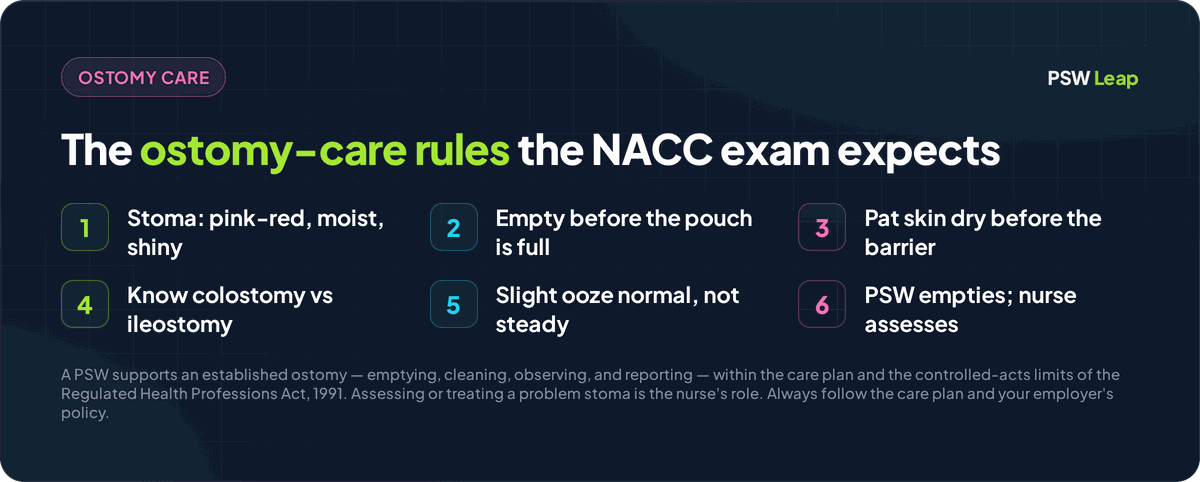
Use these one-line facts as a final review:
- Healthy stoma = pink-red, moist, shiny — report pale, dusky, purple, or black.
- Empty at one-third to one-half full — never wait until the pouch is full.
- Pat skin fully dry before a new barrier — adhesive won't stick to wet skin.
- Colostomy = formed stool; ileostomy = liquid, skin-irritating; urostomy = urine.
- Slight oozing is normal; steady bleeding is not — the stoma has no nerve endings.
- No output + cramping + hard abdomen = possible blockage — report promptly.
- A PSW empties, cleans, observes, and reports — the nurse assesses and treats.
- Protect dignity and privacy every time — adjusting to a stoma is hard.
Remember: PSW practice in Ontario always follows the client's individual care plan and your employer's policies, within the controlled-acts limits of the Regulated Health Professions Act, 1991. This article is exam-prep study material, not medical advice.
Practice more free NACC questions
You just answered 10 ostomy care questions — the NACC PSW exam spans all of its modules, from ostomy and continence to skin care, vital signs, and emergencies. The fastest way to find your weak spots is to keep practising with instant feedback.
👉 Start practising free at pswleap.com/learn — a large bank of NACC-style questions, full timed mock exams, and a Duolingo-style study path built specifically for Ontario PSW students. No subscription, and you can start with sample questions before you pay.
Closely related topics worth reviewing next: Free NACC Practice Questions on Catheter & Continence Care (the other elimination topic the exam loves) and Free NACC Practice Questions on Pressure Injuries (protecting fragile skin).
PSW Leap is an independent NACC PSW exam-prep platform for Ontario candidates. We are not affiliated with NACC. Always follow your training, your client's care plan, and your employer's policies on the job.
Published by PSW Leap
Independent NACC PSW exam prep
PSW Leap articles are written and maintained by the platform's founder, Shashank Jha, and checked against publicly available PSW curriculum standards. Found an error? Email hello@pswleap.com and we'll fix it.
Read our content methodologyPSW Leap
Practice smarter for the NACC exam. 2,500 questions. Detailed rationales. $29.99 CAD one-time — everything included.
Try 10 free questions →No account needed. Ready for the full bank? Create your account.