Free NACC Practice Questions on Multiple Sclerosis Care (Ontario PSW Exam Prep)
If you are studying for the NACC Personal Support Worker (PSW) exam in Ontario, multiple sclerosis (MS) is a condition you are genuinely likely to meet — Canada has among the highest rates of MS in the world, and the PSW is the daily set of hands helping a client stay safe, mobile, and independent while living with it. This free practice set gives you real NACC-style questions on keeping a heat-sensitive client cool, working around fatigue, preventing falls, supporting bladder and vision needs, spotting a relapse, and the PSW's scope — each with a clear answer. Work through them, then keep going at pswleap.com/learn.
What is multiple sclerosis care on the NACC PSW exam?
For the exam, caring for a client with MS means keeping them cool, working around fatigue, preventing falls, supporting bladder, vision and everyday needs, and reporting new symptoms — all within the care plan. MS is a chronic disease in which the immune system attacks myelin, the insulating cover on nerves in the brain and spinal cord, scrambling the messages between brain and body. It is usually diagnosed in young and middle adulthood, affects no two people the same way, and in its most common form it relapses — symptoms flare, then partly or fully settle. The exam treats the PSW as the daily eyes and hands: notice, support, and report — do not assess, or decide on or change medication.
Heat sensitivity, fatigue, and the invisible symptoms
Keep a client with MS cool and rested — heat and fatigue most reliably worsen MS symptoms, and both are things the PSW can manage. Many people with MS are heat-sensitive: when the body warms up, damaged nerves conduct even more poorly, so vision blurs, legs weaken, or fatigue spikes. This is Uhthoff's phenomenon — the worsening is temporary, eases as the person cools, and is not a true relapse. So run baths and showers tepid, not hot, offer cool drinks, use a fan or air conditioning, and plan the hardest tasks for the coolest part of the day.
Fatigue is the most common MS symptom and one of the most disabling — and it is invisible. A client can look perfectly well and still be too drained to finish dressing. It is not laziness or simple sleepiness. Help by conserving energy: plan demanding tasks for the client's best time (often the morning), break jobs into steps with rest between, and let them set the pace.
Mobility, spasticity, vision, and preventing falls
Falls are a major danger in MS, so keep the path clear, use the prescribed mobility aids, and never rush a client whose legs are weak, stiff, or numb. MS can cause muscle weakness, spasticity (stiffness and painful spasms), poor balance and coordination (ataxia), tremor, foot drop, and numb feet — any of which can put a client on the floor. Keep the walkway clear and lit, use the care plan's mobility aid with the brakes locked, transfer slowly, and encourage non-slip footwear. Gentle range-of-motion and good positioning ease stiffness and prevent contractures — the physiotherapist or occupational therapist prescribes the program; the PSW carries it out and reports.
Vision problems are common and often early — blurred or double vision, eye pain, or jerky eye movements that can swing with heat. Describe the environment, reduce clutter, and keep everyday items in reach and in the same place.
Bladder, bowel, communication, and everyday care
Support toileting on a schedule and watch for infection — bladder problems are very common in MS, and a urinary tract infection can make every symptom flare. MS often brings urinary urgency, frequency, incomplete emptying, or incontinence, so follow the toileting schedule, keep skin clean and dry, and give unhurried, dignified help. Report signs of a urinary tract infection — burning, cloudy or strong-smelling urine, new confusion, or fever — promptly, because a UTI can trigger a temporary worsening that looks like a relapse (a pseudo-relapse). Constipation is common too; encourage fluids and fibre as the care plan allows.
Some clients have cognitive changes — slower thinking or trouble with attention ("cog fog") that can fluctuate with fatigue and heat and is not dementia — and some have slurred, slow speech. Neither means their intelligence is gone: give them time, cut noise, and offer written reminders. Later in MS, swallowing can weaken (aspiration risk): keep the client sitting fully upright at meals, follow any texture or thickened-fluid order, and report coughing or choking. Depression is common — report low mood or withdrawal.
Medication, relapses, and the PSW's scope in Ontario
A PSW supports a client with MS and reports changes; the PSW does not manage the disease-modifying medication, decide on treatment, or assess a relapse. Many people with MS take disease-modifying therapies — injections, pills, or infusions meant to reduce relapses — plus medicines for spasticity, fatigue, bladder problems, or pain, and short steroid courses during a relapse. The PSW does not decide on, start, stop or adjust these. An injectable one is given by a PSW only through an exception in the Regulated Health Professions Act — where a nurse has assessed that, for this client, the injection is a routine activity of living (its need, response and outcome known and predictable) and has taught the PSW to give it to this client and found them competent — or through a delegation from a regulated professional who has found the PSW competent, and in either case only as the setting's legislation, the care plan and the employer's policy allow. Within the care plan and employer policy a PSW may assist with medication and must report a missed dose, a new side effect, or a client struggling to manage their treatment.
Sources: the Regulated Health Professions Act, 1991, s. 27 (2) para 5 and s. 29 (1) (accessed September 26, 2026); College of Nurses of Ontario, Teaching an unregulated care provider (accessed September 26, 2026); see also can a PSW give medication in Ontario.
A relapse is new or clearly worsening symptoms lasting more than about a day, not explained by heat or fever — for example, new weakness, numbness, or vision loss. The PSW notices it and reports it but does not diagnose it; the nurse and physician decide what to do. This sits inside the PSW's legal scope under Ontario's Regulated Health Professions Act, 1991: the PSW observes, supports, and reports, while the nurse, physician, physiotherapist, occupational therapist, or speech-language pathologist assesses and treats. Families may also lean on the Multiple Sclerosis Society of Canada for education and support; the PSW works alongside that plan and reports.
Quick terms to know: Myelin = the insulating cover on nerves that MS damages. Relapse = new or worsening symptoms that flare then settle. Uhthoff's phenomenon = the temporary symptom worsening when the body overheats. Spasticity = muscle stiffness and spasms. Pseudo-relapse = a temporary flare from heat or infection, not true new damage.
Free NACC-style practice questions: multiple sclerosis care
Each question mirrors the scenario-based, multiple-choice style of the NACC PSW exam. Try to answer before you read the explanation.
Q1. A client with MS says their legs feel much weaker after a hot shower. What should the PSW do?
Answer: Help them cool down and rest — the weakness is likely heat-related (Uhthoff's phenomenon) and temporary. Run the water tepid next time, and report it if the weakness does not ease as they cool.
Q2. Why should a PSW take a client's report of fatigue seriously in MS?
Answer: Fatigue is the most common and one of the most disabling MS symptoms, and it is invisible. The client may look well but be exhausted; it is not laziness. Conserve their energy and report a sudden increase.
Q3. A client with MS wants a bath and the bathroom is very warm. What is the safest approach?
Answer: Keep the water tepid, cool the room, and don't rush. Overheating temporarily worsens weakness, vision, and fatigue and raises the fall risk in the tub.
Q4. A PSW notices a client with MS has burning on urination and seems more confused today. What should the PSW do?
Answer: Report it promptly as a possible urinary tract infection. A UTI is common in MS and can flare symptoms like a relapse; the nurse assesses and treats.
Q5. Can a PSW adjust the timing of a client's MS disease-modifying injection to fit the routine?
Answer: No. Changing the timing of a dose is not the PSW's decision — the PSW does not decide on, start, stop or adjust disease-modifying medication. An injectable one is given by a PSW only through an RHPA exception (a routine activity of living that a nurse has assessed and taught the PSW to do for this client) or a delegation, as the setting's legislation, the care plan and the employer's policy allow; otherwise assist only within the care plan and policy, and report any missed dose.
Q6. A client with MS develops new double vision and weakness that has lasted since yesterday. What should the PSW do?
Answer: Report it to the nurse as a possible relapse. New symptoms lasting more than a day, not explained by heat or fever, need assessment — the PSW reports but does not diagnose.
Q7. A client with MS has slow, slurred speech and takes longer to answer. What should the PSW conclude?
Answer: Give them time and communicate normally — slow or slurred speech doesn't mean their thinking is impaired. Reduce noise, use short sentences, and don't finish their sentences.
Q8. A client with MS is unsteady and has stiff, spasming legs. How does the PSW reduce the fall risk?
Answer: Clear and light the path, use the prescribed mobility aid with brakes locked, and transfer slowly at a cool, rested time. Weakness and spasticity worsen with heat and fatigue.
Q9. A client with MS is exhausted by mid-afternoon every day. How should the PSW plan care?
Answer: Schedule demanding tasks for the client's best-energy time, usually the morning, and build in rest breaks. Let the client set the pace and sit for seated tasks.
Q10. A client with advanced MS coughs and chokes while drinking thin fluids. What should the PSW do?
Answer: Keep them sitting fully upright, follow the care plan's texture or thickened-fluid order, and report the choking. The PSW does not assess the swallow or change the diet — the nurse and speech-language pathologist do.
Common multiple sclerosis care mistakes to avoid on the NACC exam
- Running a hot bath or shower. Heat temporarily worsens MS symptoms — keep water and rooms tepid.
- Treating fatigue as laziness. It is a real, invisible symptom — conserve energy instead of pushing.
- Assuming slurred speech or "cog fog" means lost intelligence. Give time and communicate normally.
- Ignoring urinary symptoms. A UTI is common in MS and can mimic a relapse — report it fast.
- Deciding on or changing the medication yourself. The PSW never starts, stops or adjusts disease-modifying drugs, and gives an injectable one only through an RHPA exception or a delegation, per the care plan and employer policy.
- Rushing an unsteady client. Weakness, spasticity, and numb feet cause falls — use the prescribed aids.
The multiple sclerosis facts the NACC exam expects you to know
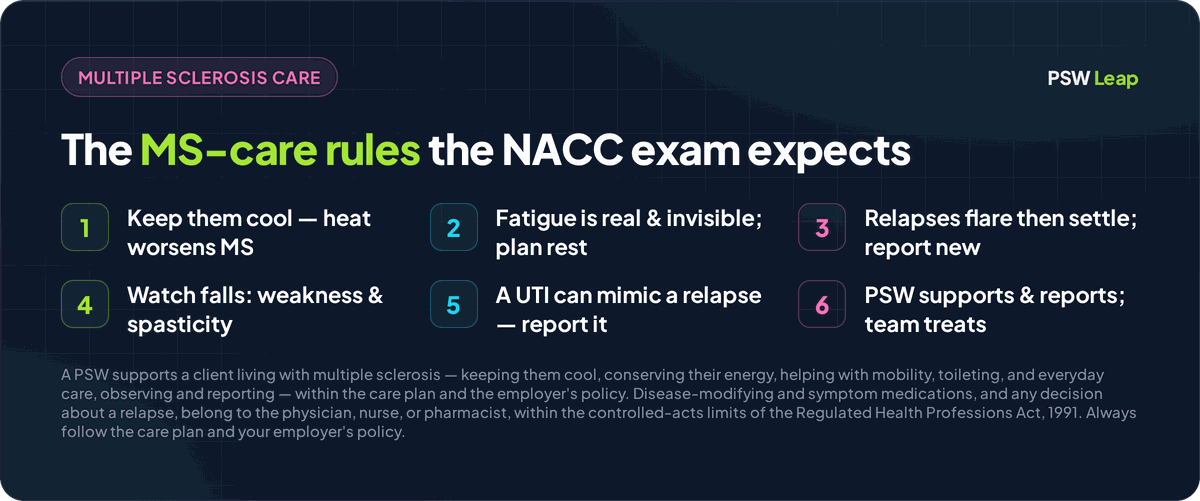
Keep these essentials straight and you'll handle most MS scenarios on the exam confidently.
Practice more free NACC questions
You just worked through the MS scenarios the NACC PSW exam loves — heat sensitivity, invisible fatigue, falls, bladder and vision needs, relapses, and the PSW's scope. Lock them in by practising in the exam's format.
👉 Start practising free at pswleap.com/learn — a large bank of NACC-style questions, full timed mock exams, and a Duolingo-style study path built for Ontario PSW students. No subscription needed to start.
Closely related topics worth reviewing next: Free NACC Practice Questions on Fall Prevention and Free NACC Practice Questions on Catheter and Continence Care — the falls and the bladder needs that run alongside multiple sclerosis.
Published by PSW Leap
Independent NACC PSW exam prep
PSW Leap articles are written and maintained by the platform's founder, Shashank Jha, and checked against publicly available PSW curriculum standards. Found an error? Email hello@pswleap.com and we'll fix it.
Read our content methodologyPSW Leap
Practice smarter for the NACC exam. 2,500 questions. Detailed rationales. $29.99 CAD one-time — everything included.
Try 10 free questions →No account needed. Ready for the full bank? Create your account.