Free NACC Practice Questions on Hip Fracture & Replacement Care (Ontario PSW Exam Prep)
If you are studying for the NACC Personal Support Worker (PSW) exam in Ontario, hip fractures and hip replacements are among the most common reasons an older client has to learn to move safely again. This free practice set gives you real NACC-style questions on hip precautions, weight-bearing orders, safe transfers, the complications you must report, and the PSW's observe-and-report scope — each with a clear answer. Then keep going at pswleap.com/learn.
What is hip fracture and hip replacement care on the NACC PSW exam?
For the exam, caring for a client after a hip fracture or hip replacement means helping them move safely within the surgeon's orders — following hip precautions and weight-bearing limits, supporting transfers and daily care, and reporting complications — without deciding those orders or treating the client yourself. A hip fracture is a break at the top of the thigh bone, most often after a fall, and is usually repaired with surgery — sometimes a hip replacement (a partial replacement swaps just the ball; a total replacement swaps the ball and the socket).
Hip precautions: the movements to avoid after a hip replacement
After a hip replacement the client must avoid the movements that can pop the new joint out of its socket. This is the hip fact the NACC exam tests most, so learn the three rules cold.
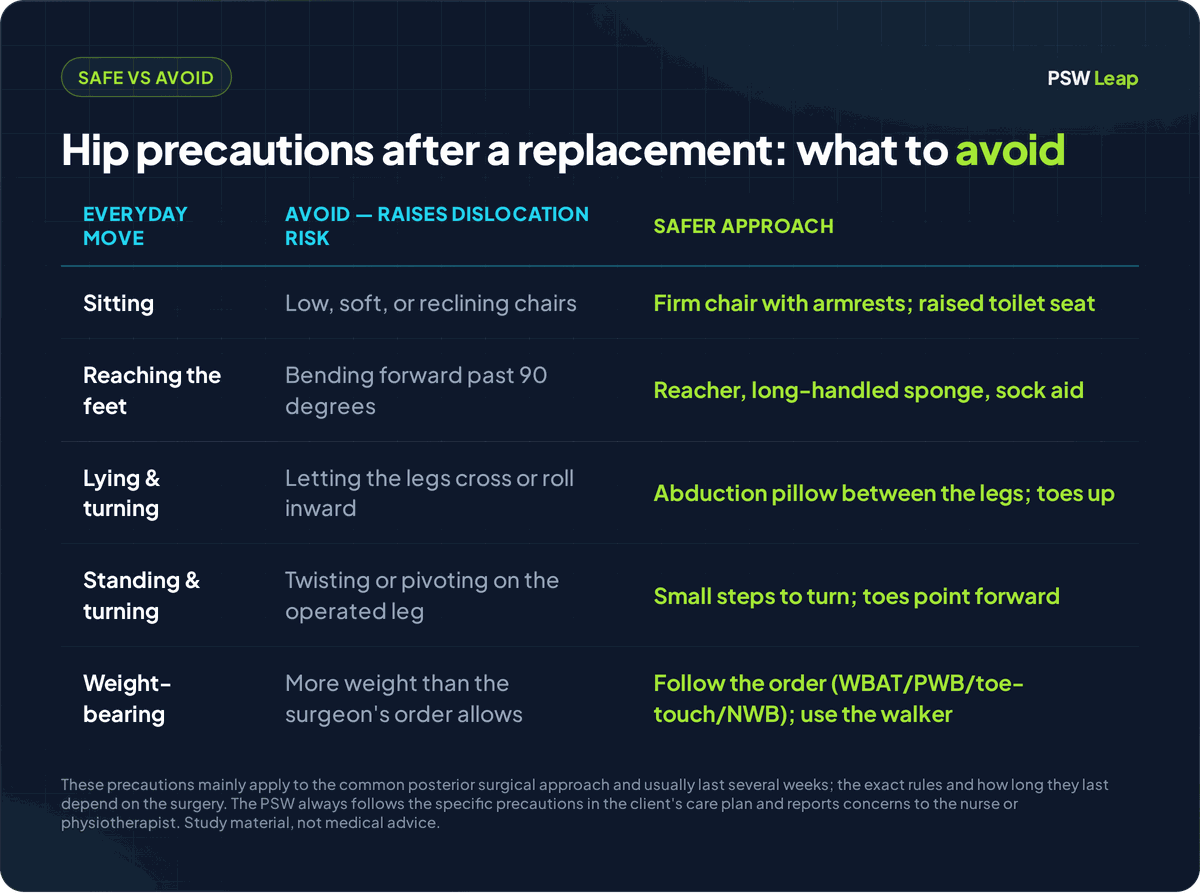
For the common posterior (back-of-the-hip) approach, the precautions are usually: do not bend the hip more than 90 degrees; do not cross the legs or bring the operated leg past the middle of the body; and do not turn or twist the operated leg inward. These limits keep the new joint seated while it heals, usually for several weeks.
Not every surgery uses the same rules — an anterior (front) approach limits different movements, and some clients have very few restrictions. That is why a PSW never assumes: follow the specific precautions written in the client's care plan and check with the nurse or physiotherapist.
Weight-bearing status, transfers, and safe mobility
Follow the surgeon's weight-bearing order exactly, and keep every surface high enough that the hip stays under 90 degrees. Weight-bearing status is the surgeon's order for how much weight the client may put through the operated leg — you may see weight-bearing as tolerated (WBAT), partial weight-bearing (PWB), toe-touch, or non-weight-bearing (NWB). The PSW never changes it and never lets the client put down more weight than allowed.
Raise the work surface with a firm chair with armrests and a raised toilet seat. Help the client slide the operated leg out in front to stand or sit, keep an abduction pillow between the legs when lying and turning, and have them take small steps to turn rather than pivot on the operated leg. Use the walker the physiotherapist set up, lock every brake before a transfer, and never rush.
Complications to watch for and report after hip surgery
Know the red flags — dislocation, blood clot, and infection — and report them fast, because a PSW spots them first. Signs of a dislocated hip are sudden severe hip or groin pain, the operated leg looking shorter or rotated out of its normal position, and the client suddenly unable to move or bear weight — report it right away and do not try to move the leg. Signs of a blood clot (deep vein thrombosis) are new pain, swelling, warmth, or redness in one calf or leg; report it and never rub or massage the leg, which can move the clot.
Signs of wound infection are fever and increasing redness, warmth, swelling, or drainage at the incision. Because the client is less mobile after surgery, also watch for pressure injuries on the heels and tailbone, constipation from pain medication, and new confusion. The PSW observes and reports these; the nurse assesses.
Medication, devices, and the PSW's scope in Ontario
Assist with medication only as the care plan directs, apply equipment as prescribed, and stay inside the observe-and-report role. The PSW never decides on, adjusts, or recommends pain medication, gives it only as the care plan and Ontario's medication-assistance rules for the setting allow, and reports unrelieved pain rather than acting on it — pain that keeps a client from moving raises the risk of clots and pressure injuries. Apply compression stockings only when the care plan calls for them, and check the skin underneath.
In Ontario, a client often moves from the acute hospital to inpatient rehab and then home — with publicly funded home care arranged through Ontario Health atHome — or into long-term care, and a PSW may support them at any of these stages as the care plan changes. Throughout, following hip precautions and weight-bearing orders and observing and reporting are the PSW's role; deciding weight-bearing, progressing exercises, assessing the wound, and managing medication are not — those belong to the surgeon, nurse, and physiotherapist.
Quick terms to know: Hip precautions = movement limits that keep a new hip from dislocating. Arthroplasty = joint replacement surgery. Dislocation = the ball of the joint slipping out of its socket. Abduction = moving a leg out away from the middle of the body (an abduction pillow keeps the legs apart). Weight-bearing status = how much weight the surgeon allows through the operated leg. DVT = deep vein thrombosis, a blood clot in a deep leg vein.
Free NACC-style practice questions: hip fracture and replacement care
Each question mirrors the scenario-based, multiple-choice style of the NACC PSW exam. Try to answer before you read the explanation.
Q1. A client three weeks after a posterior hip replacement wants to sit in a low, soft armchair. What should the PSW do?
Answer: Offer a firmer, higher chair with armrests instead — a low, soft seat bends the hip past 90 degrees and risks dislocation.
Q2. A client with a new hip replacement is lying in bed and starts to let their legs cross. What should the PSW do?
Answer: Keep an abduction pillow between the legs so they stay apart — crossing the operated leg past the midline can dislocate the joint.
Q3. A client's care plan says "toe-touch weight-bearing, left leg." The client wants to walk normally on it. What should the PSW do?
Answer: Do not let the client put full weight on the leg — follow the toe-touch order and the prescribed walker, and report that the client wants to do more.
Q4. A PSW notices a client's operated leg suddenly looks shorter and rotated out of position, and the client has severe hip pain and cannot move it. What should the PSW do?
Answer: Report it to the nurse immediately as a possible dislocation and do not try to move the leg.
Q5. A client's right calf is newly swollen, warm, red, and painful. The client asks the PSW to rub it. What should the PSW do?
Answer: Do not rub or massage the leg — these are signs of a possible blood clot; report it to the nurse right away. Massaging can dislodge a clot.
Q6. A client is standing at the walker and needs to turn toward the bed. How should the PSW guide the turn?
Answer: Have the client take small steps to turn, keeping the toes forward — never twist or pivot on the operated leg.
Q7. A client with a new hip replacement cannot reach their feet to wash and dress them without bending forward. What is the best PSW response?
Answer: Provide long-handled aids — a reacher, long-handled sponge, and sock aid — so the client avoids bending the hip past 90 degrees.
Q8. Four days after hip surgery, a client has a fever and the incision is more red, warm, and draining than yesterday. What should the PSW do?
Answer: Report the fever and the wound changes to the nurse — they are signs of possible infection.
Q9. A client recovering from hip surgery has not had a bowel movement in three days and is on pain medication. What should the PSW do?
Answer: Report the constipation to the nurse and support fluids, fibre, and movement as the care plan allows.
Q10. A client asks the PSW to help them do the leg-strengthening exercises "a bit harder" than the physiotherapist showed. What should the PSW do?
Answer: Keep to the exercises and level the physiotherapist set, and report the client's wish to progress. The PSW supports the prescribed plan but does not change or advance it.
Common hip-care mistakes to avoid on the NACC exam
- Letting the hip bend past 90 degrees instead of raising surfaces and using long-handled aids.
- Allowing the legs to cross or the operated leg to twist inward instead of using an abduction pillow and small turning steps.
- Putting more weight on the leg than the order allows instead of following the weight-bearing order and reporting.
- Massaging a swollen, painful calf, or dismissing a shortened, out-of-place leg, instead of reporting a possible clot or dislocation.
The hip-precaution facts the NACC exam expects you to know
Use these one-line facts as a final review:
- The three posterior precautions — no bending past 90 degrees, no crossing the legs, no turning the leg inward — and always follow the care plan's specific rules.
- Follow the weight-bearing order exactly — WBAT, partial, toe-touch, or non-weight-bearing — and use the prescribed walker.
- Report the red flags fast — dislocation (short, out-of-place leg), blood clot (swollen, painful calf — never massage), and wound infection (fever, drainage).
Remember: PSW practice in Ontario follows the client's care plan and your employer's policies, within the controlled-acts limits of the Regulated Health Professions Act, 1991. Following hip precautions and weight-bearing orders, assisting with medication as the care plan directs, and observing and reporting are within a PSW's role; deciding weight-bearing status, prescribing exercises, assessing the wound, and managing medication are not. This article is exam-prep study material, not medical advice.
Practice more free NACC questions
You just answered 10 hip fracture and hip replacement care questions, but the NACC PSW exam spans every module — keep practising to find your weak spots.
👉 Start practising free at pswleap.com/learn — a large bank of NACC-style questions, full timed mock exams, and a Duolingo-style study path built for Ontario PSW students. No subscription needed to start.
Closely related topics worth reviewing next: Free NACC Practice Questions on Fall Prevention and Free NACC Practice Questions on Body Mechanics — the fall that often breaks a hip, and the safe-transfer skills that protect both the client and you.
PSW Leap is an independent NACC PSW exam-prep platform for Ontario candidates. We are not affiliated with NACC. Always follow your training, your client's care plan, and your employer's policies on the job.
Published by PSW Leap
Independent NACC PSW exam prep
PSW Leap articles are written and maintained by the platform's founder, Shashank Jha, and checked against publicly available PSW curriculum standards. Found an error? Email hello@pswleap.com and we'll fix it.
Read our content methodologyPSW Leap
Practice smarter for the NACC exam. 2,500 questions. Detailed rationales. $29.99 CAD one-time — everything included.
Try 10 free questions →No account needed. Ready for the full bank? Create your account.