Free NACC Practice Questions on Heart Failure Care (Ontario PSW Exam Prep)
If you are studying for the NACC Personal Support Worker (PSW) exam in Ontario, heart failure — often called congestive heart failure, or CHF — is one of the conditions you are most likely to meet on the job and on the test. It is common in Ontario long-term care and home care, a leading reason clients return to hospital, and the PSW is often the only person who sees the client daily. This free practice set gives you real NACC-style questions on taking an accurate daily weight, spotting swelling and breathlessness, following a fluid and low-sodium plan, and the PSW's observe-and-report scope — each with a clear answer. Then keep going at pswleap.com/learn.
What is heart failure care on the NACC PSW exam?
For the exam, caring for a client with heart failure means watching for fluid building up — through a daily weight, swelling, and breathing — helping the client follow their fluid and diet plan, and reporting changes early, all within the care plan. Heart failure means the heart can no longer pump strongly enough, so fluid backs up into the lungs, abdomen, and legs — and the PSW is the daily early-warning system who catches the change.
The daily weight: the most important PSW task
Take the weight the same way every day — same time, same scale, similar clothing — and report a sudden gain; the scale catches fluid building up before swelling and breathlessness do. Weigh the client first thing in the morning, after they empty their bladder and before breakfast, and write the number down — a weight taken in heavy clothes after lunch tells you nothing.
A sudden rise means fluid is building up. The figure commonly taught is a gain of about 2 pounds (1 kg) in a day or 5 pounds (2.3 kg) in a week — but follow the exact numbers in the client's care plan, and report a jump to the nurse. The PSW takes and records the weight; deciding what the change means is the nurse's job.
Swelling, breathing, and positioning
Watch for swelling in the lowest parts of the body and breathing that worsens lying flat — and sit a breathless client upright. Fluid pools where gravity pulls it, so look for edema (swelling) in the ankles, feet, and lower legs, or over the lower back in a client who stays in bed. Tight shoes, deep sock marks, or a ring that no longer fits are early clues, and a press that leaves a dent that stays is pitting edema — all reportable.
Heart failure also makes breathing hardest when the client lies flat (orthopnea), and some wake at night gasping. Sit the client upright — raise the head of the bed or add pillows (semi-Fowler's or higher) — loosen tight clothing and stay with them. Report a client who suddenly needs more pillows, a new night-time cough, or frothy or pink-tinged sputum. Sudden severe breathlessness, chest pain, fainting, or blue lips is an emergency — get help and call 911.
Fluid limits, low sodium, and the falls risk from "water pills"
Follow the client's fluid and low-sodium plan exactly, and remember the diuretics that ease fluid also raise the falls risk. Extra fluid and salt make the heart work harder, so many clients have a daily fluid limit and a low-salt diet. The PSW helps the client stay within it and offers mouth care or ice chips for thirst if allowed — but does not add fluids, bring salty snacks, or let family override the limit without checking the nurse.
Many clients also take a diuretic ("water pill") such as furosemide (Lasix), which sends them to the bathroom often and can leave them dizzy on standing — a fall waiting to happen. Keep the toilet path clear and lit, keep a commode, urinal, and call bell within reach, help the client rise slowly, and report dizziness or any fall. The PSW assists with medication only as the care plan allows and never changes, holds, or doubles a dose.
Activity, energy, and the PSW's scope in Ontario
Balance activity with rest, watch the client during care, and stay inside the observe-and-report role. Fatigue and breathlessness on exertion are part of heart failure, so allow extra time, space out tasks, and let the client recover if they become short of breath or dizzy during care. Supporting independence still matters, but rushing a tired client does not.
In Ontario, the PSW works within the care plan and employer policies. The role is to take the daily weight, watch swelling and breathing, support the fluid and diet plan, assist with medication as the plan directs, and report — not to diagnose, adjust medication or diet, or assess the heart and lungs. The PSW is the daily eyes that catch trouble early.
Quick terms to know: Edema = swelling from fluid. Pitting edema = a press that leaves a dent that stays. Orthopnea = breathless when lying flat. Diuretic = a "water pill" that removes extra fluid. Semi-Fowler's = sitting partly upright.
Free NACC-style practice questions: heart failure care
Each question mirrors the scenario-based, multiple-choice style of the NACC PSW exam. Try to answer before you read the explanation.
Q1. A PSW is starting daily weights for a new client with heart failure. When and how should they be taken?
Answer: Same time each day (usually morning, after voiding, before breakfast), same scale, similar clothing — and record it.
Q2. A client with heart failure has gained 2 kg since yesterday. What should the PSW do?
Answer: Report the gain to the nurse right away — a sudden jump means fluid is building up. The nurse decides what it means; the PSW records and reports.
Q3. A PSW notices new swelling and deep sock marks on a client's ankles. What is this, and what should the PSW do?
Answer: It is edema (fluid swelling) — observe it, note where it is, and report it. New or worsening swelling is an early heart failure warning.
Q4. A client with heart failure is short of breath lying flat in bed. What should the PSW do first?
Answer: Sit the client upright — raise the head of the bed or add pillows — then report it. Breathing is hardest lying flat; sitting up eases it.
Q5. A client on a fluid restriction asks the PSW for an extra large glass of water. What should the PSW do?
Answer: Follow the care plan — offer mouth care or ice chips for thirst if allowed, and stay within the day's fluid limit. Report only if the client is distressed or cannot keep within the limit.
Q6. A client's family brings in salty chips and asks the PSW to serve them. What should the PSW do?
Answer: Do not serve them against a low-sodium plan — explain kindly and check with the nurse. Extra salt worsens fluid retention and swelling.
Q7. A client on furosemide (a "water pill") needs frequent, urgent trips to the toilet. What is the main PSW concern?
Answer: Falls — keep the path clear and lit, keep a commode and call bell within reach, and help the client rise slowly. Frequent trips plus dizziness on standing raise the risk.
Q8. A client suddenly becomes severely short of breath with chest pain and blue-tinged lips. What should the PSW do?
Answer: This is an emergency — stay with the client, sit them up, get help, and call 911. Do not wait to "see if it passes."
Q9. A client with heart failure becomes very tired and breathless partway through their morning wash. What should the PSW do?
Answer: Stop, let the client rest and recover, then continue at a slower pace — and report the change. Do not push a breathless client.
Q10. Can a PSW hold a client's diuretic because the client urinated a lot overnight?
Answer: No — the PSW never changes, holds, or doubles a medication dose. Assist only as the care plan allows and report the concern to the nurse.
Common heart failure care mistakes to avoid on the NACC exam
- Taking the daily weight inconsistently — different time, scale, or clothing — so the number is meaningless.
- Dismissing a sudden weight gain or new swelling as "just water" instead of reporting it.
- Laying a breathless client flat instead of sitting them upright.
- Adding fluids or salty food because the client or family asks, against the plan.
- Changing, holding, or doubling a medication on your own instead of assisting per the plan and reporting.
The heart failure facts the NACC exam expects you to know
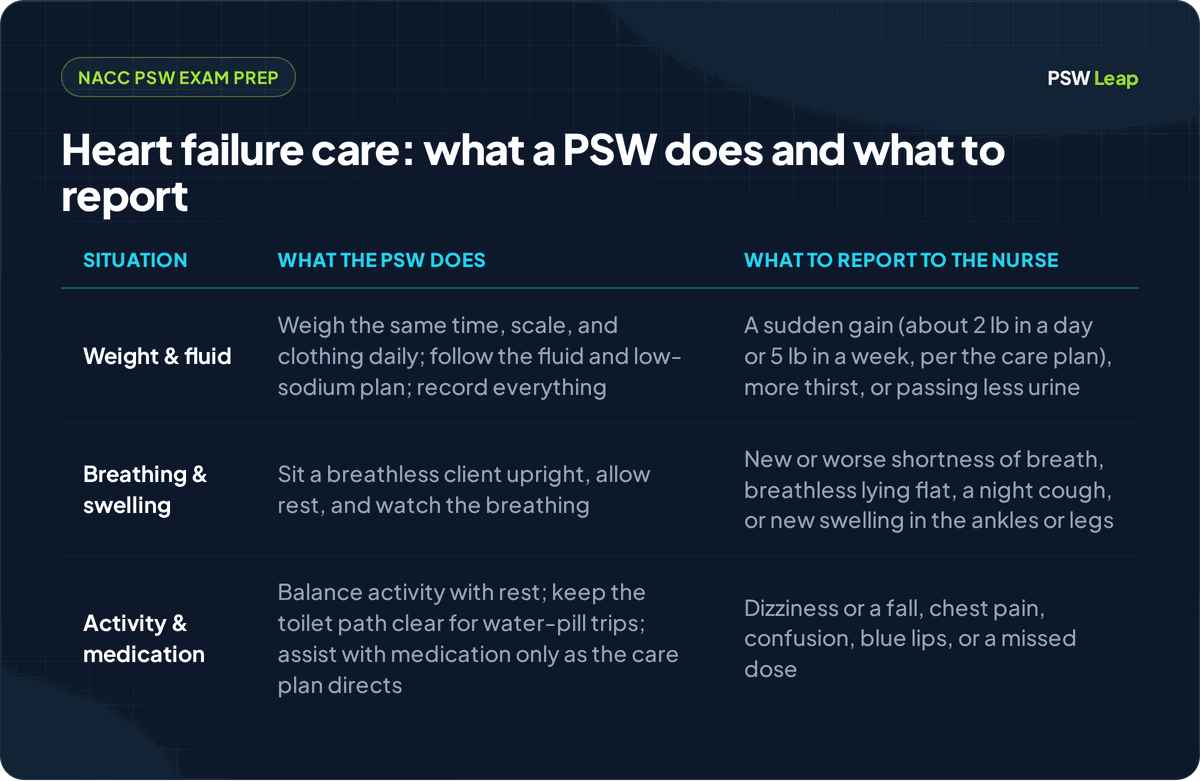
Use these one-line facts as a final review:
- The daily weight is your most important task — same time, scale, and clothing; report a sudden gain (about 2 lb in a day or 5 lb in a week, per the care plan).
- Watch the ankles, feet, lower legs, and lower back for swelling — new or worse edema is reportable.
- Sit a breathless client upright — breathing is hardest lying flat; chest pain or severe breathlessness is a 911 emergency.
- Follow the fluid and low-sodium plan exactly — don't add fluids or salty food, even when asked.
- "Water pills" raise the falls risk — clear the toilet path, help the client rise slowly, and never change a dose.
Remember: PSW practice in Ontario follows the client's care plan and your employer's policies, within the controlled-acts limits of the Regulated Health Professions Act, 1991. Taking and recording a daily weight, watching for swelling and breathing changes, helping with the fluid and diet plan, assisting with medication as the care plan directs, and observing and reporting are within a PSW's role; diagnosing, adjusting medication or fluids, and assessing the heart or lungs are not. This article is exam-prep study material, not medical advice.
Practice more free NACC questions
You just answered 10 heart failure care questions, but the NACC PSW exam spans every module — keep practising to find your weak spots.
👉 Start practising free at pswleap.com/learn — a large bank of NACC-style questions, full timed mock exams, and a Duolingo-style study path built for Ontario PSW students. No subscription needed to start.
Closely related topics worth reviewing next: Free NACC Practice Questions on Vital Signs and Free NACC Practice Questions on Nutrition and Hydration — the vital-signs and fluid-balance skills that run alongside heart failure care.
PSW Leap is an independent NACC PSW exam-prep platform for Ontario candidates. We are not affiliated with NACC. Always follow your training, your client's care plan, and your employer's policies on the job.
Published by PSW Leap
Independent NACC PSW exam prep
PSW Leap articles are written and maintained by the platform's founder, Shashank Jha, and checked against publicly available PSW curriculum standards. Found an error? Email hello@pswleap.com and we'll fix it.
Read our content methodologyPSW Leap
Practice smarter for the NACC exam. 2,500 questions. Detailed rationales. $29.99 CAD one-time — everything included.
Try 10 free questions →No account needed. Ready for the full bank? Create your account.