What Does DIPPS Stand For? The Five PSW Care Principles Explained
If there is one concept that ties together everything you will learn in your PSW program, it is DIPPS. This five-letter acronym represents the foundational principles that guide every single interaction you have with a client — from assisting with a bath to helping someone eat breakfast to making a bed while a client sits nearby. DIPPS is not just a theory concept for your textbook. It is a practical decision-making framework that you will use every day on the job, and it is the lens behind many scenario-style practice questions, including PSW Leap's.
Short answer: DIPPS stands for Dignity, Independence, Preferences, Privacy and Safety: five person-centred care principles that Ontario PSW programs and the OPSWA code of conduct use as a checklist for every care task. When principles conflict, follow the care plan and employer policy: decline unsafe requests, never force care on a client who refuses, and report.
Sources: the OPSWA Code of Conduct ("D.I.P.P.S: This acronym refers to Dignity – Independence – Preference – Privacy – Safety") and the eCampusOntario open textbook Personal Care Assistant, chapter 2.3.6 DIPPS Protocol (CC BY-NC-SA 4.0), both checked September 8, 2026. Textbooks write the third principle as "Preference" or "Preferences"; the meaning is the same.
What does DIPPS stand for?
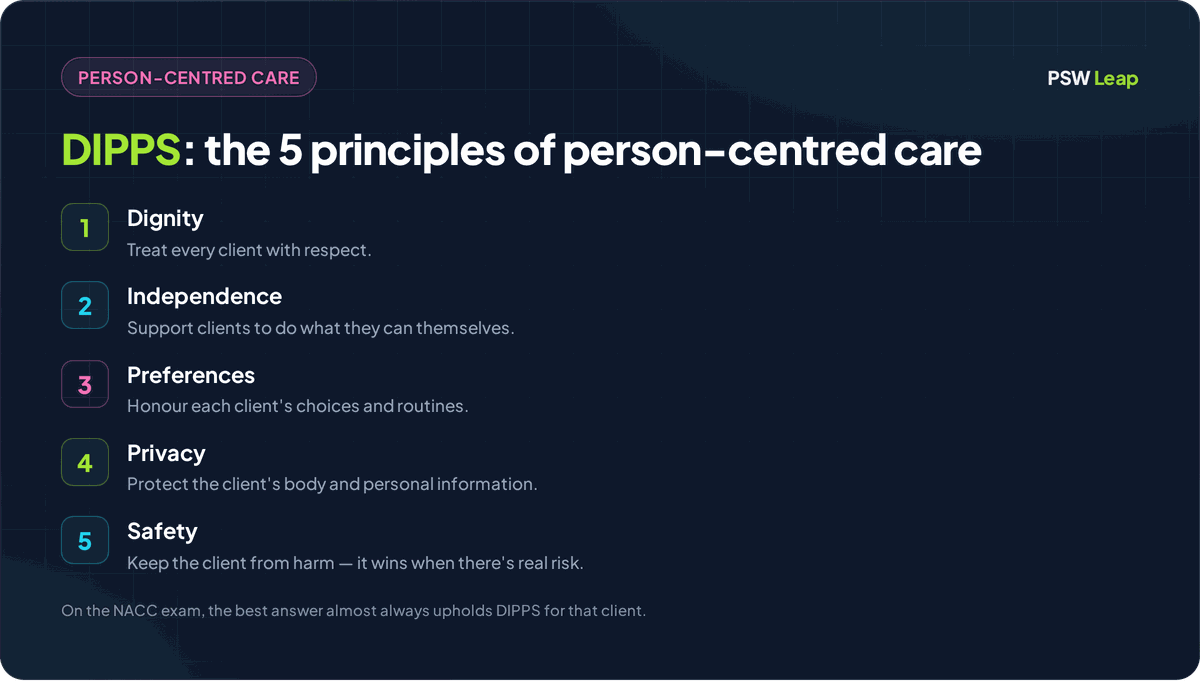
DIPPS stands for Dignity, Independence, Preferences, Privacy and Safety — a framework that reminds PSWs to consider five essential principles before, during, and after every care interaction. Each letter represents a non-negotiable aspect of client care:
- D — Dignity
- I — Independence
- P — Preferences
- P — Privacy
- S — Safety
| Principle | What it means for a PSW | Care example from this guide |
|---|---|---|
| Dignity | Treat the client as a valued adult: knock, explain before you act, use respectful language | Speaking calmly and matter-of-factly during perineal care after incontinence |
| Independence | Support the client to do what they can, even when it is slower | Setting up a meal with adaptive utensils instead of feeding a client who can feed himself |
| Preferences | Honour the client's choices about routine, food, clothing, culture and faith | Adjusting a bath time so a client can wash before prayers |
| Privacy | Protect the body and the information: doors, curtains, draping, no hallway talk | Drawing the curtain fully and lowering your voice during a bed bath in a shared room |
| Safety | Follow the care plan and remove hazards; decline unsafe requests, but a client who refuses care is never forced — explain, respect the choice, report | Getting a second person for a two-person transfer even when the client asks you to do it alone |
When you are faced with any care decision — whether in a clinical placement, on the job, or on the NACC exam — running through DIPPS mentally ensures that you are providing care that respects the whole person. Think of it as a checklist that protects both your client and you.
The Five Principles in Detail
Dignity
Dignity means treating every client as a valued human being, regardless of their age, condition, cognitive status, or level of dependence. It means speaking to adults as adults, never using baby talk or pet names unless the client has specifically asked you to. It means knocking before entering a room, explaining what you are about to do before you do it, and never discussing a client's personal information in public areas.
Real-world example: You are assisting Mrs. Thompson with perineal care after an episode of incontinence. She is visibly embarrassed. Maintaining dignity means speaking calmly and matter-of-factly, using professional language, not making facial expressions that suggest disgust, and reassuring her that this is a normal part of care. You would say something like, "Let me help you get cleaned up and comfortable — this happens, and it is nothing to worry about."
Exam trap: A question may describe a scenario where a care aide calls an elderly client "sweetie" or "dear" and ask whether this is appropriate. In practice questions, the expected answer is that this language is infantilizing and violates dignity — unless the client has specifically requested it.
Independence
Independence means encouraging and supporting clients to do as much as they can for themselves, even when it would be faster for you to do it. This is one of the hardest principles for new PSWs to practise because it feels like you are not helping enough. But promoting independence preserves the client's physical abilities, maintains their self-esteem, and respects their autonomy.
Real-world example: Mr. Patel has had a stroke and has limited use of his right hand. He can still hold a spoon and bring food to his mouth, but it takes him much longer than it would take you to feed him. Promoting independence means setting up his meal so that it is accessible (cutting food, using adaptive utensils, placing items within reach), sitting with him patiently, and only assisting when he asks or when safety requires it. You do not take the spoon and feed him simply because it is faster.
Exam trap: Questions often present scenarios where the "helpful" answer is actually the wrong one. If a question asks what to do when a client is struggling to button a shirt, the correct answer is usually to give them more time and offer verbal encouragement or adaptive aids — not to button the shirt for them.
Mrs. Chen can dress herself but takes 20 minutes. Her family asks you to dress her so she can be ready faster. What should you do?
Preferences
Preferences means respecting and honouring the client's choices about their own care. This includes how they like their bath (shower versus tub, water temperature), what they want to eat, when they prefer to go to bed, what they want to wear, and how they want their environment arranged. Preferences also extend to cultural and spiritual practices — a client's religious dietary requirements, prayer times, or cultural customs around modesty are all preferences that must be respected.
Real-world example: Mr. Okoro is Muslim and prefers to wash before his prayers. His care plan schedules his bath in the morning, but he would rather bathe in the early afternoon after lunch. As a PSW, you should communicate this preference to the care team and, whenever possible, adjust the schedule to accommodate it. His preference does not create a safety risk, so there is no reason not to honour it.
Exam trap: A question may present a situation where the client's preference conflicts with what seems more convenient for the care team. The correct answer nearly always prioritizes the client's preference — unless it creates a genuine safety concern.
Privacy
Privacy means protecting the client's physical privacy during care and protecting their personal and health information at all times. Physical privacy includes closing doors and curtains during personal care, draping clients appropriately, and minimizing exposure. Informational privacy means never discussing client details in hallways, elevators, or break rooms, and never sharing information with anyone who is not directly involved in the client's care.
Real-world example: You are giving Mr. Williams a bed bath in a semi-private room. His roommate's family is visiting on the other side of the curtain. Maintaining privacy means ensuring the curtain is fully drawn, keeping Mr. Williams covered as much as possible by only exposing the body part you are currently washing, speaking in a low voice, and not discussing his medical conditions where others can hear.
Exam trap: Scenario questions frequently test whether you know to close doors, pull curtains, and drape properly. If a question mentions that a door is open or a curtain is not drawn during personal care, the correct answer will involve addressing that privacy breach before continuing.
You are assisting a client with a shower. Another PSW knocks and asks if you need help. The door is open. What should you do first?
Safety
Safety means ensuring that the client is protected from harm at all times — both physical harm and emotional harm. This includes following proper body mechanics when transferring clients, using mechanical lifts when required, keeping the environment free of hazards (wet floors, clutter, poor lighting), ensuring bed rails are in the correct position, applying fall prevention strategies, and reporting any unsafe conditions promptly through your reporting path — or through your employer's emergency protocol and emergency services when someone is in immediate danger.
Safety is the DIPPS principle that tends to pull against the others — but it never overrides the client's right to refuse care. If a client's preference creates a genuine safety risk — for example, refusing to use a walker when they are a documented fall risk — you explain the risk plainly, decline to carry out an unsafe method, offer the safe alternatives the care plan allows, respect the client's decision, and report the refusal promptly through your reporting path to the registered staff or most accountable person so the plan can be reassessed. You do not force the measure and you do not simply ignore the risk. Deciding whether a client is capable of refusing is not the PSW's call — report the refusal so the team can address it.
Real-world example: Mrs. Davis insists on walking to the bathroom without her walker. Her care plan specifies that she must use a walker at all times due to her fall history. You should calmly explain that using the walker is part of her care plan for her safety, offer to walk alongside her, and if she continues to refuse, report the situation to your supervisor. You do not physically force her to use the walker (that would violate dignity and could constitute restraint), but you do not simply let her walk unsupported.
Exam trap: Safety-versus-independence is a classic trap in scenario-style practice questions. If a question describes a client who wants to do something independently but it is clearly unsafe (as documented in the care plan), the correct answer involves following the care plan and reporting — not blindly promoting independence.
Mr. Ahmed's care plan states he requires a two-person transfer. He tells you he feels strong today and asks you to transfer him alone. What should you do?
How DIPPS Applies to Everyday Care Tasks
DIPPS is not an abstract concept — it applies concretely to every task you perform. Here is how the five principles map to three common care activities:
Bathing
| Principle | Application |
|---|---|
| Dignity | Speak respectfully, explain each step, never rush or show impatience |
| Independence | Let the client wash the areas they can reach; assist only as needed |
| Preferences | Ask about water temperature, preferred soap, shower vs. tub |
| Privacy | Close the door, draw curtains, cover body parts not being washed |
| Safety | Check water temperature before use, use non-slip mats, stay within reach |
Feeding / Meal Assistance
| Principle | Application |
|---|---|
| Dignity | Seat the client at the table (not in bed) if possible; use real dishes, not paper plates |
| Independence | Provide adaptive utensils, cut food into manageable pieces, let the client feed themselves |
| Preferences | Serve foods the client enjoys, respect cultural and religious dietary needs |
| Privacy | Do not discuss the client's diet restrictions in front of other clients |
| Safety | Check food temperature, position the client upright, monitor for choking |
Dressing
| Principle | Application |
|---|---|
| Dignity | Let the client choose their own clothes; do not dress them in mismatched or stained items |
| Independence | Encourage the client to do what they can; assist with buttons or zippers as needed |
| Preferences | Respect their style choices even if you would choose differently |
| Privacy | Close the door, provide a robe or cover while changing |
| Safety | Ensure clothing fits properly (not too long to cause tripping), check for proper footwear |
Using DIPPS as a Decision-Making Framework on the NACC Exam
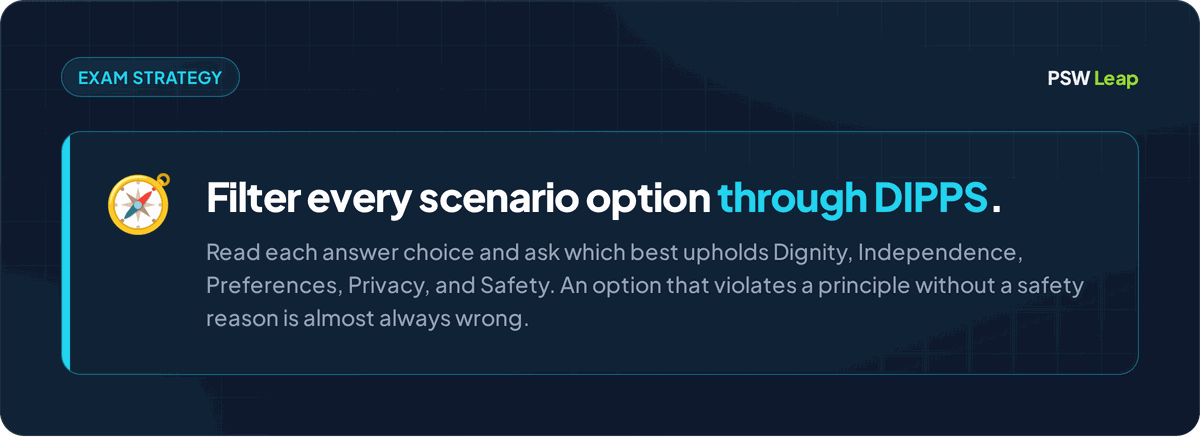
Here is the most practical advice for using DIPPS on exam day: when you read a scenario question and feel unsure about the answer, run through each letter of DIPPS and ask yourself which principle the question is testing.
Step 1: Read the scenario carefully and identify what is happening.
Step 2: Ask yourself: Does any answer choice violate Dignity? Does any choice take away Independence unnecessarily? Does any choice ignore the client's Preferences? Does any choice compromise Privacy? Does any choice create a Safety risk?
Step 3: Eliminate answer choices that violate DIPPS principles. The correct answer will be the one that respects all five — or, in cases of conflict, prioritizes Safety while preserving as many other principles as possible.
This framework works for most scenario-style practice questions, and many questions that look like clinical-skill questions (bathing, transferring) are really asking whether you can apply DIPPS. NACC's public pages do not break the exam down by topic (nacc.ca, checked September 8, 2026), so treat any claim about how often DIPPS appears as a study tip, not a fact.
A client with dementia insists on wearing a summer dress in winter when going outside for a walk. What is the best approach?
Common Exam Traps Related to DIPPS
In practice questions, these patterns lead to wrong answers:
-
Choosing the "fastest" answer. Efficiency is not a DIPPS principle. If one answer is quicker but takes away independence, and another takes longer but supports the client doing it themselves, the second answer is correct.
-
Forgetting privacy during personal care. If the scenario mentions an open door, unclosed curtain, or exposed body parts, the correct answer will address the privacy breach first.
-
Confusing safety with control. Safety means following the care plan and preventing harm. It does not mean controlling the client or overriding all their choices. You can respect preferences and maintain safety simultaneously in most situations.
-
Ignoring cultural preferences. If a scenario mentions a cultural or religious practice, the correct answer will respect it unless it creates a direct safety hazard.
-
Being "too helpful." Doing everything for the client when they can do some things independently violates the independence principle, even though it feels like good care.
Study Tips for Memorizing DIPPS
- Use the acronym as a mental checklist. Before answering any scenario question, quickly run through D-I-P-P-S in your head.
- Create flashcards with scenarios. Write a care scenario on one side and identify which DIPPS principle it tests on the other.
- Practise during clinical placements. After each client interaction, mentally review whether you addressed all five principles.
- Pay special attention to the Safety-vs-Independence tension. PSW Leap's practice questions test this tension deliberately.
For more scenario-based practice, check out our free practice questions that cover DIPPS principles in context.
Ready to practice?
Practise scenario questions with instant feedback and an explanation for every answer.
Try 10 free practice questionsConnecting DIPPS to Your Broader Exam Prep
DIPPS does not exist in isolation. It connects directly to other major exam topics:
- Scope and authority: Safety depends on knowing what a PSW is trained and permitted to do in Ontario, because a task nobody has authorized you to perform is a safety problem before it is anything else.
- IPAC and Infection Control: Proper infection control practices are a Safety requirement during every care task.
- Common Exam Mistakes: Common mistakes in scenario-style practice questions often come down to forgetting one DIPPS principle.
- How to Pass the NACC Exam: Your overall exam strategy should include DIPPS as a core decision-making tool.
Understanding DIPPS well gives you a reliable framework for scenario-style questions, on practice tests and on exam day. When in doubt, come back to these five principles — they will guide you to the correct answer more often than any other single strategy.
Frequently Asked Questions
DIPPS stands for Dignity, Independence, Preferences, Privacy, and Safety. It is a person-centred care framework taught in Ontario PSW programs and used in the OPSWA code of conduct (checked September 8, 2026); it guides how Personal Support Workers approach every interaction with a client.
DIPPS is important because it ensures that every care decision respects the client as a whole person, not just a set of tasks to complete. It protects clients' rights, promotes autonomy, and reduces the risk of harm. It is also the lens behind many scenario-style practice questions, including PSW Leap's.
NACC's public pages do not break the exam down by topic (nacc.ca, checked September 8, 2026), so there is no published figure for how often DIPPS appears. In scenario-style practice questions you are given a care situation and asked for the best response, and the expected answer usually upholds one or more DIPPS principles; when they conflict it follows the care plan and employer policy without forcing care on a client who refuses — explain, respect the choice, and report.
Written by Shashank Jha
Founder, PSW Leap
Shashank Jha is the founder of PSW Leap. He built this platform after going through the NACC exam prep process himself, to help fellow students study smarter with practice questions organized around the NACC PSW curriculum.
He's also the author of PSW Exam Success: The Ultimate Prep Book — the 455-page paperback PSW Leap grew out of.
Learn more about PSW LeapPSW Leap
Practice smarter for the NACC exam. 2,500 questions. Detailed rationales. $29.99 CAD one-time — everything included.
Try 10 free questions →No account needed. Ready for the full bank? Create your account.