Dementia Care for PSWs: Types, Stages & Person-Centred Strategies
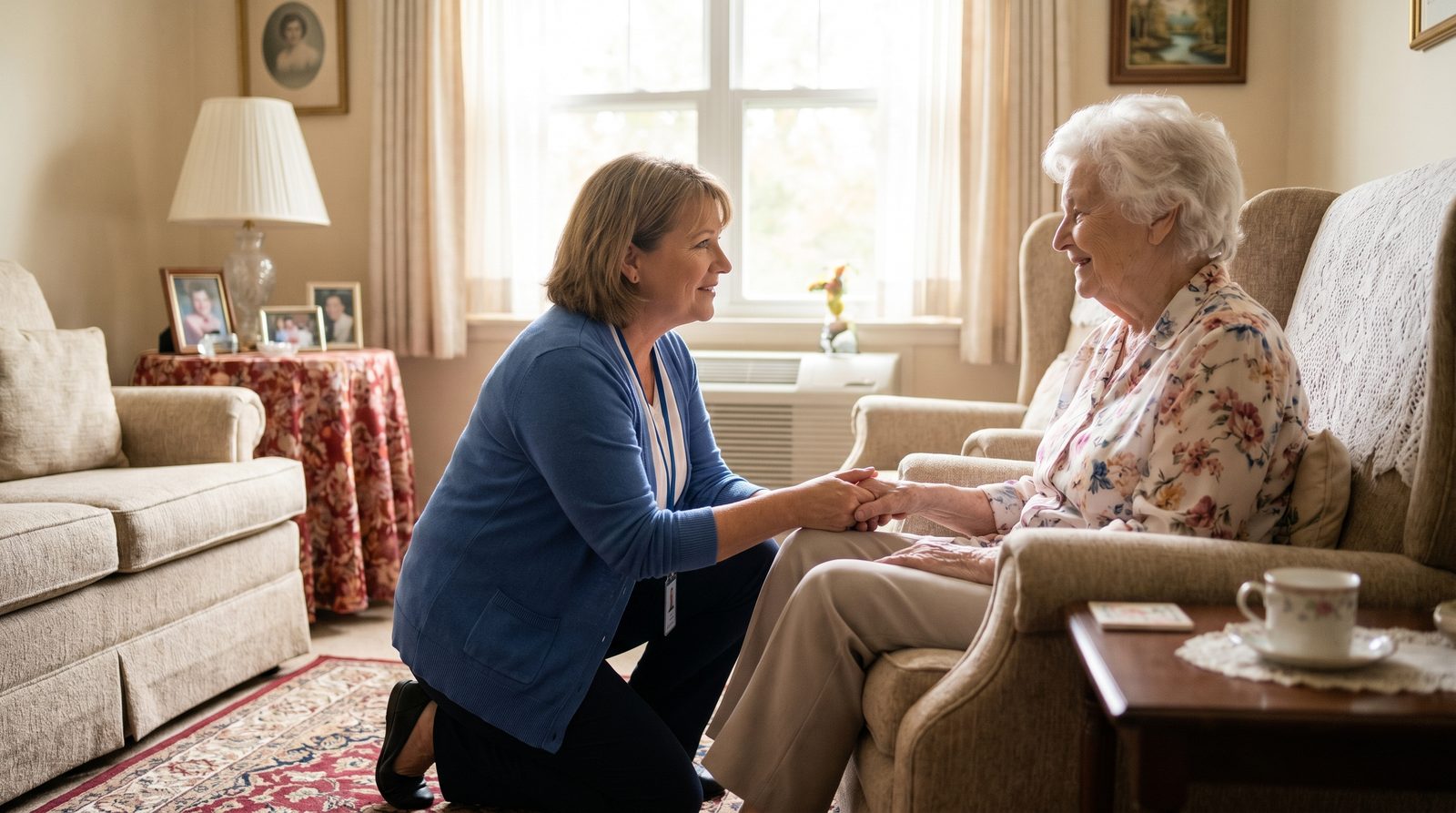
Dementia is one of the most important topics you will encounter in your PSW program and on the NACC certification exam. Module 11 is devoted entirely to cognitive and mental health conditions, and dementia care scenarios appear frequently throughout the exam. More importantly, dementia care will be a significant part of your daily practice — especially if you work in long-term care, where an estimated two-thirds of residents live with some form of dementia.
This guide covers the types of dementia you need to know, the stages of Alzheimer's disease, evidence-based communication strategies, how to respond to responsive behaviours, and the safety considerations that come up repeatedly on the NACC exam. We will approach every topic through a person-centred lens, because that is exactly what the exam expects — and what your future clients deserve.
What Is Dementia?
Dementia is not a single disease. It is an umbrella term for a group of symptoms caused by disorders that damage brain cells. These symptoms include progressive memory loss, impaired judgment, difficulty with language, personality changes, and a declining ability to perform activities of daily living (ADLs).
Key points for the NACC exam:
- Dementia is not a normal part of aging. While some mild forgetfulness is common as people age, the cognitive decline seen in dementia is far beyond what is expected.
- Dementia is progressive and irreversible in most forms. There is no cure for Alzheimer's disease, vascular dementia, or Lewy body dementia.
- Dementia affects the whole person — memory, personality, emotions, physical abilities, and social functioning.
- Some conditions can mimic dementia but are treatable (delirium, depression, medication side effects, thyroid disorders, vitamin B12 deficiency). This is why a proper medical diagnosis is essential.
Types of Dementia
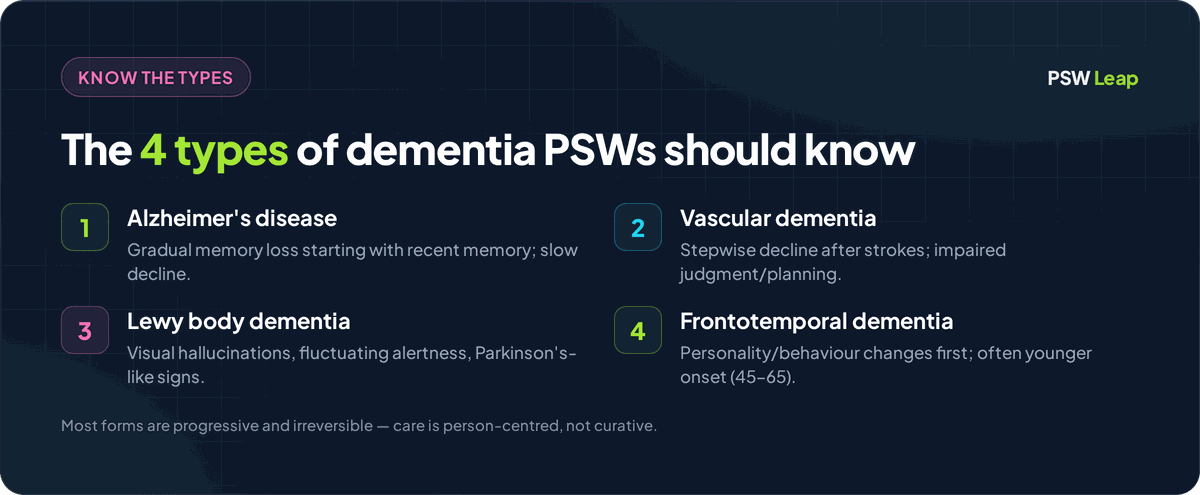
The NACC exam expects you to recognize the distinguishing features of the four major types of dementia. The table below summarizes the key differences.
| Type | Cause | Key Features | Progression |
|---|---|---|---|
| Alzheimer's Disease | Abnormal protein deposits (plaques and tangles) in the brain | Gradual memory loss starting with recent memory; difficulty with language and planning; personality changes in later stages | Slow, steady decline over 8-12 years |
| Vascular Dementia | Reduced blood flow to the brain (often from strokes or small vessel disease) | Sudden onset or stepwise decline; impaired judgment and planning; may have one-sided weakness | Stepwise — periods of stability followed by sudden drops |
| Lewy Body Dementia | Abnormal protein deposits (Lewy bodies) in brain cells | Visual hallucinations; fluctuating alertness; Parkinson's-like motor symptoms (shuffling gait, tremor, rigidity) | Gradual, with significant day-to-day fluctuations |
| Frontotemporal Dementia | Degeneration of the frontal and temporal lobes of the brain | Personality and behaviour changes first (not memory); loss of social inhibition; language difficulties | Gradual, often diagnosed at a younger age (45-65) |
Alzheimer's Disease
Alzheimer's accounts for approximately 60 to 80 percent of all dementia cases. It is the type you will encounter most often in practice and on the exam. The hallmark of Alzheimer's is the gradual loss of short-term memory that worsens over time, eventually affecting long-term memory as well.
In Alzheimer's disease, abnormal proteins form plaques between brain cells and tangles inside brain cells, which damage and eventually destroy neurons. This process begins in the hippocampus (the brain's memory centre) and gradually spreads to other areas of the brain.
Vascular Dementia
Vascular dementia is the second most common type. It occurs when the brain does not receive enough blood — often because of strokes (including "mini-strokes" or transient ischaemic attacks). Risk factors include high blood pressure, diabetes, smoking, and high cholesterol.
The key exam distinction: vascular dementia has a stepwise pattern of decline, not a gradual slope. A person may remain stable for weeks or months, then experience a sudden drop in function after a vascular event.
Lewy Body Dementia
Lewy body dementia is characterized by three features that distinguish it from other types:
- Visual hallucinations — often detailed and vivid (seeing people, animals, or objects that are not there)
- Fluctuating cognition — alertness and attention can change dramatically throughout the day or even within hours
- Parkinsonism — motor symptoms similar to Parkinson's disease (shuffling gait, rigidity, tremor)
An important note for practice: people with Lewy body dementia can have severe reactions to antipsychotic medications. If a client with Lewy body dementia is experiencing hallucinations, the PSW should report this to the nurse but should never assume medication is the appropriate response.
Frontotemporal Dementia
Frontotemporal dementia is less common but tends to affect people at a younger age (often between 45 and 65). Unlike Alzheimer's, the earliest symptoms are usually changes in personality and behaviour, not memory loss. A person may lose social inhibitions, become impulsive, show poor judgment, or become apathetic. Language difficulties are also common.
Mrs. Chen, 72, was recently diagnosed with dementia. Her family reports that she was fine for several months, then suddenly became confused and had difficulty walking on her right side. After a few weeks she seemed to stabilize, but last week she declined again. Which type of dementia is most consistent with this pattern?
The 7 Stages of Alzheimer's Disease
The Reisberg Scale (also called the Global Deterioration Scale) divides Alzheimer's disease into seven stages. This staging model helps healthcare providers, families, and PSWs understand what to expect and how to plan care at each phase.
Stage 1 — No Cognitive Decline
No noticeable symptoms. Brain changes may be occurring at a cellular level, but the person functions normally. This stage is only identified in hindsight.
Stage 2 — Very Mild Cognitive Decline
The person notices occasional memory lapses — misplacing keys, forgetting a word, or struggling to recall a name. These changes are often attributed to normal aging. No functional impairment is present, and deficits are not detectable during clinical examination.
Stage 3 — Mild Cognitive Decline (Early Confusional)
Family members and co-workers begin to notice problems. The person may have difficulty finding the right word, remembering names of new acquaintances, or planning and organizing. They may lose or misplace valuable objects. A clinical interview can detect deficits, but the person can still live independently and manage most daily tasks.
Stage 4 — Moderate Cognitive Decline (Late Confusional)
Clear-cut deficits are apparent. The person has difficulty with complex tasks such as managing finances, planning meals, or navigating unfamiliar routes. They may forget recent events or personal history. However, they typically still recognize familiar people and can perform basic ADLs (dressing, bathing, toileting) with minimal assistance. This stage often lasts approximately two years.
Stage 5 — Moderately Severe Cognitive Decline (Early Dementia)
The person can no longer live independently without some assistance. They may be unable to recall their address, phone number, or the date. They need help choosing appropriate clothing for the season or occasion. However, they generally still know their own name, the names of close family members, and can eat and use the toilet without help. This stage often lasts approximately 1.5 years.
Stage 6 — Severe Cognitive Decline (Middle Dementia)
The person requires extensive assistance with ADLs. They may be unable to dress properly without help, may experience urinary or fecal incontinence, and may not recognize familiar faces (though they can usually distinguish familiar from unfamiliar people). Personality and emotional changes are significant — suspicion, repetitive behaviours, anxiety, and agitation are common. The person may forget the name of their spouse. This stage often lasts approximately 2.5 years.
Stage 7 — Very Severe Cognitive Decline (Late Dementia)
The person has lost the ability to communicate verbally (speech may be limited to a few words or none at all), walk independently, sit without support, or swallow safely. They are completely dependent on caregivers for all ADLs. The brain can no longer coordinate basic motor functions. This stage requires total care and a focus on comfort, dignity, and quality of life.
Mr. Patel is in Stage 5 of Alzheimer's disease. His daughter asks you what she should expect at this stage. Which of the following is the most accurate response?
Person-Centred Dementia Care
Person-centred care is the guiding philosophy for all dementia care in Canada, and the NACC exam tests it extensively. The concept was developed by Dr. Tom Kitwood, who argued that people with dementia retain their personhood throughout the disease and deserve care that honours their individuality, preferences, life history, and remaining abilities.
In practice, person-centred dementia care means:
- Knowing the person, not just the diagnosis. Learn about the client's life history, cultural background, preferred routines, likes, and dislikes. A person who was a farmer for 40 years may find comfort in folding towels or sorting items — tasks that feel purposeful and familiar.
- Focusing on what the person CAN do, not what they cannot. Encourage independence wherever possible. If a client can still brush their own teeth with verbal cueing, do not do it for them.
- Validating emotions rather than correcting facts. If a client says they need to pick up their children from school (the children are now 50 years old), do not argue. Acknowledge the feeling: "It sounds like your children are important to you. Tell me about them."
- Maintaining dignity in every interaction. Use the client's preferred name, provide privacy during personal care, offer choices whenever possible, and never speak about the client as if they are not present.
- Creating a calm, predictable environment. Consistent routines, familiar objects, and a quiet environment reduce confusion and anxiety.
Ready to practice?
NACC exam questions on dementia care test whether you can apply person-centred principles to realistic scenarios. Practise with our free questions to see how well you can apply what you have learned.
Try Free Practice QuestionsCommunication Strategies for Dementia Clients
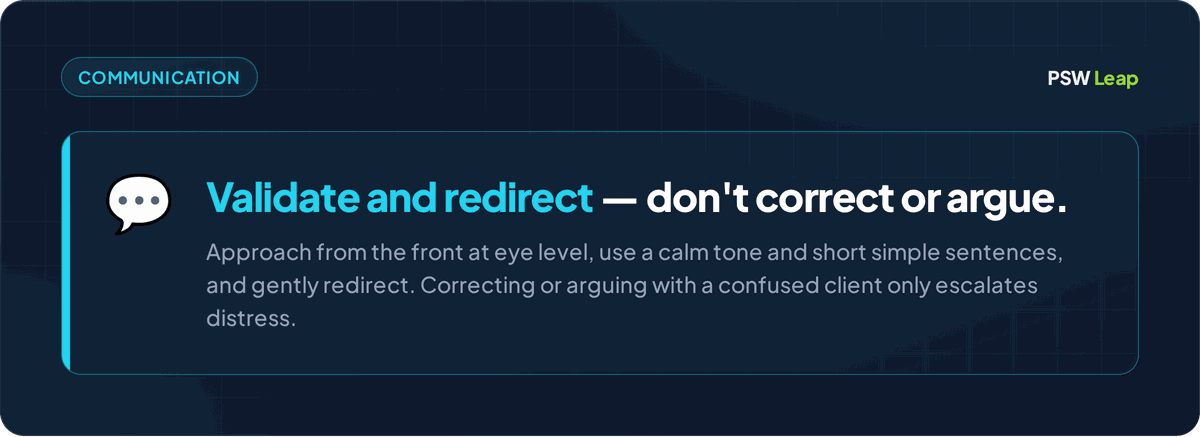
Communication is one of the most practical skills you will use every day when working with people who have dementia. As the disease progresses, the person's ability to understand language, find words, follow conversations, and express needs diminishes. Your communication approach must adapt to the person's current abilities.
General Principles
- Approach from the front. Never approach a person with dementia from behind — it can startle and frighten them.
- Make eye contact and use their name. Get the person's attention before speaking. Use their preferred name.
- Speak slowly, clearly, and calmly. Use a warm, reassuring tone. Avoid speaking loudly unless the person has a hearing impairment.
- Use simple, short sentences. Give one instruction at a time. Instead of "Let's go to the bathroom, wash your hands, and then come to the dining room for lunch," say "Let's walk to the bathroom now."
- Ask yes/no questions. Open-ended questions can be overwhelming. Instead of "What would you like for lunch?" try "Would you like soup for lunch?"
- Allow extra time for responses. It may take the person 30 seconds or more to process what you have said and formulate a response. Wait patiently without repeating or rephrasing too quickly.
- Use nonverbal communication. Gentle touch, smiles, pointing, gestures, and visual cues can communicate what words cannot.
- Avoid arguing, correcting, or quizzing. Never say "Don't you remember?" or "I told you that already." These responses cause frustration and shame.
Communication Approaches by Stage
Early stages (Stages 3-4): The person can still hold conversations but may struggle with word-finding. Be patient and offer the word gently if they are searching. Maintain normal social interactions as much as possible.
Middle stages (Stages 5-6): Language becomes more impaired. Use shorter sentences, more visual cues, and more nonverbal communication. Validation and redirection become essential strategies. The person may repeat questions or stories — respond as if you are hearing it for the first time.
Late stages (Stage 7): Verbal communication may be minimal or absent. Focus on tone of voice, facial expressions, gentle touch, and music. The person can still perceive emotions and respond to sensory experiences even when they cannot understand words.
Responding to Responsive Behaviours
The term "responsive behaviours" has replaced older terms like "challenging behaviours" or "behavioural problems" in Canadian healthcare. This language shift matters because it reflects a fundamental principle: behaviours in dementia are not random or purposeless. They are a response to something — unmet needs, environmental triggers, physical discomfort, or emotional distress that the person can no longer communicate through words.
Common Responsive Behaviours
- Wandering or walking with purpose — The person may be looking for something familiar, trying to fulfill a past routine, or feeling restless.
- Agitation or restlessness — May indicate pain, hunger, need to toilet, overstimulation, or anxiety.
- Repetitive questioning or actions — Often driven by anxiety, insecurity, or an inability to remember that the question was already asked.
- Resistance to care — Usually occurs when the person does not understand what is happening or feels their personal space is being invaded.
- Verbal or physical expressions of distress — Hitting, yelling, or swearing may be the person's only remaining way to communicate fear, pain, or frustration.
The PSW's Response
The NACC exam tests your ability to respond therapeutically to responsive behaviours. The correct approach follows this framework:
- Stay calm. Your emotional state affects the client. If you are tense or frustrated, the person will sense it and their distress may escalate.
- Ensure safety first. Protect the client and others from harm. If a client is physically aggressive, step back and give space.
- Look for the unmet need. Ask yourself: Is the person in pain? Hungry? Cold? Needing the toilet? Frightened? Bored? Overstimulated?
- Address the need. If you identify a potential cause, address it directly. Offer a snack, assist to the bathroom, reduce noise, or provide reassurance.
- Use validation and redirection. Acknowledge the person's emotion ("I can see you are upset") and gently redirect to a calming activity (looking at photos, listening to music, going for a walk).
- Document and report. Record what happened, what you observed, what you tried, and what worked. Report to the nurse so the team can look for patterns and adjust the care plan.
What NOT to do:
- Never restrain a person as a first response
- Never argue, scold, or use a raised voice
- Never take responsive behaviours personally
- Never use the word "no" as your first response — redirect instead
Mrs. Abdi, who has moderate Alzheimer's disease, becomes agitated every afternoon around 3:00 PM. She paces the hallway, tries door handles, and says she needs to go home to cook dinner for her children. Which response by the PSW is most appropriate?
Sundowning
Sundowning (also called sundown syndrome) is a pattern of increased confusion, agitation, anxiety, and restlessness that typically occurs in the late afternoon and evening hours. It is common in the middle to later stages of dementia and can be distressing for both the client and their caregivers.
Possible Causes
The exact cause of sundowning is not fully understood, but contributing factors include:
- Fatigue — accumulated tiredness from the day reduces the person's ability to cope
- Changes in lighting — reduced light creates shadows and visual distortions that can increase confusion
- Disruption of the internal body clock (circadian rhythm) — dementia damages the part of the brain that regulates sleep-wake cycles
- Hunger or thirst — unmet basic needs in the late afternoon
- Overstimulation — shift changes, increased noise, or busy activity in the environment
- Pain or discomfort — that the person cannot verbally communicate
PSW Strategies for Sundowning
- Maintain a consistent daily routine so the person knows what to expect
- Increase lighting in the late afternoon — bright, natural light can reduce confusion and shadow-related distortions
- Encourage physical activity earlier in the day to promote better sleep
- Offer a light snack in the afternoon to prevent hunger-related agitation
- Reduce stimulation in the evening — lower noise levels, turn off the television, speak softly
- Play calming music or engage in quiet, familiar activities during peak sundowning hours
- Avoid caffeine after the morning
- Report patterns to the nurse so the care team can adjust the care plan
Safety Considerations
Safety is a critical concern for people with dementia, and the NACC exam includes numerous questions about keeping clients safe while respecting their dignity and autonomy.
Fall Prevention
People with dementia are at high risk for falls due to impaired judgment, spatial awareness deficits, gait disturbances (especially in Lewy body dementia), and medication side effects. PSW strategies include:
- Ensure the environment is well-lit and free of clutter
- Encourage the use of proper footwear (non-slip, well-fitting shoes)
- Accompany clients during ambulation when needed
- Use bed alarms and call bells as directed in the care plan
- Never leave a client with impaired balance unattended in the bathroom
Elopement (Wandering Away from the Care Setting)
Elopement is a serious safety risk. A person with dementia who leaves the care setting unsupervised may become lost, exposed to weather extremes, or injured. PSW responsibilities include:
- Know which clients are at risk for elopement (as identified in the care plan)
- Be aware of the location of clients at risk during your shift
- Report any attempts to leave the building immediately
- Never prop open secured doors
- Use identification bracelets or other tracking systems as directed
Nutrition and Hydration
Dementia affects the ability to recognize hunger and thirst, use utensils, and swallow safely. PSW strategies include:
- Serve meals in a calm, quiet environment with minimal distractions
- Use contrasting colours for plates and table surfaces (a white plate on a dark placemat helps the person see the food)
- Offer finger foods if the person has difficulty using utensils
- Provide frequent sips of water throughout the day
- Monitor for signs of dysphagia (difficulty swallowing) and report immediately
- Follow any modified-texture diet orders in the care plan
Medication Safety
People with dementia may forget whether they have taken their medication, may resist taking it, or may pocket pills in their cheek without swallowing. PSWs should observe for these behaviours and report them to the nurse. Remember that you help with or give medication only as the client's care plan, the rules for your setting, your training and your employer's policy allow — your role is to follow the plan, observe and report, not to decide what medication to give or when. For a detailed look at what you can and cannot do with medications, see our guide on PSW medication assistance and scope.
Supporting Families
Families of people with dementia often experience grief, guilt, exhaustion, and emotional distress. As a PSW, you are part of the support network — not just for the client, but for their family as well.
How PSWs Can Support Families
- Listen without judgment. Family members may express frustration, anger, or guilt. Let them vent. You do not need to have answers — your presence and empathy matter.
- Share observations, not opinions. Tell the family what you observed ("Your mother ate well today and seemed to enjoy the music program") rather than offering clinical interpretations.
- Encourage self-care. Gently remind family caregivers that they need to look after their own health. Burnout is extremely common among dementia caregivers.
- Respect the family's knowledge. Family members often know the person better than anyone on the care team. Their insights about routines, triggers, and preferences are invaluable.
- Refer to appropriate resources. If a family member is struggling, let the nurse or social worker know so they can connect the family with support services such as the Alzheimer Society of Canada, respite care, or counselling.
What PSWs Should NOT Do
- Do not provide medical advice or prognosis ("I think your father is in Stage 6")
- Do not make promises you cannot keep ("I will make sure she never falls")
- Do not criticize family decisions about care
- Do not share information about other clients or compare one client's progression to another
Exam Preparation Tips for Dementia Care
Dementia questions on the NACC exam tend to follow specific patterns. Knowing these patterns gives you an advantage:
-
Person-centred care is always the right framework. If one answer option focuses on the person's dignity, preferences, or remaining abilities while others focus on the disease or task completion, the person-centred option is almost always correct.
-
Validation and redirection beat correction every time. Any answer that involves arguing with, correcting, or quizzing a person with dementia is wrong.
-
Safety questions require you to prioritize. The correct answer addresses the most immediate safety concern first, then communication, then documentation.
-
Know the distinguishing features of each dementia type. The exam will give you a scenario and expect you to recognize which type of dementia is being described.
-
Responsive behaviours always have a cause. The correct response involves looking for the unmet need, not controlling the behaviour.
For a comprehensive study approach to the entire NACC exam, see our guide on how to pass the NACC PSW exam. If you want to avoid the most common pitfalls, check out common NACC exam mistakes.
A PSW is caring for Mr. Thompson, who has Lewy body dementia. He tells the PSW that there is a dog sitting on his bed. There is no dog present. What is the most appropriate response?
Key Takeaways
- Dementia is an umbrella term for progressive brain disorders that affect memory, cognition, personality, and function. The four major types are Alzheimer's disease, vascular dementia, Lewy body dementia, and frontotemporal dementia.
- Alzheimer's disease progresses through 7 stages from no symptoms to total dependence. Understanding the stages helps you anticipate needs and plan appropriate care.
- Person-centred care — honouring the individual's preferences, history, and remaining abilities — is the foundation of all dementia care and the framework the NACC exam expects.
- Communication must be adapted to the person's stage: simple sentences, yes/no questions, nonverbal cues, and validation rather than correction.
- Responsive behaviours are always a response to an unmet need. Your job is to find and address the need, not suppress the behaviour.
- Sundowning can be managed through consistent routines, good lighting, reduced stimulation, and addressing basic needs.
- Safety considerations include fall prevention, elopement risk, nutrition and hydration, and medication safety.
- Supporting families is part of the PSW role — listen, share observations, and encourage self-care.
Ready to practice?
Dementia care is one of the most heavily tested topics on the NACC exam. Build your confidence with scenario-based practice questions that mirror the real test.
Start Practising FreeFrequently Asked Questions
The 7 stages of Alzheimer's (Reisberg Scale) are: Stage 1 — no cognitive decline; Stage 2 — very mild decline (age-related forgetfulness); Stage 3 — mild cognitive decline (early confusional); Stage 4 — moderate decline (late confusional); Stage 5 — moderately severe decline (early dementia); Stage 6 — severe decline (middle dementia, requires extensive assistance); Stage 7 — very severe decline (late dementia, total dependence on care providers).
PSWs should approach from the front, use simple and short sentences, speak slowly and calmly, avoid correcting or arguing, use yes/no questions when possible, allow extra time for responses, maintain eye contact, and use nonverbal cues like gentle touch and facial expressions. Validation and redirection are more effective than reality orientation in later stages.
Sundowning is an increase in confusion, agitation, restlessness, or anxiety that typically occurs in the late afternoon and evening hours. It is common in people with dementia and may be triggered by fatigue, low lighting, disrupted routines, or overstimulation. PSWs can help by maintaining consistent routines, increasing afternoon lighting, reducing stimulation in the evening, and offering calm reassurance.
Written by Shashank Jha
Founder, PSW Leap
Shashank Jha is the founder of PSW Leap. He built this platform after going through the NACC exam prep process himself, to help fellow students study smarter with practice questions organized around the NACC PSW curriculum.
He's also the author of PSW Exam Success: The Ultimate Prep Book — the 455-page paperback PSW Leap grew out of.
Learn more about PSW LeapPSW Leap
Practice smarter for the NACC exam. 2,500 questions. Detailed rationales. $29.99 CAD one-time — everything included.
Try 10 free questions →No account needed. Ready for the full bank? Create your account.