Palliative and End-of-Life Care — A PSW's Guide

There will come a time in your career as a PSW when you sit with someone who is dying. It may be a long-term care resident you have cared for over many months, a home care client whose family has become familiar to you, or someone you have only recently met. Regardless of the circumstances, this is one of the most meaningful roles you will ever fill. Providing compassionate, dignified care at the end of life is not just a clinical skill — it is an act of profound human kindness.
Module 9 of the NACC curriculum covers palliative and end-of-life care, and this topic appears on the certification exam in both knowledge and scenario questions. But beyond the exam, this guide is meant to help you feel prepared — practically and emotionally — for the reality of caring for people at the end of their lives.
What Palliative Care Is (and Is Not)
Palliative care is a specialized approach to care that focuses on improving the quality of life for people who are living with a life-limiting illness. It is about comfort, dignity, and support — not about curing the disease.
What palliative care IS:
- A holistic approach that addresses physical, emotional, social, and spiritual needs
- Care that can begin at any point after a life-limiting diagnosis — not only in the final days
- Focused on managing pain and symptoms so the person can live as comfortably as possible
- Supportive of both the client and their family
- Provided by a team that includes physicians, nurses, PSWs, social workers, chaplains, and volunteers
- Respectful of the client's wishes, values, and cultural practices
What palliative care is NOT:
- It is not "giving up." Palliative care can be provided alongside curative treatments in some cases.
- It is not only for people with cancer. People with heart failure, COPD, dementia, kidney disease, ALS, and many other conditions receive palliative care.
- It is not the same as euthanasia or Medical Assistance in Dying (MAiD). Palliative care neither hastens nor postpones death — it aims to make the time remaining as comfortable and meaningful as possible.
- It does not mean stopping all medical treatment. Medications for pain, nausea, anxiety, and other symptoms continue and are often intensified.
The PSW's Role in Palliative Care
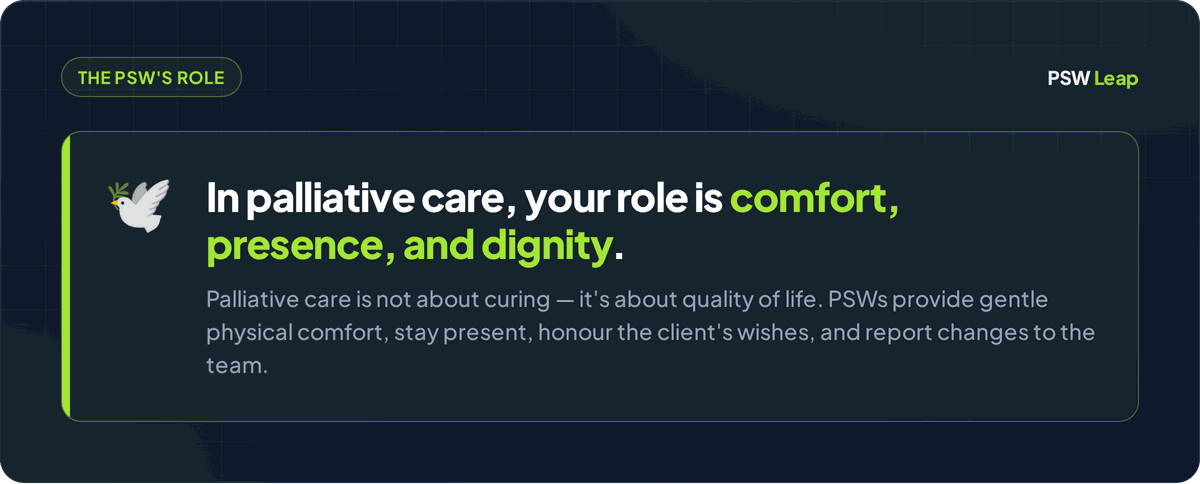
As a PSW, you spend more hands-on time with clients than any other member of the care team. In palliative care, this proximity matters enormously. You are often the first person to notice changes in a client's condition, the person who provides the most intimate care, and the constant, reassuring presence when the client and family are at their most vulnerable.
Your Responsibilities
- Physical comfort care — assisting with bathing, mouth care, skin care, repositioning, and toileting with a focus on comfort rather than routine
- Pain observation and reporting — watching for signs of pain (grimacing, guarding, moaning, restlessness) and reporting them to the nurse so pain medication can be adjusted
- Nutrition and hydration support — offering small sips of water, ice chips, or favourite foods as desired by the client, without forcing intake
- Maintaining dignity — providing privacy during personal care, using the client's preferred name, honouring their routines and preferences, and speaking to them with warmth and respect
- Emotional support — being present, listening, holding a hand, sitting quietly, or simply being in the room so the person is not alone
- Family support — offering a compassionate presence to family members, answering questions within your scope, and letting the nurse know when the family needs additional support
- Observation and reporting — documenting and reporting changes in the client's condition, including changes in breathing, consciousness, skin colour, pain level, and appetite
- Environmental comfort — adjusting lighting, temperature, noise levels, and positioning personal items (photos, religious objects) within reach
What Is NOT Your Role
- Making medical decisions about pain medication, treatment, or resuscitation
- Providing a prognosis or estimating how long the client has to live
- Discussing MAiD with the client or family (refer these conversations to the nurse or physician)
- Pronouncing death (this is done by a physician or, in some settings, an RN)
Mrs. Lawson is receiving palliative care in a long-term care home. She has not eaten in two days but is sipping water occasionally. Her daughter is upset and asks you to 'make her eat something.' What is the most appropriate response?
Source for this answer: Ontario Ministry of Colleges and Universities, Personal Support Worker Program Standard, January 2022 (PDF), vocational learning outcome 4, element D (printed p. 17) and vocational learning outcome 6, element A (printed p. 22); accessed September 26, 2026.
Physical Signs of Approaching Death
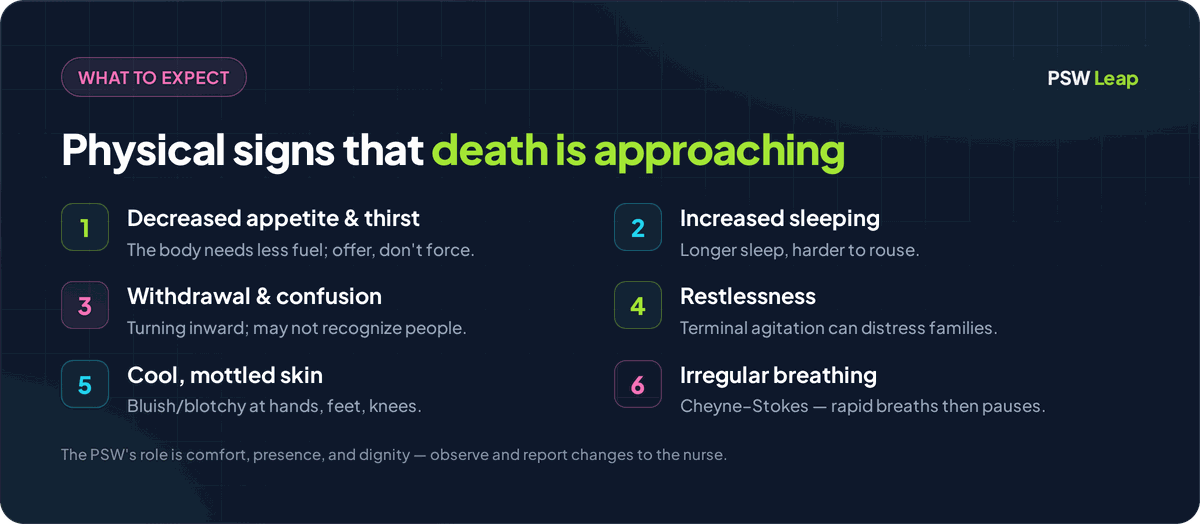
One of the most important things you can learn as a PSW is how to recognize the physical signs that death may be approaching. Understanding these signs helps you provide appropriate comfort care, prepare yourself emotionally, and support the family through what is often a frightening and unfamiliar experience.
These signs typically appear in the days to hours before death, though the timeline varies greatly from person to person.
Days to Weeks Before Death
- Decreased appetite and thirst — The body is shutting down and no longer needs fuel. The client may refuse food entirely and take only small sips of water.
- Increased sleeping — The client sleeps for longer periods and may be difficult to rouse. Waking hours become shorter.
- Withdrawal from social interaction — The client may become less interested in visitors, conversation, or activities they previously enjoyed. This is a natural turning inward, not rejection.
- Confusion or disorientation — The client may not recognize familiar people or may speak about people or places from the past.
- Restlessness or terminal agitation — Some clients become restless, pulling at bedding, trying to get out of bed, or appearing anxious. This can be distressing for families to witness.
Hours to Days Before Death
- Cool, mottled skin — The extremities (hands, feet, knees) become cool to the touch and may develop a blotchy, purplish discolouration (mottling). This begins at the periphery and moves toward the trunk.
- Changes in skin colour — Overall pallor (pale appearance) or cyanosis (bluish tinge, especially around the lips, nail beds, and earlobes).
- Irregular breathing patterns — Breathing may become irregular, with periods of rapid breathing followed by pauses (Cheyne-Stokes breathing). Breathing may become shallow and slow.
- The "death rattle" — A gurgling or rattling sound caused by secretions pooling in the airway that the client can no longer clear. This sounds distressing but is generally not uncomfortable for the client.
- Decreased urine output — Urine becomes dark and concentrated, and output decreases significantly as the kidneys shut down.
- Changes in consciousness — The client may become unresponsive. It is widely believed that hearing is one of the last senses to be lost — continue to speak to the client gently and assume they can hear you.
- Jaw relaxation and mouth breathing — The jaw may drop open and breathing occurs primarily through the mouth.
- Fixed, glassy eyes — The eyes may remain partially open with a glassy or unfocused appearance.
What to Do When You Observe These Signs
- Report your observations to the nurse calmly and factually
- Continue providing comfort care — mouth care (moist swabs for dry lips and mouth), repositioning for comfort, light blankets for coolness, and a quiet environment
- Support the family — let them know what is happening in gentle, honest terms; encourage them to talk to the client, hold their hand, or play music the client enjoyed
- Maintain the client's dignity — keep the client clean, dry, and positioned comfortably; maintain privacy
- Stay calm — your composure provides reassurance to both the client and the family
Comfort Measures
In palliative and end-of-life care, comfort is the primary goal. Every intervention should be evaluated through the lens of "Does this improve the client's comfort and quality of life?" rather than "Is this what we usually do?"
Mouth Care
Mouth care is one of the most important comfort measures in end-of-life care. As the client stops eating and drinking and breathes through the mouth, the oral mucosa becomes dry, cracked, and uncomfortable.
- Use moist swabs or a soft toothette to gently clean the mouth
- Apply lip balm or a moisturizer to cracked lips
- Offer ice chips or small sips of water if the client can swallow safely
- Perform mouth care frequently — every 1 to 2 hours for clients who are mouth-breathing
Skin Care and Repositioning
- Reposition the client for comfort, not on a rigid schedule — if repositioning causes distress, it may be more compassionate to leave the client in a comfortable position
- Use pillows to support the body and relieve pressure
- Keep skin clean and dry
- Apply barrier cream to prevent moisture-related skin breakdown
- Use soft, wrinkle-free linens
Pain Management Support
Pain management is the responsibility of the nurse and physician, but you play a critical role in identifying pain.
- Watch for nonverbal signs of pain: grimacing, furrowing the brow, clenching fists, guarding a body part, moaning, crying, restlessness, or resistance to being moved
- Report pain observations promptly so medication can be adjusted
- Help position the client comfortably
- Use non-pharmacological comfort measures: gentle touch, massage (if the client tolerates it), warm or cool compresses, calming music, and a quiet environment
Environmental Comfort
- Keep the room at a comfortable temperature
- Reduce unnecessary noise and bright lighting
- Play music the client enjoys at a low volume, if desired
- Place meaningful items within view — photographs, religious or spiritual objects, a favourite blanket
- Allow pets to visit if the setting permits and the client would enjoy it
Ready to practice?
Palliative care questions on the NACC exam focus on comfort, dignity, and knowing what to report. Practise with realistic scenario questions to build your confidence.
Try Free Practice QuestionsAdvance Directives and DNR/DNI Orders
Advance directives are legal documents in which a person records their wishes about medical treatment in the event that they become unable to make decisions for themselves. Understanding advance directives is essential for PSWs because they guide the care you provide.
Key Terms
- Advance Directive (Living Will) — A written document expressing the person's wishes regarding medical treatment, life-sustaining measures, and end-of-life care. In Ontario, this is sometimes called a "prior capable wish."
- Power of Attorney for Personal Care (POA) — A person designated by the client to make healthcare decisions on their behalf when they are no longer capable of doing so. The POA is legally required to follow the client's known wishes.
- DNR (Do Not Resuscitate) — A medical order that instructs healthcare providers not to perform CPR if the client's heart stops or they stop breathing.
- DNI (Do Not Intubate) — A medical order that instructs healthcare providers not to insert a breathing tube if the client stops breathing.
What PSWs Need to Know
- Know which clients have a DNR/DNI order. This information should be in the care plan and, in many settings, posted at the bedside.
- A DNR order does not mean "do not treat." The client still receives all other care — medications, comfort measures, hygiene, nutrition support, and emotional support.
- Respect the client's autonomy. A DNR order reflects the client's informed choice. It is not your place to judge, question, or try to change this decision.
- If you are unsure about a client's status, ask the nurse before an emergency occurs. You do not want to discover a client's wishes in the middle of a crisis.
- If a client without a DNR order stops breathing or has no pulse, call for help immediately and begin CPR (if you are trained and it is consistent with your workplace policy).
You are caring for Mr. Santos, who has a DNR order. He tells you he is having chest pain. What should you do?
MAiD — What PSWs Should Know
Medical Assistance in Dying (MAiD) has been legal in Canada since 2016. As a PSW, you will not participate in the MAiD process, but you should understand what it is and how it may affect your care environment.
Key points:
- MAiD is a process by which a physician or nurse practitioner provides or prescribes medication to intentionally end a person's life, at their request
- MAiD is only available to people who meet specific legal criteria, including having a grievous and irremediable medical condition
- PSWs do not participate in the MAiD process. You will not be asked to administer MAiD medication or be present during the procedure unless you choose to be.
- You may be asked to provide care to a client who has requested MAiD — continue providing your usual compassionate care
- If a client asks you about MAiD, do not provide information or opinions — refer them to the nurse or physician
- You have the right to conscientious objection — if MAiD conflicts with your moral or religious beliefs, you may request not to be assigned to a client during the MAiD process. However, you must never abandon a client or refuse to provide routine care.
- Be aware that other staff members and family may have strong feelings about MAiD. Respect everyone's perspective and maintain confidentiality.
Grief and Bereavement
Grief is a natural response to loss. When a client dies, grief may be experienced by the family, by other residents or clients in the care setting, and by you.
Supporting Grieving Families
- Be present. Sometimes the most helpful thing you can do is sit quietly with a family member. You do not need to have the right words.
- Use the client's name. Saying "Mrs. Okafor was a wonderful person" is more meaningful than "I am sorry for your loss."
- Avoid cliches. Phrases like "They are in a better place" or "At least they are not suffering anymore" may not be comforting and can feel dismissive. Instead, try "I can see how much you loved them" or "I will miss caring for her."
- Listen more than you speak. Let the family share memories, express anger, or cry without trying to fix their grief.
- Respect cultural and religious practices. Different cultures have different rituals, beliefs, and practices around death. Some families may want to wash and dress the body themselves. Some may have specific prayers or rituals. Ask what the family needs and accommodate whenever possible.
- Know when to refer. If a family member is showing signs of complicated grief (inability to function, prolonged intense distress, talk of self-harm), let the nurse or social worker know immediately.
After-Death Care
In many settings, PSWs assist with after-death care (also called post-mortem care). This includes:
- Treating the body with dignity and respect at all times
- Positioning the body according to facility policy (usually supine, with the head slightly elevated)
- Closing the eyes and mouth gently
- Removing tubes and equipment as directed by the nurse
- Bathing the body and changing linens
- Applying identification as per facility policy
- Allowing the family time with the body if they wish
Follow your facility's specific procedures and any documented cultural or religious preferences.
Cultural Considerations
Canada's diversity means you will care for people from many cultural and religious backgrounds. End-of-life care is deeply personal and cultural, and what feels right for one person may be very different from what feels right for another.
General Principles
- Ask, do not assume. The best way to learn about a person's cultural or spiritual needs is to ask them or their family. "Is there anything important to you that we should know about your care preferences?" is a respectful question.
- Respect rituals and practices. Some families may bring traditional medicines, religious items, or specific foods. Accommodate these whenever possible and check with the nurse if you are unsure.
- Be aware of your own biases. You bring your own cultural background and beliefs about death to this work. Be conscious of how they may influence your care and remain open to practices that differ from your own.
- Language barriers. If the client or family does not speak English fluently, request interpreter services. Do not rely on family members (especially children) to interpret medical information.
Examples (Not Exhaustive)
- Some Indigenous families may want to perform smudging ceremonies, have an Elder present, or have the window opened at the time of death
- Some Muslim families may want the dying person to face Mecca and may wish to wash and shroud the body themselves
- Some Hindu families may want to place holy water in the client's mouth and may prefer not to have the body washed by non-family members
- Some Catholic clients may request a priest for the Sacrament of the Anointing of the Sick
- Some Jewish families observe specific practices around the body and may want a Shomer (guardian) to stay with the body
These are general examples — individual practices vary widely within every culture and religion. Always ask the specific family what they need.
Mr. Adekunle is actively dying. His family asks if they can perform a traditional prayer ritual in his room that involves burning incense. The facility has a no-smoking policy. What should the PSW do?
Self-Care for PSWs
Caring for people at the end of their lives is one of the most emotionally demanding aspects of PSW work. You may develop bonds with clients and their families, and the repeated experience of loss can take a cumulative toll. This is normal, and it does not make you weak — it makes you human.
Recognizing Compassion Fatigue
Compassion fatigue is the emotional and physical exhaustion that comes from caring for people who are suffering. Signs include:
- Feeling emotionally numb or detached
- Dreading going to work
- Difficulty sleeping or constant fatigue
- Irritability or mood changes
- Feeling hopeless or questioning whether your work matters
- Physical symptoms like headaches, stomach problems, or frequent illness
- Difficulty separating work life from personal life
Strategies for Self-Care
- Acknowledge your feelings. It is okay to feel sad when a client dies. Allow yourself to grieve.
- Talk about it. Share your feelings with trusted colleagues, friends, or family. Many workplaces offer Employee Assistance Programs (EAPs) with free counselling.
- Attend debriefing sessions. If your workplace offers debriefing after a client's death, participate. Talking through the experience with your team is healing.
- Set boundaries. It is important to care deeply, but it is also important to maintain boundaries that protect your emotional health. You can be compassionate without carrying every client's suffering home with you.
- Take care of your body. Eat well, exercise, get enough sleep, and take your breaks during shifts.
- Find meaning. Remember that your presence at the end of someone's life is a gift. Many families will tell you that the PSW's calm, compassionate care was the most comforting part of their loved one's final days.
- Seek professional help if needed. If you are struggling with persistent sadness, anxiety, or difficulty functioning, reach out to a mental health professional. There is no shame in needing support.
Key Takeaways
- Palliative care focuses on comfort, dignity, and quality of life for people with life-limiting illness. It is not about giving up — it is about living as well as possible.
- The PSW's role centres on physical comfort, emotional support, observation and reporting, and maintaining dignity. You are an essential member of the palliative care team.
- Learn to recognize the physical signs of approaching death so you can provide appropriate care, support families, and report observations calmly.
- Comfort measures — mouth care, repositioning, pain observation, and environmental adjustments — are the foundation of end-of-life care.
- DNR means do not resuscitate, not do not treat. Clients with DNR orders still receive full comfort care.
- MAiD is legal in Canada. PSWs do not participate but should understand it and refer questions to the nurse or physician.
- Cultural and spiritual practices around death are deeply personal. Ask, respect, and accommodate.
- Take care of yourself. Compassion fatigue is real, and seeking support is a sign of professional maturity, not weakness.
For more on the clinical topics that appear on the NACC exam, explore our guides on dementia care for PSWs and PSW scope of practice in Ontario. For a comprehensive study plan, see how to pass the NACC PSW exam.
Frequently Asked Questions
The PSW's role in palliative care is to provide physical comfort, emotional support, and dignified personal care to clients who are approaching end of life. This includes assisting with hygiene, mouth care, repositioning for comfort, monitoring for pain, supporting families, and maintaining the client's dignity and preferences. PSWs do not make medical decisions but are essential members of the palliative care team who observe, report, and provide hands-on compassionate care.
DNR stands for Do Not Resuscitate. It is a medical order that instructs healthcare providers not to perform cardiopulmonary resuscitation (CPR) if the client's heart stops beating or they stop breathing. A DNR order does not mean 'do not treat' — the client continues to receive all other care, comfort measures, and medications. PSWs must know which clients have a DNR order and understand that this is the client's informed choice, supported by their healthcare team.
Physical signs that death may be approaching include: decreased appetite and thirst, increased sleeping, withdrawal from social interaction, cool and mottled skin (especially on the extremities), irregular or Cheyne-Stokes breathing, decreased urine output, restlessness or terminal agitation, changes in skin colour (pallor, cyanosis), and the 'death rattle' caused by secretions in the airway. These signs may appear hours to days before death and are part of the body's natural process of shutting down.
Written by Shashank Jha
Founder, PSW Leap
Shashank Jha is the founder of PSW Leap. He built this platform after going through the NACC exam prep process himself, to help fellow students study smarter with practice questions organized around the NACC PSW curriculum.
He's also the author of PSW Exam Success: The Ultimate Prep Book — the 455-page paperback PSW Leap grew out of.
Learn more about PSW LeapPSW Leap
Practice smarter for the NACC exam. 2,500 questions. Detailed rationales. $29.99 CAD one-time — everything included.
Try 10 free questions →No account needed. Ready for the full bank? Create your account.