Free NACC Practice Questions on Seizure and Epilepsy Care (Ontario PSW Exam Prep)
If you are studying for the NACC Personal Support Worker (PSW) exam in Ontario, seizure and epilepsy care is exactly the kind of emergency the test loves — because a client can seize at any moment and the PSW is the person right there. Epilepsy is common in Ontario long-term care, group homes, and home care. This free practice set gives you real NACC-style questions on what to do during a seizure, why you never restrain a client or put anything in their mouth, the recovery position, when to call 911, and the PSW's scope on rescue medication — each with a clear answer. Work through them, then keep going at pswleap.com/learn.
What is seizure and epilepsy care on the NACC PSW exam?
For the exam, caring for a client during a seizure means keeping them safe from injury, timing the seizure, using the recovery position afterward, calling for help, and reporting — never restraining them or putting anything in their mouth. A seizure is a sudden burst of abnormal electrical activity in the brain; epilepsy is the ongoing condition of having repeated seizures. The type you will most often see described is the tonic-clonic seizure (once called grand mal): the client stiffens (the tonic phase), then jerks rhythmically (the clonic phase), loses consciousness, and may lose bladder or bowel control. Some clients get a warning sensation first, called an aura.
During a seizure: protect, time, and never restrain
While a client is seizing, your only jobs are to keep them safe and time it — do not hold them down and do not put anything in their mouth. If the client is falling, ease them to the floor. Cushion the head with something soft (a folded towel or your hand), move furniture and hazards away, loosen tight clothing at the neck, and take off their glasses. Note the time the seizure starts — how long it lasts decides everything that comes next.
Two actions are always wrong, and both show up as tempting exam answers. Never restrain the client's movements — holding them down can injure their muscles and joints and does not stop the seizure. Never put anything in the mouth — a spoon, a finger, or a rolled cloth. The jaw clamps hard, breaking teeth and fingers, and a person physically cannot "swallow their tongue." Only move the client at all if they are in real danger — near a staircase, water, a road, or a hot surface. Otherwise, stay close, stay calm, and let the seizure run its course.
After the seizure: the recovery position and post-ictal care
Once the jerking stops, roll the client onto their side into the recovery position, stay with them, and let them come round in their own time. Lying on the side keeps the airway open and lets saliva or vomit drain out of the mouth instead of into the lungs (which risks aspiration). Tilt the head slightly back, keep checking that the client is breathing, and stay until they are fully recovered.
The minutes after a seizure are the post-ictal phase: the client is often confused, exhausted, and may not remember the seizure at all. Reassure them in a calm, quiet voice and reorient them gently. If they were incontinent during the seizure, protect their dignity — give privacy, and offer to help them clean up once they are alert. Do not give food, drink, or medication until the client is fully awake and able to swallow safely. Then document what you saw while it is fresh.
When to call 911, and the PSW's scope on rescue medication in Ontario
Call 911 if a seizure lasts more than 5 minutes, repeats before the client recovers, is a first-ever seizure, causes injury or breathing trouble, happens in water, or does not regain consciousness — and always follow the care plan and your facility's emergency protocol. A seizure of 5 minutes or longer, or back-to-back seizures without recovery in between, is called status epilepticus and is a true medical emergency. Blue lips, trouble breathing, or a client who does not wake up all mean get help now. On the exam, escalating early is almost always the right choice over "keep watching."
Some clients with epilepsy have a prescribed rescue medication — such as buccal (in-the-cheek) midazolam or rectal diazepam — in their care plan for a prolonged seizure. Giving that medication is beyond a PSW's routine role: it happens only when the PSW has specific training and employer authorization, and the care plan or a nurse's delegation directs it — never on the PSW's own decision. Without that training and authorization, your job in the emergency is to give seizure first aid and call for help. Whatever else happens, report every seizure: the time it started, how long it lasted, what the body did, any warning, incontinence, injury, breathing, and how long recovery took. The PSW observes and reports; the nurse assesses and decides what happens next.
Quick terms to know: Tonic-clonic = stiffening then jerking, with loss of consciousness. Aura = a warning sensation some clients feel before a seizure. Post-ictal = the confused, drowsy recovery phase after a seizure. Status epilepticus = a seizure of 5 minutes or more, or repeated seizures without recovery — a medical emergency.
Free NACC-style practice questions: seizure and epilepsy care
Each question mirrors the scenario-based, multiple-choice style of the NACC PSW exam. Try to answer before you read the explanation.
Q1. A client suddenly stiffens, falls, and begins jerking. What should the PSW do first?
Answer: Stay calm, note the time, cushion the head, clear hazards, and protect them from injury.
Q2. During the seizure, the client's jaw is clenched. Should the PSW place something in their mouth to protect the tongue?
Answer: No — never put anything in a seizing client's mouth. A person cannot swallow their tongue, and objects break teeth or fingers and can block the airway.
Q3. Another PSW moves to hold the client's arms and legs still. What should you do?
Answer: Stop them — never restrain a seizing client. Holding them down can injure muscles and joints and does nothing to stop the seizure.
Q4. The jerking has stopped and the client is unconscious but breathing. What position should the PSW use?
Answer: The recovery position — roll the client onto their side. This keeps the airway open and lets saliva or vomit drain, preventing aspiration.
Q5. A client's tonic-clonic seizure has now lasted more than 5 minutes. What does this mean and what should the PSW do?
Answer: This is status epilepticus, a medical emergency — call 911 and follow the facility protocol and care plan. A seizure of 5 minutes or longer needs emergency help.
Q6. After the seizure the client is confused, drowsy, and can't remember what happened. What is this, and what should the PSW do?
Answer: This is the post-ictal phase — stay with the client, reassure them calmly, and reorient them gently.
Q7. The client was incontinent during the seizure. What should the PSW do?
Answer: Protect their dignity — give privacy and help them clean up once they are fully alert. Incontinence during a seizure is involuntary.
Q8. A client has a prescribed buccal rescue medication in their care plan. Can any PSW give it during a seizure?
Answer: No — giving rescue medication is beyond a PSW's routine role. It requires specific training, employer authorization, and care-plan or nurse direction; otherwise give first aid and call for help.
Q9. It is a client's first-ever seizure and there is no seizure history in the care plan. What should the PSW do?
Answer: Call 911 — a first-ever seizure always needs emergency assessment. Keep the client safe, time it, and report what you saw.
Q10. The seizure is over and the client is now alert. What should the PSW document and report to the nurse?
Answer: The time it started, how long it lasted, what the body did, any warning, incontinence, injury, and how long recovery took. The PSW observes and reports; the nurse assesses.
Common seizure care mistakes to avoid on the NACC exam
- Putting something in the client's mouth to "protect the tongue" — always the wrong answer.
- Restraining or holding the client down during the seizure instead of clearing the space around them.
- Leaving the client alone to go find help instead of staying, timing the seizure, and calling out.
- Using the recovery position during the active jerking instead of after it stops.
- Giving food, drink, or medication before the client is fully alert, or assuming any PSW may give a rescue medication.
The seizure and epilepsy facts the NACC exam expects you to know
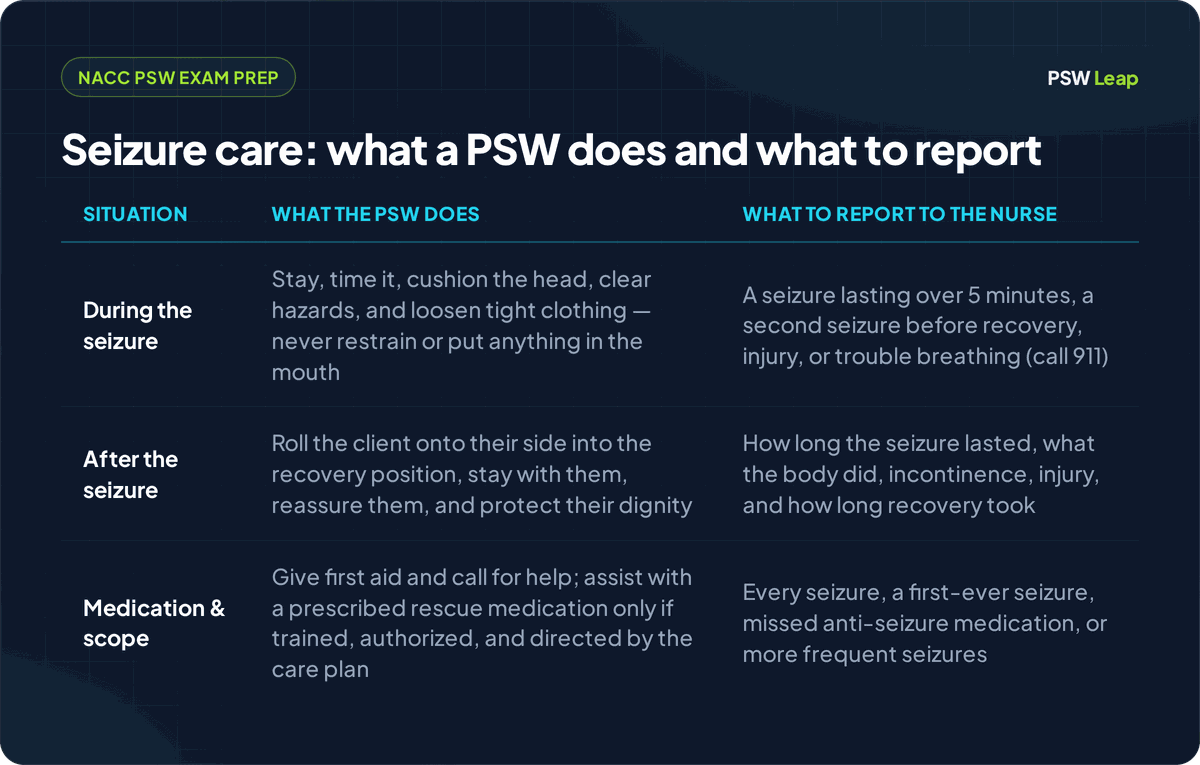
Use these one-line facts as a final review:
- Protect, time, and never restrain — cushion the head, clear hazards, and never put anything in the mouth.
- Recovery position after, not during — roll the client onto their side once the jerking stops to keep the airway clear.
- Call 911 for status epilepticus — a seizure over 5 minutes, a repeat before recovery, a first-ever seizure, injury, breathing trouble, water, or no return to consciousness.
- Post-ictal confusion is normal — stay, reassure, protect dignity, and wait until the client is fully alert.
- Rescue medication is not a routine PSW task — first aid and call for help unless you are trained, authorized, and directed by the care plan.
Remember: PSW practice in Ontario follows the client's care plan and your employer's policies, within the controlled-acts limits of the Regulated Health Professions Act, 1991. Giving seizure first aid, using the recovery position, calling for help, and observing and reporting are within a PSW's role; diagnosing a seizure and giving a rescue medication without training, authorization, and care-plan direction are not. This article is exam-prep study material, not medical advice.
Practice more free NACC questions
You just answered 10 seizure care questions, but the NACC PSW exam spans every module — keep practising to find your weak spots fast.
👉 Start practising free at pswleap.com/learn — a large bank of NACC-style questions, full timed mock exams, and a Duolingo-style study path built for Ontario PSW students. No subscription needed to start.
Closely related topics worth reviewing next: Free NACC Practice Questions on Emergency Response and Free NACC Practice Questions on Fall Prevention — the emergencies and injuries that run alongside seizure care.
PSW Leap is an independent NACC PSW exam-prep platform for Ontario candidates. We are not affiliated with NACC or any epilepsy organization. Always follow your training, your client's care plan, and your employer's policies on the job.
Published by PSW Leap
Independent NACC PSW exam prep
PSW Leap articles are written and maintained by the platform's founder, Shashank Jha, and checked against publicly available PSW curriculum standards. Found an error? Email hello@pswleap.com and we'll fix it.
Read our content methodologyPSW Leap
Practice smarter for the NACC exam. 2,500 questions. Detailed rationales. $29.99 CAD one-time — everything included.
Try 10 free questions →No account needed. Ready for the full bank? Create your account.