Free NACC Practice Questions on Oral & Dental Care (Ontario PSW Exam Prep)
If you are studying for the NACC Personal Support Worker (PSW) exam in Ontario, oral and dental care is one of those quiet, high-yield topics that is easy to underrate — until you learn that a neglected mouth can put a frail client at real risk of pneumonia. In Ontario long-term care and home care, the PSW is the person who gives mouth care every day and is first to spot when something is wrong. This free practice set gives you real NACC-style questions on why daily mouth care prevents pneumonia, caring for a client with dementia who resists, dry mouth from medications, the oral changes to report, dentures and dysphagia, and what falls inside a PSW's scope, each with a clear answer. Work through them, then keep going with the full question bank at pswleap.com/learn. Before or after this set, the free NACC-style sample quiz gives you 10 mixed NACC-style sample questions with explanations and needs no signup.
What is oral and dental care on the NACC PSW exam?
For the exam, oral and dental care is the daily mouth care a PSW gives to keep a client's mouth clean, comfortable, and healthy — and it is tested as infection prevention, not just grooming. The "right answer" in an oral-care question almost always combines doing the care gently and often, protecting the client from aspiration, watching for changes, and reporting anything unusual — while staying inside a PSW's scope.
Why mouth care matters more than it looks: the pneumonia link
The single most important idea on this topic is that a dirty mouth can cause pneumonia. The mouth is full of bacteria, and when a client has a weak swallow or spends long stretches lying down, saliva carrying those bacteria can slip into the lungs — that is aspiration, a leading cause of pneumonia in older adults. Daily mouth care lowers the number of bacteria in the mouth, which is exactly why it is treated as infection prevention.
There is a second reason the exam cares. A sore or dry mouth makes eating painful, so the client eats less — leading quickly to weight loss and dehydration. A healthy mouth also protects comfort, taste, speech, and dignity. Mouth care is never "just cosmetic."
The PSW's role in Ontario: give the care, watch, and report
A PSW gives routine daily mouth care and reports changes; a nurse, dentist, or dental hygienist assesses and treats problems. In Ontario, a PSW works from the client's individual care plan and the employer's policies, within the controlled-acts limits of the Regulated Health Professions Act, 1991. Ontario's long-term care standards expect mouth care to be part of every resident's daily care. Best practice is at least twice a day, and it continues even when a client cannot eat by mouth, because an unused mouth still dries out and grows bacteria.
Two scope points the exam rewards. First, mouth care is still given to an unconscious client, but safely — head turned to the side, only a little moisture, so nothing runs down the throat (full hands-on steps are in our personal care & hygiene set). Second, a PSW observes and reports oral problems but does not diagnose or treat them.
Quick terms to know: Aspiration = fluid, food, or saliva going into the lungs instead of the stomach. Aspiration pneumonia = a lung infection that follows. Xerostomia = dry mouth, often a medication side effect. Thrush (oral candidiasis) = a fungal infection that shows as white patches. Plaque = the sticky bacterial film on teeth that daily brushing removes. Baseline = what is normal for this client's mouth.
Free NACC-style practice questions: oral and dental care
Each question below mirrors the scenario-based, multiple-choice style of the NACC PSW exam. Try to answer before you read the explanation.
Q1. Why is daily mouth care considered a form of infection prevention, not just hygiene?
Answer: Because a mouth full of bacteria can lead to aspiration pneumonia. Saliva carrying oral bacteria can slip into the lungs, especially in a client with a weak swallow. Daily mouth care lowers that bacterial load — which is why it is a safety task.
Q2. How often should a PSW provide oral care, and does it stop if a client cannot eat by mouth?
Answer: At least twice a day and after meals — and no, it does not stop. A client who is fed by tube or is unconscious still needs mouth care, because the mouth dries out and bacteria build up when it is not used.
Q3. A client with dementia clamps her mouth shut and pushes the toothbrush away. What should the PSW do?
Answer: Stay calm, do not force her mouth open, and try a gentler approach. Approach from the side at eye level, explain simply, offer the brush so she can help, and break the task into small steps at a calmer moment. Forcing a clamped mouth causes fear and injury; if she keeps refusing, document it and tell the nurse.
Q4. A client on several medications says his mouth is always dry. What is likely happening, and what can the PSW do?
Answer: This is xerostomia — dry mouth — often caused by medications. Many common drugs reduce saliva. The PSW offers frequent sips of water within the care plan, keeps the lips moist, and avoids drying products like alcohol mouthwash. Because a medication may be the cause, report it to the nurse.
Q5. During mouth care, the PSW notices white patches inside the client's cheeks that leave a raw spot when wiped. What should the PSW do?
Answer: Do not try to scrub them off — report them to the nurse. White patches that wipe off to a raw, red base can be thrush (a fungal infection). The PSW notices the change and reports it so the nurse can assess and treat — a PSW does not diagnose.
Q6. How does a PSW care for a client who has both natural teeth and partial dentures?
Answer: Clean the teeth, gums, tongue, and roof of the mouth, and clean the dentures separately. Brush the natural teeth and gently clean the soft tissues, then clean the dentures separately — our personal care & hygiene set has the full denture-cleaning steps. The key point: dentures do not replace mouth care.
Q7. A conscious client with dysphagia needs mouth care. How does the PSW keep it safe?
Answer: Sit the client upright, use minimal fluid, and avoid rinses that pool in the mouth. Keep them sitting up, use a soft or foam swab with only a little moisture, and never flood the mouth with water. This lowers the aspiration risk — the same danger that makes dysphagia a high-yield topic.
Q8. A client's denture is causing a sore spot on the gum. Can the PSW adjust or file the denture to fix it?
Answer: No — remove the denture if it is hurting, and report the sore to the nurse. Adjusting, filing, or repairing a denture is not a PSW task. Take the denture out if it is causing harm, give comfort, and report so a nurse or dental professional can assess the fit.
Q9. Why does a healthy mouth matter for a client's nutrition and dignity?
Answer: A painful or dry mouth makes eating and drinking hard, leading to weight loss and dehydration. Sore gums, loose teeth, or thrush make a client eat less, and poor oral health also affects taste, speech, and dignity.
Q10. How should a PSW document oral care and anything found in the mouth?
Answer: Record the care given, exactly what you observed, and the client's own words, then report changes. Describe any patches, sores, bleeding, or refusal factually, and use the client's words in quotes. Clear, objective notes let the nurse act quickly.
Common oral-care mistakes to avoid on the NACC exam
- Treating mouth care as optional or cosmetic instead of infection prevention against aspiration pneumonia.
- Skipping mouth care because a client cannot eat by mouth — the mouth still needs cleaning when a client is tube-fed or unconscious.
- Forcing the mouth open on a client who resists, instead of staying calm, trying a gentler approach, and reporting continued refusal.
- Using drying products — alcohol mouthwash or lemon-glycerin swabs — on an already dry mouth.
- Trying to diagnose, treat, or adjust — scrubbing off white patches, or filing a denture — instead of observing and reporting.
The oral-care facts the NACC exam expects you to know
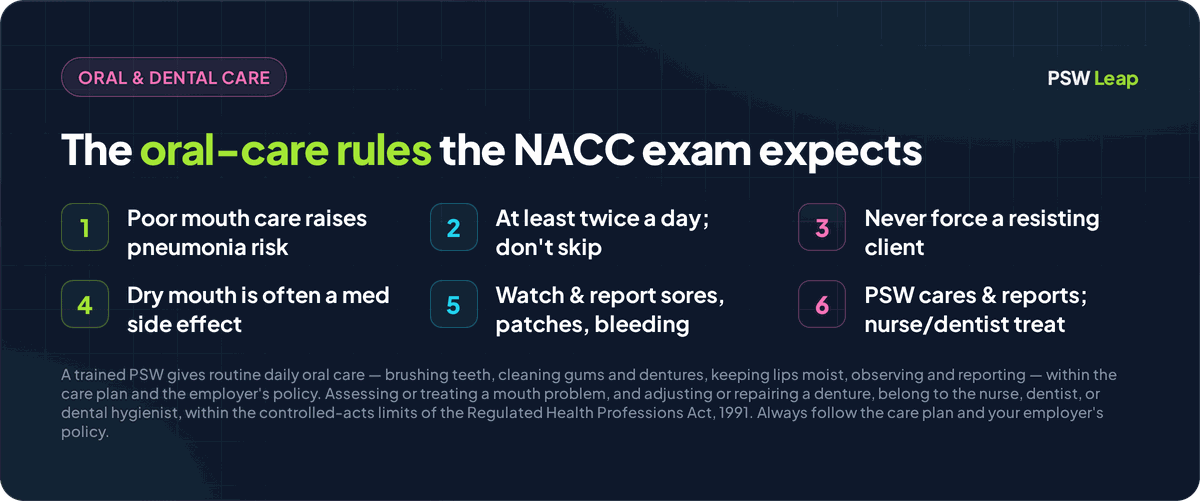
Use these one-line facts as a final review:
- A dirty mouth can cause pneumonia — daily mouth care lowers oral bacteria and the aspiration risk.
- At least twice a day, and after meals — mouth care continues even for unconscious or tube-fed clients.
- Never force a resisting client — stay calm, try a gentler approach, and report continued refusal.
- Dry mouth is usually a medication side effect — offer fluids and moisture, avoid drying products, and report it.
- Watch and report white patches, non-healing sores, bleeding gums, loose teeth, and ill-fitting dentures.
- Dentures do not replace mouth care — clean the gums, tongue, and palate too.
- A PSW gives routine care and reports; the nurse, dentist, or hygienist assesses and treats.
Remember: PSW practice in Ontario always follows the client's individual care plan and your employer's policies, within the controlled-acts limits of the Regulated Health Professions Act, 1991. Giving daily oral care and reporting changes is within a PSW's role; diagnosing, treating, and adjusting dentures are not. This article is exam-prep study material, not medical advice.
Practice more free NACC questions
You just answered 10 oral and dental care questions, and the NACC exam spans every module. The fastest way to find your weak spots is to keep practising with instant feedback.
👉 Start practising free at pswleap.com/learn — a large bank of NACC-style questions, full timed mock exams, and a Duolingo-style study path built specifically for Ontario PSW students. No subscription, and you can start with sample questions before you pay.
Closely related topics worth reviewing next: Free NACC Practice Questions on Personal Care & Hygiene (the full hands-on steps for bathing, dentures, and unconscious mouth care) and Free NACC Practice Questions on Dysphagia (the swallowing problems that make mouth care an aspiration-safety task).
PSW Leap is an independent NACC PSW exam-prep platform for Ontario candidates. We are not affiliated with NACC. Always follow your training, your client's care plan, and your employer's policies on the job.
Published by PSW Leap
Independent NACC PSW exam prep
PSW Leap articles are written and maintained by the platform's founder, Shashank Jha, and checked against publicly available PSW curriculum standards. Found an error? Email hello@pswleap.com and we'll fix it.
Read our content methodologyPSW Leap
Practice smarter for the NACC exam. 2,500 questions. Detailed rationales. $29.99 CAD one-time — everything included.
Try 10 free questions →No account needed. Ready for the full bank? Create your account.