Abuse & Neglect — What Every PSW Must Know
Recognizing abuse and neglect is one of the most important responsibilities you carry as a Personal Support Worker. You spend more direct time with clients than almost any other member of the care team, which means you are often the first person to notice warning signs. Knowing what to look for, understanding your legal obligations, and reporting correctly can protect vulnerable people from ongoing harm.
This topic appears consistently on the NACC certification exam, typically in scenario-based questions that ask you to identify indicators of abuse or choose the correct course of action when you suspect it. Mastering this content is essential for both the exam and your practice.
Short answer (checked September 17, 2026): In an Ontario long-term care home, a person who has reasonable grounds to suspect abuse of a resident by anyone, or neglect of a resident by the licensee or staff that resulted in harm or a risk of harm, reports immediately to the Director under the Fixing Long-Term Care Act, 2021 (s. 28 (1)). In a retirement home the same immediate report goes to the Registrar of the Retirement Homes Regulatory Authority under the Retirement Homes Act, 2010 (s. 75 (1)). Telling your supervisor is your employer's internal step and does not replace a report the law requires.
Why This Topic Matters
The clients you care for — elderly residents in long-term care, people with disabilities, individuals with cognitive impairments — are among the most vulnerable members of our communities. They may depend entirely on others for basic needs, which creates an inherent power imbalance. Some cannot communicate effectively, some are isolated from family, and some may not recognize that what is happening to them constitutes abuse.
As a PSW, you are their eyes, ears, and voice. Your observations can be the difference between abuse continuing and abuse being stopped.
Types of Abuse and Their Indicators
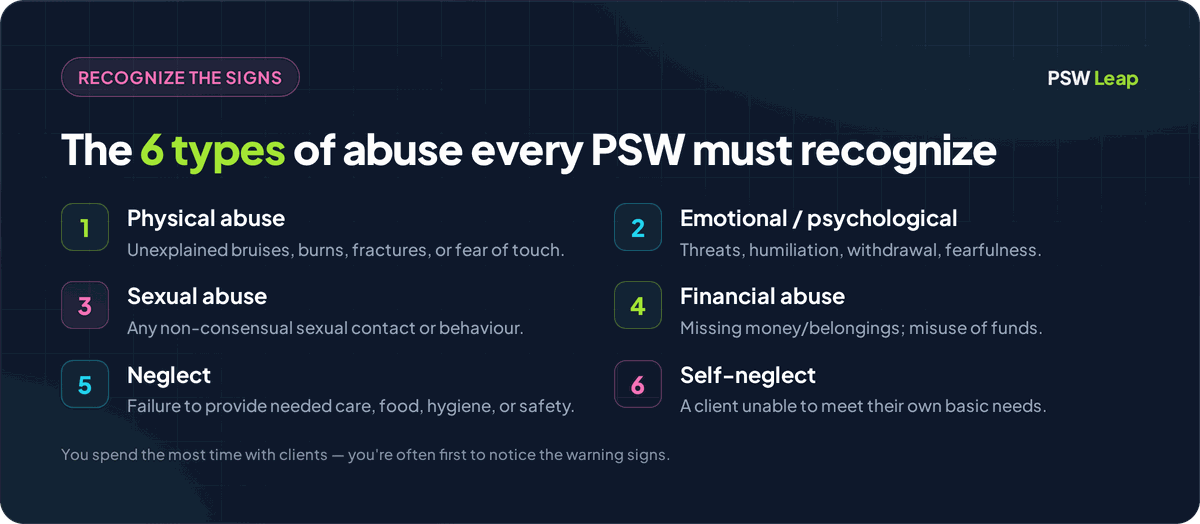
There are six types of abuse and neglect that every PSW must understand. For each type, you need to know the definition and the common indicators (warning signs) that you may observe.
Summary Table: Types of Abuse and Key Indicators
| Type of Abuse | Definition | Key Indicators |
|---|---|---|
| Physical | Use of force that causes pain, injury, or impairment | Unexplained bruises, burns, fractures; injuries in various stages of healing; fear of being touched; injuries inconsistent with explanation |
| Emotional / Psychological | Verbal or non-verbal behaviour that causes mental anguish | Withdrawal, fearfulness, depression, anxiety; client flinches when caregiver approaches; caregiver belittles, threatens, or isolates client |
| Sexual | Any sexual contact or behaviour without consent | Bruising around genitals or inner thighs; torn or bloody undergarments; sudden behavioural changes; fear of specific individuals; STIs |
| Financial | Unauthorized use of a person's money, property, or assets | Sudden inability to pay bills; missing belongings; unexplained bank withdrawals; changes to wills or power of attorney; client unaware of finances |
| Neglect | Failure to provide necessary care, supervision, or necessities of life | Poor hygiene, malnutrition, dehydration; untreated medical conditions; soiled bedding or clothing; unsafe living conditions; isolation |
| Self-Neglect | A person's inability or unwillingness to care for themselves | Hoarding, unsanitary living conditions, refusal of needed medical care, inadequate food or clothing, social withdrawal |
Detailed Breakdown of Each Type
Physical Abuse
Physical abuse is the use of physical force against a client that results in pain, injury, impairment, or bodily harm. This includes hitting, slapping, pushing, kicking, pinching, biting, and the inappropriate use of physical restraints or medication (chemical restraint).
Indicators to watch for:
- Unexplained bruises, welts, or cuts, especially in unusual locations (inner arms, back, thighs, face)
- Injuries in various stages of healing, suggesting repeated incidents
- Burns, particularly patterned burns (cigarette burns, iron-shaped marks)
- Fractures, sprains, or dislocations that do not match the explanation given
- Client flinches, cowers, or shows fear when a specific person approaches
- Reluctance to undress or be examined
- Over-sedation or changes in alertness that are not explained by medical conditions
What PSWs often miss: Rough handling during care — pulling a client up in bed too forcefully, gripping an arm too tightly during a transfer, or rushing through repositioning in a way that causes pain — can constitute physical abuse even if no visible injury results. The intent does not need to be malicious for it to be reportable.
Emotional and Psychological Abuse
Emotional abuse involves verbal or non-verbal behaviour that causes mental distress, fear, humiliation, or degradation. This includes yelling, threatening, name-calling, belittling, intimidating, isolating, ignoring, or withholding affection as punishment.
Indicators to watch for:
- Client appears withdrawn, anxious, or depressed without a clear medical cause
- Client flinches, tenses, or becomes agitated when a specific caregiver is present
- Client is reluctant to speak openly or changes the subject when asked about their care
- Caregiver speaks to the client in a belittling, condescending, or threatening tone
- Caregiver isolates the client from other residents, family, or activities
- Sudden changes in behaviour, appetite, or sleep patterns
- Client expresses feelings of hopelessness, worthlessness, or fear
What PSWs often miss: Emotional abuse can come from family members, other residents, or staff. It is not limited to caregivers. Ignoring a client's call bell repeatedly, giving a client the "silent treatment," or making fun of a client's appearance are all forms of emotional abuse.
Sexual Abuse
Sexual abuse is any sexual contact or behaviour directed at a client without their full, informed consent. This includes unwanted touching, sexual assault, forced nudity, taking sexual photographs, and making sexual comments. Consent cannot be given by a person who is cognitively unable to understand what is happening.
Indicators to watch for:
- Unexplained bruising around the breasts, genitals, or inner thighs
- Torn, stained, or bloody undergarments
- Difficulty walking or sitting without an obvious medical reason
- Sexually transmitted infections, especially in clients who are not sexually active
- Sudden behavioural changes: withdrawal, aggression, nightmares, fear of being alone with certain individuals
- Inappropriate sexual behaviour that is new or out of character
- Client becomes distressed during personal care (bathing, dressing, toileting)
What PSWs often miss: Sexual abuse of elderly or cognitively impaired clients is significantly underreported. Changes in behaviour during personal care routines — such as a client who was previously cooperative becoming fearful or resistant — should always be noted and reported.
Financial Abuse
Financial abuse is the unauthorized or improper use of a client's money, property, or financial resources. This includes theft, fraud, forging signatures, pressuring a client to change their will, misusing a power of attorney, and charging for services not provided.
Indicators to watch for:
- Client suddenly cannot afford basic necessities (medication, personal items)
- Missing personal belongings (jewellery, clothing, electronics)
- Unexplained changes to bank accounts, wills, or power of attorney documents
- A new "friend" or family member who shows excessive interest in the client's finances
- Client seems confused or unaware of their financial situation
- Unpaid bills despite having adequate income or savings
- Client expresses fear about money or about a specific person managing their finances
What PSWs often miss: Financial abuse is often perpetrated by family members or trusted individuals, which makes it difficult for clients to report. A client who suddenly stops purchasing personal items or who mentions that "someone is taking care of my money now" warrants attention.
You notice that Mrs. Garcia, who usually has well-kept nails and wears her favourite earrings, now has chipped nails and her earrings are missing. She says her son 'is holding them for safekeeping.' What type of abuse might this indicate?
Sources for this answer: O. Reg. 246/22, s. 2 (1); O. Reg. 166/11, s. 1 (1); Fixing Long-Term Care Act, 2021, ss. 2 (1) and 28 (1); Retirement Homes Act, 2010, ss. 2 (1) and 75 (1); all accessed September 26, 2026.
Neglect
Neglect is the failure by a caregiver to provide the care, supervision, and necessities of life that a client needs. This can be intentional (deliberately withholding care) or unintentional (due to lack of knowledge, resources, or staffing). Regardless of intent, neglect is reportable.
Indicators to watch for:
- Poor personal hygiene (unwashed hair, body odour, dirty nails) that is not the client's baseline
- Malnutrition or dehydration (weight loss, sunken eyes, dry skin and mucous membranes)
- Untreated pressure injuries (bedsores), especially Stage 3 or 4
- Soiled clothing or bedding that is not changed promptly
- Untreated medical conditions or medications not being administered
- Unsafe or unsanitary living conditions
- Client left alone for extended periods without supervision when they require it
- Lack of necessary assistive devices (glasses, hearing aids, dentures, walker)
What PSWs often miss: Neglect can be systemic. If your facility is consistently understaffed and clients are not receiving timely care, that is still neglect — even if no individual is intentionally withholding care. Raise systemic concerns through your facility's internal reporting channels — and where you have reasonable grounds to suspect that neglect of a resident by the licensee or staff that resulted in harm or a risk of harm has occurred or may occur, the statutory report described below is required as well: immediately to the Director in a long-term care home, or to the Registrar of the Retirement Homes Regulatory Authority in a retirement home.
Self-Neglect
Self-neglect occurs when a person is unable or unwilling to provide for their own basic needs. This is different from other types of abuse because there is no external perpetrator — the person is the source of the neglect. However, PSWs still have a responsibility to report and address self-neglect.
Indicators to watch for:
- Hoarding behaviour that creates safety hazards
- Refusal to eat, drink, or take necessary medications
- Refusal of needed medical care or treatment
- Living in unsanitary conditions (in home care settings)
- Wearing clothing that is inappropriate for the weather
- Social withdrawal and isolation
- Lack of basic utilities (heat, water, electricity) in home settings
Important distinction: A competent adult has the right to make decisions about their own care, even decisions you disagree with. Self-neglect becomes a concern when the person's cognitive capacity is impaired or when their living situation presents an immediate safety risk. Report your observations to your supervisor, who will determine the appropriate response.
The PSW's Duty to Report
Two Ontario statutes turn this duty into law for residents of long-term care homes and retirement homes; both are set out below.
Legal Obligation Under the FLTCA
In Ontario, the Fixing Long-Term Care Act, 2021 (FLTCA) places a mandatory reporting duty on any person — PSWs included — who has reasonable grounds to suspect that one of the matters listed in s. 28 (1) has occurred or may occur — matters concerning a resident of a long-term care home. That list includes abuse of a resident by anyone, and neglect of a resident by the licensee or staff that resulted in harm or a risk of harm to the resident.
Key points about this legal duty:
- Safety comes first. If someone is in immediate danger, follow your employer's emergency protocol and call emergency services before anything else. The reporting steps below come after the person is safe.
- You do not need to be certain. Reasonable grounds to suspect is sufficient. If something does not look right, report it.
- The report goes to the Director, immediately. Under s. 28 (1), the person who has the reasonable grounds reports the suspicion, and the information it is based on, immediately to the Director — the person appointed under section 185 of the Act.
- Telling your supervisor does not replace that report. Notifying your supervisor or charge nurse is your employer's internal step, and your employer's abuse policy sets out how the report is made and documented. Neither that notification nor the paperwork discharges the s. 28 (1) duty, and neither should delay it.
- Failure to report is an offence. Six categories of person are guilty of an offence if they fail to make a report required by s. 28 (1), and item 4 of that list is "A staff member" (s. 28 (5)).
- Reporting is protected. No person may retaliate against you, or threaten to, because a report has been made under section 28 (s. 30 (1)); dismissing, disciplining or suspending a staff member counts as retaliation (s. 30 (3)).
Retirement Homes: the Retirement Homes Act, 2010
A retirement home is not a long-term care home, and the statutes keep them apart: the Retirement Homes Act, 2010 (RHA) defines "retirement home" so that premises governed by the Fixing Long-Term Care Act, 2021 are excluded (RHA s. 2 (1), clause (d) (v)). One Act or the other applies to the home you are working in, never both.
The duty itself reads almost like the FLTCA's. Under RHA s. 75 (1), a person who has reasonable grounds to suspect that one of the listed matters has occurred or may occur shall immediately report the suspicion, and the information it is based on, to the Registrar — the Registrar of the Retirement Homes Regulatory Authority, the body the Act establishes and the official it appoints (RHA s. 2 (1)). The abuse and neglect item covers abuse of a resident by anyone, and neglect of a resident by the licensee or the staff of the retirement home of the resident, if it results in harm or a risk of harm to the resident.
Three details are worth carrying into the exam and onto a shift:
- A resident is not required to report, but may (s. 75 (2)) — the duty sits with you, not with the person you are caring for.
- Failing to make the report is an offence for a staff member of a retirement home (s. 98 (1) (c) (iii)), and coercing, intimidating, discouraging or permitting someone not to report is an offence for those same persons — the licensee or manager, an officer or director, or a staff member (s. 98 (1) (d)). That offence sits in the Act's general offence section rather than beside the duty — a difference in where the provision lives, not in whether staff are covered.
- Retaliation is prohibited. No person may retaliate, or threaten to, because anything has been disclosed to the Registrar or an inspector (s. 115 (1)).
So the two regimes run in parallel: the same immediate duty, a different recipient (the Director in long-term care, the Registrar of the Retirement Homes Regulatory Authority in a retirement home), slightly different trigger wording — the FLTCA reads "that resulted in harm or a risk of harm", the RHA reads "if it results in harm or a risk of harm" — and the failure-to-report offence in a different place in each Act. In both, telling your supervisor is the employer's internal step and not the statutory report.
Reporting in Other Care Settings
The two statutory duties above are tied to residents of long-term care homes and retirement homes. In other settings you still have professional and ethical obligations to report suspected abuse or neglect. In home care, community care and hospital settings, follow your employer's abuse policy and report through your reporting path — your immediate supervisor, or the most accountable person your employer has named for that client. If anyone is in immediate danger, call emergency services first. If you work with children, the Child, Youth and Family Services Act imposes a separate mandatory duty to report.
Who to Report To
- The Director, under the FLTCA (long-term care homes) — immediately, by the person who has the reasonable grounds (s. 28 (1))
- The Registrar of the Retirement Homes Regulatory Authority (retirement homes) — immediately, on the same terms (RHA s. 75 (1))
- Your immediate supervisor, charge nurse or most accountable person — your employer's internal step, and the reporting path in home care, community care and hospital settings; it runs alongside a statutory report, never instead of one
- Police — if you believe a crime has been committed; call emergency services when anyone is in immediate danger
- The Ontario Ombudsman or Patient Ombudsman — if you believe your report is not being acted upon
What to Report
When making a report, include:
- What you observed — specific, objective observations (not interpretations)
- When you observed it — date, time, and circumstances
- Where — the location and setting
- Who was involved — the client, and any other individuals present
- What the client said — use the client's own words if possible, in quotation marks
- Any other relevant context — changes from baseline, previous incidents, patterns
You notice unexplained bruises on a resident's upper arms that were not there yesterday. The resident says, 'I don't want to talk about it.' What should you do?
Reporting vs. Investigating — A Critical Distinction
This is one of the most important concepts for both the NACC exam and your practice: PSWs report. PSWs do not investigate.
Your role is to:
- Observe — notice changes, signs, and indicators
- Document — record your objective observations accurately and promptly
- Report — make the report your setting requires, and tell the person your employer's policy names
Your role is not to:
- Question or interrogate the client about what happened
- Confront the suspected abuser
- Collect evidence or conduct interviews
- Determine whether abuse actually occurred
- Decide whether the situation is "serious enough" to report
Investigation is the responsibility of management, regulatory bodies, and in some cases, law enforcement. If you step into an investigative role, you may inadvertently compromise the investigation, put yourself or the client at risk, or act outside your scope of practice.
Exam tip: If an exam question gives you a scenario involving suspected abuse and one of the answer options involves questioning the client in detail or confronting a co-worker, that option is almost always wrong. The correct answer involves documenting observations and reporting them. In an Ontario long-term care home the FLTCA report to the Director is required immediately, and telling your supervisor does not discharge it.
Documentation Best Practices
When you document observations related to potential abuse or neglect, follow these principles:
-
Be objective. Write what you saw, heard, or measured — not what you think happened. Write "bruise approximately 5 cm in diameter on the left upper arm" rather than "client was hit on the arm."
-
Be specific. Include size, colour, location, and any other measurable details. Use body diagrams if your facility provides them.
-
Use the client's own words. If the client tells you something, document it in quotation marks: Client stated, "He grabbed my arm."
-
Record the date and time of your observation and when you reported it.
-
Do not speculate. Do not write "I think the night shift caused this." Document facts only.
-
Do not alter documentation. Once you have documented your observations, do not go back and change them, even if you are pressured to do so.
Protecting Vulnerable Adults — Your Role
Beyond reporting individual incidents, PSWs play a broader role in protecting vulnerable adults:
- Build trust with clients. Clients are more likely to disclose abuse to someone they trust. Being consistently kind, respectful, and reliable builds that trust over time.
- Know your clients' baselines. The better you know a client's normal behaviour, appearance, and mood, the more quickly you will notice changes that may indicate abuse.
- Support a culture of safety. Speak up if you see a colleague providing rough or disrespectful care. Use your facility's reporting channels.
- Maintain professional boundaries. Accepting gifts from clients, developing personal relationships, or sharing personal information can blur the lines and create vulnerabilities.
NACC Exam Scenarios — What to Expect
On the NACC exam, abuse and neglect questions typically take one of these forms:
-
Identification scenarios: You are given a description of a client and asked to identify which type of abuse the indicators suggest. Use the table above as your reference.
-
Action scenarios: You observe something concerning and must choose the correct response. The correct answer is almost always: document observations, report without delay. In a long-term care or retirement home the statutory report — to the Director under the FLTCA, or to the Registrar under the RHA — is required immediately, and telling your supervisor does not discharge it.
-
Legal knowledge questions: You are asked about the PSW's duty to report, who to report to, or what the FLTCA requires. Remember: reasonable grounds, mandatory reporting, whistleblower protection.
-
Boundary scenarios: You are asked what is and is not within the PSW's scope when abuse is suspected. Remember: report and document, do not investigate.
A resident tells you that another staff member 'hurts her when no one is looking' but begs you not to tell anyone. What should you do?
Key Takeaways for Your Exam
- Know all six types of abuse and their indicators — the table format is your best study tool
- Remember: report, do not investigate
- The FLTCA imposes a legal duty to report in long-term care — reasonable suspicion is enough, and the report goes immediately to the Director (s. 28 (1))
- In a retirement home the same immediate duty runs to the Registrar of the Retirement Homes Regulatory Authority (RHA s. 75 (1)); telling your supervisor discharges neither report
- Document objectively using the client's own words
- Safety overrides confidentiality — you cannot keep allegations of abuse secret
- Whistle-blowing protections sit in both Acts (FLTCA s. 30 (1); RHA s. 115 (1)) — no one may retaliate against you, or threaten to, for making a report
For more on the NACC exam format and strategy, see our guide on how to pass the NACC PSW exam. To understand the boundaries of your role as a PSW, review our post on PSW scope of practice in Ontario.
Ready to practice?
Practise abuse recognition scenarios and test your knowledge of reporting duties with instant feedback.
Try Free Practice QuestionsSources
- Law — Fixing Long-Term Care Act, 2021, ss. 2, 28 and 30, checked September 17, 2026 (consolidation period December 11, 2025; e-Laws currency date September 14, 2026).
- Law — Retirement Homes Act, 2010, ss. 2, 75, 98 and 115, checked September 17, 2026 (consolidation period June 28, 2024; e-Laws currency date September 14, 2026).
- Law — Regulated Health Professions Act, 1991, ss. 27 and 29, checked September 17, 2026 (consolidation period January 1, 2026; e-Laws currency date September 14, 2026) — the controlled-acts statute behind the scope boundary this post refers to, worked through in our PSW scope of practice in Ontario guide.
This is exam-preparation education, not clinical or legal advice. What you must report, and to whom, is governed by the law for your setting, your employer's policies and the client's plan of care. PSW Leap is not affiliated with NACC.
Frequently Asked Questions
PSWs must be able to recognize six types of abuse: physical abuse, emotional or psychological abuse, sexual abuse, financial abuse, neglect, and self-neglect. Each type has distinct indicators that PSWs are trained to observe and report.
Yes, and in two Ontario settings it is a statutory duty. In a long-term care home, the Fixing Long-Term Care Act, 2021 requires a person with reasonable grounds to suspect abuse of a resident by anyone, or neglect of a resident by the licensee or staff that resulted in harm or a risk of harm, to report immediately to the Director (s. 28 (1)); a staff member who fails to make that report commits an offence (s. 28 (5)). In a retirement home, the Retirement Homes Act, 2010 requires the same immediate report to the Registrar of the Retirement Homes Regulatory Authority (s. 75 (1)), and failing to make it is an offence for a staff member of a retirement home (s. 98 (1) (c) (iii)). In other settings, follow your employer's abuse policy and your reporting path. Telling your supervisor is an internal step and does not replace a report the law requires.
Under s. 28 (1) of the Fixing Long-Term Care Act, 2021, a person who has reasonable grounds to suspect that one of the matters the subsection lists has occurred or may occur shall immediately report the suspicion, and the information it is based on, to the Director — the person appointed under section 185 of the Act. Those matters include abuse of a resident by anyone and neglect of a resident by the licensee or staff that resulted in harm or a risk of harm. You do not need to be certain: reasonable grounds to suspect is enough. Telling your supervisor or charge nurse is your employer's internal step and does not discharge the s. 28 (1) report, and no one may retaliate against you for making it (s. 30 (1)).
Written by Shashank Jha
Founder, PSW Leap
Shashank Jha is the founder of PSW Leap. He built this platform after going through the NACC exam prep process himself, to help fellow students study smarter with practice questions organized around the NACC PSW curriculum.
He's also the author of PSW Exam Success: The Ultimate Prep Book — the 455-page paperback PSW Leap grew out of.
Learn more about PSW LeapPSW Leap
Practice smarter for the NACC exam. 2,500 questions. Detailed rationales. $29.99 CAD one-time — everything included.
Try 10 free questions →No account needed. Ready for the full bank? Create your account.