Free NACC Practice Questions on Kidney Disease & Dialysis Care (Ontario PSW Exam Prep)
If you are studying for the NACC Personal Support Worker (PSW) exam in Ontario, kidney disease and dialysis care is a topic worth taking seriously — because the clients on your caseload who have failing kidneys come with a handful of rules that reverse what you were taught about everyone else. In Ontario long-term care and home care, more and more clients live with chronic kidney disease, and the exam expects you to know how to keep them safe. This free practice set gives you real NACC-style questions on protecting the access, the fluid limit, the renal diet, dialysis-day safety, and a PSW's scope, each with a clear answer. Work through them, then keep going with the full question bank at pswleap.com/learn.
What is kidney disease and dialysis care on the NACC PSW exam?
For the exam, this topic is about supporting a client whose kidneys no longer clean the blood well — most often a client on dialysis — while protecting their treatment access and following their fluid and diet orders. In chronic kidney disease (CKD) the kidneys slowly lose the ability to filter waste and remove extra fluid, so both build up; when they fail, dialysis does the filtering artificially. The "right answer" in a kidney-care question almost always combines protecting the access, respecting the fluid and diet limits, and reporting changes — inside a PSW's scope.
Why this topic matters: the rules that get reversed
The single most important idea is that a dialysis client is the exception to some of your normal habits — get the everyday rule right for everyone else, but know the switch:
- Fluids: you usually encourage them; here you follow a fluid limit — the failing kidneys cannot clear extra water, so too much strains the heart and lungs.
- Blood pressure: you can usually use either arm; here you never use the access arm — no cuff, no blood draw, nothing tight on it.
- Diet: you usually just encourage good intake; here you follow a special renal diet, often lower in potassium, phosphorus, and sodium, with a protein target set by the care team.
Miss one of these and you can genuinely harm the client — a cuff can damage the client's lifeline, extra fluid can leave them breathless — which is why the exam tests kidney care so carefully.
The PSW's role in Ontario: protect, follow, observe, and report
A PSW supports daily care, protects the dialysis access, follows the fluid and diet orders, and reports changes; the nurse and dialysis team run the treatment and make the medical decisions. In Ontario, a PSW works from the client's individual care plan and the employer's policies, within the controlled-acts limits of the Regulated Health Professions Act, 1991.
Two access types show up. Hemodialysis cleans the blood through a machine, usually three times a week, using an AV fistula or graft in the arm. Peritoneal dialysis is often done at home, using the lining of the abdomen and a soft tube in the belly. In both cases the PSW protects the site, keeps it clean and dry, and reports problems — but running the machine, doing exchanges, and changing the access dressing are nursing tasks, unless a PSW is specifically trained, authorized, and directed to do a defined part.
Quick terms to know: CKD = chronic kidney disease, the gradual loss of kidney function. Dialysis = artificial filtering of the blood when the kidneys fail. AV fistula = a surgically joined artery and vein used as the access for hemodialysis. Thrill = the soft buzzing vibration you feel over a working fistula. Fluid overload = too much fluid in the body, causing swelling and shortness of breath.
Free NACC-style practice questions: kidney disease and dialysis care
Each question below mirrors the scenario-based, multiple-choice style of the NACC PSW exam. Try to answer before you read the explanation.
Q1. What is chronic kidney disease, and why might a client need dialysis?
Answer: The kidneys slowly lose their ability to filter waste and remove extra fluid, so both build up in the body. When that loss becomes severe, dialysis takes over the filtering, while the nurse and kidney team handle the medical management.
Q2. A client has an AV fistula in the left arm. Which arm does the PSW use for blood pressure, and why?
Answer: The right arm — never the arm with the fistula. A blood-pressure cuff squeezes the fistula and can damage or clot it, and that access is the client's lifeline for dialysis. The same rule applies to blood draws, IVs, tight sleeves, and jewellery on that arm.
Q3. During care, the PSW cannot feel the usual buzz over the client's fistula. What should the PSW do?
Answer: Report it to the nurse right away — a missing thrill can mean the fistula has clotted. That soft buzzing vibration (the thrill) tells you blood is flowing through the access; if it is gone, the access may be failing, which is urgent. The PSW does not try to fix it — observe and report.
Q4. A dialysis client is very thirsty and asks for a large glass of water, but the care plan lists a daily fluid limit. What does the PSW do?
Answer: Stay within the fluid limit — offer a small allowed amount and help the client cope with thirst. You might offer ice chips (counted as fluid), sips spaced through the day, or mouth care to ease the dry feeling. You do not push extra fluids, and you report ongoing thirst or any swelling.
Q5. Why is a dialysis client often on a low-potassium and low-phosphorus diet, and what is the PSW's job with it?
Answer: Because failing kidneys cannot clear extra potassium and phosphorus, which build up and can harm the heart and bones. The PSW follows the ordered renal diet — serving the meals provided, noticing what the client actually eats, and reporting poor intake — but does not set or change the diet.
Q6. Why does the PSW weigh a dialysis client daily and report big changes?
Answer: Because weight is the quickest sign of fluid building up between sessions. A sudden gain usually means fluid overload, not fat. Weigh at the same time, on the same scale, in similar clothing, and report a rapid rise with any swelling or shortness of breath.
Q7. A client returns from hemodialysis tired and dizzy when they stand. How does the PSW keep them safe?
Answer: Have them rise slowly, plan for rest, and watch closely for a fall. Dialysis can lower blood pressure, so change position gradually, keep a call bell close, and offer food or fluids within the care-plan limits. Blood pressure still goes on the non-access arm; report ongoing dizziness or confusion.
Q8. A client on dialysis has very dry, itchy skin and is scratching it raw. What can the PSW do?
Answer: Give gentle skin care — moisturize, keep nails short, and avoid harsh soaps and hot water. Dry, itchy skin is common with kidney disease, and soothing it prevents scratches that can lead to a skin infection. Any new sore or broken skin is reported.
Q9. The PSW notices the client's fistula site is red, warm, swollen, and tender. What should the PSW do?
Answer: Do not press or massage it — report the signs of possible infection to the nurse. Redness, warmth, swelling, and pain point to infection, which is serious in a dialysis access. The PSW keeps the area clean and dry and reports promptly so the nurse can assess and treat.
Q10. A client does peritoneal dialysis at home through a tube in the abdomen. Can the PSW do the exchange or change the catheter dressing?
Answer: No — the exchange and the dressing change are nursing tasks, not a PSW's. The PSW keeps the site clean and dry, watches for redness, leaking, or cloudy fluid, and reports concerns, but does not connect bags or change the dressing unless specifically trained, authorized, and directed under the care plan.
Common kidney and dialysis mistakes to avoid on the NACC exam
- Using the access arm for blood pressure or a blood draw — it is off-limits for cuffs, needles, and anything tight.
- Encouraging fluids out of habit on a client with a fluid restriction, instead of following the limit and reporting.
- Attempting the treatment — a dialysis line, an exchange, or an access dressing — instead of leaving it to the nurse or dialysis team.
The kidney and dialysis facts the NACC exam expects you to know
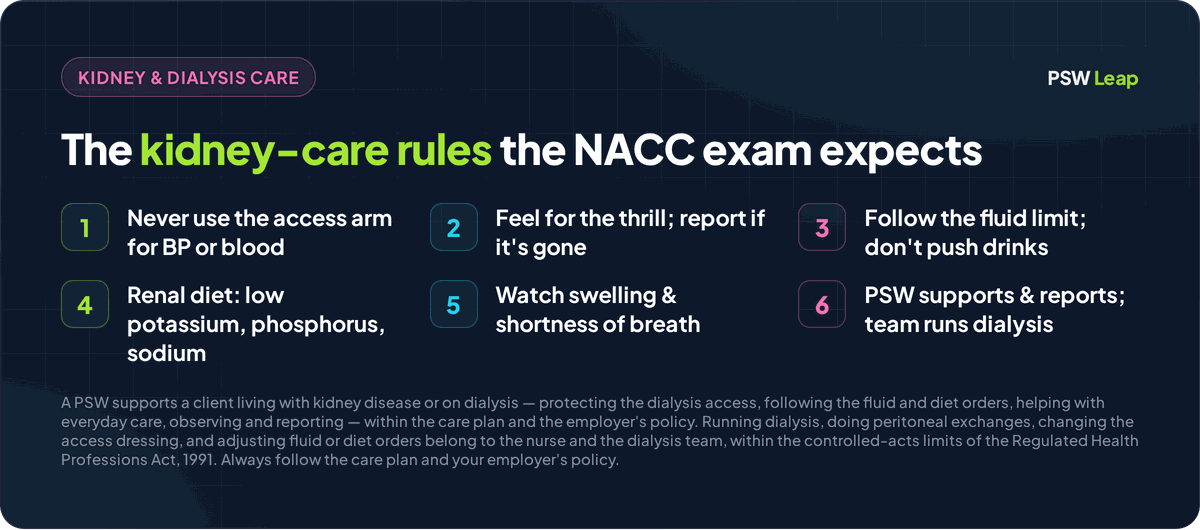
Use these one-line facts as a final review:
- Never use the access arm for blood pressure, blood draws, IVs, or anything tight.
- Feel for the thrill over a fistula — if it is gone, or the site bleeds or looks infected, report it now.
- Follow the fluid limit — do not push extra drinks; ice chips and mouth care ease thirst.
- Follow the renal diet — often low potassium, phosphorus, and sodium; you serve, you do not set it.
- Watch for fluid overload — swelling, sudden weight gain, and shortness of breath.
- After dialysis, expect tiredness and low blood pressure — rise slowly and prevent falls.
- A PSW supports and reports; the nurse and dialysis team run the treatment.
Remember: PSW practice in Ontario always follows the client's individual care plan and your employer's policies, within the controlled-acts limits of the Regulated Health Professions Act, 1991. Protecting the access, following the fluid and diet orders, and reporting changes are within a PSW's role; running dialysis, doing exchanges, changing the access dressing, and adjusting orders are not. This article is exam-prep study material, not medical advice.
Practice more free NACC questions
You just answered 10 kidney and dialysis care questions, and the NACC exam spans every module. The fastest way to find your weak spots is to keep practising with instant feedback.
👉 Start practising free at pswleap.com/learn — a large bank of NACC-style questions, full timed mock exams, and a Duolingo-style study path built specifically for Ontario PSW students. No subscription, and you can start with sample questions before you pay.
Closely related topics worth reviewing next: Free NACC Practice Questions on Diabetes Care (the leading cause of kidney failure in Ontario) and Free NACC Practice Questions on Nutrition & Hydration (the usual "encourage fluids" rule the dialysis client reverses).
PSW Leap is an independent NACC PSW exam-prep platform for Ontario candidates. We are not affiliated with NACC. Always follow your training, your client's care plan, and your employer's policies on the job.
Published by PSW Leap
Independent NACC PSW exam prep
PSW Leap articles are written and maintained by the platform's founder, Shashank Jha, and checked against publicly available PSW curriculum standards. Found an error? Email hello@pswleap.com and we'll fix it.
Read our content methodologyPSW Leap
Practice smarter for the NACC exam. 2,500 questions. Detailed rationales. $29.99 CAD one-time — everything included.
Try 10 free questions →No account needed. Ready for the full bank? Create your account.