Free NACC Practice Questions on Bowel Care & Constipation (Ontario PSW Exam Prep)
If you are studying for the NACC Personal Support Worker (PSW) exam in Ontario, bowel care and constipation are higher-yield than most students expect — constipation is one of the most common problems in long-term care and home care, and the PSW is usually the first to notice a client has not "gone" in days. This free practice set gives you real NACC-style questions on telling constipation from a fecal impaction, spotting overflow diarrhea, what a PSW observes and reports, and why giving a suppository, enema, or digital stimulation is a delegated controlled act, each with a clear answer. Work through them, then keep going with the full question bank at pswleap.com/learn.
What is bowel care on the NACC PSW exam?
For the exam, bowel care is the everyday support a PSW gives so a client can stay regular and comfortable — fluids and fibre within the care plan, activity, a steady toileting routine, skin care, and watchful observing-and-reporting — without crossing into the tasks that belong to a nurse. The "right answer" in a bowel-care question almost always combines supporting normal elimination, protecting the client's dignity, and reporting any change from their normal pattern promptly. It sits inside the elimination part of personal care, but it carries a scope edge the exam loves to test — and because a PSW knows each client's normal pattern, an early catch keeps a simple constipation from becoming a painful, dangerous impaction.
Constipation, impaction, and the warning signs to report
Constipation means bowel movements that are infrequent, hard, dry, or hard to pass; a fecal impaction is what can follow — a hard mass of stool the client can no longer pass on their own. An impaction is the more serious problem: it can bring pain, a hard or swollen abdomen, nausea or vomiting, and sometimes watery stool that leaks around the blockage.
That last sign is the exam's favourite trap. When liquid stool leaks past a hard, stuck mass, it can look like ordinary diarrhea — this is overflow (paradoxical) diarrhea. The wrong instinct is to chart "diarrhea" and move on. The right move is to recognize that a client who has been constipated and is now leaking watery stool may have an impaction underneath, and to report it so the nurse can assess.
The PSW's role in Ontario: routine care vs the controlled act
A PSW supports normal elimination and reports problems; a nurse assesses, decides, and performs the procedures that the law controls. In Ontario, a PSW works from the client's individual care plan and the employer's policies, within the controlled-acts limits of the Regulated Health Professions Act, 1991. Plenty of bowel care is routine PSW work: offering fluids and fibre within the care plan, encouraging movement, keeping a toileting routine, helping with continence products, and observing and reporting.
Three tasks are not routine PSW work. Giving a suppository or an enema is medication administration (and, for an enema, a procedure into the body), and digital stimulation or manually removing stool means putting a finger beyond the anal verge — which the Regulated Health Professions Act, 1991 names as a controlled act. A PSW may perform any of these only when an RN or RPN has formally delegated that specific task, it is documented, and the care plan and employer policy support it. Without that delegation, the safe and correct answer — on the exam and on the job — is that the PSW does not do them, and reports the constipation instead.
Quick terms to know: Constipation = infrequent, hard, difficult stool. Fecal impaction = a hard, stuck mass of stool the client cannot pass. Overflow diarrhea = watery stool leaking around an impaction (looks like diarrhea, is not). Bristol Stool Chart = a 1–7 picture scale for describing stool consistency. Controlled act = a procedure the RHPA restricts (here, anything beyond the anal verge). Delegation = a nurse formally authorizing a specific PSW to do a controlled act.
Free NACC-style practice questions: bowel care & constipation
Each question below mirrors the scenario-based, multiple-choice style of the NACC PSW exam. Try to answer before you read the explanation.
Q1. A client has not had a bowel movement in three days. What should the PSW do?
Answer: Report the change and support normal elimination — don't give a laxative or suppository on your own. Three days with no bowel movement (or fewer than the client's normal) is worth reporting to the nurse. While you do, keep offering fluids, support fibre and activity within the care plan, and offer the toilet at the usual times.
Q2. What is the difference between constipation and a fecal impaction?
Answer: Constipation is infrequent, hard, difficult stool; an impaction is a hard mass the client can no longer pass. Impaction is the more serious problem. The PSW recognizes the warning signs and reports — relieving an impaction is a nursing decision.
Q3. A client who has been constipated suddenly starts leaking watery stool. Is this diarrhea?
Answer: Probably not — it can be overflow diarrhea around an impaction, so report it. Liquid stool can leak past a hard, stuck mass and look like diarrhea. Treating it as simple diarrhea misses the blockage underneath. Report it so the nurse can assess.
Q4. Can a PSW in Ontario give a client a suppository or an enema?
Answer: Only if an RN or RPN has formally delegated that task and it's in the care plan and policy. Suppositories and enemas are not routine PSW tasks. Without a proper delegation, the PSW does not give them — the PSW reports the constipation and lets the nurse decide.
Q5. Is removing hard stool with a gloved finger part of the PSW's routine scope?
Answer: No — putting a finger beyond the anal verge is a controlled act under the RHPA. Digital stimulation and manual removal of stool require a formal nurse delegation, documentation, and care-plan support. On its own, it is outside a PSW's scope, so the answer is to report a suspected impaction, not to clear it yourself.
Q6. What everyday measures help a PSW prevent constipation?
Answer: Fluids, fibre, movement, and a regular toileting routine — all within the care plan. Offer fluids regularly, support a fibre-rich diet, encourage activity as the client is able, and take the client to the toilet at consistent times, responding promptly to the urge.
Q7. How should a PSW position a client for a bowel movement?
Answer: Upright, feet flat and supported, leaning slightly forward — with privacy and enough time. Sitting upright with the feet supported (a footstool helps) and a slight forward lean uses gravity and posture to make passing stool easier. Privacy, patience, and not rushing the client matter just as much.
Q8. What should a PSW observe and record about a client's bowel movements?
Answer: Frequency, amount, colour, and consistency, plus any blood, mucus, pain, or straining — against their normal. Use objective terms (hard lumps, soft and formed, or watery — the Bristol Stool Chart helps). Note the time. The PSW records the facts; the PSW does not guess at the cause.
Q9. Which bowel changes must a PSW report right away?
Answer: No movement in about three days (or below normal), black/tarry or bloody stool, a hard or swollen painful abdomen, vomiting, or sudden watery leaking. Each can signal an impaction, bleeding, or another problem the nurse must assess — reporting promptly is the PSW's most important bowel-care action.
Q10. A client is embarrassed and refuses help with toileting. What should the PSW do?
Answer: Respect their dignity and the refusal, offer privacy and alternatives, and report it — never force care. Bowel care is private and intimate. Stay calm and unhurried, protect privacy, try again later or offer another approach, and document the refusal. Forcing care is never the answer.
Common bowel-care mistakes to avoid on the NACC exam
- Charting overflow leaking as plain "diarrhea" instead of recognizing it may be liquid stool escaping around an impaction — and reporting it.
- Giving a suppository, enema, or laxative on your own initiative rather than reporting and waiting for the nurse — these need a formal delegation.
- Attempting digital stimulation or to "dig out" hard stool — that is a controlled act beyond a PSW's routine scope.
- Treating "no bowel movement in a few days" as nothing instead of reporting a change from the client's normal pattern.
The bowel-care facts the NACC exam expects you to know
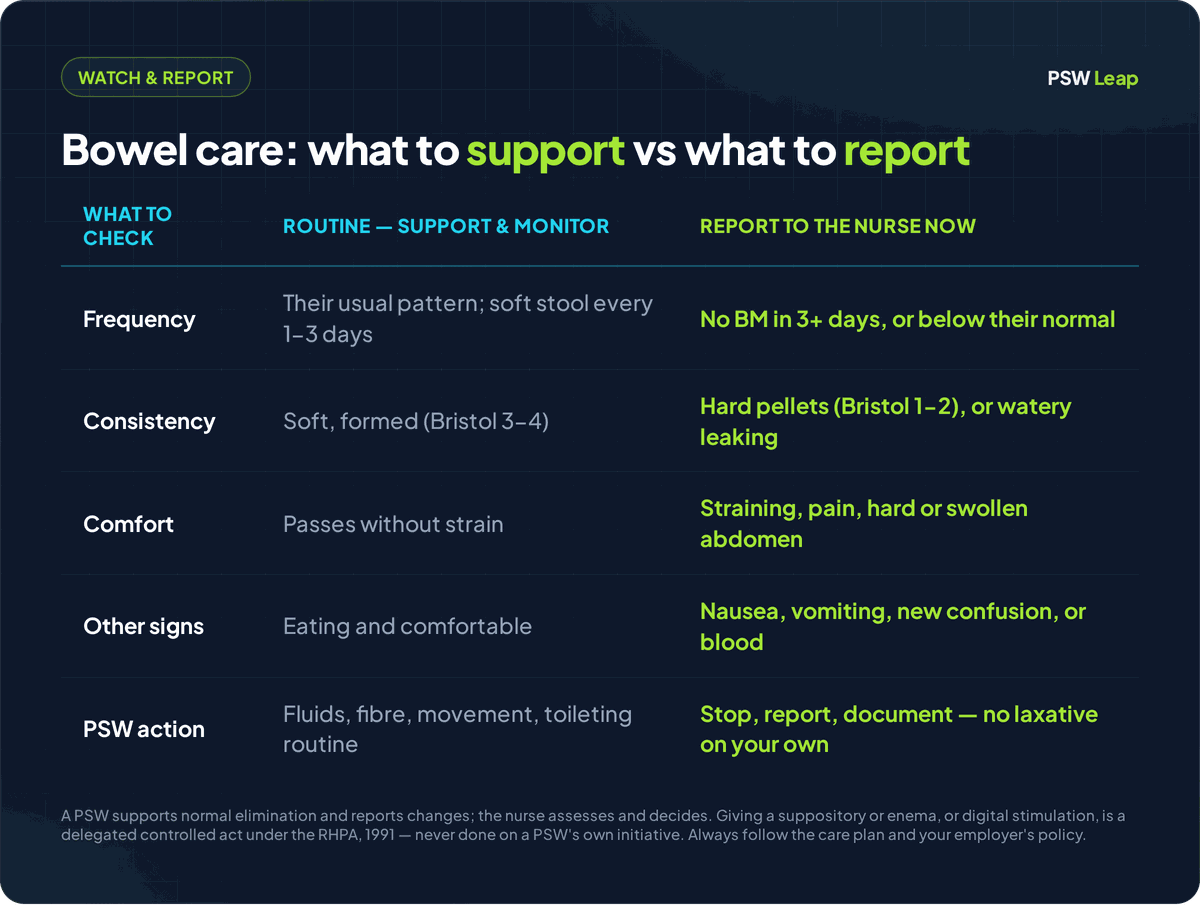
Use these one-line facts as a final review:
- Support normal elimination — fluids, fibre, movement, and a regular toileting routine, all within the care plan.
- Know the difference — constipation is hard, infrequent stool; an impaction is a hard mass the client cannot pass, and it is more serious.
- Watch for overflow diarrhea — watery leaking in a constipated client can be stool escaping around a blockage; report it, don't write it off as diarrhea.
- Report the red flags now — no movement in about three days or below normal, black/tarry or bloody stool, a hard or painful abdomen, vomiting.
- Suppositories, enemas, and digital stimulation are delegated controlled acts — a PSW does them only with a formal RN/RPN delegation, never on their own.
- Protect dignity — bowel care is private; privacy, patience, and respecting refusals are part of doing it right.
- A PSW observes and reports; the nurse assesses, decides, and performs the controlled procedures.
Remember: PSW practice in Ontario always follows the client's individual care plan and your employer's policies, within the controlled-acts limits of the Regulated Health Professions Act, 1991. Supporting elimination and reporting changes is within a PSW's role; giving suppositories or enemas, performing digital stimulation, and diagnosing the cause are not, unless formally delegated. This article is exam-prep study material, not medical advice.
Practice more free NACC questions
You just answered 10 bowel-care questions — the fastest way to find your weak spots is to keep practising with instant feedback.
👉 Start practising free at pswleap.com/learn — a large bank of NACC-style questions, full timed mock exams, and a Duolingo-style study path built specifically for Ontario PSW students. No subscription, and you can start with sample questions before you pay.
Closely related topics worth reviewing next: Free NACC Practice Questions on Nutrition & Hydration (the fluids and fibre that prevent constipation) and Free NACC Practice Questions on Catheter & Continence Care (the other half of elimination care).
PSW Leap is an independent NACC PSW exam-prep platform for Ontario candidates. We are not affiliated with NACC. Always follow your training, your client's care plan, and your employer's policies on the job.
Published by PSW Leap
Independent NACC PSW exam prep
PSW Leap articles are written and maintained by the platform's founder, Shashank Jha, and checked against publicly available PSW curriculum standards. Found an error? Email hello@pswleap.com and we'll fix it.
Read our content methodologyPSW Leap
Practice smarter for the NACC exam. 2,500 questions. Detailed rationales. $29.99 CAD one-time — everything included.
Try 10 free questions →No account needed. Ready for the full bank? Create your account.