Free NACC Practice Questions on Tube Feeding and Enteral Nutrition (Ontario PSW Exam Prep)
If you are studying for the NACC Personal Support Worker (PSW) exam in Ontario, tube feeding and enteral nutrition are exactly the kind of high-risk daily care the test asks about. Tube feeding is common in Ontario long-term care, group homes, and home care. This free practice set gives you real NACC-style questions on keeping the client upright to prevent aspiration, mouth care during NPO, what to do when a tube comes out or a client vomits, and the PSW's scope on running feeds, giving medication, and inserting tubes — each with a clear answer. Work through them, then keep going at pswleap.com/learn.
What is tube feeding and enteral nutrition on the NACC PSW exam?
For the exam, supporting a tube-fed client means keeping them positioned safely upright, giving mouth care, watching how they tolerate the feed, protecting their dignity, and reporting — never inserting the tube, choosing the formula, or giving medication through it. Enteral nutrition is liquid formula delivered straight into the stomach or intestine through a tube when a client cannot eat enough safely by mouth. A nasogastric (NG) tube goes in through the nose and is usually short-term; a gastrostomy (G-tube), often placed as a PEG, goes through the wall of the abdomen for longer-term feeding. The feed may be given as a bolus (a set amount by syringe), by gravity drip, or by a pump running continuously.
The PSW's role in tube feeding: support and observe, never insert or medicate
A PSW's job with a tube-fed client is the surrounding care — positioning, mouth care, keeping the tube secure, watching, and reporting — not the clinical procedures. Three lines are always outside a PSW's scope, and each is a tempting exam answer. Never insert, remove, or reposition the tube — putting a device into a body opening is a controlled act done by a nurse or physician, not a PSW. Never give medication through the tube — administering drugs through an NG, G-, or J-tube is a nurse's task. Never decide the formula, the rate, or when to start on your own.
Running an established feed sits in between: it is not itself a controlled act, but it carries real risk, so it is only done by a PSW who has specific training, employer authorization, and direction from the care plan or a nurse — never on the PSW's own decision, and in many Ontario settings the nurse runs the feed while the PSW provides the care around it. The PSW supports and reports; the nurse assesses and decides.
Positioning and aspiration: keep the client upright
The single most important thing a PSW does during a feed is keep the client sitting up — head of the bed raised to at least 30 degrees, ideally 30 to 45 degrees, during the feed and for about 30 to 60 minutes afterward. A client who lies flat can have formula flow back up and be breathed into the lungs. This is aspiration, and it can cause aspiration pneumonia — one of the most serious risks of tube feeding.
If the client needs to lie flatter for other care, the feed is paused first when the care plan allows, and the client is returned to an upright position before it restarts. A tube-fed client often takes nothing by mouth, so mouth care matters more, not less — the mouth still dries out and needs regular cleaning for comfort and to prevent infection.
When to stop the feed and call the nurse
Stop the feed and call the nurse if the client coughs or chokes, sounds wet or gurgly, vomits, has a swollen or painful abdomen, or if the tube comes out, leaks, or looks blocked — the PSW's job is to stop, keep the client safe, and report, not to fix the tube. If a G-tube is pulled out, do not try to push it back in: cover the site with a clean dressing and report it at once, because the opening can begin to close within hours. If the client vomits during a feed, stop the feed, sit them fully upright, keep the airway clear, stay with them, and report.
Between feeds, watch for and report signs the client is not tolerating the feeding: nausea, repeated vomiting, diarrhea or constipation, weight change, or redness, swelling, bleeding, or leaking around the tube site. Never raise or lower the feed rate to "fix" a problem — that is a clinical decision. Report what you saw and let the nurse assess. When in doubt, stop the feed and call for help; on the exam, stopping and reporting early is almost always the right choice over carrying on.
Quick terms to know: Enteral nutrition = feeding liquid formula through a tube into the stomach or intestine. NG tube = a tube through the nose, usually short-term. G-tube / PEG = a tube through the abdominal wall for longer-term feeding. NPO = nothing by mouth. Aspiration = formula or fluid entering the lungs instead of the stomach.
Free NACC-style practice questions: tube feeding and enteral nutrition
Each question mirrors the scenario-based, multiple-choice style of the NACC PSW exam. Try to answer before you read the explanation.
Q1. A client is receiving a tube feed in bed. What position should the PSW keep them in?
Answer: Sitting upright with the head of the bed raised to at least 30 degrees, during the feed and for 30 to 60 minutes after. This uses gravity to prevent aspiration.
Q2. A client with a PEG tube is NPO but asks the PSW for a glass of water. What should the PSW do?
Answer: Do not give it — NPO means nothing by mouth, even water. Offer mouth care for comfort, explain kindly, and report the request to the nurse.
Q3. During the feed the client starts coughing and their voice sounds wet. What should the PSW do?
Answer: Stop the feed, keep the client upright, and call the nurse. A wet voice and coughing can mean formula is entering the airway (aspiration).
Q4. A client's G-tube has been accidentally pulled out. What should the PSW do?
Answer: Stop the feed, do not try to reinsert it, cover the site with a clean dressing, and call the nurse right away. The opening can start to close within hours.
Q5. A nurse asks the PSW to give the client's crushed morning pills down the G-tube. Is this within the PSW's role?
Answer: No — giving medication through a feeding tube is outside the PSW scope. Medication through an NG, G-, or J-tube is a nurse's task.
Q6. Who inserts or replaces a nasogastric or gastrostomy tube?
Answer: A nurse or physician — never the PSW. Inserting a device into a body opening is a controlled act under the RHPA.
Q7. The client has taken nothing by mouth for days and has a dry, uncomfortable mouth. What should the PSW do?
Answer: Provide regular mouth care. Oral hygiene is essential even — especially — when a client is not eating by mouth, for comfort and to prevent infection.
Q8. Can any PSW start a client's tube feed on their own decision?
Answer: No — running an established feed needs specific training, employer authorization, and care-plan direction. In many settings the nurse runs the feed; a PSW never starts one on their own judgment.
Q9. Midway through the feed the client vomits. What should the PSW do?
Answer: Stop the feed, sit the client fully upright, keep the airway clear, stay with them, and report to the nurse. Vomiting during a feed raises the aspiration risk.
Q10. What should the PSW observe and report during and after a tube feed?
Answer: Coughing or choking, vomiting, a swollen or painful abdomen, leakage or redness at the tube site, tube position, and how the client tolerated the feed. The PSW observes and reports; the nurse assesses.
Common tube feeding mistakes to avoid on the NACC exam
- Leaving the client lying flat during or right after a feed instead of keeping the head of the bed raised.
- Giving food or water by mouth to an NPO client, or thinking "just a sip" is allowed.
- Trying to reinsert a G-tube that has come out instead of covering the site and calling the nurse.
- Giving medication down the tube or flushing it without specific training and authorization.
- Carrying on with the feed when the client is coughing, vomiting, or uncomfortable instead of stopping and reporting.
The tube feeding facts the NACC exam expects you to know
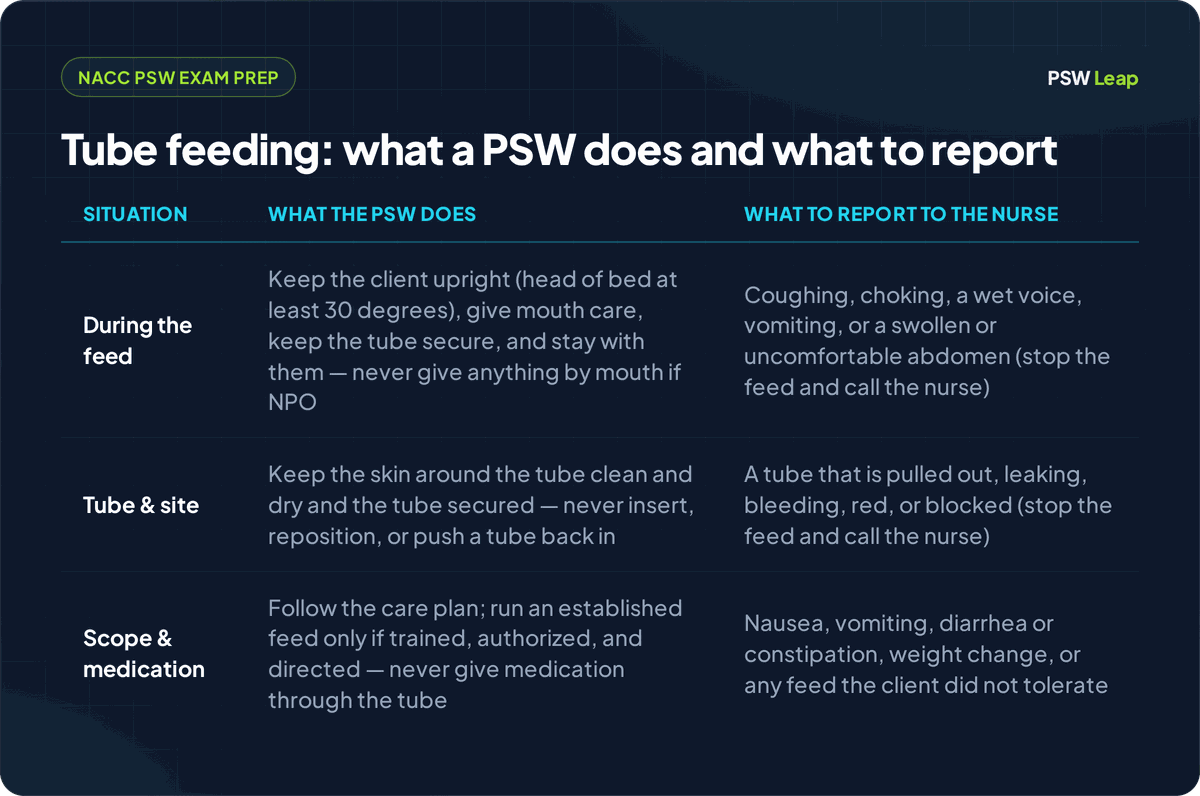
Use these one-line facts as a final review:
- Upright, not flat — keep the head of the bed raised at least 30 degrees during the feed and for 30 to 60 minutes after, to prevent aspiration.
- NPO means nothing by mouth — no food, no fluids, not even a sip of water; offer mouth care instead.
- Never insert or reposition the tube — that is a controlled act for a nurse or physician; a pulled-out G-tube gets covered and reported, not pushed back in.
- Medication down the tube is not a PSW task — that is a nurse's job; the PSW does the surrounding care.
- Stop and report — coughing, vomiting, a swollen abdomen, or a tube that leaks or comes out all mean stop the feed and call the nurse.
Remember: PSW practice in Ontario follows the client's care plan and your employer's policies, within the controlled-acts limits of the Regulated Health Professions Act, 1991. Providing positioning, mouth care, observation, and reporting for a tube-fed client is within a PSW's role; inserting or repositioning a feeding tube and giving medication through it are not, and running an established feed is done only with specific training, authorization, and care-plan direction. This article is exam-prep study material, not medical advice.
Practice more free NACC questions
You just answered 10 tube feeding questions, but the NACC PSW exam spans every module — keep practising to find your weak spots fast.
👉 Start practising free at pswleap.com/learn — a large bank of NACC-style questions, full timed mock exams, and a Duolingo-style study path built for Ontario PSW students. No subscription needed to start.
Closely related topics worth reviewing next: Free NACC Practice Questions on Nutrition and Hydration and Free NACC Practice Questions on Dysphagia — the feeding, swallowing, and aspiration care that run alongside enteral nutrition.
PSW Leap is an independent NACC PSW exam-prep platform for Ontario candidates. We are not affiliated with NACC or any medical or nutrition organization. Always follow your training, your client's care plan, and your employer's policies on the job.
Published by PSW Leap
Independent NACC PSW exam prep
PSW Leap articles are written and maintained by the platform's founder, Shashank Jha, and checked against publicly available PSW curriculum standards. Found an error? Email hello@pswleap.com and we'll fix it.
Read our content methodologyPSW Leap
Practice smarter for the NACC exam. 2,500 questions. Detailed rationales. $29.99 CAD one-time — everything included.
Try 10 free questions →No account needed. Ready for the full bank? Create your account.